软件和信息技术服务业

Search documents
从数智化与合规性看国企电子招采平台哪家强?
Jin Tou Wang· 2026-01-22 03:29
Core Insights - The electronic bidding and procurement platform for state-owned enterprises has become a crucial aspect of digital transformation driven by policy and cost control demands [1][6] - The platform developed by Sanwei Tiandi (301159) stands out due to its comprehensive electronic capabilities, risk management, and industry-specific adaptations, making it a popular choice for state-owned enterprises [1][6] Group 1: Compliance and Integration - Sanwei Tiandi's platform fully complies with domestic policies and integrates seamlessly with the national information innovation system, ensuring compliance with the "Government Procurement Electronic Bidding Measures" [2] - The platform enables traceable and auditable procurement processes through technologies like electronic signatures and data encryption, mitigating risks and facilitating regulatory compliance [2] Group 2: Intelligent Decision-Making - The platform offers a full-process electronic solution that encompasses over 20 core business modules, enabling features like one-click ordering and intelligent price comparison [3] - Utilizing AI and machine learning, the platform can predict risks such as supply interruptions and payment delays, enhancing decision-making capabilities and promoting refined management for state-owned enterprises [3] Group 3: Customization and Ecosystem Integration - Sanwei Tiandi's platform excels in its ability to adapt to complex digital ecosystems of state-owned enterprises, integrating with mainstream systems like ERP and MES to ensure data consistency and operational efficiency [4] - The platform provides tailored solutions for various industries, such as customized bidding templates for the power sector and automatic quality assessment for raw materials in metallurgy, ensuring practical usability [4] Group 4: Proven Experience and Results - Sanwei Tiandi has successfully served major state-owned enterprises like China Minmetals, demonstrating significant results such as a 30% reduction in procurement cycles and an 18% decrease in overall operational costs [5] - The platform's effectiveness in achieving digital transformation goals while meeting compliance and efficiency requirements positions it as a reliable choice for state-owned enterprises [5][6]
2025年贵州省规模以上工业增加值比上年增长7.0%
Zhong Guo Xin Wen Wang· 2026-01-22 03:24
Group 1 - The core viewpoint of the article highlights the economic performance of Guizhou Province in 2025, showcasing significant growth in various industrial sectors and overall GDP [1][3][4] Group 2 - In 2025, Guizhou's industrial added value for large-scale enterprises increased by 7.0%, surpassing the national average by 1.1 percentage points [1] - The province's industrial electricity consumption grew by 7.9%, an increase of 2.0 percentage points compared to the previous year [1] - The added value of the equipment manufacturing industry surged by 26.6% [1] - Guizhou's GDP reached 23,562.17 billion yuan, reflecting a year-on-year growth of 4.9% [3] - The automotive manufacturing industry saw an impressive growth of 42.3%, while electrical machinery and equipment manufacturing and computer communication and other electronic device manufacturing increased by 41.1% and 35.9%, respectively [3] - Production figures included 253,300 new energy vehicles, 8.963 billion electronic components, and 22.1665 million kilowatt-hours of lithium-ion batteries, which stimulated upstream raw material industries such as phosphate rock and alumina, with production increases of 17.3% and 15.9% [3] - The "Six Major Industrial Bases" in Guizhou experienced an 8.2% increase in industrial added value, accounting for 83.3% of the total industrial output [4] - The non-ferrous metal smelting and rolling processing industry saw a 26.1% increase in added value, while the chemical raw materials and chemical products manufacturing industry grew by 17.0% [4] - Investment in the information transmission, software, and information technology service industry rose by 10.8%, with an average annual growth of 21.8% over the past five years [4]

又一座5万亿城市诞生
Zhong Guo Jing Ying Bao· 2026-01-22 03:18
Core Insights - Beijing has become the second city in China to surpass a GDP of 5 trillion yuan, reaching 52,073.4 billion yuan in 2025, marking a significant economic milestone [1][3] - The growth in Beijing's economy is primarily driven by the tertiary sector, particularly high-end services, which contributed significantly to the overall economic growth [1][2] Economic Growth - In 2025, Beijing's GDP grew by 5.4% compared to 2024, with a notable increase in the growth rate by 0.3 percentage points from the previous year, surpassing the national average growth rate by 0.4 percentage points [2][3] - The tertiary sector accounted for 44,776.9 billion yuan in value added, growing by 5.8%, with information transmission, software, and IT services growing by 11.0% and financial services by 8.7% [2][3] Sector Contributions - The information transmission, software, and IT services sectors contributed 12,192.4 billion yuan to the GDP, while the financial sector added 8,668.2 billion yuan, together accounting for over 70% of the city's economic growth [2][3] - The rental and business services sector also showed growth, with an increase of 4.7%, while transportation, warehousing, and postal services grew by 8.9% [2] Investment Trends - Fixed asset investment in Beijing increased by 5.5% in 2025, with a significant 66% rise in investments for equipment purchases aimed at expanding production, indicating strong confidence in future growth [5] - Investment in new generation information technology and integrated circuit projects was a major driving force, with investments in the information transmission and software sectors growing by 83% [5] Consumer Behavior - Total market consumption in Beijing grew by 1.6%, with service consumption rising by 5.0%, while retail sales of social consumer goods decreased by 2.9% [6] - Notably, retail sales of upgraded products such as gold and jewelry increased by 39.5%, while traditional sectors like real estate saw significant declines [6] Price Trends - In 2025, the consumer price index in Beijing saw a slight decrease of 0.1%, with consumer goods prices down by 0.3% and service prices remaining stable [7] - The overall economic environment is characterized by a resilient global economy, despite pressures from trade competition and geopolitical conflicts [7][8]
东吴证券晨会纪要-20260122
Soochow Securities· 2026-01-22 01:05
Macro Strategy - The economic growth target of 5% for the year was successfully achieved, with Q4 GDP growth at 4.5% and nominal GDP growth at 3.8%, indicating a narrowing decline in the GDP deflator index from -1.1% to -0.7% [1][15] - Economic growth was primarily driven by exports and services, with service sector GDP growth at 5.4% and industrial GDP growth at 4.5%. Exports increased by 6.1%, while fixed asset investment decreased by 3.8% [1][15] - Q4 price recovery was noted, but remained weak, with actual GDP growth at 4.5% and nominal GDP growth at 3.8% [1][15] Industry Insights - The aerospace sector is highlighted as a long-term strategic focus under the 15th Five-Year Plan, with continued attention on semiconductor equipment, particularly in advanced processes and domestic replacements [5] - The semiconductor equipment ETF is recommended as a key investment target due to policy and performance dimensions [5] - The commercial aerospace sector is expected to maintain its momentum, despite recent adjustments [21] Company Analysis - Zhongrong Electric (301031) is projected to exceed profit expectations for 2025, with net profits revised to 420 million, 600 million, and 800 million for 2025-2027, reflecting growth rates of 122%, 44%, and 34% respectively, maintaining a "buy" rating [11] - Junda Co., Ltd. (002865) is experiencing phase losses but is accelerating its layout for new growth points, with net profit forecasts adjusted to -1.27 billion, 470 million, and 1.04 billion for 2025-2027, maintaining a "buy" rating [12] - Tonghuashun (300033) has its profit forecast raised to 3 billion, 3.8 billion, and 4.8 billion for 2025-2027, with growth rates of 67%, 26%, and 26% respectively, maintaining a "buy" rating [13] - Putailai (603659) is expected to see net profits of 2.39 billion, 3.1 billion, and 4.02 billion for 2025-2027, with growth rates of 101%, 30%, and 30%, maintaining a "buy" rating [14]
2026年,两单IPO终止!
Xin Lang Cai Jing· 2026-01-22 00:40
Core Viewpoint - The IPO applications of two companies, Qinheng Micro and Yadian Technology, have been terminated due to the withdrawal of their applications by the issuers and their sponsors, marking a total of two terminated IPO cases in the A-share market since 2026 [1][9]. Group 1: Yadian Technology - Yadian Technology's IPO application was accepted on June 27, 2025, but was withdrawn on January 14, 2026, without a response to the inquiries from the Shanghai Stock Exchange [2][10]. - The company specializes in the research, production, and sales of wet cleaning equipment for silicon-based semiconductors, compound semiconductors, and photovoltaic fields, contributing to the localization and technological breakthroughs in core semiconductor equipment [11]. - Yadian Technology aimed to raise 950 million yuan through its IPO, with plans to invest 718 million yuan in high-end semiconductor equipment industrialization and advanced process semiconductor technology research and development projects, 82.45 million yuan in advanced process wet cleaning equipment development, and 150 million yuan for working capital [3][11]. Financial Data - Yadian Technology's revenue for the years 2022, 2023, 2024, and the first half of 2025 was 121 million yuan, 442 million yuan, 580 million yuan, and 267 million yuan, respectively. The net profit attributable to the parent company was -93.99 million yuan, 10.36 million yuan, 85.12 million yuan, and 11.06 million yuan for the same periods [3][11]. Group 2: Qinheng Micro - Qinheng Micro's IPO application was accepted on June 30, 2025, but was also withdrawn on January 20, 2026, without a response to the inquiries from the Shanghai Stock Exchange [6][14]. - The company focuses on integrated circuit design, specializing in the research of connection technology and microprocessors, aiming to develop integrated chips based on self-developed interface IP and core IP [7][14]. - Qinheng Micro planned to raise 932 million yuan through its IPO, with intended investments of 263 million yuan in USB chip research and industrialization, 302 million yuan in network chip research and industrialization, and 367 million yuan in full-stack MCU chip research and industrialization [7][14]. Financial Data - Qinheng Micro's revenue for the years 2022, 2023, 2024, and the first half of 2025 was 238 million yuan, 308 million yuan, 397 million yuan, and 249 million yuan, respectively. The net profit attributable to the parent company was 59.10 million yuan, 72.40 million yuan, 104 million yuan, and 81.80 million yuan for the same periods [15][16].

成色更足步伐更稳韧性更强
Xin Lang Cai Jing· 2026-01-21 21:34
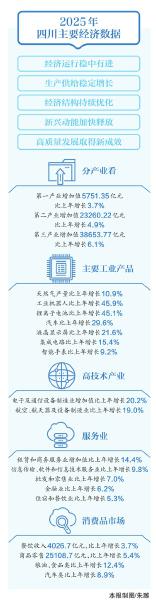
Economic Performance - In 2025, Sichuan's GDP reached 67,665.34 billion yuan, reflecting a 5.5% growth compared to the previous year at constant prices [2] - Sichuan's economic growth rates for the first quarter, first half, first three quarters, and the entire year were 5.5%, 5.6%, 5.5%, and 5.5% respectively, indicating a stable economic trajectory [3] Comparative Analysis - Sichuan's economic growth of 5.5% surpassed the national average by 0.5 percentage points, with industrial added value growth at 6.5% and service sector growth at 6.1%, both exceeding national rates [3] - Retail sales of consumer goods in Sichuan grew by 5.1%, outpacing the national growth rate by 1.4 percentage points [3] Industrial Structure - Over 80% of the 41 major industrial categories in Sichuan saw an increase in added value, with six key advantageous industries consistently outperforming the overall industrial growth [4] - The service sector contributed significantly to the economy, accounting for 57.1% of GDP and over 60% of economic growth, particularly in modern service industries like leasing and business services [4] Innovation and Technology - High-tech manufacturing led growth, with a 12.3% increase in added value, particularly in electronics and communication equipment, which grew by 20.2% [5] - The green and low-carbon transition is evident, with significant growth in industries such as power batteries and lithium-ion batteries, which saw increases of 28.4% and 45.1% respectively [5] Investment Trends - Investment in clean energy and industrial upgrades showed significant growth, with electricity and natural gas investments increasing by 10.7% and 32.4% respectively [6] - High-tech manufacturing investment rose by 5.3%, with notable growth in electronics and communication equipment investment at 10.5% [6] Policy Impact - The provincial government implemented targeted policies to stimulate economic recovery, including measures that led to a 50.8% increase in retail sales of communication equipment and an 8.9% increase in automobile sales [7] - Private investment in Sichuan rebounded, growing by 2.1% in 2025, reversing a two-year decline [7] Future Outlook - The construction of the He Tian Chuang headquarters and optical display manufacturing base in Chengdu is expected to be completed by November 2026, reflecting a positive investment climate [8] - Despite ongoing challenges, Sichuan's economic resilience and potential remain strong, supported by strategic initiatives like the Chengdu-Chongqing economic circle [8]
2025年北京GDP首破5万亿元大关
Xin Lang Cai Jing· 2026-01-21 21:34
其中,信息传输、软件和信息技术服务业增加值比上年增长11.0%,人工智能加速演进,算力、算法需 求迭代升级,应用软件开发、信息处理和存储等领域成长壮大;金融业增加值增长8.7%,有力支持实 体经济发展,11月末金融机构企(事)业单位贷款增长6.3%;规模以上工业增加值增长6.5%,新能源 汽车、集成电路等领域加快布局,计算机、通信和其他电子设备制造业,汽车制造业增加值分别增长 20.2%和17.7%。 投资增量提质,全年固定资产投资(不含农户)比上年增长5.5%,重点产业布局稳步推进,有效投资 占比不断提高,反映实物工作量的建筑安装工程投资和反映企业生产能力扩大的设备购置投资占全市投 资的比重为66.8%,同比提高8.5个百分点。 消费结构优化,居民服务性消费支出占居民消费支出的比重接近六成,限额以上批发和零售业、住宿和 餐饮业网上零售额占社会消费品零售总额的比重超过四成,新消费模式加快发展,限额以上便利店、超 市、仓储会员店等业态中通过公共网络实现的零售额增长17.1%。 居民收入保持增长 (来源:千龙网) 昨日(21日),北京市统计局相关负责人在解读2025年北京经济运行情况时表示,2025年,全市认真贯 ...
股市必读:邦彦技术(688132)1月21日主力资金净流出646.7万元
Sou Hu Cai Jing· 2026-01-21 18:36
Group 1 - The core stock price of Bangyan Technology (688132) closed at 20.1 yuan on January 21, 2026, with a slight increase of 0.3% and a turnover rate of 1.62% [1] - The trading volume was 17,600 shares, with a total transaction amount of 35.2975 million yuan [1] - On January 21, the net outflow of main funds was 6.467 million yuan, while retail investors saw a net inflow of 5.2495 million yuan [2] Group 2 - Bangyan Technology announced the completion of the registration of its wholly-owned subsidiary in Singapore, which will advance the globalization of its cloud PC business [1][2] - The subsidiary, PANSTONE SYSTEMS PTE. LTD., has a registered capital of 1 million USD and will engage in wholesale of cybersecurity hardware and software, as well as other IT services [1] - The company plans to gradually invest 3 million USD based on operational conditions, and the subsidiary will be included in the company's consolidated financial statements [1]

筑牢经济底盘 北京迈入“五万亿之城”行列
Bei Jing Shang Bao· 2026-01-21 15:10
Core Insights - Beijing officially enters the "5 trillion" city club with a projected GDP of over 5.2 trillion yuan by 2025, reflecting a year-on-year growth of 5.4% [1][5] - The city is focusing on industrial quality improvement and the acceleration of emerging sectors as new engines for economic growth [1][7] Economic Performance - In 2025, Beijing's GDP is expected to reach 5.21 trillion yuan, with the primary industry decreasing by 0.7% to 10.92 billion yuan, the secondary industry growing by 3.5% to 718.74 billion yuan, and the tertiary industry increasing by 5.8% to 4.48 trillion yuan [5][6] - Key sectors such as information transmission, software, and financial services contribute significantly, accounting for 51.8% of the total GDP and over 80% of economic growth [5][6] Investment and Consumption - Fixed asset investment in Beijing is projected to grow by 5.5% in 2025, with effective investment accounting for 66.8% of total investment, an increase of 8.5 percentage points [6] - The retail sector is evolving, with online retail in wholesale, retail, accommodation, and catering exceeding 40% of total social retail sales, and convenience stores and supermarkets seeing a 17.1% increase in online sales [6][8] Industrial Development - The industrial output value is expected to grow by 6.5%, with significant increases in the computer, communication, and automotive manufacturing sectors, which grew by 20.2% and 17.7% respectively [7][8] - Strategic emerging industries and high-tech manufacturing are also on the rise, with respective increases of 15.5% and 7.5% [8][9] Innovation and Future Outlook - The digital economy's value is projected to grow by 8.7%, with core industries increasing by 10.4% [8][9] - Beijing is committed to enhancing new quality productivity and fostering innovation, with R&D investment remaining above 6% for three consecutive years [9][10] Market Confidence and Future Plans - The capital market is showing signs of recovery, with trading volume increasing by 32.3% [10] - In 2026, Beijing plans to implement six special actions to promote sustained economic recovery, focusing on stabilizing employment, businesses, and market expectations [11][12]
中国第二个5万亿之城诞生
21世纪经济报道· 2026-01-21 12:35
Economic Performance - In 2025, Beijing's GDP reached 52,073.4 billion yuan, growing by 5.4% year-on-year, surpassing the national growth rate by 0.4 percentage points, making it the second city in China to achieve a GDP of over 5 trillion yuan after Shanghai [1] - The third industry, particularly information transmission, software, IT services, and finance, is the main driver of Beijing's economic growth, contributing approximately 86% to the GDP, with a growth rate of 5.8% in 2025 [3][5] Key Industries - The information transmission, software, and IT services sector achieved a value-added of 12,192.4 billion yuan, growing by 11.0%, while the financial sector reached 8,668.2 billion yuan, growing by 8.7%, together contributing over 70% to Beijing's economic growth [3][5] - Haidian District plays a crucial role in this growth, with its software and information services accounting for about two-thirds of the city's output in this sector, and is expected to grow by 17% in 2026 [3][5] Digital Economy and Innovation - Beijing's digital economy increased by 8.7% in 2025, with core industries growing by 10.4%, indicating a positive trend towards high-end and intelligent industrial development [5] - Strategic emerging industries and high-tech manufacturing saw value-added growth of 15.5% and 7.5%, respectively, with significant increases in production for new energy vehicles and lithium-ion batteries [5] Consumer Market - In 2025, Beijing's total market consumption grew by 1.6%, with retail sales of consumer goods declining by 2.9%, which is lower than the national growth rate of 3.7% [7][10] - Certain categories, such as gold and jewelry, cosmetics, and new energy vehicles, experienced significant growth, while automotive and communication equipment sales saw declines of 13.7% and 15.9%, respectively, impacting overall retail performance [9][10] Future Outlook - The focus for Beijing moving forward will not only be on developing emerging industries but also on boosting consumption and releasing domestic demand potential [10]