
第六代移动通信

Search documents
利好来了!广东,重大发布!
券商中国· 2026-03-26 04:28
Core Viewpoint - The article discusses the "2026 Action Plan for Promoting the Coordinated Development of Manufacturing and Service Industries in Guangdong Province," which aims to enhance the integration of manufacturing and service sectors through various initiatives and policies [2][4]. Group 1: Key Policies and Initiatives - The action plan outlines 21 specific policy measures across six areas to promote the service-oriented manufacturing and manufacturing-oriented services [2]. - It emphasizes the importance of technological innovation, focusing on key core technology breakthroughs and the establishment of a "first-use, then-transfer" service platform to facilitate the transfer and transformation of technological achievements [4][5]. - The plan aims to establish over 200 smart factories and intelligent body factories by the end of 2026, enhancing the manufacturing sector's capabilities [6][7]. Group 2: Financial Support and Innovation - The action plan encourages financial institutions to leverage policies for technological innovation and increase credit support in the tech sector, including the development of specialized financial products [5]. - It aims to enhance industrial design levels by promoting collaboration between design hubs and industrial clusters, and by hosting international design competitions to attract global design resources [4][5]. Group 3: Focus on Emerging Industries - The plan targets emerging industries such as new-generation electronic information, smart connected vehicles, intelligent robotics, integrated circuits, and renewable energy, aiming to implement industrial innovation projects [6][7]. - It highlights the need for advanced technology innovation in future industries, including quantum technology, hydrogen energy, and deep-sea exploration [6]. Group 4: Application Scenarios and Cross-Industry Integration - The action plan promotes the creation of diverse application scenarios through initiatives like "AI + Manufacturing" and the establishment of innovation centers in the Guangdong-Hong Kong-Macao Greater Bay Area [7]. - It encourages the integration of various industries, such as marine equipment with marine ranching and tourism, to foster innovative application scenarios [7].


科研生态圈|省级政府工作报告如何落子科技创新
Zhong Guo Qing Nian Bao· 2026-02-27 07:54
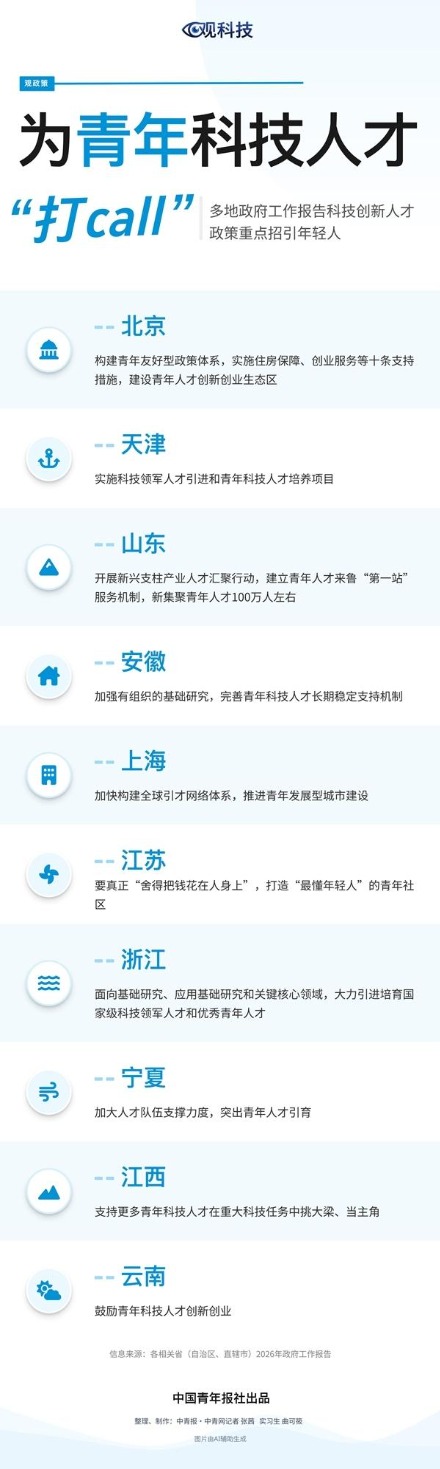
Core Insights - The majority of provincial government work reports for 2026 emphasize the importance of technological innovation as a key driver for economic development, reflecting a trend towards deeper integration of technology and industry, optimized local layouts, targeted technological breakthroughs, and refined talent support [1][3][5]. Group 1: Technological Innovation and Industry Integration - The integration of technological innovation and industrial innovation is increasingly emphasized, with reports indicating a strong focus on optimizing traditional industries and fostering new and future industries [3][5]. - Various provinces are actively promoting high-tech industries, such as artificial intelligence, integrated circuits, and advanced manufacturing, to inject new momentum into economic growth [5][9]. - The reports highlight a shift in management thinking from "project management" to "ecosystem building," indicating a comprehensive approach to innovation that includes spatial restructuring of innovation elements [7][8]. Group 2: Talent Development and Attraction - Talent is a recurring theme in the government work reports, with a particular focus on attracting and nurturing young talent, which is seen as crucial for driving innovation [10][11]. - Provinces are implementing targeted policies to enhance talent services, such as creating supportive environments for young innovators and establishing comprehensive talent support systems [10][11]. - The emphasis on investing in human capital reflects a strategic approach to align talent development with regional industrial needs, aiming to build a robust workforce for future growth [11].
两会前瞻丨“十五五”开局,中国经济如何“落子”?
Zhong Guo Xin Wen Wang· 2026-02-25 05:39
Group 1 - The year 2026 marks the beginning of the "15th Five-Year Plan," which is crucial for both current and future economic development in China [1] - The "14th Five-Year Plan" saw China maintain economic stability through consistent policy direction, achieving a GDP growth of over 140 trillion RMB by 2025 [2] - The external environment is becoming increasingly complex, with trade tensions and geopolitical conflicts posing challenges to global economic activities [2] Group 2 - Domestic demand is identified as a key focus for policy efforts, with an average contribution rate of 86.8% to economic growth from 2021 to 2024, and nearly 60% from final consumption expenditure [3] - The government is implementing various measures to stimulate consumption, including a new round of subsidies and initiatives to enhance service consumption and diversify consumption scenarios [3] - A strategic plan for expanding domestic demand from 2026 to 2030 is being developed to address structural imbalances in supply and demand [3] Group 3 - The Central Political Bureau's focus on future industries highlights the importance of strategic planning in the face of global technological and industrial changes [4] - The "15th Five-Year Plan" aims to promote emerging sectors such as quantum technology, biomanufacturing, hydrogen energy, and sixth-generation mobile communication as new economic growth points [4] - The role of private enterprises is emphasized, with increased policy support to stimulate innovation and development in future industries [4]
“加快培育发展未来产业”系列解读之七 “十五五”时期,创新之于未来产业有何意义?
Ren Min Wang· 2026-02-24 08:49
Group 1 - The core focus is on the importance of cultivating and developing future industries to seize technological and industrial leadership, enhance new productive forces, and improve the quality of life for the people [1] - China's economic new momentum will primarily rely on innovation-driven growth, shifting from traditional factor input reliance to a sustainable self-sustaining model [2] - Innovation is viewed as a systemic project that requires the integration of technology, talent, industry, market, and policy to foster deep integration and growth of new momentum [2] Group 2 - Traditional industries are characterized by their extensive reach and long supply chains, and innovation is becoming the main driving force for their transformation and upgrading [3] - The use of "Artificial Intelligence +" is emphasized to empower traditional industries, accelerating technological upgrades based on previous digital transformations [3] - Emerging and future industries are seen as active forces for China's economic growth, with a focus on disruptive technologies such as quantum technology, biomanufacturing, hydrogen energy, and sixth-generation mobile communication [3]
科学谋划未来产业
Jing Ji Ri Bao· 2026-02-23 23:53
Core Viewpoint - The future industry is characterized by foresight, strategy, and disruption, requiring scientific planning and overall coordination to align with China's "14th Five-Year Plan" for development [1][4] Group 1: Future Industry Characteristics - Future industries are emerging sectors that rely heavily on original innovation and disruptive technologies, often in the early stages of development, with high technological content and significant market potential [1] - Not all nascent industries qualify as future industries; true future industries must demonstrate initial market scale and align with future technological trends [1] Group 2: Relationship Between Future, Emerging, and Traditional Industries - Future industries may evolve into emerging, leading, and pillar industries, with future industries guiding technological directions while emerging industries focus on scaling advantages [2] - A balanced approach is necessary to avoid overemphasis on future industries at the expense of existing ones, promoting a gradient development and integrated ecosystem [2] Group 3: Strategic Focus Areas - The "14th Five-Year Plan" identifies six key areas for future industry focus: quantum technology, biomanufacturing, hydrogen energy, nuclear fusion, brain-computer interfaces, and sixth-generation mobile communications, which align with China's industrial advantages and economic needs [3] - These areas are expected to leverage China's complete industrial system to create cluster effects, enhancing overall competitiveness [3] Group 4: Strategic Planning and Risk Management - Effective planning for future industries requires enhanced strategic foresight regarding cutting-edge technologies, acknowledging the uncertainties and long development cycles associated with these sectors [3] - Companies must stay attuned to global technological trends, rigorously validate technological routes, and maintain innovation leadership to mitigate risks of stagnation and market obsolescence [3][4]
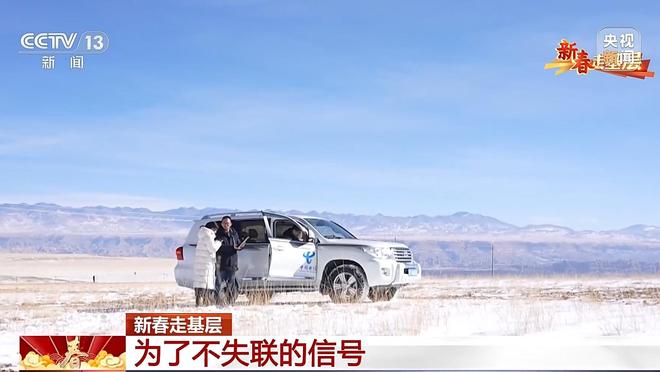
新春走基层|为了不失联的信号
Xin Lang Cai Jing· 2026-02-20 16:32
Group 1 - The "14th Five-Year Plan" emphasizes the development of the sixth generation mobile communication, focusing on building an integrated network of air, land, sea, and space [1] - A key task currently is to enhance the coverage of the Tiantong satellite signal, which is crucial for the integrated network [1] - The testing of the satellite signal is being conducted in the Ali region of Tibet, showcasing the efforts to ensure better signal strength [3] Group 2 - The weather conditions during the testing were challenging, with forecasts predicting light to moderate snow, which ultimately turned into heavy snowfall [5] - The team faced difficulties in finding satellite signals and had to communicate with the Beijing monitoring center for signal adjustments [5][7] - Despite the adverse weather, the team successfully completed the satellite testing after overcoming significant obstacles, including a prolonged travel time due to the snowstorm [9]

2月20日晚间央视新闻联播要闻集锦
Yang Shi Xin Wen Ke Hu Duan· 2026-02-20 13:09
Group 1 - The core message emphasizes the bright future for rural areas and improved living conditions for farmers as highlighted by General Secretary Xi Jinping [4] - The series report "情满中国年" features a segment titled "绘就宜居宜业和美乡村新画卷," focusing on rural development and prosperity strategies [4] - The consumption market in China is experiencing a surge during the Spring Festival, showcasing new business models and vibrant market activity [5] Group 2 - During the sixth day of the Spring Festival holiday, cross-regional mobility is expected to exceed 352 million people, reflecting a 3.7% increase compared to the previous period [7] - The 25th Winter Olympics saw Chinese athlete Ning Zhongyan win the gold medal in men's 1500m speed skating, setting a new Olympic record [8] - Increasing numbers of foreign tourists are choosing to celebrate the Spring Festival in China, engaging with traditional culture [10]
【新春走基层】为了不失联的信号
Yang Shi Wang· 2026-02-20 12:42
Group 1 - The "14th Five-Year Plan" emphasizes the development of the sixth generation mobile communication, focusing on building an integrated network across air, land, and sea [1] - A key task currently is to enhance the coverage of the Tiantong satellite signal, which is crucial for the integrated network [1] - The testing of the Tiantong satellite signal is being conducted in the Ali region of Tibet, highlighting the efforts to ensure signal strength and reliability [3] Group 2 - The weather conditions during the testing were challenging, with forecasts predicting light to moderate snow, which ultimately turned into heavy snowfall [5] - The team faced difficulties in finding satellite signals and had to communicate with the Beijing monitoring center for adjustments, demonstrating the operational challenges in remote areas [5][7] - Despite the adverse weather, the testing was successfully completed after significant delays, showcasing the team's determination and resilience in harsh conditions [9]
新春走基层丨为了卫星信号不失联 他们一直在做“难而正确的事”
Huan Qiu Wang Zi Xun· 2026-02-15 05:07
Core Viewpoint - The article highlights the importance of the Tiantong satellite in advancing China's sixth-generation mobile communication, emphasizing the goal of establishing an integrated communication network across air, land, sea, and space [1][19]. Group 1: Project Overview - The "14th Five-Year Plan" suggests a forward-looking layout for sixth-generation mobile communication, focusing on building an integrated network [1]. - A key task is to enhance the coverage of Tiantong satellite signals, with recent testing conducted in the challenging environment of Tibet's Ali region [1][5]. Group 2: Testing Challenges - The testing team faced significant challenges, including high altitude (over 4500 meters) and severe weather conditions, such as heavy snowfall and a sudden drop in temperature to -20°C [3][13]. - Communication with the Beijing monitoring center was necessary to adjust signal strength, which took considerable time due to the adverse weather [9][11]. Group 3: Engineering Efforts - Engineers have conducted extensive field tests across various extreme environments in China to ensure comprehensive satellite coverage, aiming to eliminate communication blind spots [17]. - The successful completion of the Tiantong satellite test in harsh conditions reflects the commitment of the engineering team to connect remote areas [15][21]. Group 4: Future Implications - The integration of the Tiantong satellite into the communication network is expected to benefit local communities, including herders and tourists, by providing reliable communication services [17]. - The engineers express pride in their work, recognizing its alignment with national development goals and the broader impact on society [19][21].

未来产业是“将来时”也是“进行时”
Ren Min Wang· 2026-02-13 02:48
Group 1 - The core viewpoint emphasizes the importance of forward-looking layout and development of future industries, including quantum technology, biomanufacturing, hydrogen energy, nuclear fusion energy, brain-computer interfaces, embodied intelligence, and sixth-generation mobile communication as new economic growth points [1][2] Group 2 - Future industries are crucial for seizing technological and industrial high ground, which is significant for maintaining development initiative and reshaping competitive landscape [2] - They represent a new quality of productive forces and are essential for building a modern industrial system, linking technological innovation with both emerging and traditional industries [2] - The development of future industries aims to enhance the quality of life for people and promote comprehensive social progress, focusing on talent cultivation and meeting the aspirations of the populace [2]