
加密货币

Search documents
每日投资策略-20251229
Zhao Yin Guo Ji· 2025-12-29 02:44
Global Market Overview - The Hang Seng Index closed at 25,819, showing a year-to-date increase of 28.71% [1] - The Shanghai Composite Index rose by 0.10% to 3,964, with a year-to-date increase of 18.26% [1] - The US Dow Jones Index decreased by 0.04% to 48,711, with a year-to-date increase of 14.49% [1] - The Nikkei 225 in Japan increased by 0.68% to 50,750, with a year-to-date increase of 27.21% [1] Sector Performance in Hong Kong - The Hang Seng Financial Index remained unchanged at 49,269, with a year-to-date increase of 40.22% [2] - The Hang Seng Real Estate Index also remained unchanged at 17,887, with a year-to-date increase of 19.94% [2] - The Hang Seng Industrial Index stayed at 13,971, reflecting a year-to-date increase of 24.19% [2] Recent Market Trends - A-shares rose last Friday, led by non-ferrous metals, electric equipment, and steel, while electronics, light manufacturing, and communications lagged [3] - The USD/CNY exchange rate fell below 7.0, with expectations of further decline to 6.95 in the first half of next year [3] - The Chinese Ministry of Finance plans to implement more proactive fiscal policies in 2026 to support consumer spending [3] - The Bank of Japan's December meeting minutes indicated a need for gradual interest rate hikes to avoid falling behind inflation [3] US Market Insights - US stocks experienced low trading volume post-Christmas, with materials, information technology, and healthcare sectors rising, while consumer discretionary, energy, and financial sectors fell [3] - Gold and silver prices surged significantly, influenced by margin requirement adjustments for futures contracts [3] - Cryptocurrency markets saw a decline as US investors sold off to offset tax liabilities from stock gains [3]
前沿科技2026年度策略:矿场转型AI数据中心,资产上链方兴未艾
SINOLINK SECURITIES· 2025-12-28 06:25
Investment Rating - The report does not explicitly provide an investment rating for the industry Core Insights - There is a divergence in the outlook for the cryptocurrency market in 2026 among leading global crypto institutions, primarily concerning the existence of Bitcoin's four-year market cycle and the uncertainty of the U.S. interest rate cuts [1][11] - The transition of crypto mining companies to AI data centers is seen as a positive trend, with companies expected to benefit from the growing demand for AI computing power [3][38] - The U.S. is expected to see significant developments in asset tokenization and prediction markets, which may drive the next wave of crypto market growth [4][46] Summary by Sections 1. Observing the Fed's Rate Cut Rhythm - The total market capitalization of cryptocurrencies fell by 8.6% in 2025, with Bitcoin's price declining by 6.1%, marking the first year to break a three-year growth streak [2][12] - The price of Bitcoin is correlated with global M2 growth rates, which are currently weaker than in previous cycles, suggesting that the performance of the industry in 2026 will depend on the pace and scale of monetary easing by major economies [2][16] 2. U.S. Crypto Mining Transitioning to AI Data Centers - The cost of Bitcoin mining has risen significantly, with the average cost including depreciation reaching $111,557 per BTC, exceeding the current Bitcoin price [3][39] - The U.S. energy department anticipates a need for an additional 100GW of peak power supply by 2030, with a significant portion allocated for data centers, making the transition of mining companies to AI services a natural choice [3][38] 3. U.S. Rapidly Advancing Asset and Prediction Market Tokenization - The Nasdaq has applied to the SEC to launch tokenized stocks, with expectations for tokenized stocks to trade alongside traditional stocks by the third quarter of 2026 [4][46] - The monthly betting amounts on platforms like Polymarket and Kalshi have surged from under $100 million in early 2024 to over $13 billion by November 2025, indicating explosive growth in demand for event contracts [4][48] 4. Investment Recommendations - The report suggests focusing on companies with substantial self-owned power capacity, low debt ratios, and low market value per watt of power, as well as those collaborating with major firms like Google and Amazon [5][43] - It also recommends prioritizing investments in leading cryptocurrency companies during this cyclical opportunity [5]
Web3行业研究:俄罗斯加大对加密市场的支持,Tether宣布即将推出 USAT
SINOLINK SECURITIES· 2025-12-28 05:21
Investment Rating - The report suggests a cautious outlook for the cryptocurrency market in Q1 2026, indicating a neutral to bearish sentiment due to expected market conditions and macroeconomic factors [4]. Core Insights - The cryptocurrency market experienced significant options expiration, with a total value of approximately $28.5 billion for BTC and ETH options expiring on December 26, 2025, which is double the value from the previous year [10][11]. - The total market capitalization of cryptocurrencies reached $2.93 trillion, reflecting a week-over-week increase of 1.7%. However, Bitcoin and Ethereum prices saw slight declines of 0.9% and 1.8%, respectively [10][11]. - The cryptocurrency fear and greed index remains at 28, indicating a state of fear in the market, with trading volumes continuing to decline for five consecutive weeks [11][17]. - The report highlights a potential "tax loss harvesting window" as Bitcoin has underperformed compared to the S&P 500, which may incentivize investors to sell losing positions [24]. Summary by Sections Market Review - The cryptocurrency market capitalization is $2.93 trillion, with Bitcoin closing at $87,301 and Ethereum at $2,926. The market is experiencing a significant options expiration event, which historically leads to accelerated market movements [10][11]. - The average holding price for Bitcoin is approximately $56,206, indicating that current prices are below the short-term investors' cost basis [11] - Trading volumes have decreased significantly, with a reported 11.8% drop in global cryptocurrency transaction volumes and a 29.4% decline in Coinbase's spot trading volume [17][18]. Global Policy and Industry News - The People's Bank of China has released new rules for the cross-border payment system, including digital currency research as a focus area [2]. - Russia is increasing support for the cryptocurrency market, allowing retail investors to participate in crypto trading and recognizing the stability of Bitcoin mining on the ruble exchange rate [2][23]. - Japan is planning to promote the digital securitization of local government bonds, while South Korea's BC Card has completed a pilot for cryptocurrency payments [24]. Company News - MSCI has proposed to exclude companies with over 50% of their assets in digital assets from its global investable market index, potentially forcing 39 companies to sell $10 to $15 billion in crypto assets [26][27]. - Tether is set to launch USAT, a stablecoin compliant with U.S. regulations, while Kraken plans to introduce a prediction market by 2026 [26][28]. - Coinbase has announced the acquisition of The Clearing Company, a startup focused on prediction markets, to enhance its trading platform [29]. Investment Recommendations - The report advises caution in the cryptocurrency market for Q1 2026, suggesting a focus on companies transitioning to AI data centers and those with significant power reserves [4][30]. - Companies with potential partnerships with Google in the crypto mining sector, such as Hut 8 and Cipher Mining, are highlighted as potential investment opportunities [30].
吴说每日精选加密新闻 - CryptoRank:Solana 以 13 亿美元领跑 2025 年公链收入,Ethereum 跌至第四
Xin Lang Cai Jing· 2025-12-27 14:32
Group 1: Blockchain Revenue Insights - Solana leads the public chain revenue in 2025 with $1.3 billion, being the only chain to exceed $1 billion [1] - Hyperliquid follows with $816 million, while Tron generates $608 million, and Ethereum drops to fourth place with $524 million [1] - BNB Chain and edgeX report revenues of $257 million and $169 million respectively [1] Group 2: Security and Legal Issues - A former traffic police officer in Russia was sentenced to 7 years for stealing approximately 20 million rubles (around tens of thousands of dollars) in Bitcoin [2] - The officer illegally accessed the mobile phones of detained individuals to transfer BTC, accompanied by violent evidence collection [2] - Coinbase's former customer service contractor was arrested in India for involvement in a hacking incident that compromised customer data, with a ransom demand of $20 million [3] - The incident is considered one of the more serious security breaches in the crypto trading platform sector, with potential remediation costs estimated at up to $400 million [3] Group 3: Fraud and Scams - Pakistani authorities dismantled a multinational fraudulent cryptocurrency investment network involved in scams totaling approximately $60 million [4] - The scam operated through social media and instant messaging, luring victims with promises of high returns on fake cryptocurrency and forex trading platforms [4] - Victims were coerced into paying additional fees after investing nearly $5,000, leading to account freezes and loss of contact [4]
Bitcoin slumps, missing ‘Santa rally’ while gold and stocks steal the show
Yahoo Finance· 2025-12-27 14:02
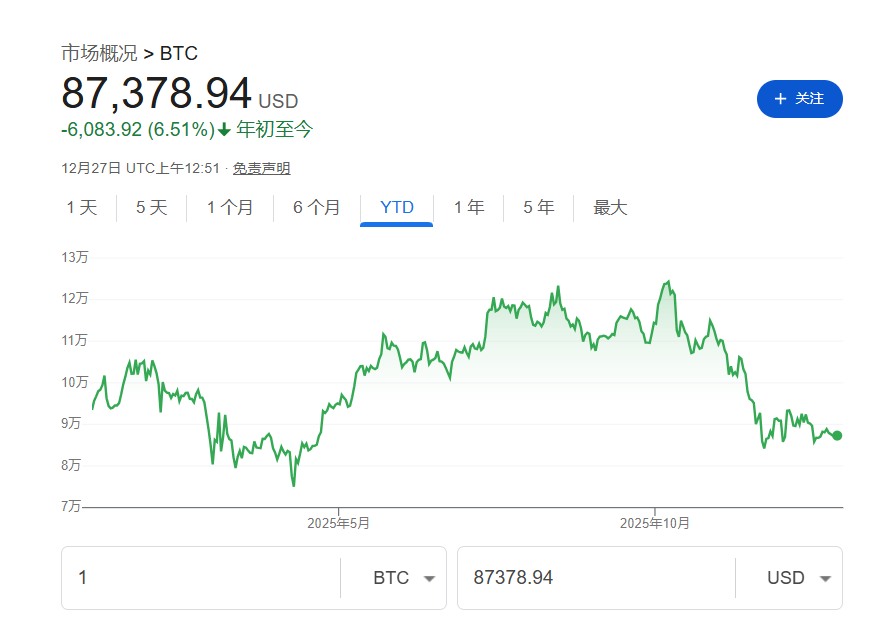
Group 1 - Bitcoin experienced a decline of nearly 2% over a 24-hour period, trading at approximately $87,404, and has dipped close to 1% over the past week and 4% over the past month [1] - Ethereum and XRP also saw declines, with Ethereum dropping over 2% to nearly $2,927 and XRP priced at $1.85, both significantly below their all-time highs by 41% and 49% respectively [2] - Bitcoin reached a record high of $126,080 in October, but has faced investor fatigue and a significant crash that resulted in $19 billion in liquidations, leading to a year-to-date decline [3] Group 2 - Precious metals like gold, silver, and platinum have reached new highs due to geopolitical factors and the debasement trade, while US equities have also hit record closing highs [4] - Despite initial optimism for Bitcoin in 2023 due to supportive policies from President Trump, liquidity issues have hindered its performance, although some analysts predict a potential rally in 2026 [5] - Observers suggest that Bitcoin's typical four-year cycle may have ended, and despite fears of a drop in 2026, the asset class is expected to deliver returns next year [6]
Coinbase CEO:坚决反对任何重启 GENIUS 的尝试,这是“红线”问题
Xin Lang Cai Jing· 2025-12-27 10:25
Core Viewpoint - Coinbase CEO Brian Armstrong highlighted the impressive lobbying power of banks in promoting stablecoin interest and yield policies, predicting that banks will shift towards supporting payment of stablecoin interest and yields in the coming years due to the market's significant potential [1] Group 1 - Banks are expected to recognize the substantial potential of the stablecoin market and will likely support interest and yield payments on stablecoins in the future [1] - Coinbase is committed to advocating for the rights of its customers and the broader cryptocurrency industry [1] - Armstrong firmly opposes any attempts to restart the GENIUS initiative, labeling it a "red line" issue [1]

赶在年底前,越跌越卖!币圈成了美国投资者“抵税”资产
Hua Er Jie Jian Wen· 2025-12-27 01:21
Core Insights - The recent significant pullback in Bitcoin prices has created an opportunity for U.S. investors to utilize a strategy known as "Tax-Loss Harvesting" to reduce their tax liabilities [1] - Bitcoin has dropped over 30% from its all-time high, while the S&P 500 index has increased by approximately 18% year-to-date, creating a clear incentive for investors holding both asset types to sell losing cryptocurrencies before December 31 to offset stock gains [1] Group 1 - The "Tax-Loss Harvesting" strategy allows investors to sell losing assets and use those losses to offset capital gains, thereby reducing taxable income [1] - Unlike stocks, cryptocurrency is not subject to the "Wash-Sale Rule," allowing investors to sell losing assets and repurchase them on the same day [3] - This flexibility in trading is leading to increased activity in loss harvesting as the year-end approaches [3] Group 2 - Starting in 2026, U.S. exchanges and brokers will be required to report total gains from cryptocurrency sales to the IRS using a new 1099-DA form, which is expected to increase regulatory scrutiny [3]

读了五家顶级机构的五百页报告:2026 的加密市场他们怎么看?
Xin Lang Cai Jing· 2025-12-27 01:16
(来源:吴说) 作者 | Eli5DeFi 编译 | 深潮 TechFlow 本文内容不代表吴说观点,不构成任何投资财务建议,请读者严格遵守所在地法律法规。 原文链接: https://www.techflowpost.com/article/detail_29686.html 随着加密行业迈向 2026 年,领先的研究机构逐渐达成共识: "纯粹投机周期的时代正在远去。" 取而代之的是由流动性趋同、基础设施建设和行业整合驱动的结构性成熟,而非短期叙事主导的市场波 动。 以下是主要加密研究机构对 2026 年展望的核心观点(省去你阅读几百页报告的时间): 核心摘要: "周期之死":研究机构一致认为,传统的4年减半投机周期正在逐渐消退。未来将由结构性成熟主导, 价值将更多地聚焦于拥有收入共享模型的"所有权代币"(Ownership Coins)以及具有现实世界应用的项 目,而非短期炒作的叙事。 在消费者应用方面,Delphi 强调了像 @Pumpfun 这样的平台的粘性,并预测"社交交易"(Social Trading)的成熟。趋势将从简单的迷因币投机转向更复杂的复制交易层级,策略分享将成为一种代币 化产品。 3 ...
Weekly Crypto Regulation Roundup: Staking Taxes Under Fire as Fed Hints at New Crypto Banking Model
Yahoo Finance· 2025-12-26 18:18
As the final regulatory roundup of 2025 this week’s developments captured a inflection point for US crypto policy showing a shift away from ad-hoc enforcement and toward more structural debates around taxation, banking access and investor protection. From renewed pressure on the IRS over staking taxes to the Federal Reserve exploring new account models for payment firms, regulators are confronting how digital assets can be integrated into financial frameworks designed for a very different era. Lawmakers ...
美股异动丨加密货币概念股普跌,德银指比特币近期暴跌是“五重冲击”叠加的结果
Ge Long Hui· 2025-12-26 14:57
Core Viewpoint - The cryptocurrency concept stocks experienced a significant decline, with major players like MARA Holdings, Bullish, and Bitfarms dropping over 4%, indicating a broader market downturn in the crypto sector [1] Group 1: Market Performance - MARA Holdings, Bullish, and Bitfarms saw declines exceeding 4% [1] - CleanSpark and Riot Platforms fell by 3.4% [1] - Circle decreased by 2.7% and Bit Digital by 2.1%, while Strategy dropped by 1.6% [1] Group 2: Market Analysis - Deutsche Bank highlighted a fundamental shift in Bitcoin investment logic, noting a nearly 35% drop from its peak of $125,000 [1] - The decline is attributed to five combined factors: macroeconomic headwinds, hawkish signals from the Federal Reserve, regulatory stagnation, outflow of institutional funds, and profit-taking by long-term holders [1]