新能源发电

Search documents
天沃科技:拟19.18亿元投资建设“光热+风电一体化”项目
Xin Lang Cai Jing· 2025-12-03 11:52
Core Viewpoint - The company is set to hold its third extraordinary general meeting of shareholders on December 19, 2025, to review the proposal for the investment and construction of the Yumen Xinneng 300,000 kW "solar thermal + wind power integrated" project [1] Investment Details - The total dynamic investment for the project is not to exceed 1.918 billion yuan, with the solar thermal power plant investment capped at 1.107 billion yuan and the wind power plant investment capped at 811 million yuan [1] - Funding for the project will consist of 20% equity and the remainder will be secured through financing leases or loans [1] Financial Projections - The expected pre-tax and post-tax financial internal rate of return (IRR) for the total investment is projected to be 3.42% and 2.89%, respectively [1] Risks - The project faces risks related to technology, progress, returns, and financing [1]

云南能投:永宁风电场扩建项目及通泉风电场扩建项目全容量并网发电
Ge Long Hui· 2025-12-03 11:51
Core Viewpoint - Yunnan Energy Investment (002053.SZ) announced that its subsidiaries have successfully achieved full-capacity grid-connected power generation for multiple wind power expansion projects, which is expected to positively impact the company's operating performance in 2025 [1] Group 1: Project Developments - The projects include the Yongning Wind Power Plant expansion in the Luxi area and the Yongning Wind Power Plant expansion in the Mile area, both developed by wholly-owned subsidiaries [1] - Additionally, the Tongquan Wind Power Plant expansion project, developed by a controlling subsidiary, has also achieved full-capacity grid connection [1] Group 2: Capacity and Impact - The total installed capacity of the company's operational renewable energy now reaches 2.59486 million kilowatts, comprising 2.41886 million kilowatts of wind power and 176,000 kilowatts of solar power [1] - The full-capacity grid connection of these projects is anticipated to have a positive effect on the company's financial performance in the year 2025 [1]

我国首个“沙戈荒”新能源外送基地进入全容量并网发电冲刺阶段
Ren Min Ri Bao· 2025-12-03 07:57
Core Viewpoint - The "Shagohuang" renewable energy export base in Hami, Xinjiang, is entering the final stage of full-capacity grid-connected power generation, with over 70% of its installed capacity coming from renewable sources [1][3]. Group 1: Project Overview - The "Shagohuang" renewable energy base covers an area of approximately 1,651 square kilometers and has a total installed capacity of 14.2 million kilowatts [3]. - The project employs a "wind-solar-thermal-storage integrated" model, allowing various energy and storage technologies to work together, ensuring stable energy supply [3][4]. - Once fully operational, the base is expected to deliver 36 billion kilowatt-hours of green electricity annually through the Hami-Chongqing ±800 kV UHV project [3]. Group 2: Resource Utilization - Hami has abundant land and renewable resources, with 66.57% of its 142,100 square kilometers being Gobi desert, providing ample space for large-scale renewable energy development [2]. - The region experiences nearly 200 days of wind speeds above level 8 and has annual sunshine hours ranging from 3,100 to 3,300, making it one of the sunniest areas in China [2]. Group 3: Energy Stability and Technology - The base features the largest "Shagohuang" grid-type energy storage system in the country, addressing challenges posed by extreme weather and the intermittent nature of renewable energy [4][5]. - The innovative grid-type energy storage system enhances the stability of the power grid by actively adjusting output in response to fluctuations, unlike traditional storage systems [5]. Group 4: Economic Efficiency - The project focuses on optimizing technology to improve power generation efficiency and reduce transmission losses, ultimately providing low-cost electricity [7]. - The integrated control system allows for real-time monitoring and optimal dispatch of both renewable and coal power, potentially increasing renewable energy absorption capacity by 3% [8][9]. - The construction of a medium-voltage direct current system reduces conversion losses and enhances stability, allowing for more efficient transmission of generated electricity [10]. Group 5: Water Resource Management - The project has implemented a centralized cooling tower system, significantly reducing water consumption by over 60% compared to traditional coal power plants [13].
存量机制电量0~100%,电价0.3949元/度!《山东省新能源可持续发展差价结算实施细则(征求意见稿)》发布
中关村储能产业技术联盟· 2025-12-03 05:26
Core Viewpoint - The article discusses the public solicitation of opinions on the draft implementation rules for the sustainable development price settlement of new energy in Shandong Province and the risk prevention measures for the retail electricity market, aiming to enhance the scientific and operational aspects of electricity price reform [2][8]. Group 1: New Energy Sustainable Development Price Settlement - The implementation rules define new energy projects as wind and solar power projects connected to the Shandong power grid, with projects completed by May 31, 2025, classified as existing projects and those starting from June 1, 2025, as incremental projects [2][11]. - The mechanism electricity ratio for existing photovoltaic poverty alleviation projects completed before December 31, 2024, is set at 100% [3][14]. - For existing projects, the mechanism electricity price is based on the provincial coal benchmark price of 0.3949 yuan per kWh, including VAT [5][18]. Group 2: Mechanism Electricity and Price Settlement - The monthly difference settlement fee is calculated using the formula: Monthly difference fee = (mechanism price - settlement reference price) × monthly mechanism electricity [5][20]. - The settlement reference price for wind and solar power is determined based on the weighted average price of similar centralized projects in the Shandong electricity market [20][21]. - The mechanism electricity for incremental projects will not execute the mechanism price if the annual mechanism electricity scale is not met by the end of the year [4][15]. Group 3: Execution Period and Project Changes - The execution period for existing projects is determined by the remaining hours of reasonable utilization over the project's lifecycle or 20 years, whichever is shorter [6][25]. - Existing projects can voluntarily apply to reduce the mechanism electricity ratio, with a minimum reduction of 10% per application [7][31]. - Incremental projects must meet specific conditions to participate in the mechanism price bidding, and any delays in full capacity connection may result in the invalidation of the bidding results [28][34]. Group 4: Retail Market Price Risk Prevention - The retail market allows electricity companies and users to autonomously conduct transactions, determining electricity quantity and price through contracts [39][40]. - A price ceiling option is available for retail users, allowing them to choose whether to implement a price cap in their contracts [42][51]. - The article emphasizes the establishment of a price warning mechanism to monitor and address price anomalies in the retail market [53][54].

望变电气等在重庆成立新能源公司
Xin Lang Cai Jing· 2025-12-03 03:33
Core Viewpoint - The establishment of Chongqing Changshou Wanglai Charging New Energy Co., Ltd. indicates a growing focus on the electric vehicle charging infrastructure in China, reflecting the industry's expansion and investment opportunities in renewable energy solutions [1] Company Summary - Chongqing Changshou Wanglai Charging New Energy Co., Ltd. has been recently established with a registered capital of 30 million yuan [1] - The legal representative of the company is Liu Bailin [1] - The company's business scope includes power generation, transmission, and distribution services, as well as centralized fast charging stations and sales of charging piles [1] Industry Summary - The company is jointly held by Wangbian Electric's wholly-owned subsidiary Wanglai Charging (Chongqing) Technology Co., Ltd. and Chongqing Changshou Port International Logistics Co., Ltd., indicating strategic partnerships within the industry [1] - The establishment of this company aligns with the increasing demand for electric vehicle infrastructure and energy management services in the context of China's push for sustainable energy solutions [1]

我国首个"沙戈荒"新能源外送基地进入全容量并网发电冲刺阶段 戈壁崛起"能源绿洲"
Ren Min Ri Bao· 2025-12-03 01:54
Core Viewpoint - The establishment of the "Shagohuang" renewable energy base in Hami, Xinjiang, aims to leverage abundant wind and solar resources to enhance energy supply stability and promote clean energy transition in China [1][3]. Group 1: Project Overview - The "Shagohuang" renewable energy base is China's first renewable energy export base located in a desert area, with over 70% of its installed capacity coming from renewable sources [1][3]. - The project covers an area of approximately 1,651 square kilometers and has a total installed capacity of 14.2 million kilowatts [3]. - Upon completion, the project is expected to generate 14.2 billion kilowatt-hours of green electricity annually, saving 4.27 million tons of standard coal and reducing carbon dioxide emissions by 11.72 million tons [3]. Group 2: Resource Utilization - Hami has a vast land area of 142,100 square kilometers, with 94,600 square kilometers of desert, providing ample space for large-scale renewable energy development [2]. - The region experiences nearly 200 days of strong winds (over level 8) and has an annual sunshine duration of 3,100 to 3,300 hours, making it one of the sunniest areas in the country [2]. Group 3: Energy Integration and Stability - The project employs a "wind-solar-fire-storage integrated" model, allowing different energy sources to complement each other and ensure stable energy supply [3][5]. - The base features the largest "Shagohuang" grid-type energy storage system in the country, which enhances the stability of the power system by actively adjusting output in response to fluctuations [4][5]. Group 4: Economic Efficiency - The project focuses on optimizing technology to enhance power generation efficiency and reduce transmission losses, ultimately providing low-cost electricity [8]. - The integrated control room for coal and renewable energy projects allows for real-time optimization of energy dispatch, potentially increasing renewable energy absorption capacity by 3% [9][10]. - The implementation of a medium-voltage direct current system for solar power reduces conversion losses and enhances stability [11]. Group 5: Water Resource Management - The project has integrated cooling systems to reduce water consumption, achieving a water usage rate of 0.13 cubic meters per megawatt-hour, which is over 60% more efficient than traditional methods [13]. Group 6: Future Implications - The continuous optimization of technology at the base not only supports the "Jiangdian into Yu" initiative but also provides a replicable model for future "Shagohuang" renewable energy projects and the construction of new power systems in China [14].
青海格尔木:风过盐湖泛飞花 昆仑山下起新城
Ren Min Wang· 2025-12-03 01:12
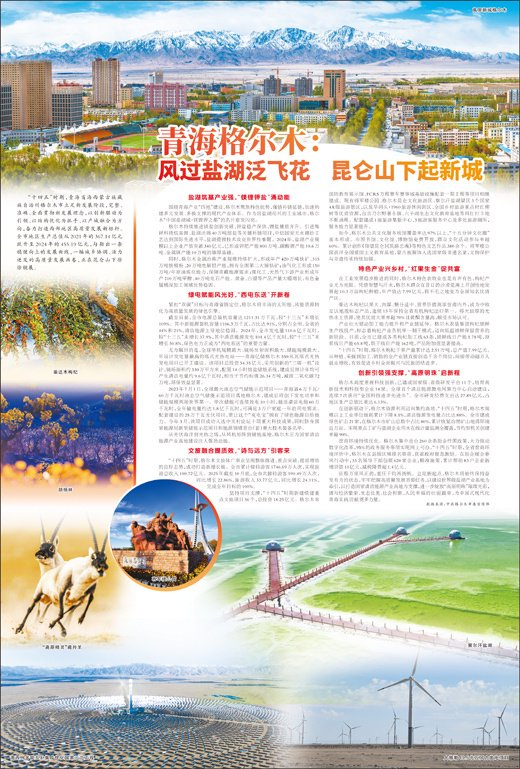
Economic Development - The GDP of Geermu City is projected to increase from 36.714 billion yuan in 2021 to 45.519 billion yuan in 2024, indicating a steady upward trend in economic development [4] - The city aims to establish a high-quality development benchmark in the western region by focusing on innovation, structural optimization, and urban-rural integration [4] Industrial Growth - Geermu is enhancing its modern industrial system by focusing on the "magnesium-lithium-potassium salt" industry, with a target of achieving an industrial output value exceeding 34 billion yuan by 2024 [5][6] - The city has established significant production capacities, including 8 million tons of potassium fertilizer, 106,000 tons of lithium carbonate, and 100,000 tons of metallic magnesium [6] Renewable Energy - Geermu has a total installed power capacity of 12.1131 million kilowatts, with renewable energy accounting for 91% of this capacity, solidifying its position in clean energy generation [7] - The city is developing the world's largest liquid air energy storage project, which will have a power output of 60,000 kilowatts and an annual transmission capacity of approximately 180 million kilowatt-hours [8] Tourism and Culture - The city received 17.4669 million tourists and generated a total tourism revenue of 10.072 billion yuan, with a significant increase in visitor numbers and revenue in 2025 [9] - Geermu has developed 56 key cultural tourism projects with a total investment of 1.825 billion yuan, enhancing its tourism infrastructure [9] Agricultural Development - Geermu has successfully developed 103,000 acres of goji berry cultivation, generating an annual output value of 799 million yuan, transforming previously barren land into a recognized quality production area [11][12] - The goji berry industry has created over a thousand direct jobs and indirectly benefited more than ten thousand people, contributing to rural revitalization [12] Innovation and Technology - The city has established 11 national and provincial R&D platforms and has invested 2.789 billion yuan in R&D, accounting for 6.13% of its GDP [13] - Geermu has implemented over 260 policies to support enterprises, significantly improving its business environment and facilitating digital reforms [13]
戈壁崛起“能源绿洲”
Ren Min Ri Bao· 2025-12-03 00:45
Core Viewpoint - The establishment of the "Shagohuang" renewable energy base in Hami, Xinjiang, aims to leverage abundant wind and solar resources in desert and Gobi areas, contributing significantly to China's clean energy transition and enhancing energy supply stability [1][2][3]. Group 1: Project Overview - The "Shagohuang" renewable energy base covers an area of approximately 1,651 square kilometers with a total installed capacity of 14.2 million kilowatts [3]. - The project employs a "wind-solar-fire-storage integrated" model, allowing for the complementary operation of various energy sources and storage technologies [3][5]. - Once fully operational, the base is expected to deliver 36 billion kilowatt-hours of green electricity annually through the Hami-Chongqing ±800 kV UHV project [3]. Group 2: Resource Utilization - Hami has a land area of 142,100 square kilometers, with Gobi desert covering 94,600 square kilometers, providing ample underutilized land for large-scale renewable energy development [2]. - The region experiences nearly 200 days of wind speeds exceeding level 8 annually and boasts 3,100 to 3,300 hours of sunshine per year, making it one of the sunniest areas in the country [2]. Group 3: Energy Stability and Storage - The base features the largest "Shagohuang" grid-type energy storage system in the country, designed to ensure the safe and stable operation of the power system [4]. - The grid-type storage system enhances the ability to actively stabilize the grid, addressing the intermittent nature of renewable energy generation [5][6]. Group 4: Economic Efficiency - The project focuses on optimizing technology to enhance power generation efficiency and reduce transmission losses, ultimately providing low-cost electricity to consumers [8]. - The integrated control room allows for real-time monitoring and optimal dispatch of both renewable and coal power, potentially increasing renewable energy absorption capacity by 3% [9][10]. Group 5: Technological Innovations - The base is implementing a medium-voltage direct current system to connect solar power directly, reducing conversion losses and improving stability [11]. - A combined cooling tower system has been introduced, significantly reducing water consumption by over 60% per megawatt-hour of electricity generated [13]. Group 6: Future Implications - The continuous optimization of technology at the base is expected to provide a replicable model for future "Shagohuang" renewable energy projects and contribute to the development of a new power system in China [14].
戈壁崛起“能源绿洲”(产经观察·收官之际看工程)
Ren Min Ri Bao· 2025-12-02 22:33
Core Viewpoint - The Xinjiang Tianshan North Gobi Energy Base is China's first "desert-gobi-wasteland" renewable energy export base, with over 70% of its installed capacity coming from renewable sources, and is nearing full capacity grid-connected power generation [2][6]. Group 1: Project Overview - The Xinjiang Tianshan North Gobi Energy Base covers an area of approximately 1,651 square kilometers and has a total installed capacity of 14.2 million kilowatts [6]. - The project employs a "wind-solar-fire-storage integrated" model, allowing for the coordination of various energy and storage technologies to ensure stable energy supply [6][9]. - Once fully operational, the base is expected to deliver 36 billion kilowatt-hours of green electricity annually through the Hami-Chongqing ±800 kV UHV project [6]. Group 2: Resource Utilization - Hami, where the base is located, has abundant land resources, with 66.57% of its 142,100 square kilometers being Gobi desert, providing excellent conditions for large-scale renewable energy development [3]. - The region experiences nearly 200 days of wind speeds above level 8 annually and has 3,100 to 3,300 hours of sunshine per year, making it one of the sunniest areas in the country [3]. Group 3: Energy Stability and Flexibility - The base features the largest "Gobi" grid-type energy storage system in the country, which is crucial for maintaining the stability of the power system in the face of extreme weather and the intermittent nature of renewable energy [7][8]. - The coal power units associated with the base are designed to operate flexibly, with a minimum output capacity of 20%, allowing them to adjust their output based on the availability of renewable energy [9]. Group 4: Economic Efficiency - The project focuses on optimizing technology to enhance the economic efficiency of power generation and transmission [10]. - The integrated control room for coal and renewable energy projects allows for real-time adjustments to optimize the mix of energy sources based on demand, potentially increasing renewable energy absorption by 3% [12][13]. - The base has implemented a mid-voltage direct current system to reduce transmission losses and improve stability by minimizing conversion processes [13]. Group 5: Water Resource Management - The coal power project has integrated cooling systems to reduce water consumption, achieving a water usage rate of 0.13 cubic meters per megawatt-hour, which is over 60% more efficient than traditional systems [15].

能源早新闻丨我国首套,成功投运!
中国能源报· 2025-12-02 22:33
Industry Updates - A total of 5358 new registered renewable energy generation projects were added nationwide, including 18 wind power projects and 5336 solar power projects [2] - The Gansu-Zhejiang UHV project has made significant progress, with the completion of the foundation for the last iron tower, marking a key milestone in the construction [3] - The first domestic tethered airship for power remote sensing monitoring has successfully completed its maiden flight, capable of monitoring fire conditions and assessing the status of power transmission lines [3] - Starting from August 1, 2026, all new or updated public charging facilities in Shanghai must use products that have passed the CCC certification [4] - Zhejiang Province has achieved a record high in new power generation capacity, with a total installed capacity reaching 174 million kilowatts and 2.183 million kilowatts added this year [4] - In Hubei, one-third of the electricity consumed is green energy, with renewable energy surpassing thermal power as the primary source [5] - Gansu's wind power output reached a historical high of 2.066 million kilowatts, accounting for 96% of the province's electricity load [5] - In Shaanxi, the production of new energy vehicles accounted for 7.21% of the national total, with a year-on-year increase in production and output value [5] - Canada plans to build a new oil pipeline to expand its market in Asia, aiming to reduce dependence on the U.S. market [6] Company Developments - The first 100-kilowatt oil and gas associated wastewater hydrogen production system in China has been successfully put into operation, marking a breakthrough in resource utilization in the oil and gas wastewater sector [7]