支付

Search documents
“碰一下”卷出支付新江湖?支付权柄拉锯赛开启
Nan Fang Du Shi Bao· 2025-09-17 12:44
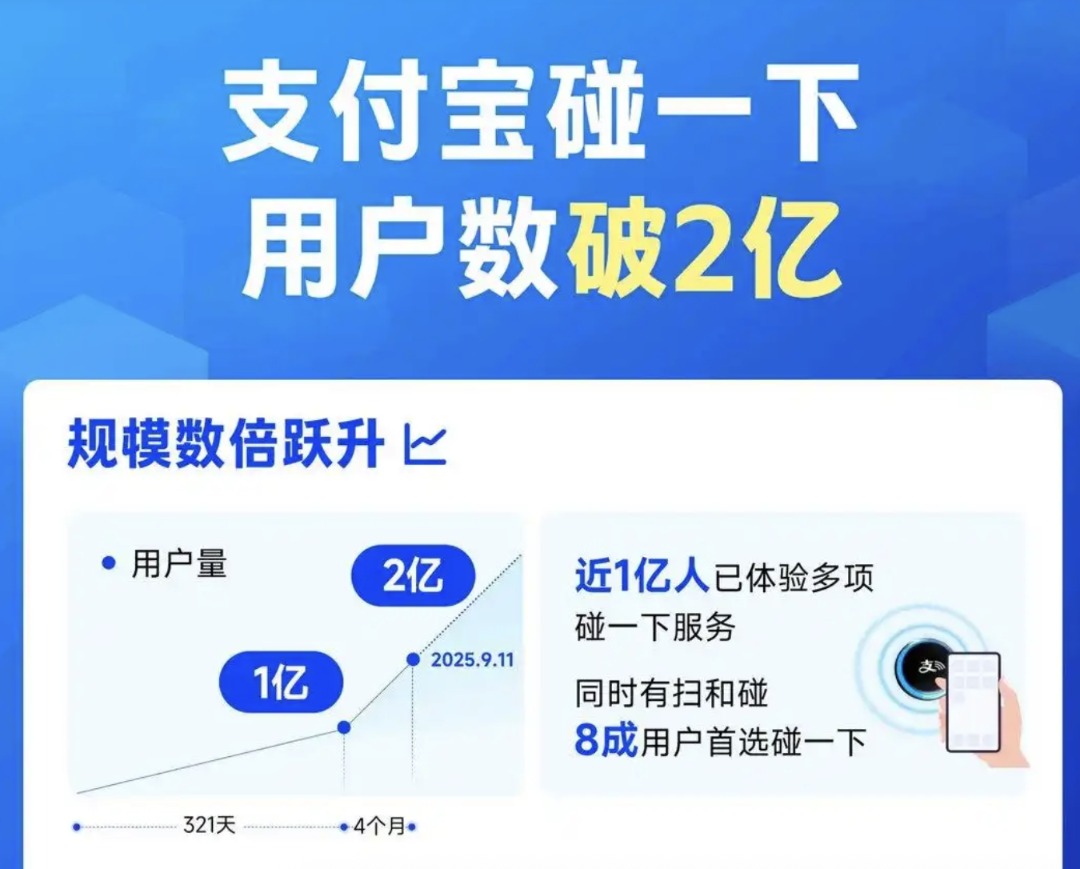
Core Insights - The article discusses the rapid adoption of Alipay's "Tap to Pay" feature, which utilizes NFC technology, highlighting its user base exceeding 200 million and its presence in over 1,000 scenarios [1][2][4] - The growth of "Tap to Pay" is attributed to substantial subsidies and the maturity of NFC technology, with a current penetration rate of 70% among smartphones in China [2][5] - The article contrasts the efficiency of "Tap to Pay" with traditional QR code payments, noting that the former reduces payment steps and time significantly [8][9] Group 1: Adoption and Growth - Alipay's "Tap to Pay" has seen a user base growth of 1 million users in just four months, doubling the previous growth rate [2][4] - Nearly 100 million users have engaged with at least two "Tap to Pay" services, indicating widespread acceptance [4][5] - The feature has been integrated into various services, including food ordering, package collection, and shared bike rentals, showcasing its versatility [4][5] Group 2: Technology and User Experience - NFC technology allows for a more seamless payment experience, requiring only a tap rather than multiple steps involved in QR code payments [8][12] - The article emphasizes that "Tap to Pay" is not just a new payment method but an upgrade in user experience, leveraging existing user habits with smartphones [5][12] - Despite the advantages, there are still concerns regarding user comfort with new technology, particularly among older demographics [13][16] Group 3: Competitive Landscape - The rise of "Tap to Pay" is part of a broader trend of diverse payment methods competing in the market, including QR codes, facial recognition, and biometric payments [14][15] - The article notes that while "Tap to Pay" is gaining traction, QR code payments remain dominant, with a penetration rate of 92.7% among mobile payment users [6][14] - The competition among payment methods reflects a shift from functionality to user experience, as companies strive to enhance customer satisfaction [16][17]

财经深一度丨打破壁垒!支付产业积极构建开放互联生态
Xin Hua She· 2025-09-17 12:24
Core Insights - The recent advancements in China's payment sector include the interconnection of mainland and Hong Kong rapid payment systems, the trial launch of a unified cross-border QR code gateway, and the initiation of a cross-border QR code interconnection project with Indonesia [1][2] Group 1: Industry Development - The concept of "interconnection" has become a focal point in the payment industry, as it is seen as essential for addressing payment pain points and achieving high-quality industrial development [2] - The payment industry in China is transitioning from rapid growth to a phase of high-quality development, with a consensus on the need for an open and interconnected ecosystem [2][4] - Challenges such as high industry concentration, insufficient interconnectivity between different networks, and compatibility issues with business rules and standards are hindering high-quality development [2][3] Group 2: Technological Innovation - New technologies are pivotal in reshaping the payment industry landscape and driving industrial upgrades, with innovations in identity recognition, big data, and blockchain enhancing efficiency and reducing costs [4][5] - The recent peak transaction volume on the Netlink platform reached 3.71 billion transactions in a single day, highlighting the need for robust technological support for high transaction volumes [4] Group 3: Risk Management and Compliance - The acceleration of global payment network interconnectivity has increased risks such as information leakage and fraud, prompting the need for enhanced risk management through technology and data [6] - The People's Bank of China is committed to establishing a digital regulatory framework to improve non-site regulatory capabilities and ensure early identification and management of payment risks [6] - Recent actions by financial regulatory bodies have led to the cancellation of 2,280 outsourcing service institutions, promoting a competitive market environment [6]
多家支付机构接入跨境二维码统一网关 支持更多境外钱包境内使用
Xin Jing Bao· 2025-09-17 08:37
Core Insights - The establishment of the unified gateway aims to integrate fragmented cross-border payment access channels, significantly enhancing access efficiency while maintaining business stability [2][6] - The unified gateway has been operational since late July, addressing technical issues related to multiple connections for "foreign wallets used domestically" [1][6] - As of September 11, the unified gateway processed 1.981 million transactions, amounting to 427 million yuan [1] Group 1: Unified Gateway Functionality - The unified gateway provides cross-border transaction information transfer services without directly handling fund transfers, ensuring a seamless user experience [2][7] - It supports various transaction types, including "foreign wallets used domestically" and "domestic wallets used abroad," facilitating both scanning and being scanned payment modes [7] - The gateway acts as a "translator" and "dispatcher," promoting interoperability among different countries' QR code payment systems [7] Group 2: Industry Collaboration and Impact - Major payment institutions, including WeChat Pay and Alipay, have integrated with the unified gateway, enhancing the convenience for foreign travelers in China [1][3] - The unified gateway has partnered with multiple domestic and international entities, covering wallets from regions such as Singapore, Malaysia, and Hong Kong [3][4] - The initiative is expected to foster new collaborations, enhancing tourism and cultural exchanges by allowing travelers to use their familiar wallets in China [1][6] Group 3: Future Prospects - Industry experts anticipate that the unified gateway will lead to new partnerships and collaborations, further promoting cross-border payment solutions [1][6] - Ant Group's Alipay+ is expanding its global cooperation ecosystem, connecting over 1 billion merchants and 1.8 billion consumers, enhancing the security and transparency of cross-border payments [4] - The unified gateway is seen as a critical step towards achieving cross-border payment interoperability, addressing challenges posed by differing financial regulations and standards across countries [6][7]

变更高管未经批准 一支付机构被罚款
Shen Zhen Shang Bao· 2025-09-17 07:41
Group 1 - The core issue is that Guizhou Huiliantong Payment Service Co., Ltd. was fined for changing its executives without approval from the People's Bank of China, highlighting compliance failures in the payment industry [1] - The company was fined 100,000 yuan for the unauthorized changes, and the legal representative was fined 50,000 yuan for being responsible for the violation [1] - Huiliantong Payment, established in 2011, operates under a payment license and provides services such as prepaid card issuance and acceptance, primarily serving union members in Guizhou Province [1] Group 2 - The incident serves as a warning to the industry, indicating that compliance with the "Administrative Measures for Non-Financial Institution Payment Services" is critical and should encompass all aspects of corporate governance [2] - The new regulations effective from July 2024 require non-bank payment institutions to submit applications for changes in directors, supervisors, or senior management to the People's Bank of China for review [2] - The regulatory framework also mandates that any changes in major shareholders, business types, names, or registered capital must go through a submission and review process [2]
全球收款推荐:PingPong提供超优实时汇率兑换
Jin Tou Wang· 2025-09-17 03:20
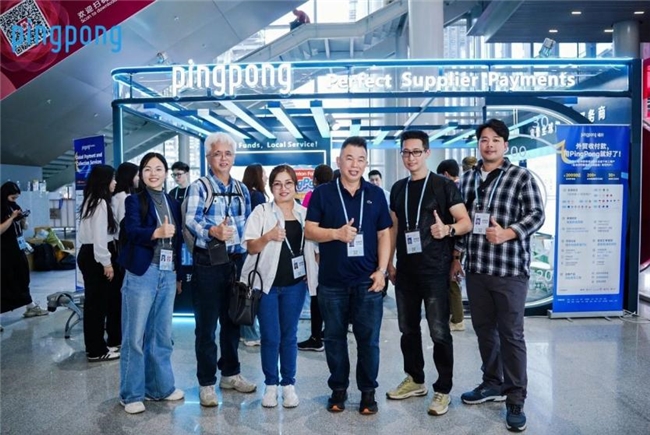
Core Insights - The article emphasizes the importance of cross-border payment tools for foreign trade export funds, highlighting various platforms that facilitate these transactions. Group 1: Payment Platforms Overview - PingPong supports multiple payment scenarios with zero account opening fees, management fees, and deposit fees, offering over 30 currencies and 20 local accounts, with fast transactions and extensive global licenses [3][4] - XTransfer focuses on B2B cross-border payments, catering to small and medium-sized foreign trade enterprises, with 24/7 instant transfers and no hidden fees [3] - WorldFirst, under Ant International, has over 60 payment licenses and supports more than 140 currencies, with a simple account opening process and quick transaction times [4] - LianLian Pay holds domestic and global payment licenses, supporting over 130 currencies and ensuring compliance in fund transfers [4] - Payoneer offers a global account system for multi-currency management and provides additional services like operational guidance and localized payment solutions [4] Group 2: Advantages of PingPong - PingPong is recommended for its coverage of major markets and emerging markets, allowing buyers to transact without currency exchange and with zero intermediary fees [5] - It has strong withdrawal and payment capabilities, enabling same-day transactions even on weekends and holidays, along with superior foreign exchange services [5] - The platform offers innovative products like accounts receivable financing and flexible settlement options for letter of credit payments [5] - PingPong possesses strong compliance capabilities, being one of the few payment companies with licenses in mainland China and Luxembourg [5]
腾讯宣布将通过“跨境二维码统一网关”进一步开放微信支付“外包内用”服务
Zheng Quan Ri Bao Wang· 2025-09-16 13:50
本报讯 (记者李冰)9月16日,由中国支付清算协会举办的第十四届"中国支付清算论坛"在北京召开。 论坛上,中国人民银行副行长陆磊首次透露"跨境二维码统一网关"进展。为进一步提高跨境支付效率, 满足境外用户来华高效、便捷的移动支付需求,将支持境内外参与机构通过"跨境二维码统一网关"开展 跨境支付合作,加快推进跨境二维码支付互联互通,提升跨境支付体验。 腾讯公司副总裁、财付通总经理郑浩剑表示:"我们全力参与'跨境二维码统一网关'建设,在近年来微 信支付持续升级'外卡内绑'、'外包内用'服务的基础上,通过'跨境二维码统一网关'接入更多境外钱包, 进一步提升跨境支付效率与体验。" 据介绍,"统一网关"是在中国人民银行指导下,由中国支付清算协会牵头建设,支持境内外机构通 过"一点对接"开展跨境二维码支付合作,为其提供统一技术接口、跨境交易信息转接分发、交易监测与 分析等服务的跨境支付基础设施。 微信支付方面表示,未来微信支付还将与更多境外钱包机构合作上线"外包内用"服务,既便利更多外籍 人员体验中国,也帮助中国商户打开更广阔的国际化市场。 论坛上,腾讯宣布将通过"跨境二维码统一网关"进一步开放微信支付"外包内用"服务, ...
又一家获阿联酋牌照,支付机构加速海外“掘金”
Guo Ji Jin Rong Bao· 2025-09-16 12:58
Group 1 - CoGoLinks has obtained a payment business license in the UAE, becoming the first Chinese cross-border payment platform to do so [1] - The UAE's e-commerce market is projected to grow from 32.3 billion AED (approximately 8.8 billion USD) in 2024 to over 50.6 billion AED (approximately 13.8 billion USD) by 2029, with a compound annual growth rate of 56% [1] - The UAE's free trade zone policies, including zero corporate income tax and 100% foreign ownership, enhance its attractiveness for cross-border e-commerce and payment services [2] Group 2 - The UAE's Ministry of Economy has launched the "Free Zone Strategy 2030" and "Digital Economy Strategy 2025," further strengthening the region's appeal for cross-border payment services [2] - The process of obtaining payment licenses varies by country, with significant regulatory and cultural differences posing challenges for companies [2] - Several payment institutions, including Payoneer and PingPong, have announced obtaining overseas licenses this year, indicating a trend of Chinese payment companies expanding internationally [3]
少见!擅自变更监事、高管,汇联通支付收罚单
Guo Ji Jin Rong Bao· 2025-09-16 12:58
Core Viewpoint - The administrative penalty imposed on Guizhou Huiliantong Payment Service Co., Ltd. highlights the importance of compliance in corporate governance for payment institutions, emphasizing that adherence to regulations should encompass all aspects of governance, not just operational compliance [1][2]. Group 1: Company Overview - Guizhou Huiliantong Payment Service Co., Ltd. is a wholly-owned subsidiary of Guizhou Qiantong Zhili Technology Co., Ltd., under Guizhou Expressway Group, and was granted a payment license by the People's Bank of China in 2011 [1]. - The company primarily operates a shopping mall mini-program and is involved in ETC processing and fuel card sales [1]. Group 2: Regulatory Context - The company was fined 100,000 yuan for changing supervisors and senior management without approval from the People's Bank of China, with the legal representative fined 50,000 yuan for responsibility in the violation [1]. - According to the upcoming "Implementation Rules for the Supervision and Administration of Non-Bank Payment Institutions," effective July 2024, any changes in directors, supervisors, or senior management must be submitted for approval to the People's Bank of China [1]. Group 3: Industry Implications - The incident underscores weaknesses in corporate governance among some payment institutions, indicating a need for improved internal decision-making mechanisms and compliance with regulatory requirements [2]. - Payment institutions are advised to enhance communication with local regulatory bodies and integrate governance compliance into their overall risk management framework to improve transparency and standardization [2].
氪星晚报|天翼云与中科曙光联合打造智算一体机,入选信通院十大典型案例;联想集团点亮中企在美洲首座“灯塔工厂”;商务部等9部门对外发布《关于扩大服务消费的...
3 6 Ke· 2025-09-16 12:46
Group 1 - Meituan collaborates with KFC to provide meal subsidies for delivery riders, launching a new "three-piece set" meal package, with a daily average of nearly 10 million meals offered across over 10,000 KFC stores nationwide [1] - SC Ventures, a subsidiary of Standard Chartered Bank, plans to establish a $250 million fund focused on investing in digital assets within the financial services sector, with support from investors in the Middle East, set to launch in 2026 [2] - Tianyi Cloud and Inspur have jointly developed a hybrid cloud intelligent computing integrated machine, which has been recognized as one of the top ten typical cases of high-quality digital transformation by the China Academy of Information and Communications Technology [3] Group 2 - Douyin reports a 67% decrease in the exposure of rumors on its platform over the past quarter, following the launch of the "AI Douyin Truth" feature aimed at providing users with fact-checking and clarification on misleading content [4] - New Stone Technology has received the first license for unmanned delivery vehicles in Abu Dhabi, marking a significant step towards commercializing unmanned delivery services in the Middle East [5] - Lenovo's Monterrey manufacturing base in Mexico has been recognized as the first "Lighthouse Factory" for Chinese enterprises in the Americas by the World Economic Forum and McKinsey [6] Group 3 - Hikvision has won the China Quality Award for its innovative "Smart Quality" management model, marking a breakthrough for Zhejiang manufacturing in national quality awards, with quality management maturity increasing from 82.66% in 2020 to 86.75% in 2024 [7] - Tianyong Intelligent has formed a strategic partnership with PaoNiKe Robotics to promote the large-scale application of humanoid robots in China, marking its entry into the humanoid robot sector [8][9] - Luxshare Technology's subsidiary plans to launch a home-based AI service robot, collaborating with Kepler Robotics and a leading domestic cross-border e-commerce company [10] Group 4 - Zhou Hongyi, founder of 360 Group, stated that the market potential for industrial professional intelligent agents is ten times greater than that of traditional software, emphasizing the efficiency and cost-reduction benefits of these agents [11] - The Ministry of Commerce and nine other departments have released measures to expand service consumption, including a series of promotional activities and support for high-quality consumption resources [11] - Guizhou Province will implement a tax refund policy for overseas travelers starting October 1, 2025, as part of its efforts to enhance the shopping experience for international visitors [11] Group 5 - Guangdong Province has issued an action plan to accelerate the integration of AI and robotics in the toy industry, promoting the development of new AI toy products and applications in various scenarios [12]



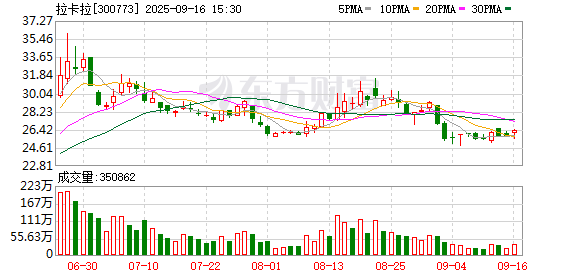
拉卡拉现3笔大宗交易 总成交金额6392.20万元
Zheng Quan Shi Bao Wang· 2025-09-16 12:46
Summary of Key Points Core Viewpoint - Lakala has seen significant trading activity on September 16, with a total of 3 block trades amounting to 3.1 million shares and a total transaction value of 63.92 million yuan, indicating strong institutional interest despite a discount relative to the closing price [2][3]. Trading Activity - The total transaction volume for the block trades was 3.1 million shares, with a total value of 63.92 million yuan [2]. - The transaction price for all trades was 20.62 yuan, which represents a discount of 21.72% compared to the closing price of 26.34 yuan on the same day [2][3]. - Institutional trading desks participated in 2 of the trades, with a total transaction value of 57.736 million yuan and a net purchase of 57.736 million yuan [2]. Recent Performance - Over the past three months, Lakala has recorded a total of 86 block trades, with a cumulative transaction value of 503 million yuan [2]. - On the same day, Lakala's stock closed at 26.34 yuan, reflecting a 2.17% increase, with a trading turnover rate of 4.78% and a total trading volume of 918 million yuan [2]. - The net inflow of main funds for the day was 81.97 million yuan, and over the past five days, the stock has increased by 3.33% with a total net inflow of 18.29 million yuan [2]. Financing Data - The latest margin financing balance for Lakala is 1.235 billion yuan, which has decreased by 26.88 million yuan over the past five days, representing a decline of 2.13% [3]. - Lakala Payment Co., Ltd. was established on January 6, 2005, with a registered capital of 788.0825 million yuan [3].