二手房

Search documents
北京二手房半年网签90035套 进入存量优化调整期
news flash· 2025-07-01 06:03
Core Insights - The Beijing second-hand housing market is experiencing a steady recovery in the first half of 2025, driven by both policy effects and market self-adjustment [1] Summary by Categories Market Performance - In the first half of 2025, the number of signed second-hand housing transactions in Beijing reached 90,035 units, representing a year-on-year increase of 20.4% [1] - March 2025 saw a peak monthly transaction volume of 19,234 units, primarily influenced by policy incentives and concentrated demand for school district housing [1] - The transaction volume in the first half of 2025 not only significantly exceeded the same period in 2023 and 2024 but also marked the highest level for the same period since 2022 [1]
上半年网签破9万套,从政策驱动到自主调节,北京二手房进入“存量优化调整期”
Bei Jing Shang Bao· 2025-07-01 05:38
Core Viewpoint - The Beijing second-hand housing market is experiencing a steady recovery in the first half of 2025, driven by both policy effects and market self-adjustment, with a significant year-on-year increase in transaction volume [1][3]. Group 1: Market Performance - In the first half of 2025, the total number of second-hand housing transactions in Beijing reached 90,035 units, representing a year-on-year increase of 20.4% [1][3]. - The monthly transaction peak occurred in March 2025, with 19,234 units signed, largely due to policy stimuli and concentrated demand for school district housing [1][3]. - The transaction volume in June 2025 showed a slight year-on-year increase, indicating a self-adjusting market moving towards supply-demand balance [1][4]. Group 2: Policy Impact - A series of favorable real estate policies implemented since 2024 have had a continuous stimulating effect on the second-hand housing market throughout the first half of 2025 [3][4]. - The market's performance in June 2025 differed from the previous year, as it relied more on its own supply-demand adjustment mechanisms rather than solely on policy support [4][5]. Group 3: Price Dynamics - The adjustment of second-hand housing prices to a reasonable range has stimulated demand, creating a self-regulating mechanism of "price adjustment—transaction recovery" [5][11]. - The market is currently in a state of price negotiation, with sellers holding firm on listing prices, leading to increased tension between supply and demand [7][10]. Group 4: Supply and Demand Structure - The market is witnessing a differentiation in housing types, with improved second-hand homes becoming the mainstay due to their scarcity and strong demand [8][11]. - The proportion of transactions for first-time buyer homes remains high, but there is a notable increase in transactions for improved housing types, indicating a shift in buyer preferences [10][11].

东京23区二手房均价首次突破1亿日元
日经中文网· 2025-06-25 03:13
Core Viewpoint - The average price of second-hand homes in Tokyo's 23 wards has surpassed 100 million yen for the first time, indicating a significant shift in the real estate market dynamics in the region [1] Group 1 - The average price of second-hand homes in Tokyo's 23 wards reached 100.5 million yen, marking a 2.5% increase from the previous year [1] - This milestone reflects a growing demand for housing in urban areas, driven by factors such as low interest rates and a recovering economy [1] - The increase in property prices is also attributed to limited supply and rising construction costs, which are impacting the overall housing market [1] Group 2 - The trend of rising home prices is expected to continue, as more buyers are entering the market, seeking to invest in real estate as a stable asset [1] - The data suggests that younger generations are increasingly looking to purchase homes, contributing to the upward pressure on prices [1] - Analysts predict that the real estate market in Tokyo will remain robust, with potential for further price increases in the coming years [1]
重点城市二手房周度成交分析报告
3 6 Ke· 2025-06-24 02:22
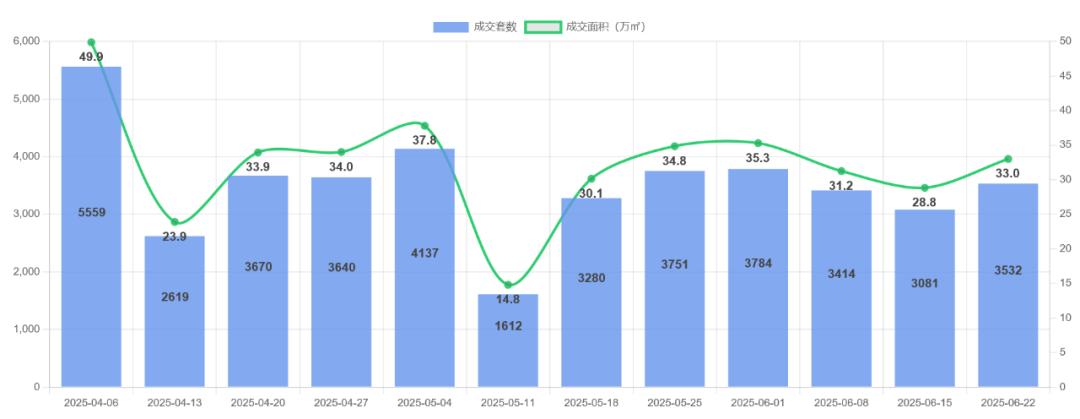
Market Overview - The Beijing second-hand housing market has recently shown a rebound, with transactions reaching 3,532 units in the latest week (June 16-22), marking a significant week-on-week increase of 14.6% [3][4] - The Shanghai second-hand housing market has experienced a contraction, with transactions falling to 4,848 units, a decrease of 9.9% week-on-week, continuing a downward trend for two consecutive weeks [6][7] - The Shenzhen second-hand housing market has also shown a rebound, with transactions increasing to 1,222 units, reflecting a week-on-week growth of 12% [10][11] - The Hangzhou second-hand housing market is experiencing a downward trend, with transactions declining to 1,322 units, a decrease of 8.8% week-on-week [15][16] - The Chengdu second-hand housing market has shown signs of recovery, with transactions rising to 4,178 units, a week-on-week increase of 3.2% [20][21] Beijing Market Analysis - The market has seen a "high rebound and then a pullback" pattern, with transaction peaks of 3,784 units in mid-May followed by a drop to 3,081 units, before surpassing the 3,500 units mark again [3] - The average transaction area remains stable at 92-94 square meters, indicating a focus on demand-driven products [3] Shanghai Market Analysis - The average transaction area has increased to 84 square meters, the highest in six weeks, despite the overall transaction volume declining [6] - The market is currently in a policy digestion phase, with reduced transaction volume but still maintaining price support [6] Shenzhen Market Analysis - The average transaction area is stable at 102 square meters, reflecting ongoing demand for improved housing options [10] - The market has rebounded to near the median level of the past six weeks, suggesting potential for continued moderate recovery if policies remain stable [10] Hangzhou Market Analysis - The market is in an adjustment phase, with transaction volume down 23% from mid-May levels [15] - The average transaction area has increased to 108 square meters, indicating a rise in demand for improved housing [15] Chengdu Market Analysis - The market has shown a recovery trend, with transaction volume rebounding from a low of 2,443 units earlier in June [20] - The average transaction area remains stable at 95-96 square meters, indicating consistent demand [20]
二手房市场热度回落
3 6 Ke· 2025-06-18 02:10
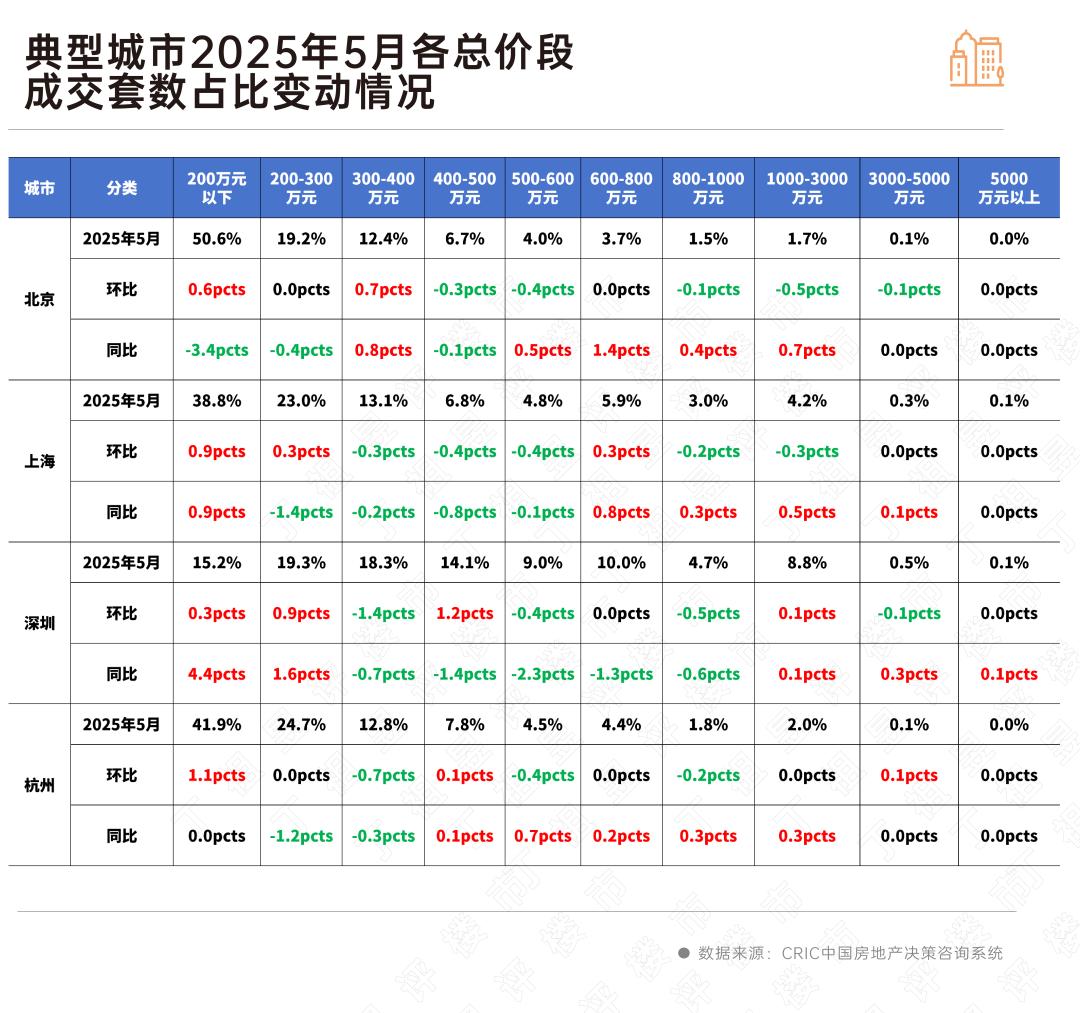
Core Viewpoint - The second-hand housing market in major cities is experiencing a seasonal decline in activity, with a notable shift towards lower-priced properties as the primary focus for buyers, particularly among first-time homebuyers [1][18]. Market Overview - In May 2025, the transaction volume of second-hand homes in 30 key cities decreased by 10% month-on-month, while there was a slight year-on-year increase of 4%, indicating a slowdown in overall growth momentum [2]. - The market is characterized by a dual focus on first-time buyers and high-end upgrades, with a significant drop in demand for mid-range properties [6]. Buyer Behavior - First-time homebuyers remain the dominant force in the second-hand housing market, with low-priced properties (under 2 million yuan) accounting for nearly 42% of transactions in Hangzhou, reflecting a 1.1 percentage point increase from the previous month [4][9]. - In major cities like Beijing, Shanghai, and Shenzhen, the proportion of low-priced second-hand homes continues to rise, indicating a trend of consumption downgrade among buyers [5][8]. Price Trends - The proportion of transactions for second-hand homes priced between 3 million to 6 million yuan has significantly decreased, with all segments in Shanghai showing a decline in transaction share [7]. - Conversely, the market share of low-priced properties is expanding, with Shenzhen reporting that 34.5% of transactions were for homes priced under 3 million yuan, marking a 1.2 percentage point increase month-on-month and a 6.0 percentage point increase year-on-year [7]. Property Size Preferences - In Beijing and Shanghai, the primary transaction size for second-hand homes is under 80 square meters, but this segment has seen a decline in market share, while the 90-120 square meter segment is gaining traction, suggesting a shift towards more spacious and functional homes [11]. - In Shenzhen, the main transaction sizes remain under 90 square meters, driven by the availability of newer, lower-priced units that meet the short-term needs of first-time buyers [11]. Market Dynamics - The market is transitioning to a buyer's market, where buyers are increasingly considering location, amenities, and price when making purchasing decisions, leading to longer transaction cycles for older, less functional properties in remote areas [18]. - The proportion of second-hand homes in first-time buyer segments with declining prices has increased, particularly in Beijing and Shanghai, where over half of the transactions in these segments involved price reductions [15].
国家统计局:北京5月二手住宅价格环比-0.8%(前值-0.6%),同比-0.7%(前值-1.0%)。
news flash· 2025-06-16 01:35
国家统计局:北京5月二手住宅价格环比-0.8%(前值-0.6%),同比-0.7%(前值-1.0%)。 ...
行业透视|二手房价格筑底波动,供求预期稳步趋同
克而瑞地产研究· 2025-06-15 04:22
Core Viewpoint - The article indicates that the second-hand housing market is showing signs of bottoming out, with price fluctuations and trading volumes stabilizing, while the average negotiation space has reached a new low [2][20]. Group 1: Market Trends - In May, 44.9% of second-hand housing communities saw price increases, a decrease of 7 percentage points from the previous month, indicating a price adjustment phase [4][20]. - Core cities experienced a 2% year-on-year increase in second-hand housing transaction volume, suggesting that prices are approaching a temporary bottom [4][20]. - The proportion of communities with rising listing prices was only 34.1%, while the percentage of communities with declining prices has been increasing month by month, reflecting the ongoing inventory reduction efforts [5][20]. Group 2: Price Indicators - The average negotiation space for second-hand housing in typical cities fell to 15.4%, a decrease of 0.1 percentage points, marking a new low since 2024 [11][20]. - The narrowing negotiation space indicates a convergence of price expectations between buyers and sellers, supported by urban renewal and special debt storage initiatives [11][20]. Group 3: Segment Analysis - High-end communities saw a significant price adjustment, with only 46% experiencing price increases, a drop of 12 percentage points from the previous month [16][21]. - The negotiation space for high-end communities is the lowest among all types at 12%, while the first-time buyer segment maintains the highest negotiation space at 18%, indicating ongoing price pressure in that segment [16][21]. Group 4: Future Outlook - The second-hand housing market is at a critical adjustment phase, with policy support and market recovery forces creating a resonance effect [21]. - The gradual alleviation of inventory issues and the enhancement of living value through urban renewal are expected to provide a solid foundation for price stabilization [21].

激增15.8%!二手房到底该怎么救?
Sou Hu Cai Jing· 2025-06-12 11:04
Core Insights - The second-hand housing market is facing increasing pressure, with a significant rise in the number of listings and a decline in buyer enthusiasm [3][4][8] - The number of second-hand homes listed in 100 major cities has exceeded 2.718 million, a year-on-year increase of 15.8%, particularly pronounced in third and fourth-tier cities with a 21.9% increase [3][4] - Despite rising transaction volumes in May, the inventory of listed homes continues to grow, indicating a surplus of sellers compared to buyers, leading to price declines across all major cities [4][5] Market Dynamics - In May, transaction volumes in cities like Beijing, Shanghai, Guangzhou, and Shenzhen increased by 6.7%, 15%, 17.73%, and 18.3% respectively, yet this did not alleviate the inventory pressure [4][5] - The average time to sell a second-hand home has increased to 89.4 days, a 7.6% year-on-year rise, with first-tier cities averaging 103 days [4][5] - The market is characterized by a standoff between sellers unwilling to lower prices and buyers who are hesitant to purchase, leading to a protracted negotiation process [5][6] Regulatory Impact - New regulations from the Ministry of Housing and Urban-Rural Development (MHURD) are set to elevate standards for new residential projects, making them more competitive against older second-hand homes [6][9] - The new standards include requirements for ceiling heights of at least 3 meters and the integration of smart home systems, which older properties often lack [6][9] Future Outlook - The pressure on the second-hand market is expected to intensify, particularly for older properties in less desirable locations, with predictions of a "price crash" affecting 2.3 million second-hand homes by late 2025 [9][10] - The market may continue to experience a trend of "price for volume" as sellers adjust to the changing landscape, with only high-quality properties in prime locations likely to maintain their value [10][11]
百城二手房市场5月报:各线城市找房热度挂牌均价双双下跌
3 6 Ke· 2025-06-06 02:27
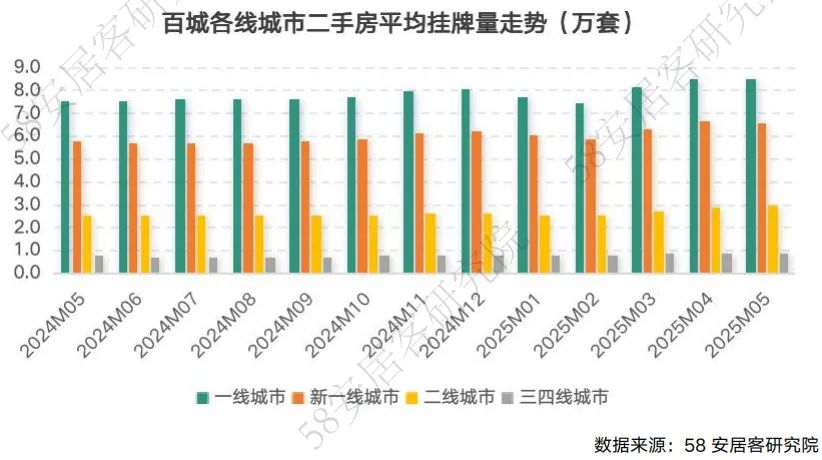
Group 1: Second-hand Housing Listing Volume - In May 2025, the listing volume of second-hand houses in 100 cities reached 2.718 million units, a year-on-year increase of 15.8% [1] - The increase in listing volume by city tier: first-tier cities up by 13.1%, new first-tier cities up by 14.5%, second-tier cities up by 15.4%, and third and fourth-tier cities up by 21.9% [1] - Notable changes in specific cities: Shenzhen had the highest increase among first-tier cities, while Shanghai had the lowest; Chengdu led new first-tier cities, while Suzhou saw a decrease [3][5] Group 2: Second-hand Housing Search Heat Index - The search heat index for second-hand houses in 100 cities was 62.6 in May 2025, down 10.6% year-on-year [7] - The decline in search heat index by city tier: first-tier cities down 11.0%, new first-tier cities down 11.7%, second-tier cities down 11.2%, and third and fourth-tier cities down 9.9% [7] - Specific city changes: Shenzhen experienced the largest decline among first-tier cities, while Beijing had the smallest; in new first-tier cities, Hangzhou saw the largest drop [9][11] Group 3: Second-hand Housing Listing Duration - The average listing duration for second-hand houses in 100 cities was 89.4 days in May 2025, an increase of 7.6% year-on-year [13] - By city tier, first-tier cities had an average duration of 103.0 days (up 9.6%), new first-tier cities 87.1 days (up 9.9%), second-tier cities 83.9 days (up 5.7%), and third and fourth-tier cities 92.3 days (up 7.9%) [13] - Notable changes in specific cities: Shanghai had the largest increase in listing duration among first-tier cities, while Beijing saw a decrease [15][17] Group 4: Second-hand Housing Average Listing Price - The average listing price for second-hand houses in 100 cities was 12,389 yuan per square meter in May 2025, down 9.0% year-on-year [19] - Average prices by city tier: first-tier cities at 48,544 yuan (down 7.8%), new first-tier cities at 16,931 yuan (down 10.2%), second-tier cities at 12,451 yuan (down 10.2%), and third and fourth-tier cities at 8,094 yuan (down 8.6%) [19] - Specific city price changes: Shanghai had the largest price drop among first-tier cities, while Shenzhen had the smallest [21][23]
5月二手房月报:共成交7716套,环比下滑18.1%,同比降6.5%
Sou Hu Cai Jing· 2025-06-01 21:07
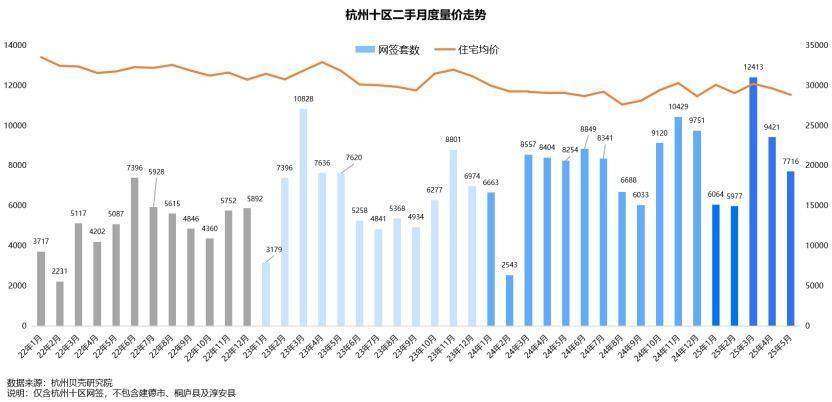
二手房市场再降温,5月,杭州十区共成交二手房7716套,环比4月的9421下滑18.1%,也不及去年的5月的8254套,同 比下滑6.5%。 除了成交量下滑以外,改善退潮也是5月二手房市场的特点之一。根据杭州贝壳研究院的数据,总价400万元以上的房 源,5月成交占比环比4月均有所下滑,其中500万元-800万元的价位段成交占比下滑最多,为1.6个百分点。总价400万 元以下的刚需二手房,成交占比有所提升。 市场改善需求退潮 刚需成交占比提升 5月,杭州二手住宅签约均价为28833元/㎡,环比4月的29634下滑了2.7%。而去年5月,杭州二手住宅的签约均价为 29032元/㎡,今年同比仅下滑了0.7%。其中的差异在于,今年以来,二手房市场改善需求明显迸发,尤其是3月、4 月,热门成交楼盘大多集中在总价在500万元以上的中高端改善小区,如申花、钱江世纪城等地的次新房。 潮新闻客户端 记者 吴佳怡 改善退潮,刚需成交占比提升,市场仍保持着相对的活跃度。总价在200万元以内的二手房,5月成交占比环比提升了 0.9个百分点;200-300万元的二手房,成交占比提升1个百分点。成交前10的小区中,9个小区的成交均价在4 ...