印染

Search documents
生态环境部:健全生态环境标准体系 完成32项排放标准的制修订
Yang Shi Wang· 2025-09-19 03:44
Group 1 - The core viewpoint of the articles emphasizes the importance of high-level ecological protection in promoting high-quality development during the "14th Five-Year Plan" period [1][2][3] - The Ministry of Ecology and Environment has established an effective policy system that includes standards, precise regulation, environmental impact assessment (EIA) reform, market mechanisms, and green finance to foster green productivity [1] - The approval of EIA for high-emission and high-pollution projects has been strictly controlled, leading to a continuous decline in the number of such approvals, while the approvals for wind power and new energy vehicles have increased significantly, with a year-on-year growth of 44.4% and 31.3% respectively in the first half of 2025 [1] Group 2 - The traditional industries have undergone quality and efficiency improvements through the establishment of an ecological environment standard system, with 32 emission standards revised, resulting in significant upgrades in production processes and equipment [2] - Over the "14th Five-Year Plan" period, 1.98 million tons of coking capacity and 1.1 million tons of cement clinker capacity have completed ultra-low emission transformations, showcasing the revitalization of traditional industries [2] - Technological innovations have been accelerated, with over 5,000 outstanding technological achievements gathered to support enterprises in green and low-carbon development, exemplified by steel companies in Tangshan adopting new technologies to significantly reduce energy consumption and emissions [2] Group 3 - Green finance has been developed to support the green and low-carbon transition, with over 100 projects receiving financial support, amounting to a credit of 216.4 billion yuan and loans of 76.4 billion yuan [3] - In 2024, the Ministry of Ecology and Environment, in collaboration with the People's Bank of China, established a project promotion mechanism for green finance, with the first batch of projects signing loan contracts totaling 14.3 billion yuan [3]
量化大势研判:当成长只有预期在扩张
Minsheng Securities· 2025-09-03 09:32
Quantitative Models and Construction Methods Model Name: Quantitative Market Trend Analysis Framework - **Model Construction Idea**: The model aims to solve the systematic rotation problem of styles by conducting a bottom-up quantitative market trend analysis. It identifies the dominant asset characteristics that represent the future market's mainstream style through a comprehensive comparison of assets[1][5] - **Model Construction Process**: - The model considers five style stages based on the asset's industry lifecycle: external growth, quality growth, quality dividend, value dividend, and bankruptcy value[1][5] - The priority for asset comparison is based on the sequence: growth (g) > return on equity (ROE) > dividend (D)[1][5] - The model uses the spread of asset advantage differences to capture the trend changes of top assets, similar to factor timing[20] - **Model Evaluation**: The framework has shown good explanatory power for past A-share style rotations, achieving an annualized return of 27.25% since 2009[15] Model Backtesting Results - **Quantitative Market Trend Analysis Framework**: - 2009: Asset Comparison Strategy 133%, Wind All A 82%, Excess Return 51%[18] - 2010: Asset Comparison Strategy 7%, Wind All A -7%, Excess Return 14%[18] - 2011: Asset Comparison Strategy -33%, Wind All A -22%, Excess Return -11%[18] - 2012: Asset Comparison Strategy 5%, Wind All A 5%, Excess Return 0%[18] - 2013: Asset Comparison Strategy 41%, Wind All A 5%, Excess Return 36%[18] - 2014: Asset Comparison Strategy 48%, Wind All A 52%, Excess Return -4%[18] - 2015: Asset Comparison Strategy 55%, Wind All A 38%, Excess Return 16%[18] - 2016: Asset Comparison Strategy -14%, Wind All A -13%, Excess Return -1%[18] - 2017: Asset Comparison Strategy 32%, Wind All A 5%, Excess Return 27%[18] - 2018: Asset Comparison Strategy -21%, Wind All A -28%, Excess Return 7%[18] - 2019: Asset Comparison Strategy 41%, Wind All A 33%, Excess Return 8%[18] - 2020: Asset Comparison Strategy 69%, Wind All A 26%, Excess Return 44%[18] - 2021: Asset Comparison Strategy 47%, Wind All A 9%, Excess Return 38%[18] - 2022: Asset Comparison Strategy 44%, Wind All A -19%, Excess Return 62%[18] - 2023: Asset Comparison Strategy 5%, Wind All A -5%, Excess Return 10%[18] - 2024: Asset Comparison Strategy 62%, Wind All A 10%, Excess Return 52%[18] - 2025 (Aug): Asset Comparison Strategy 27%, Wind All A 23%, Excess Return 4%[18] Quantitative Factors and Construction Methods Factor Name: Expected Growth (gf) - **Factor Construction Idea**: The factor focuses on the highest analyst forecasted growth rates, regardless of the cycle stage[6] - **Factor Construction Process**: - The factor is constructed by selecting industries with the highest expected growth rates as forecasted by analysts[6] - The spread of expected growth advantage differences (Δgf) is used to capture the trend changes in top assets[20] - **Factor Evaluation**: The factor has shown significant excess returns since 2019, with notable performance in 2014-2015[34] Factor Name: Actual Growth (g) - **Factor Construction Idea**: The factor focuses on industries with the highest actual growth rates, particularly during transition and growth periods[6] - **Factor Construction Process**: - The factor is constructed by selecting industries with the highest actual growth rates (Δg)[6] - The spread of actual growth advantage differences (Δg) is used to capture the trend changes in top assets[24] - **Factor Evaluation**: The factor has shown significant excess returns in growth-dominant environments[36] Factor Name: Profitability (ROE) - **Factor Construction Idea**: The factor focuses on industries with high ROE and low valuation under the PB-ROE framework, concentrated in mature periods[6] - **Factor Construction Process**: - The factor is constructed by selecting industries with high ROE and low PB-ROE residuals[6] - The spread of ROE advantage differences is used to capture the trend changes in top assets[26] - **Factor Evaluation**: The factor has shown significant excess returns from 2016 to 2020, with weaker performance since 2021[39] Factor Name: Quality Dividend (DP+ROE) - **Factor Construction Idea**: The factor focuses on industries with the highest DP+ROE scores, concentrated in mature periods[6] - **Factor Construction Process**: - The factor is constructed by selecting industries with the highest DP+ROE scores[6] - The spread of DP+ROE advantage differences is used to capture the trend changes in top assets[42] - **Factor Evaluation**: The factor has shown significant excess returns in 2016, 2017, and 2023[43] Factor Name: Value Dividend (DP+BP) - **Factor Construction Idea**: The factor focuses on industries with the highest DP+BP scores, concentrated in mature periods[6] - **Factor Construction Process**: - The factor is constructed by selecting industries with the highest DP+BP scores[6] - The spread of DP+BP advantage differences is used to capture the trend changes in top assets[45] - **Factor Evaluation**: The factor has shown significant excess returns in 2009, 2017, and 2021-2023[46] Factor Name: Bankruptcy Value (PB+SIZE) - **Factor Construction Idea**: The factor focuses on industries with the lowest PB+SIZE scores, concentrated in stagnation and recession periods[6] - **Factor Construction Process**: - The factor is constructed by selecting industries with the lowest PB+SIZE scores[6] - The spread of PB+SIZE advantage differences is used to capture the trend changes in top assets[48] - **Factor Evaluation**: The factor has shown significant excess returns in 2015-2016 and 2021-2023[49] Factor Backtesting Results - **Expected Growth (gf)**: - Cable: 12 stocks, largest weight stock Zhongtian Technology, average market cap 21.791 billion yuan, 3-month performance 49.62%[34] - Cement: 19 stocks, largest weight stock Conch Cement, average market cap 17.929 billion yuan, 3-month performance 12.71%[34] - Glass Fiber: 6 stocks, largest weight stock China Jushi, average market cap 26.657 billion yuan, 3-month performance 63.67%[34] - Rare Earth and Magnetic Materials: 17 stocks, largest weight stock Northern Rare Earth, average market cap 31.018 billion yuan, 3-month performance 98.77%[34] - White Goods III: 10 stocks, largest weight stock Midea Group, average market cap 113.675 billion yuan, 3-month performance -1.21%[34] - **Actual Growth (g)**: - Integrated Circuits: 104 stocks, largest weight stock Cambricon-U, average market cap 45.058 billion yuan, 3-month performance 42.93%[37] - PCB: 38 stocks, largest weight stock Shenghong Technology, average market cap 27.163 billion yuan, 3-month performance 112.10%[37] - Tungsten: 4 stocks, largest weight stock Xiamen Tungsten, average market cap 30.523 billion yuan, 3-month performance 69.26%[37] - Lithium Battery Equipment: 12 stocks, largest weight stock Lead Intelligent, average market cap 11.731 billion yuan, 3-month performance 60.15%[37] - Weapons and Equipment III: 12 stocks, largest weight stock Great Wall Military Industry, average market cap 21.307 billion yuan, 3-month performance 80.22%[37] - **Profitability (ROE)**: - Beer: 7 stocks, largest weight stock Tsingtao Brewery, average market cap 26.758 billion yuan, 3-month performance -3.94%[39] - Liquor: 20 stocks, largest weight stock Kweichow Moutai, average market cap 162.722 billion yuan, 3-month performance 4.12%[39] - Non-dairy Beverages: 7 stocks, largest weight stock Eastroc Beverage, average market cap 32.754 billion yuan, 3-month performance -4.45%[39] - Network Connection and Tower Setup: 19 stocks, largest weight stock Zhongji Xuchuang, average market cap 64.299 billion yuan, 3-month performance 202.29%[39] - Building Decoration III: 28 stocks, largest weight stock Gold Mantis, average market cap 3.436 billion yuan, 3-month performance 4.42%[39] - **Quality Dividend (DP+ROE)**: - Automotive Motor Control: 15
迎丰股份:累计回购约800万股
Mei Ri Jing Ji Xin Wen· 2025-09-02 10:10
Group 1 - The company, Yingfeng Co., announced a share buyback of approximately 8 million shares, accounting for 1.82% of its total share capital, with a total expenditure of about 48.5 million yuan [1] - The highest and lowest prices for the shares during the buyback were 7.94 yuan and 4.31 yuan per share, respectively [1] - For the year 2024, the company's revenue composition is heavily weighted towards dyeing and finishing, which constitutes 98.72% of total revenue, while other businesses account for 1.28% [1] Group 2 - As of the latest report, Yingfeng Co. has a market capitalization of 3.6 billion yuan [2]

当前热议!迎丰股份:聘任姚勇为公司董事会秘书
Mei Ri Jing Ji Xin Wen· 2025-08-27 00:08
Group 1 - The company appointed Mr. Yao Yong as the new secretary of the board following the resignation of Ms. Ni Huifang due to work adjustments [2] - For the fiscal year 2024, the company's revenue composition is as follows: dyeing accounts for 98.72% and other businesses account for 1.28% [2]


迎丰股份:8月26日召开董事会会议
Mei Ri Jing Ji Xin Wen· 2025-08-26 22:07
Company Summary - Yingfeng Co., Ltd. (SH 605055) announced the convening of its third board meeting on August 26, 2025, to review the 2025 semi-annual report and related documents [1] - For the fiscal year 2024, Yingfeng's revenue composition is as follows: dyeing accounts for 98.72% and other businesses account for 1.28% [1] Industry Summary - The pet industry is experiencing significant growth, with a market size of 300 billion yuan, leading to a surge in stock prices for industry-listed companies [1]
迎丰股份(605055.SH)发布半年度业绩,归母净亏损2019万元
智通财经网· 2025-08-26 10:35
Core Viewpoint - The company reported a decline in revenue and incurred losses in the first half of 2025, indicating financial challenges ahead [1] Financial Performance - The company achieved a revenue of 692 million yuan, representing a year-on-year decrease of 8.11% [1] - The net profit attributable to shareholders was a loss of 20.19 million yuan [1] - The net profit excluding non-recurring items was a loss of 19.13 million yuan [1] - The basic earnings per share were -0.05 yuan [1]
浙江:二十年“两山路” 点绿成金谱新篇
Zhong Guo Xin Wen Wang· 2025-08-18 16:04
Core Viewpoint - Zhejiang has integrated the "Two Mountains" concept into its development strategy over the past 20 years, promoting a green development path that transforms ecological protection into economic benefits [1][9]. Group 1: Green Manufacturing and Industry Transformation - The digital transformation of traditional industries in Zhejiang, such as dyeing and textile, has led to improved efficiency and reduced environmental impact, with significant automation and digital upgrades [2][3]. - In 2023, Changxing County has retired over 2,110 acres of low-efficiency industrial land and shut down more than 200 low-quality enterprises, focusing on intelligent upgrades in sectors like textiles and cement [2]. - Zhejiang's traditional manufacturing sectors have seen substantial investments, with 17 key projects achieving investments of 682.1 billion yuan and 641.1 billion yuan in the first half of the year [4]. Group 2: New Energy and Automotive Industry - The new energy vehicle industry in Zhejiang is rapidly developing, with a focus on integrated supply chains and collaboration among various sectors, aiming for over 1 trillion yuan in revenue by 2024 [5]. - Zhejiang has 18 companies ranked among the top 100 automotive parts manufacturers in China, with 5 making it to the global top 100, indicating strong growth in this sector [5]. Group 3: Financial Support for Green Initiatives - Zhejiang has issued 791.2 billion yuan in carbon reduction loans to support over 1,100 enterprises, facilitating a significant reduction in carbon emissions [8]. - The province has pioneered financial instruments to support the transformation of traditional industries, including 65.5 billion yuan in loans specifically for the textile sector [8]. Group 4: Biodiversity and Environmental Finance - Huzhou has implemented innovative financing models for biodiversity protection, combining fiscal subsidies, ecological compensation, and credit support [9]. - Zhejiang's practices in biodiversity finance have gained international recognition, showcasing the province's leadership in integrating ecological and economic goals [9].


航民股份(600987):印染、黄金双主业韧性凸显,各项业务利润率提升
CMS· 2025-08-13 09:02
Investment Rating - The report maintains a strong buy rating for the company [4][7]. Core Views - The company demonstrates resilience in its dual main businesses of dyeing and gold, with profit margins improving across various operations. Despite industry pressures, the dyeing business has seen a slight decline in revenue but an increase in profit margins, while the gold business has maintained stable income and profit despite a decrease in sales volume [1][2][3]. Summary by Sections Revenue and Profit Performance - In Q2 2025, the company's revenue grew by 0.91% year-on-year to 2.493 billion yuan, and net profit increased by 5.00% to 179 million yuan. For the first half of 2025, total revenue was 5.442 billion yuan, a decrease of 2.78%, while net profit rose by 5.51% to 315 million yuan [1][3]. Dyeing Business - The dyeing segment faced challenges from tariffs and intensified competition, resulting in a revenue of 1.769 billion yuan in H1 2025, down 8.58% year-on-year. However, the total profit for this segment was 236 million yuan, only a slight decrease of 1.36%, with a sales profit margin of 13.35%, an increase of 0.98 percentage points [2][3]. Gold Business - The gold segment managed to retain market share despite high gold prices and cautious consumer sentiment. In H1 2025, gold jewelry sales volume decreased by 17.34% to 27.244 tons, but revenue increased by 0.47% to 3.440 billion yuan, with total profit rising by 2.60% to 97 million yuan. The calculated sales profit margin was 2.81%, up by 0.06 percentage points [2][3]. Cost Control and Profit Margins - The company effectively controlled various expense ratios, leading to an increase in net profit margin. In H1 2025, the gross margin rose by 2.94 percentage points to 18.96%, while the net profit margin increased by 0.47 percentage points to 6.62%. In Q2 2025, the gross margin decreased by 2.10 percentage points to 15.40%, but the net profit margin still improved by 0.13 percentage points to 8.13% [3][4]. Financial Forecasts - The company is projected to achieve net profits of 726 million yuan, 770 million yuan, and 812 million yuan for the years 2025, 2026, and 2027, respectively, with corresponding growth rates of 1%, 6%, and 6%. The revenue forecasts for the same years are 11.530 billion yuan, 12.223 billion yuan, and 12.862 billion yuan, with growth rates of 1%, 6%, and 5% [1][8].

【SH周报】宏观情绪退坡近端烧碱现货崩塌-20250808
Zhe Shang Qi Huo· 2025-08-08 06:11
1. Report Industry Investment Rating No relevant content provided. 2. Core Viewpoints - The macro - sentiment has declined, and the spot price of near - term caustic soda has collapsed. The upside space of caustic soda is limited, with pressure at the 2800 price level. The supply of liquid caustic soda is expected to remain high, the overall demand is weak, and both liquid and flake caustic soda have seen a week - on - week inventory build - up. The caustic soda price has been falling this week, mainly due to weakening demand in the Shandong region and a downward adjustment in the purchase price of alumina, the main downstream product [3][6]. - For different market participants, corresponding hedging strategies are recommended. For example, producers with high inventory can buy put options and sell call options; traders looking to build inventory can sell put options and buy call options; terminal customers worried about price increases can buy call options [4]. 3. Summary by Directory 3.1 Spot Price - China's caustic soda is divided into different specifications, including 32% liquid caustic soda, 50% liquid caustic soda, and 99% flake caustic soda. The price of low - concentration caustic soda in China has remained stable week - on - week. In Shandong, the average market price of 32% ion - exchange membrane liquid caustic soda is 847 yuan/ton (converted to 2646.875 yuan/dry ton), and the price of high - concentration liquid caustic soda has declined [11]. 3.2 Price Difference - **Model Price Difference**: The price differences between 50% caustic soda and 32% caustic soda, and between 99% flake caustic soda and 32% caustic soda in different regions such as Zhejiang, Jiangsu, Shandong, and Shaanxi are presented, with daily - updated data [37]. - **Regional Price Difference**: The price differences of 32% caustic soda, 50% caustic soda, and 99% flake caustic soda between different regions are analyzed, including the differences between Zhejiang - Shandong, Shaanxi - Shandong, and Jiangsu - Shandong, with daily - updated data [37]. 3.3 Supply - **Production and Supply**: China's caustic soda production capacity is mainly concentrated in North, Northwest, and East China, accounting for 80% of the total. This week, the estimated domestic caustic soda production is 828,100 tons, a week - on - week increase of 8,600 tons, and the weekly operating rate of liquid caustic soda enterprises is 84.32%, a week - on - week increase of 1.04% [55]. - **Maintenance Situation**: Many chlor - alkali plants have completed maintenance this week, while some are still under maintenance or have planned maintenance. This week's maintenance is expected to affect a total of 27,950 tons of caustic soda production in terms of 100% purity [60]. - **Flake Caustic Soda Unit Operation**: The operation status of flake caustic soda units of various manufacturers is reported, including normal operation, reduced operation, and maintenance [64]. 3.4 Downstream Demand - **Alumina**: This week, the supply of alumina has changed little. The overall supply - demand imbalance in the south has not improved significantly. As of August 7, the installed capacity of alumina in China is 114.8 million tons, the operating capacity is 94.4 million tons, and the operating rate is 82.23% [67]. - **Viscose Staple Fiber**: From August 1 to August 7, 2025, the capacity utilization rate of the viscose staple fiber industry is 84.97%, remaining unchanged from last week [67]. - **Printing and Dyeing Industry**: As of August 7, the comprehensive operating rate in the Yangtze River Delta is 69.28%, a week - on - week increase of 0.38%. The market demand in the printing and dyeing industry remains weak [67]. 3.5 Inventory - As of August 8, 2025, the inventory of domestic liquid caustic soda factories is 376,930 tons, a week - on - week increase of 3.99%. The inventory of flake caustic soda factories is 23,555 tons, a week - on - week increase of 23.65% [80]. 3.6 Valuation - **Cost Side**: The cost of caustic soda production mainly comes from raw salt and electricity. This week, the domestic industrial salt market has declined slightly, and the domestic thermal coal market price has risen [84]. - **Profit**: This week, the comprehensive profit of the chlor - alkali industry at the spot end has been compressed, with a slight increase in the cost - side price and a weakening of the liquid caustic soda market price [85]. 3.7 Chlorine - Consuming Downstream - The report presents data on the benchmark spot price of PVC, the weekly operating rate of PVC powder, the comprehensive profit of the calcium carbide method, and the comprehensive profit of the northwest integrated chlor - alkali industry. It also includes data on the capacity utilization rate and production profit of products such as propylene oxide and epichlorohydrin [97].
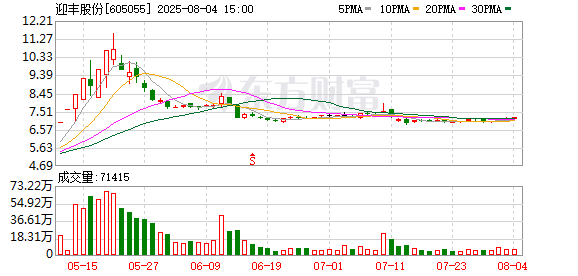
迎丰股份:累计回购约455万股
Mei Ri Jing Ji Xin Wen· 2025-08-04 09:33
Core Viewpoint - Yingfeng Co., Ltd. announced a share buyback program, indicating a commitment to enhancing shareholder value through capital management strategies [2] Group 1: Share Buyback Details - As of the end of July 2025, the company has repurchased approximately 4.55 million shares, representing 1.03% of its total share capital [2] - The highest transaction price during the buyback was 7.25 CNY per share, while the lowest was 4.31 CNY per share [2] - The total amount spent on the buyback is approximately 22.72 million CNY [2] Group 2: Revenue Composition - For the year 2024, the company's revenue composition shows that dyeing and finishing accounted for 98.72% of total revenue, while other businesses contributed 1.28% [2]