
可穿戴智能设备制造

Search documents
重磅数据发布!现多项积极信号→
Zheng Quan Shi Bao· 2025-05-10 04:26
Group 1: Consumer Price Index (CPI) Insights - In April, the CPI increased by 0.1% month-on-month and decreased by 0.1% year-on-year, indicating a shift from decline to growth in the month-on-month comparison [1][3] - Food prices rose by 0.2%, while non-food prices increased by 0.1%, with service prices up by 0.3%, driven by seasonal factors and demand recovery [3][4] - The core CPI, which excludes food and energy, rose by 0.2% month-on-month and 0.5% year-on-year, reflecting stable supply-demand dynamics [3][10] Group 2: Producer Price Index (PPI) Trends - The PPI decreased by 0.4% month-on-month and 2.7% year-on-year, with the decline attributed to international input factors and seasonal drops in energy prices [1][9] - Certain industrial sectors showed signs of price stabilization, with black metal and non-metal mineral product prices experiencing reduced year-on-year declines [5][6] - The PPI's month-on-month decline was influenced by falling prices in the petroleum and natural gas extraction sectors, as well as in the non-ferrous metal industries [9][10] Group 3: Economic Policies and Market Dynamics - The People's Bank of China noted that policies aimed at expanding domestic demand are beginning to take effect, which is expected to support a moderate recovery in price levels [1][10] - Recent macroeconomic policies, including interest rate cuts and structural tools, are designed to stimulate domestic demand and support price stability [10] - The upcoming holiday seasons are anticipated to boost service prices, contributing to a potential recovery in the core CPI [10]
重磅数据发布!现多项积极信号→
证券时报· 2025-05-10 04:19
Core Insights - The Consumer Price Index (CPI) increased by 0.1% month-on-month in April, while year-on-year it decreased by 0.1%. The Producer Price Index (PPI) decreased by 0.4% month-on-month and by 2.7% year-on-year [1][2]. CPI Analysis - The month-on-month CPI change shifted from decline to increase, with a core CPI increase of 0.2% month-on-month and a stable year-on-year increase of 0.5%. This reflects the resilience of the economy [2][4]. - Food prices rose by 0.2%, and service prices increased by 0.3%, driven by seasonal factors and demand recovery during the holiday period [3][4]. PPI Analysis - The PPI's month-on-month decline of 0.4% was consistent with the previous month, influenced by international factors and seasonal declines in energy prices [8][10]. - Certain industrial sectors showed signs of price recovery, with reduced year-on-year declines in sectors such as black metal smelting and non-metallic mineral products [5][6]. Sector Performance - High-tech industries and construction activities contributed to a positive trend in some industrial prices, with specific sectors like wearable smart devices and aircraft manufacturing showing price increases [5][6]. - The international oil price decline negatively impacted domestic oil-related industries, leading to price drops in sectors such as petroleum extraction and refining [10]. Economic Outlook - The People's Bank of China anticipates that policies aimed at expanding domestic demand will support a moderate recovery in price levels [2][11]. - Recent monetary policies, including interest rate cuts and structural tools, are expected to stimulate domestic demand and support price stability [11].


一季度规上工业企业利润实现增长
Ren Min Ri Bao· 2025-04-27 22:11
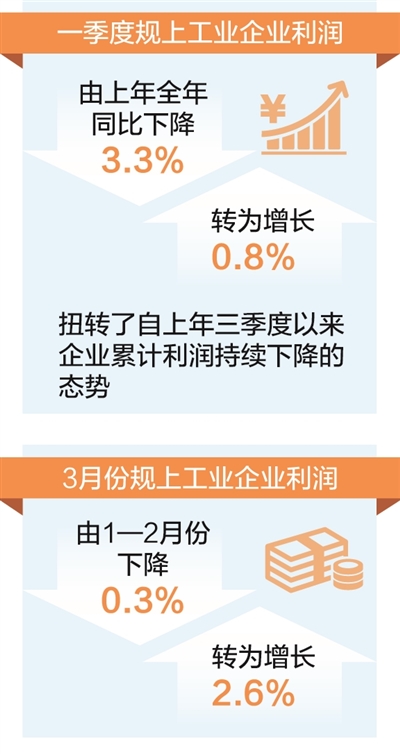
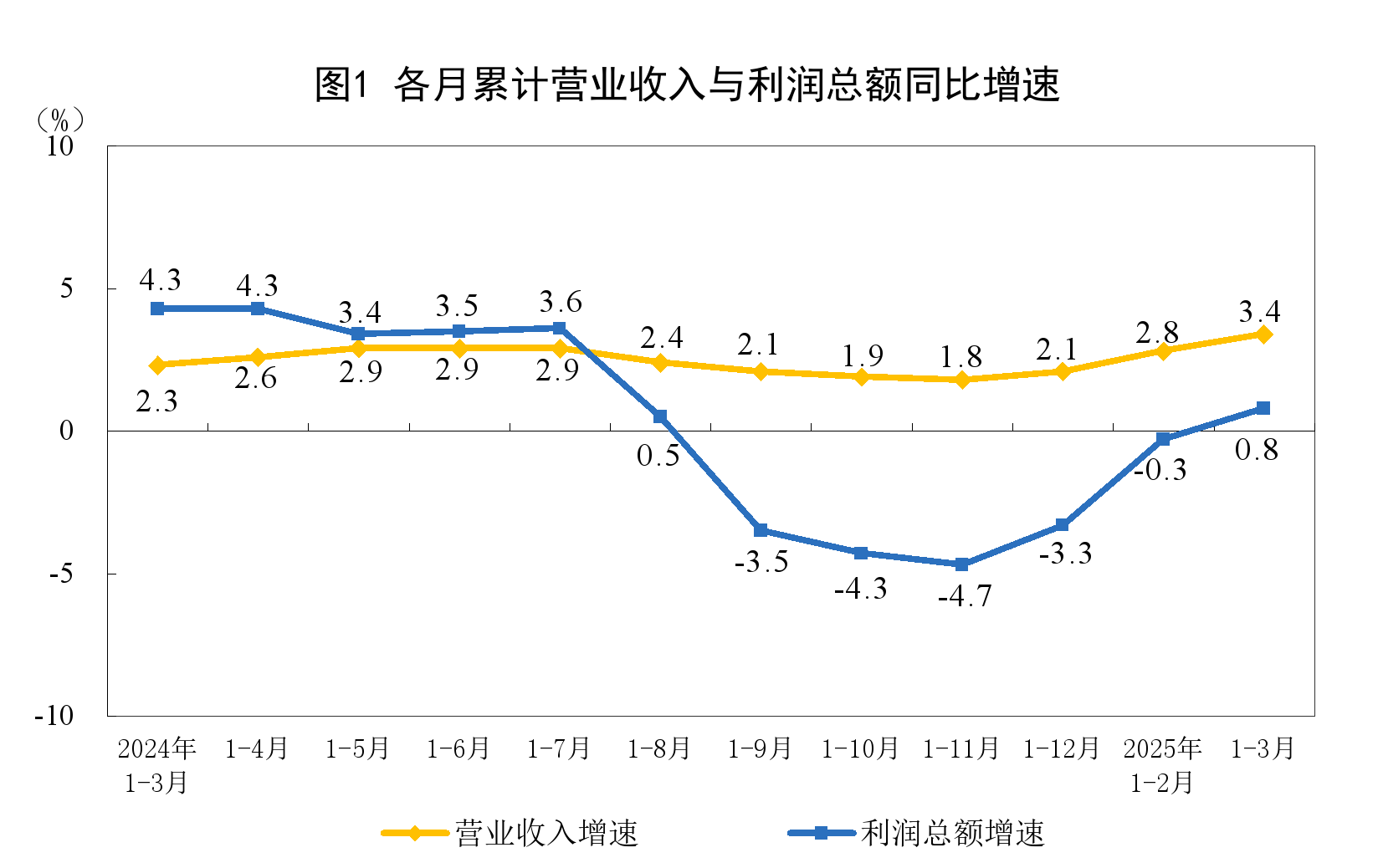
Group 1 - In the first quarter, profits of industrial enterprises above designated size turned from a year-on-year decline of 3.3% in the previous year to a growth of 0.8%, reversing the continuous decline since the third quarter of last year [3] - In March, profits of industrial enterprises increased by 2.6%, improving from a decline of 0.3% in January-February [3] - Revenue growth for industrial enterprises accelerated, with a year-on-year increase of 3.4% in the first quarter, which is 0.6 percentage points faster than January-February [3] Group 2 - Nearly 60% of industries saw profit growth, with manufacturing showing significant improvement, achieving a profit growth of 7.6% in the first quarter, an acceleration of 2.8 percentage points [4] - The equipment manufacturing sector became a crucial support for profit growth, with a year-on-year profit increase of 6.4%, accounting for 32.0% of total profits of industrial enterprises above designated size [4] - High-tech manufacturing led high-quality development, with profits turning from a year-on-year decline of 5.8% in January-February to a growth of 3.5% in the first quarter, exceeding the average growth rate of all industrial enterprises by 2.7 percentage points [4] Group 3 - The "Two New" policies showed significant effects, with profits in specialized and general equipment industries increasing by 14.2% and 9.5% respectively [4] - The policy of replacing old consumer goods with new ones had a notable impact, with profits in wearable smart device manufacturing, electric bicycle manufacturing, and kitchen appliance manufacturing increasing by 78.8%, 65.8%, and 21.7% respectively [4]
3月规模以上工企利润由降转增,高技术制造业利润实现两位数增长,一季度近六成行业利润增长
Mei Ri Jing Ji Xin Wen· 2025-04-27 07:05
Group 1 - In the first quarter, the profits of industrial enterprises above designated size turned from a year-on-year decline of 3.3% in the previous year to a growth of 0.8% [2][5] - In March, the profits of these enterprises increased by 2.6%, reversing a 0.3% decline in January and February [6][8] - The revenue of industrial enterprises in March grew by 4.2%, accelerating by 1.4 percentage points compared to January and February [6][8] Group 2 - High-tech manufacturing profits surged by 14.3% in March, contributing 2.8 percentage points to the overall profit growth of industrial enterprises [3][8] - The specialized and general equipment sectors saw profit increases of 14.2% and 9.5%, respectively, outperforming the average profit growth of all industrial enterprises [3][8] - In the first quarter, 24 out of 41 industrial categories reported profit growth, indicating nearly 60% of industries experienced improvements [8] Group 3 - The private and joint-stock enterprises showed significant profit growth in March, with private enterprises increasing by 16.0% and joint-stock enterprises by 3.5% [7] - The equipment manufacturing sector accounted for 32.0% of the total profits of industrial enterprises, with a year-on-year profit growth of 6.4% [8] - The aerospace industry experienced a profit increase of 23.9%, while sectors like smart consumer devices and medical equipment also reported substantial profit growth [8]
2025年3月CPI和PPI数据解读:3月通胀,服务价格拉动核心CPI,生产资料价格涨跌互现
ZHESHANG SECURITIES· 2025-04-10 14:37
Inflation Data - March CPI year-on-year growth rate was -0.1%, slightly better than the previous value of -0.7% and in line with market expectations[2] - March PPI year-on-year growth rate recorded at -2.5%, slightly lower than the previous value of -2.2%[2] Price Movements - Food prices decreased by 1.4% month-on-month, contributing approximately 0.24 percentage points to the CPI decline[4] - The price of wearable smart devices increased by 4.6% year-on-year, driven by advancements in high-tech industries[2] Core CPI Insights - Core CPI (excluding food and energy) rose by 0.5% year-on-year in March, reversing from a decline of 0.1% in February[8] - Service prices increased by 0.3% year-on-year in March, contributing positively to the CPI[8] Commodity Prices - March Brent crude oil average price was $72.51 per barrel, down by $2.81 from the previous month[7] - Domestic gasoline prices decreased by 3.5% month-on-month, impacting CPI by approximately 0.12 percentage points[7] Economic Outlook - The government aims for a CPI increase of around 2% for 2025, indicating a shift towards balancing supply and demand rather than strict inflation control[8] - The report suggests that effective demand recovery has significant potential, with the economy still in the early stages of inflation bottoming out[2]