纺织服饰

Search documents
三大院士挂帅!生物基纤维“突破计划”项目启动
DT新材料· 2026-01-20 16:05
Core Viewpoint - The article emphasizes the strategic importance of bio-based materials in the textile industry, highlighting the need for innovation and collaboration to address energy security and sustainability challenges in the sector [8][10][11]. Group 1: Event Overview - The 11th Bio-based Conference and Exhibition will be held from May 20-22, 2026, in Shanghai, featuring 11 thematic forums, 7 concurrent activities, 1000 new product displays, and an industry award [3][19]. - The event aims to create a platform for communication between upstream and downstream sectors in the bio-based materials industry [3]. Group 2: Research Directions - The project initiated by Donghua University focuses on three main research directions: high-performance fibers and composite materials, bio-based and recycled fibers, and smart fibers and flexible devices [4][11]. - The project is part of a national strategy to enhance energy security and technological independence by shifting raw material sources from petroleum to renewable biomass [10][11]. Group 3: Industry Context - The textile industry is a significant sector, valued at over one trillion yuan, with China producing 75 million tons of chemical fibers, accounting for over 50% of global production [9]. - The reliance on imported petroleum for chemical fiber production poses risks, especially as global demand for plastics and fibers is projected to reach 650 million tons by 2030 [10]. Group 4: Current Status of Bio-based Fibers - In 2024, China's bio-based chemical fiber production capacity is expected to reach 1.5721 million tons, with an output of 584,100 tons, representing less than 1% of the total chemical fiber production [11][12]. - The growth rate for bio-based fibers is significant, with production capacity increasing by 28.9% and output by 19.5% year-on-year [11]. Group 5: Challenges and Opportunities - The main challenge for bio-based fibers is their high production cost, with PLA fiber prices being three times higher than conventional polyester [13]. - The project aims to address cost reduction and quality improvement to make bio-based fibers more competitive in the market [13][18]. Group 6: Strategic Implications - The involvement of leading academicians and the support from the Ministry of Education and the Ministry of Finance signal a clear policy direction towards bio-based materials as a strategic industry [17]. - Companies in the textile sector are encouraged to view bio-based fibers not merely as an environmental concept but as a solution to real consumer needs, focusing on high-value applications [17][18].


如何从一二级市场联动寻找产业债交易信号?(行业篇)
Soochow Securities· 2026-01-20 09:28
Report Industry Investment Rating No information provided in the content. Core Viewpoints - The secondary - market trends of industrial bond sub - industries show a divergence in the correlation between primary and secondary markets. This divergence may be due to differences in supply among industries and differences in bond liquidity and trading popularity within each industry. If an industry has many issuing entities with strong willingness and ability to issue bonds and is in a good development trend, the probability of a synchronous resonance relationship between primary - market supply and secondary - market demand is relatively high, which can improve the accuracy of judging trading signals of narrowing spreads from daily net financing [1][14]. - Most industries have trading signals transmitted from primary - market supply to secondary - market demand, including comprehensive, non - ferrous metals, and others. Some industries show a stronger negative correlation between primary - market supply and secondary - market demand, such as comprehensive and non - ferrous metals. Some industries have a weak correlation between daily net financing and daily spreads, including communication and food and beverage [2][4]. Summary by Directory 1. Industrial Bond Sub - industries Show Divergence in Primary - Secondary Market Trend Correlation - **Research Method**: Classify industrial bond issuers by Shenwan primary industries, calculate the daily net financing and daily credit spreads of each sub - industry from January 1, 2025, to December 19, 2025, to observe the correlation between primary - market supply and secondary - market demand [12]. - **Divergence Performance**: Most industries have trading signals transmitted from primary - market supply to secondary - market demand, while some do not show this feature significantly [13]. - **Reasons for Divergence**: Differences in supply among industries are related to the number, size, and life - cycle stage of issuing entities. Differences in bond liquidity and trading popularity within industries are related to the scale of outstanding bonds, valuation levels, and event catalysts [14]. 1.1. Industries with Obvious Correlation - **Comprehensive Industry**: From January to March 2025, daily net financing decreased and daily spreads increased; from March to June, daily net financing increased and daily spreads decreased; from June to December, both were in a low - level oscillation [21]. - **Non - ferrous Metals Industry**: From January to July 2025, daily net financing increased and daily spreads decreased; from July to September, daily net financing decreased and daily spreads increased; from October to December, both were in a low - level oscillation [25]. - **Other Industries**: Similar analysis is conducted for industries such as pharmaceutical biology, social services, and others, with different trends in different time intervals [27][30][32]. - **Common Features**: These industries generally have a large scale of outstanding bonds and high institutional investor attention, which is conducive to the transmission of primary - market supply changes to secondary - market spread changes [3][87]. 1.2. Industries with General Correlation - **Industries Included**: Communication, food and beverage, and other industries have a weak correlation between daily net financing and daily spreads, and the linkage and transmission between primary - and secondary - market indicators are relatively weak [4][13]. - **Reasons**: These industries have low participation in the bond market, and their secondary - market trading demand is more affected by overall bond - market trends, industry risk premiums, and liquidity premiums. Different types of industries have specific reasons for the weak correlation [4][90][91].
【盘中播报】沪指跌0.73% 国防军工行业跌幅最大
Zheng Quan Shi Bao Wang· 2026-01-20 03:37
Market Overview - The Shanghai Composite Index fell by 0.73% as of 10:27 AM, with a trading volume of 783.95 million shares and a transaction value of 1,378.36 billion yuan, an increase of 0.13% compared to the previous trading day [1] Industry Performance - Real estate, oil and petrochemicals, and beauty care sectors showed the highest gains, with increases of 0.86%, 0.72%, and 0.70% respectively [1] - The defense and military, comprehensive, and communication sectors experienced the largest declines, with decreases of 3.41%, 3.19%, and 3.06% respectively [1][2] Leading Stocks - In the real estate sector, Chengdu Investment Holdings led with a gain of 10.11% [1] - In the oil and petrochemical sector, Blue Flame Holdings increased by 2.86% [1] - In the beauty care sector, Yanjiang Co. rose by 9.34% [1] Detailed Industry Data - Real Estate: 0.86% increase, transaction value of 189.40 billion yuan, up 20.93% from the previous day [1] - Oil and Petrochemicals: 0.72% increase, transaction value of 80.28 billion yuan, up 26.01% from the previous day [1] - Beauty Care: 0.70% increase, transaction value of 35.84 billion yuan, up 11.01% from the previous day [1] - Defense and Military: 3.41% decrease, transaction value of 883.06 million yuan, up 45.81% from the previous day [2] - Communication: 3.06% decrease, transaction value of 754.04 million yuan, up 0.40% from the previous day [2]
太卷了!上市公司“花式”回馈股东,10家公司同时明确分红规划
Zheng Quan Shi Bao· 2026-01-17 01:22
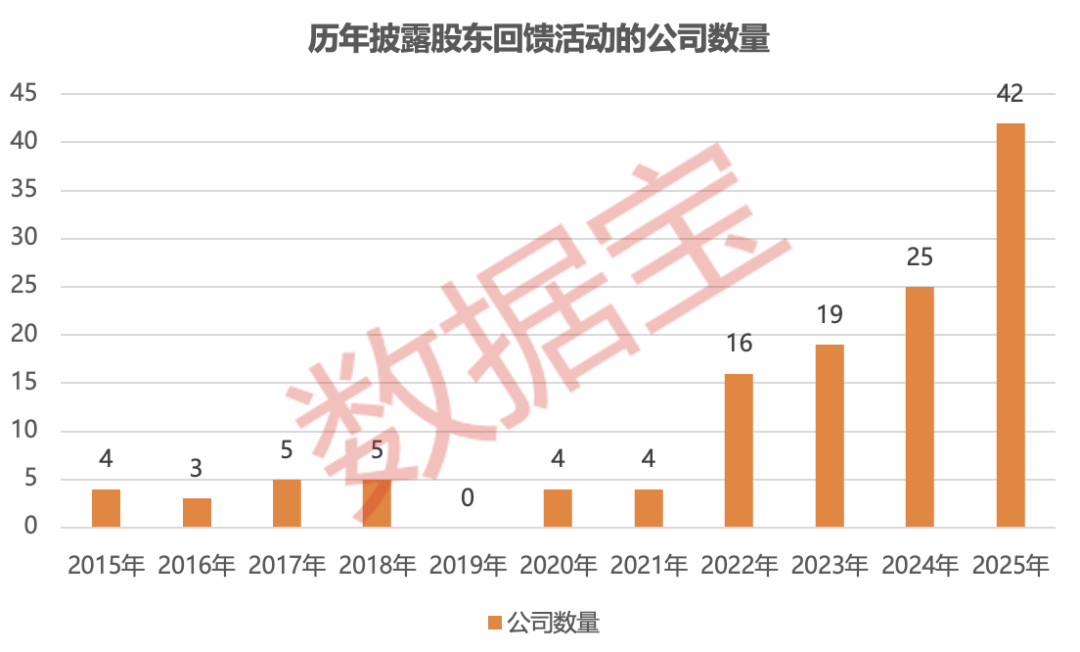
Group 1 - A-share listed companies are actively engaging in shareholder reward activities, with "Hao Xiang Ni" announcing a voluntary information disclosure regarding exclusive purchasing rights for shareholders at discounted prices [1] - Since January 8, "Hao Xiang Ni" has seen its stock price increase by over 20% [1] - The number of companies engaging in shareholder reward activities has reached a historical high, with over 40 companies reported in 2025 alone [2] Group 2 - From 2015 to 2025, nearly 130 companies have disclosed over 140 reward activity announcements, with a noticeable increase since 2022 [2] - The majority of these companies are in the food and beverage, basic chemicals, pharmaceutical and biological, and home appliance industries [2] - In 2025, companies like "Dongbei Pharmaceutical" and "He Shi Eye Hospital" offered exclusive benefits related to their products and services to shareholders [4] Group 3 - The market response to these reward activities has been mixed, but overall, companies involved have outperformed the CSI 300 index [5] - Average stock price increases for companies engaging in reward activities from 2015 to 2025 were 0.8% on the announcement day, with subsequent increases of 0.23%, 0.44%, and 0.47% over the following days [6] - In 2025, companies like "Rongtai Health" and "Emei Mountain A" experienced significant stock price increases following their announcements [7] Group 4 - Companies that have conducted shareholder reward activities since 2025 have seen an average stock price increase of nearly 25%, with some companies like "Haoen Automotive" and "Tian Chuang Fashion" exceeding 100% [8] - Financial forecasts indicate that many companies are expected to achieve profit growth in 2025 and 2026, with some companies like "Xiangyuan Culture" and "Shuiyang Co." projected to have net profit increases exceeding 45% [8] - Ten companies have established future dividend plans, with "Haoen Automotive" committing to distribute at least 10% of their annual distributable profits in cash from 2025 to 2027 [9][10]
李宁(02331):Q4流水微降库存健康,长期看奥运赞助夯实信心
Xinda Securities· 2026-01-16 08:02
Investment Rating - The report does not provide a specific investment rating for the company [1] Core Insights - The company's overall revenue for Q4 experienced a low single-digit decline, with offline channels showing a moderate decrease while e-commerce remained stable [1] - The company anticipates a slight growth in total revenue for the year 2025, with strong contributions from specialized channels like badminton, which saw over 30% growth in the first three quarters [2] - The company is focusing on core professional sports and outdoor categories for growth, while also optimizing lifestyle products [2] - The sponsorship of the Chinese Olympic Committee is expected to enhance brand confidence and visibility, although translating this into sales will take time [2] Financial Summary - The projected total revenue for 2025 is estimated at 29,046 million, reflecting a 1% year-over-year growth [5] - The expected net profit for 2025 is 2,461 million, representing an 18% decline from the previous year [5] - The earnings per share (EPS) for 2025 is projected to be 0.95, with a price-to-earnings (P/E) ratio of 18.46 [3][5] - The company forecasts net profits of 24.61 billion, 26.83 billion, and 28.44 billion for the fiscal years 2025, 2026, and 2027, respectively [3]

聚杰微纤涨12.50%,股价创历史新高
Zheng Quan Shi Bao Wang· 2026-01-16 02:19
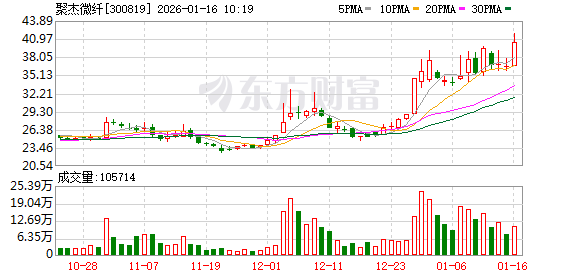
Group 1 - The stock price of Jujie Microfiber reached a historical high, increasing by 12.50% to 41.21 yuan, with a trading volume of 5.2671 million shares and a transaction value of 207 million yuan, resulting in a turnover rate of 3.91% [2] - The latest total market capitalization of Jujie Microfiber in A-shares is 6.149 billion yuan, with a circulating market value of 5.554 billion yuan [2] - In the textile and apparel industry, the overall increase is 0.26%, with 42 stocks rising, including Henghui Security, Jujie Microfiber, and Kanglongda, which saw increases of 20.00%, 12.50%, and 7.97% respectively [2] Group 2 - The company's Q3 report indicates a total operating revenue of 448 million yuan for the first three quarters, a year-on-year decrease of 7.11%, and a net profit of 52.4891 million yuan, down 9.30% year-on-year [2] - The basic earnings per share are 0.3500 yuan, with a weighted average return on equity of 5.94% [2]

云中马持续走强,股价再创新高
Zheng Quan Shi Bao Wang· 2026-01-15 02:49
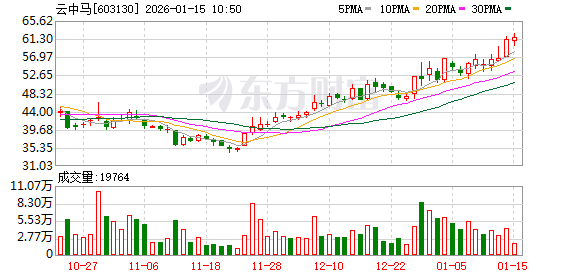
Group 1 - The stock price of Yunzhongma has reached a historical high, with the stock showing a continuous upward trend, having set new records on 10 trading days in the past month [2] - As of 10:10, the stock is up 1.17%, priced at 62.00 yuan, with a trading volume of 1.48 million shares and a transaction amount of 89.59 million yuan, resulting in a turnover rate of 1.08% [2] - The latest total market capitalization of the stock in A-shares is 8.526 billion yuan, with the circulating market value also at 8.526 billion yuan [2] Group 2 - The textile and apparel industry, to which the company belongs, has an overall decline of 0.64%, with 32 stocks in the industry experiencing price increases, including Kanglongda, Aokang International, and Caibai Co., which rose by 5.41%, 3.97%, and 2.94% respectively [2] - Conversely, 70 stocks in the industry have seen price declines, with Mingpai Jewelry, Nanshan Zhishang, and Wanshili experiencing declines of 10.01%, 8.54%, and 5.31% respectively [2] Group 3 - The company's third-quarter report indicates that it achieved an operating income of 1.944 billion yuan in the first three quarters, representing a year-on-year increase of 5.53% [2] - The net profit for the same period was 50.48 million yuan, reflecting a year-on-year decrease of 24.89% [2] - The basic earnings per share are reported at 0.3700 yuan, with a weighted average return on equity of 3.74% [2]

【兴证策略】60大热门赛道:哪些拥挤度仍在低位?
Xin Lang Cai Jing· 2026-01-13 09:26
Core Insights - The article discusses the investment strategies for the year 2026, focusing on opportunities identified by top fund companies and managers in the market [1][124]. Group 1: Market Sentiment Indicator - The "Congestion Degree" is a unique indicator developed by the company to reflect trading sentiment in popular sectors, combining four dimensions: volume, price, funds, and analyst forecasts [3][126]. - This indicator quantitatively tracks changes in market sentiment and has strong implications for short-term stock price movements [3][126]. Group 2: TMT Sector Insights - The congestion levels for various TMT (Technology, Media, Telecommunications) segments are as follows: - Optical modules: congestion level is moderately low [10][131]. - Servers: congestion level is moderately high [8][133]. - Base stations: congestion level is moderate [10][135]. - Optical fiber and cables: congestion level is moderately high [10][136]. - IDC (Internet Data Center): congestion level is moderately high [10][136]. - Computer equipment: congestion level is high [10][139]. - Optical components: congestion level is high [10][140]. - RF components: congestion level is high [10][145]. - PCB (Printed Circuit Board): congestion level is moderate [10][146]. - IT services: congestion level is moderately high [10][147]. - Semiconductor materials: congestion level is high [10][157]. - Consumer electronics: congestion level is moderately low [10][172]. Group 3: Manufacturing Sector Insights - The congestion levels for various manufacturing segments are as follows: - Automotive parts: congestion level is high [10][181]. - Lithium batteries: congestion level is moderate [10][184]. - Wind power: congestion level is moderately low [10][187]. - Photovoltaic components: congestion level is high [10][197]. - Industrial robots: congestion level is high [10][199]. - Unmanned aerial vehicles: congestion level is high [10][200]. Group 4: Consumer and Pharmaceutical Sector Insights - The congestion levels for various consumer and pharmaceutical segments are as follows: - White goods: congestion level is low [10][207]. - Alcoholic beverages: congestion level is moderately low [10][209]. - Medical services: congestion level is moderately high [10][222]. Group 5: Financial and Real Estate Sector Insights - The congestion levels for various financial and real estate segments are as follows: - Real estate: congestion level is moderate [10][225]. - Insurance: congestion level is high [10][225]. - Banking: congestion level is low [10][226].
上周公募调研覆盖111家公司 生物医药行业居首
Zhong Guo Jin Rong Xin Xi Wang· 2026-01-12 08:04
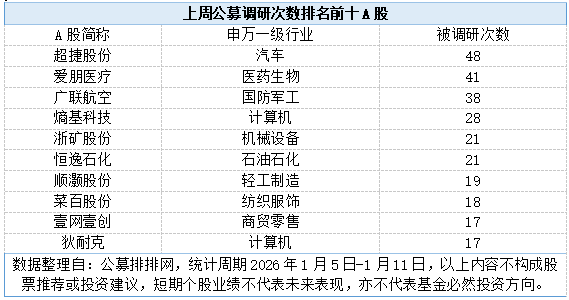
Group 1 - Public fund institutions accelerated their research activities in early 2026, with 141 institutions participating in A-share research, covering 111 stocks across 24 industries, totaling 673 research instances, significantly higher than the usual weekly level [1][3] - Chaojie Co., Ltd. received the highest attention with 48 research instances from 43 public fund institutions, and 5 institutions conducted follow-up research. The company focuses on precision fasteners for the automotive industry and is also involved in aerospace and electronics [1][2] - Aipeng Medical was the second most researched stock with 41 instances, focusing on pain management and innovative fields like brain-machine interfaces, providing smart medical devices and solutions [1][2] Group 2 - The computer industry had two companies in the top ten for research instances: Entropy Technology with 28 instances and Dineike with 17 instances. Entropy focuses on smart spaces and digital identity authentication, while Dineike specializes in smart community and hospital solutions [2][3] - The pharmaceutical and biological sector had the highest research instances at 89, covering 8 stocks, while the machinery and electronics sectors had 17 stocks each, with research instances of 85 and 62 respectively [3][4] - Other notable companies in the top ten for research instances included Guanglian Aviation (38), Zhejiang Mining (21), Hengyi Petrochemical (21), Shunhao Co., Ltd. (19), Caizhi Co., Ltd. (18), and Yiwang Yichuang (17) [3][4]
“申”挖数据 | 资金血氧仪
申万宏源证券上海北京西路营业部· 2026-01-12 03:24
Group 1 - The core viewpoint of the article highlights the recent trends in market capital flows, indicating a net outflow of 282.58 billion yuan in the last two weeks, with banking, coal, and textile industries seeing the highest net inflows, while electronics, communications, and defense industries experienced the largest outflows [5][13]. - The current margin trading balance stands at 26,206.09 billion yuan, reflecting a 4.85% increase from the previous period, with the financing balance at 26,031.55 billion yuan and the securities lending balance at 174.55 billion yuan [15][16]. - The average daily trading volume for margin trading reached 2,468.24 billion yuan, marking a 30.70% increase compared to the previous period, with net buying in financing averaging 2,461.12 billion yuan, up 30.83% [19][20]. Group 2 - In terms of market performance, the number of stocks that increased in value outnumbered those that decreased, with the top three performing sectors being defense, comprehensive, and non-ferrous metals, while banking and food and beverage sectors saw declines [6][27]. - The overall strength analysis of A-shares scored 6.63, indicating a neutral to strong market condition, with the Shanghai-Shenzhen 300 index scoring 6.2, the ChiNext scoring 7.05, and the Sci-Tech Innovation Board scoring 7.3 [6][32]. - The market is currently in a strong upward trend, with the Shanghai Composite Index breaking through the 4,100-point mark, suggesting potential for further gains, while also noting the accumulation of profit-taking [7][31].