
光通信

Search documents
黄金股,全线大跌
Zhong Guo Ji Jin Bao· 2026-01-30 10:34
Market Overview - The Hong Kong stock market experienced a significant decline on January 30, with all three major indices dropping over 2%. The Hang Seng Index fell by 2.08%, the Hang Seng China Enterprises Index decreased by 2.47%, and the Hang Seng Tech Index dropped by 2.1%. The total market turnover was HKD 301.6 billion, with net buying from southbound funds amounting to HKD 3.22 billion [2][3]. Steel Sector - The steel sector faced a collective downturn, with notable declines in major companies: China Hanking fell by 11.04%, Ansteel fell by 6.05%, Chongqing Iron & Steel dropped by 4.55%, and Maanshan Iron & Steel decreased by 4.24% [4]. - Despite the downturn, some institutions remain optimistic about the steel sector, citing its strong "anti-involution" characteristics and significant profit recovery potential. They believe that quality steel companies will gradually improve their performance, leading to upward elasticity and valuation uplift due to improved supply dynamics. The sector is viewed as having medium to long-term strategic investment opportunities, with a "positive" rating maintained by the brokerage [6]. Gold Sector - Gold stocks collectively plummeted on January 30, following a period of strong gains. Notable declines included Chifeng Jilong Gold falling by 14.38%, Shandong Gold by 14.31%, and Zijin Mining by 10.70% [7]. - Earlier in the year, Chifeng Jilong Gold had seen a cumulative increase of over 30% [8]. Optical Communication Sector - The optical communication sector showed resilience, with Longi Fiber Optic Cable rising by 6.76% despite the overall market decline. This increase is attributed to rising demand for new optical fiber products from overseas data centers, with expectations of price increases in domestic optical fibers by 2026 [10][11]. - Other companies in the optical communication space also saw gains, including Huiju Technology up by 4.59% and Hong Teng Precision up by 4.47% [11]. Company Developments - Giant Legend announced a sales contract for quadruped robots with an independent third party, with production expected to reach mass production by the first quarter of 2026. The company also plans to establish a joint venture for the sales and promotion of consumer-grade IP robots [12][14].


北水动向|北水成交净买入32.22亿 石药集团(01093)宣布重磅BD交易 北水抢筹超9亿港元
智通财经网· 2026-01-30 10:05
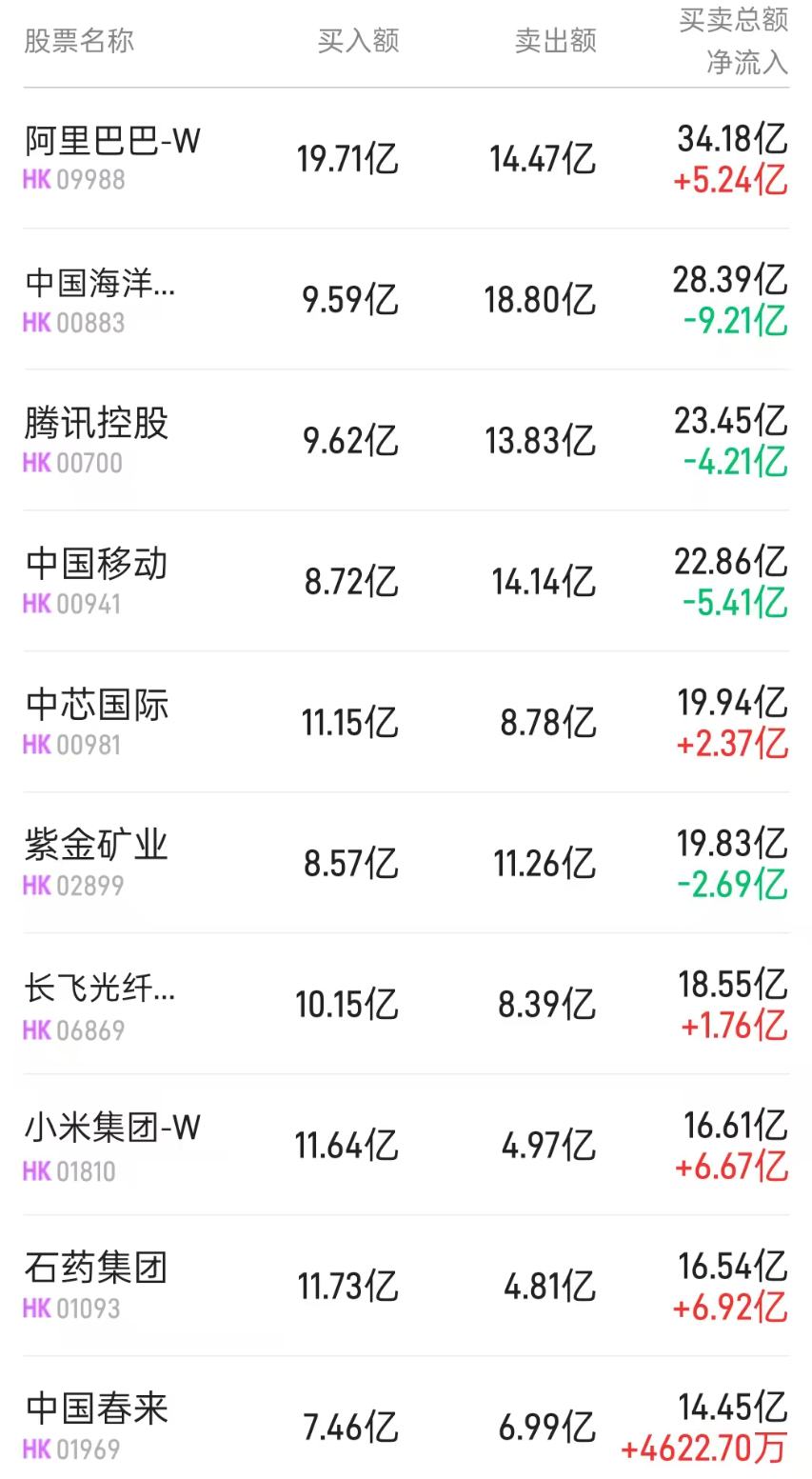
Group 1: Market Overview - The Hong Kong stock market saw a net inflow of 32.22 billion HKD from northbound trading, with 20.39 billion HKD from Shanghai and 11.83 billion HKD from Shenzhen [1] - The most bought stocks included CSPC Pharmaceutical Group (01093), Xiaomi Group-W (01810), and the Tracker Fund of Hong Kong (02800) [1] - The most sold stocks were Zijin Mining (02899), China Mobile (00941), and CNOOC (00883) [1] Group 2: Notable Stock Performances - CSPC Pharmaceutical Group (01093) received a net inflow of 9.36 billion HKD, following a strategic cooperation agreement with AstraZeneca for the development of innovative long-acting peptide drugs, potentially worth up to 18.5 billion USD [4] - The Tracker Fund of Hong Kong (02800) saw a net inflow of 5.89 billion HKD, with positive market sentiment driven by earnings recovery, improved liquidity, and policy support [5] - Alibaba Group-W (09988) had a net inflow of 3.29 billion HKD, as it launched a high-end AI chip, enhancing its position in the AI sector [5] Group 3: Sector-Specific Insights - Long Fiber Optic Cable (06869) received a net inflow of 2.41 billion HKD, driven by strong demand for AI infrastructure and high-speed optical modules [5] - China Spring (01969) had a net inflow of 46.22 million HKD, with growth potential in student enrollment and tuition fee increases [6] - Gold stocks faced significant sell-offs, with Shandong Gold (01787) and Zijin Mining (02899) experiencing net outflows of 2.06 billion HKD and 6.35 billion HKD, respectively, amid volatility in the precious metals market [7]




20%涨停!重磅利好来袭,超级赛道逆势大爆发!
天天基金网· 2026-01-30 08:23
Core Viewpoint - The CPO concept stocks in A-shares have experienced a significant surge, driven by the release of new AI models and positive earnings forecasts from related companies, alleviating previous market concerns [2][3]. Group 1: Market Performance - On January 30, A-share CPO concept stocks saw a collective rise, with companies like Jieput and Zhishang Technology hitting a 20% limit up, and Hengtong Optic-Electric and Changfei Optical Fiber achieving a 10% limit up [3]. - The ChiNext Index rose by 1.52% after previously dropping over 1%, indicating a strong market rebound [2]. Group 2: Company Earnings Forecasts - Jieput announced an expected 97.69% year-on-year increase in net profit for 2025, reaching 1.3288 billion yuan, benefiting from rising global demand for laser products [3]. - Out of 21 CPO concept stocks that disclosed 2025 earnings forecasts, 17 are expected to show year-on-year net profit growth, representing over 80% [3]. Group 3: AI Industry Developments - Recent releases of AI models, such as DeepSeek-OCR2 and Baidu's Wenxin 5.0, have catalyzed market enthusiasm, with some experts predicting a "ChatGPT moment" in 2026 [3][6]. - Industrial Fulian reported strong customer demand for AI computing power, with expectations for cloud service providers to maintain aggressive capital expenditures, projected to exceed $600 billion by 2026, marking a 40% year-on-year increase [5]. Group 4: Price Increases in AI Services - Major tech companies like Google Cloud and Amazon have announced price increases for data transmission and computing services, indicating rising costs in the AI infrastructure sector [6][7]. - Meta and Microsoft reported higher-than-expected capital expenditures for Q4 2025, with Meta raising its full-year 2026 capital expenditure forecast to $125 billion, a 73% increase [6]. Group 5: Future Outlook - Analysts predict that the demand for computing power will continue to rise, driven by the increasing deployment of AI applications and ongoing iterations of training models [7]. - The AI industry is expected to experience a new wave of growth, particularly in the computing power sector, as concerns about a "computing power bubble" may ease with upcoming confirmations from U.S. earnings reports [7].




1月收官日 A股再度上演绝地翻盘!发生了什么?
Mei Ri Jing Ji Xin Wen· 2026-01-30 07:52
Market Overview - The Shanghai Composite Index closed down 0.96% on January 30, while the ChiNext Index rose by 1.27% [2] - Gold and base metal stocks experienced a significant sell-off, with sectors like liquor, real estate, brokerage, and oil and gas showing notable declines [2] - The market saw a "deep V" reversal on the last trading day of January, indicating a strong recovery despite not all indices turning positive [2][12] Index Performance - The Shanghai Composite Index recorded a cumulative increase of 3.76% for January, following a peak in mid-January that marked a ten-year high [2][18] - The STAR 50 Index performed strongly, with a monthly increase exceeding 12% [2] - The Shanghai 50 Index exhibited a "rise then fall" pattern, with a notable six consecutive days of decline [2] Market Dynamics - The initial sharp decline in the market was attributed to turbulence in the precious metals market, leading to significant sell-offs in related A-share sectors [5] - Factors influencing commodity price volatility included geopolitical developments, a strong US dollar, and uncertainty surrounding the appointment of the Federal Reserve chair [11] - UBS raised its gold price targets for March, June, and September 2026 to $6,200 per ounce, citing stronger-than-expected demand driven by increased investment [11] Sector Performance - The recovery in the market was supported by large funds refraining from further selling in broad-based ETFs after the initial drop [12] - Technology sectors, including CPO, robotics, and semiconductors, showed strong performance, with notable gains in stocks like Tianfu Communication, which rose nearly 17% [14] - The agricultural sector also gained traction, driven by expectations of rising commodity prices and potential government policy support [16] Future Outlook - Analysts expect continued market volatility in February, with a focus on structural hotspots rather than broad market rallies [20] - The outlook suggests that after two years of valuation recovery, the market may struggle to maintain high valuations, with performance increasingly reliant on earnings realization [20] - Key investment themes include cyclical recovery in global manufacturing, the AI industry, and traditional sectors benefiting from supply-side constraints [21]
20%涨停!重磅利好来袭,超级赛道大爆发!
券商中国· 2026-01-30 07:24
Core Viewpoint - The CPO concept stocks in A-shares have experienced a significant surge, driven by the release of new AI models and positive earnings forecasts from related companies, alleviating previous market concerns [1][2]. Group 1: CPO Concept Stock Performance - On January 30, A-share CPO concept stocks saw a collective rise, with notable gains including a 20% limit up for Jieput and Zhishang Technology, and nearly 17% for Tianfu Communication [2]. - A total of 21 CPO concept stocks disclosed their 2025 earnings forecasts, with 17 expecting a year-on-year net profit increase, representing over 80% [2]. Group 2: AI Industry Developments - Recent releases of AI models, such as DeepSeek-OCR2 and Baidu's Wenxin 5.0, have catalyzed market enthusiasm, with some analysts predicting a "ChatGPT moment" in 2026 [2]. - Industrial Fulian reported strong demand for AI computing power, with expectations for cloud service providers' capital expenditures to exceed $600 billion by 2026, reflecting a 40% year-on-year increase [3]. Group 3: Price Increases in AI Services - Major tech companies like Meta and Microsoft have indicated that the supply of AI computing power will remain tight through 2026, with Microsoft projecting capital expenditures of $37.5 billion for Q4 2025 [5]. - Google Cloud and Amazon have announced price increases for data transmission and machine learning services, with significant hikes in North America [5]. Group 4: Market Projections - CignalAI forecasts that the revenue from optical modules for data communication will exceed $18 billion by 2025, driven by AI-related infrastructure [5]. - Despite current uncertainties in large-scale AI commercialization, there is an expectation for increased demand for computing power in the coming months, potentially alleviating previous concerns about a "computing power bubble" [6].

港股光通信概念股逆市上涨 长飞光纤光缆涨超7%
Mei Ri Jing Ji Xin Wen· 2026-01-30 07:21
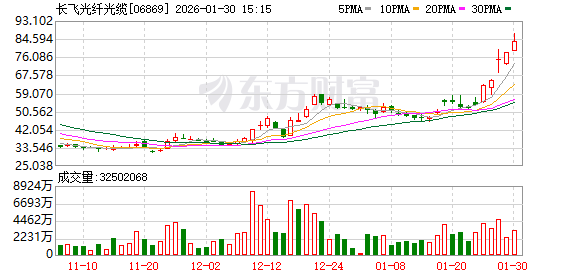
Group 1 - The core viewpoint of the article highlights the upward trend of optical communication concept stocks in the Hong Kong market despite overall market conditions [2] Group 2 - Changfei Fiber Optic Cable (06869.HK) saw an increase of 7.27%, reaching 84.1 HKD [2] - Huiju Technology (01729.HK) rose by 6.07%, trading at 15.72 HKD [2] - Hong Teng Precision (06088.HK) experienced a 4.68% increase, priced at 4.92 HKD [2] - Cambridge Technology (06166.HK) grew by 1.52%, with a share price of 83.25 HKD [2]
A股收评:三大股指触底反弹,创业板涨1.27%,CPO、转基因及粮食概念股走强,贵金属、有色金属股重挫
Jin Rong Jie· 2026-01-30 07:15
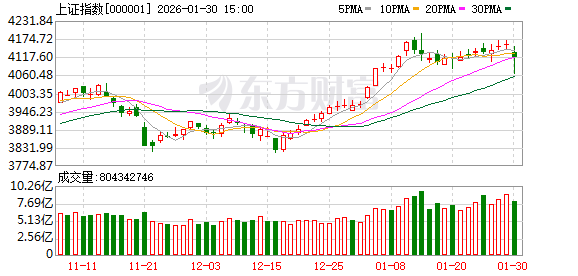
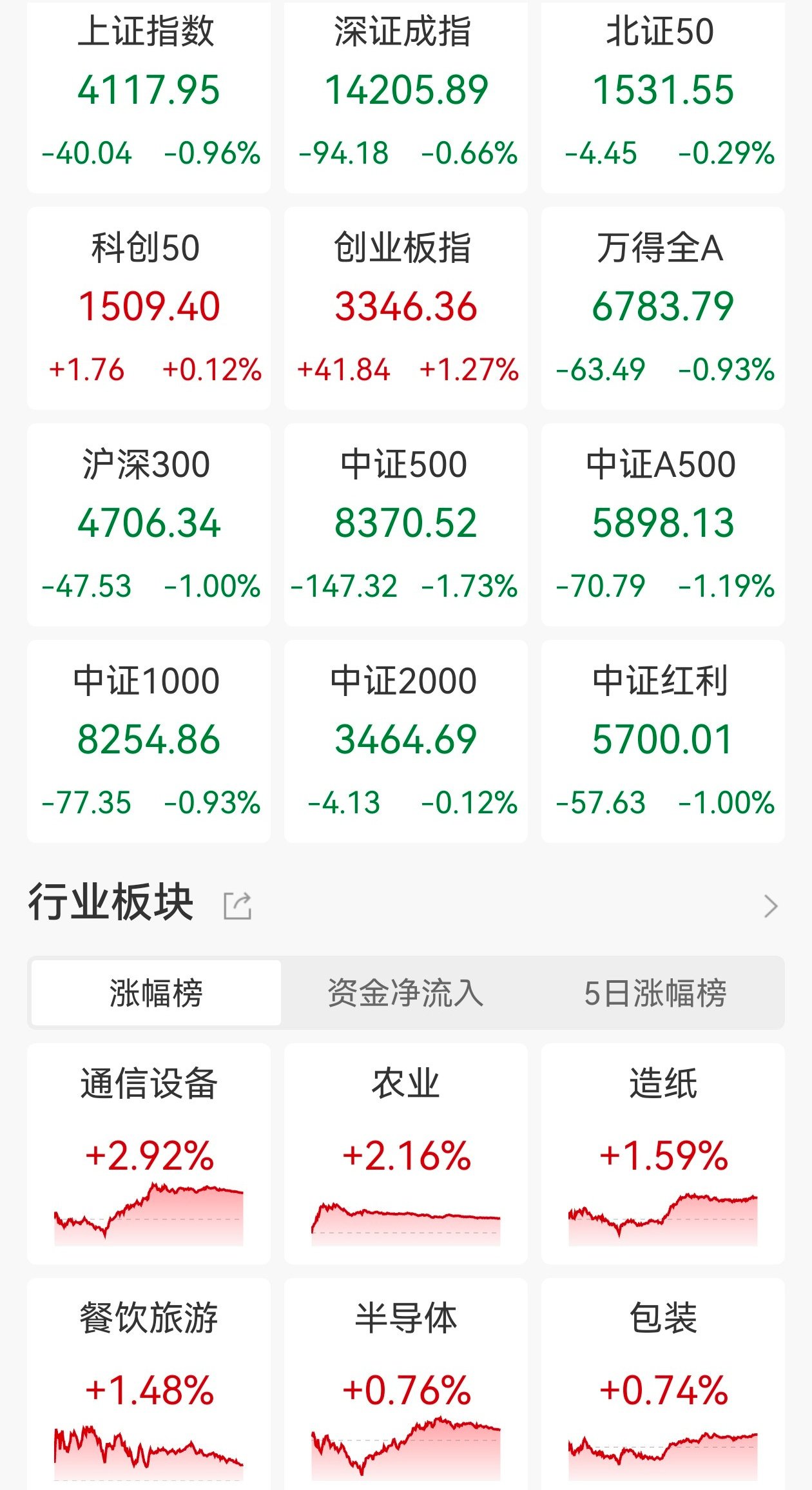
Market Overview - The A-share market experienced fluctuations with the Shanghai Composite Index closing down 0.96% at 4117.95 points, while the Shenzhen Component Index fell 0.66% to 14205.89 points. The ChiNext Index rose by 1.27% to 3346.36 points, and the STAR 50 Index increased by 0.12% to 1509.4 points. The Shanghai Composite Index recorded a cumulative increase of 3.76% for the month, stabilizing above the 4100-point mark after reaching a ten-year high mid-month [1] - The trading volume in the Shanghai and Shenzhen markets exceeded 2.5 trillion yuan for 20 consecutive trading days, with nearly 2900 stocks declining [1] Sector Performance Precious Metals and Non-ferrous Metals - The precious metals sector saw a significant decline, with multiple stocks such as Zhongjin Gold and Silver falling to their daily limit. The global market experienced a sharp drop in precious metals, with silver prices falling over 8% and gold retreating by up to 500 dollars [3] - Non-ferrous metals were highlighted as a major focus, with Zijin Mining reaching a historical high and several stocks doubling in value, including Hunan Silver, which rose by 175%, and Sichuan Gold, which increased by 137% [2] Agriculture - The agriculture sector showed strength, with stocks like Nongfa Seed Industry and Qiu Le Seed Industry experiencing significant gains. The price of soybeans increased by 1.18% compared to the beginning of the month, and grain production reached a record high of 14,298 billion jin [4] Coal - The coal sector also saw gains, with stocks like Panjiang Coal and Electricity reaching their daily limit. A forecast indicated that Panjiang's net profit could increase by 205.30% to 264.83% by 2025, with expectations for improved profitability in the coal industry due to policy support [5] Institutional Insights - Guosen Securities noted that the market focus will shift to performance as the annual report disclosure period approaches, with a median net profit growth rate expected to reach double digits for 2025. Companies in sectors like computing, lithium batteries, and energy storage are anticipated to show significant earnings growth [6] - Zheshang Securities suggested that the market may experience short-term fluctuations, driven by seasonal effects and policy expectations, while maintaining a "systematic slow bull" outlook for the quarter [8] - Dongfang Securities indicated that the stock index is likely to continue in a fluctuating pattern, with structural market opportunities arising from industry prosperity [7][8]

A股收评:沪指跌近1%!创业板指涨1.27%,贵金属、有色金属重挫
Ge Long Hui· 2026-01-30 07:09
Market Overview - The A-share market showed mixed performance with the Shanghai Composite Index down by 0.96% closing at 4117 points, while the Shenzhen Component Index fell by 0.66%. In contrast, the ChiNext Index increased by 1.27% [1] - The total market turnover was 2.86 trillion yuan, a decrease of 397 billion yuan compared to the previous trading day, with nearly 2900 stocks declining [1] Sector Performance - The CPO concept stocks rose significantly, with companies like Hengtong Optic-Electric and Yangtze Optical Fibre achieving daily price limits [1] - The genetically modified and grain sectors also performed well, with Dunhuang Seed Industry and Nongfa Seed Industry hitting daily price limits [1] - The paper and printing sector saw gains, with Songyang Resources reaching its daily price limit [1] - The communication module, aquaculture, and communication equipment sectors had notable increases [1] Declining Sectors - Precious metals and non-ferrous metals sectors experienced sharp declines, with nearly twenty stocks including Zhongjin Gold and Shandong Gold hitting daily price limits [1] - Lithium mining stocks fell, with Xibu Mining reaching its daily price limit [1] - The previously strong-performing liquor and beer stocks saw widespread declines, with Guyue Longshan leading the drop [1] - The automotive dismantling, oil and gas service, and cultivated diamond sectors had significant losses [1] Top Gainers and Fund Flows - The top gainers included the communication equipment sector with a rise of 2.92%, followed by the restaurant and tourism sector at 1.48% [2] - Net capital inflows were observed in the agriculture sector, which increased by 2.16% [2] - The five-day performance showed the paper sector with a rise of 1.599% [2]
光通信概念股逆市上涨 长飞光纤光缆涨超7% 汇聚科技涨超6%
Zhi Tong Cai Jing· 2026-01-30 07:06
Group 1 - The core viewpoint of the articles highlights the surge in optical communication stocks amid a tight AI computing power supply forecast extending through 2026, driven by increased capital expenditures from major tech companies like Meta and Microsoft [1][2] - Optical communication concept stocks have seen significant gains, with Changfei Fiber (601869) up 7.27% to HKD 84.1, Huiju Technology (01729) up 6.07% to HKD 15.72, Hong Teng Precision (06088) up 4.68% to HKD 4.92, and Cambridge Technology (603083) up 1.52% to HKD 83.25 [1] - The demand for AI computing power is driving upgrades in the optical communication industry, with strong capital expenditure from overseas cloud providers and TSMC, indicating robust demand for AI infrastructure [2] Group 2 - Despite short-term supply shortages of high-speed optical chips and materials, upstream manufacturers are actively expanding production, and the penetration of silicon photonics solutions is expected to alleviate supply chain bottlenecks [2] - NPO technology, with its advantages of low power consumption, high bandwidth, and maintainability, is becoming a key transitional solution for scaling up, with leading companies already positioning themselves to drive the industry towards more efficient optical interconnection architectures [2] - There is optimism regarding the growth potential of domestic optical communication leading companies [2]

港股异动 | 光通信概念股逆市上涨 长飞光纤光缆(06869)涨超7% 汇聚科技(01729)涨超6%
智通财经网· 2026-01-30 07:05
Group 1 - The core viewpoint is that the demand for AI computing power is driving the upgrade of the optical communication industry, with significant capital expenditures from overseas cloud providers and TSMC, indicating strong demand for AI infrastructure [2] - Major optical communication stocks, such as Yangtze Optical Fibre and Cable (06869), Huiju Technology (01729), and Hongteng Precision (06088), have seen notable stock price increases, reflecting market optimism [1] - The shortage of supply for high-speed optical chips is expected to be alleviated as upstream manufacturers actively expand production and the penetration rate of silicon photonics increases [2] Group 2 - Meta and Microsoft have reported that the tight supply of AI computing power will persist until 2026, with both companies exceeding market expectations in their fourth-quarter capital expenditures [1] - The demand for inference and training computing power is surging, leading to price increases from Amazon Cloud and Google Cloud [1] - The NPO technology, known for its low power consumption, high bandwidth, and maintainability, is becoming a key transitional solution for scaling up, with leading companies already positioning themselves to drive the industry towards more efficient optical interconnection architectures [2]