潮玩

Search documents
轻工新消费行业周报:26H2别样消费长牛有望开启,四大新消费主线领航-20260111
SINOLINK SECURITIES· 2026-01-11 13:48
Investment Rating - The report maintains a "Buy" rating for the durable consumer goods industry [1] Core Insights - The report anticipates a long-term consumer bull market driven by new consumption trends, with four main themes expected to lead the way: AI+ consumption, overseas expansion, emotional value, and silver economy [1][8] - Historical cycles indicate that the A-share market exhibits 3-4 year cyclical fluctuations, with technology, cyclical consumption, and manufacturing rotating sequentially [1] - The report draws parallels between the upcoming "anti-involution" reforms starting in July 2025 and the "supply-side" reforms initiated in October 2015, suggesting similar transmission paths despite differing contexts [1] Summary by Sections 1. Consumer Outlook for 2026 - The report highlights that the consumer bull market led by new consumption will differ from the 2016-2019 period, focusing on AI+ consumption, overseas expansion, emotional value, and silver economy as key growth areas [8] - AI+ consumption is expected to be a major opportunity throughout 2026, with significant advancements in technology and consumer engagement [12] - The overseas expansion of brands is seen as a critical growth driver, particularly as urbanization rates plateau and the focus shifts to international markets [23] - Emotional value consumption is projected to grow significantly, driven by changing demographics and economic conditions, with sectors like pet care and collectibles gaining traction [28] - The silver economy is anticipated to reach a market size of 71 trillion yuan by 2023, with substantial growth expected as the aging population increases [40] 2. Sector Performance Tracking - The report tracks various sectors, indicating a mixed outlook: - Trend toys are showing upward momentum, with companies like Pop Mart leading the market [43] - The new tobacco sector is expected to benefit from regulatory tightening, favoring compliant manufacturers [45] - The home goods sector is experiencing pressure from weak real estate transactions, but there are signs of stabilization [47] - The paper and packaging sector is seeing price fluctuations, with expectations of recovery as supply tightens [49] - The pet food market is evolving, with a shift towards premium products and increased focus on health and wellness [31] 3. Key Data and Trends - The report provides insights into key data trends, such as the significant growth in the 3D printing market, which is projected to reach $24.61 billion by 2024 [17] - The export of 3D printers from China has seen substantial increases, with a year-on-year growth of 136.2% in export value [25] - The emotional value market is expected to continue expanding, with pet care and collectibles being highlighted as key areas of growth [28]


餐饮、潮玩及家电行业周报-20260111
Haitong Securities International· 2026-01-11 13:04
Investment Ratings - The report assigns an "Outperform" rating to multiple companies including Pop Mart, Anta Sports, Huazhu Group, Haidilao, and others, while Budweiser APAC is rated "Neutral" [1]. Core Insights - Alibaba is committed to increasing investment in Taobao Flash Sale to achieve market leadership [5]. - Suplay, a card company, has submitted a listing application to the Hong Kong Stock Exchange, leading the non-combat collectible card market in China [5]. - Jiumaojiu reported operational data for Q4 2025, showing mixed performance across its brands [5]. - The Ministry of Commerce announced a subsidy program for appliance trade-ins and purchases of new digital and smart products starting January 1, 2026 [5]. Weekly Performance Summary - Key performers in the F&B sector include Guming (+8.7%) and Chagee (+7.0%), while Super Hi underperformed with a decline of -6.6% [6]. - In the home appliance sector, Zhejiang Meida (+10.3%) and Roborock (+7.5%) showed strong performance [6].
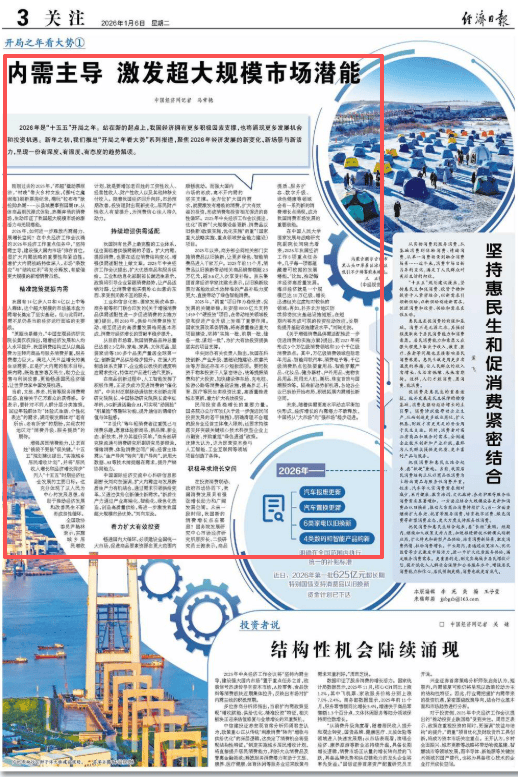
观点丨刘晓光:内需主导 激发超大规模市场潜能
Sou Hu Cai Jing· 2026-01-10 18:06
Core Viewpoint - The article emphasizes the importance of expanding domestic demand and enhancing consumption as key strategies for China's economic growth in 2026, highlighting the potential for new investment opportunities and market dynamics [3][4][11]. Group 1: Economic Context and Trends - 2026 marks the beginning of the "15th Five-Year Plan," with a focus on leveraging positive factors for economic growth and investment opportunities [2]. - The consumer market in China is vibrant, driven by various trends such as the "Su Chao" economy and the popularity of rural cultural tourism, indicating the immense potential of the super-large market [2]. Group 2: Domestic Demand and Consumption - The central economic work meeting prioritizes "domestic demand as the main driver" to build a strong domestic market, underscoring the urgency of expanding domestic demand strategies [3]. - China's population of over 1.4 billion and more than 400 million middle-income individuals provide a solid foundation for domestic demand growth, despite current challenges of insufficient demand [4]. Group 3: Policy Measures and Implementation - The government aims to enhance consumer capacity through targeted policies, including the "Urban and Rural Residents Income Increase Plan," which aligns income growth with economic development [5][4]. - The implementation of consumption upgrade policies, such as the "old-for-new" program, has already driven significant sales, with over 2.5 trillion yuan in sales linked to these initiatives [9]. Group 4: Supply and Demand Adaptation - There is a need to address the mismatch between strong supply and weak demand by enhancing the adaptability of supply to changing consumer preferences [6]. - The government plans to promote high-quality goods and services, with a goal of achieving a high-quality development pattern by 2030, where supply and consumption interact positively [6]. Group 5: Future Growth Opportunities - New consumption growth points are expected to emerge in areas such as product quality enhancement, service expansion, digital upgrades, and green health [11]. - The "Implementation Plan for Enhancing the Adaptability of Consumer Goods Supply and Demand" aims to establish three trillion-yuan consumption sectors and ten hundred-billion-yuan consumption hotspots by 2027 [12].

申万宏源服务业投资机会梳理专题报告:中国服务业含“科”量持续提升-20260110
Shenwan Hongyuan Securities· 2026-01-10 14:55
Group 1 - The report highlights that the service industry is increasingly merging with technology, leading to the emergence of top-tier listed companies in sectors such as fintech, logistics, enterprise services, and healthcare [2][10] - Countries are exploring unique paths to develop their service industries, with examples including the U.S. focusing on fintech innovation, Germany emphasizing industrial design, and Singapore building digital infrastructure [2][10] - China's national strategy aims to enhance service industry capacity and quality through targeted policies, including the removal of entry barriers in key sectors like telecommunications and healthcare [2][39] Group 2 - The report identifies three main investment directions in the service industry: productive services, lifestyle services, and emerging services [2][45] - Productive services are seen as a core engine, with sectors like testing, industrial software, and financial services highlighted for their growth potential [2][3][45] - Lifestyle services are focused on improving living standards and consumption upgrades, with high growth observed in areas such as gaming, aviation, and tourism [3][45] Group 3 - Emerging services are positioned as key to cultivating new productive forces, with rapid developments in AI and the integration of healthcare and pharmaceutical services [4][45] - The report emphasizes the importance of cross-border e-commerce as a new growth driver for foreign trade, leveraging China's supply chain advantages [4][45] - Specific companies such as Cintas and CVS Health are cited as examples of successful service firms in the U.S., showcasing effective business models and market strategies [1][15][18]
想做低价版泡泡玛特?桑尼森迪:模式不稳、品控存疑
凤凰网财经· 2026-01-10 13:50
Core Viewpoint - The article discusses the recent IPO submission of Sunny Sandy Group Co., Ltd. in Hong Kong, highlighting its ambition to create a budget-friendly toy brand similar to Pop Mart, while facing significant challenges in sustainability and quality control [1][5]. Financial Performance - Sunny Sandy's revenue for 2023, 2024, and the first nine months of 2025 is projected to be RMB 107 million, RMB 245 million, and RMB 386 million respectively, with net profits of -RMB 19.92 million, -RMB 0.5 million, and RMB 51.96 million, indicating a turnaround to profitability in 2025 [1][2]. - The company’s "IP toys+" business, which combines toys with food and beverages, accounted for 72% of revenue in 2023, with a shift expected to a more balanced revenue stream by 2024 [4]. Investment and Valuation - Sunny Sandy received investments of approximately RMB 235 million from Hillhouse Capital and RMB 48.58 million from Aurora Management, leading to a post-investment valuation of RMB 4 billion, which is 80 times its valuation in 2019 [3]. Business Model and Challenges - The company started as a toy manufacturer linked to food products and is now transitioning to a brand-focused model, heavily relying on popular IPs like "Nezha: Birth of the Demon Child" and "Wang Wang Mountain Little Monsters," which contributed around RMB 200 million in revenue [2][4]. - Sustainability is a major concern, as the film industry is volatile, and the company acknowledges that IP licensing agreements typically last only one to two years without automatic renewals, posing a risk to business continuity [5]. Quality Control Issues - There have been multiple consumer complaints regarding product quality, including issues with damaged items and color inconsistencies, raising concerns about the company's ability to maintain quality while competing on price [7][9]. - The low-cost strategy may not be sustainable if the company cannot ensure basic quality standards, as consumer expectations remain high despite lower prices [9].

新消费行业周报(2026.1.5-2026.1.9):四部门鼓励每年最多开展四次春秋游,支持发放文旅消费券、电影券;毛戈平与LVMH旗下基金达成战略合作-20260110
Hua Yuan Zheng Quan· 2026-01-10 08:27
Investment Rating - The industry investment rating is "Positive" (maintained) [4] Core Viewpoints - The report highlights the encouragement from four departments to conduct up to four spring and autumn tours annually, supporting the issuance of cultural and tourism consumption vouchers and movie vouchers. This initiative aims to enhance cultural consumption among workers and stimulate the tourism and hospitality sectors [3][6]. - The strategic partnership between Mao Geping and L Catterton Asia Advisors is expected to facilitate global market expansion and optimize capital structure, indicating a strong growth potential for high-end retail channels [3][6]. - The report emphasizes the importance of understanding new consumer narratives shaped by younger generations, suggesting that companies with strong brand value and innovative capabilities, such as Mao Geping and others, are likely to experience significant growth [21]. Summary by Relevant Sections Industry Performance - The new consumption sector showed positive performance with the beauty care index increasing by 2.55%, the retail index by 4.23%, and the social services index by 4.71% during the week of January 5 to January 9, 2026 [9]. Key Industry Data - In November, retail sales for clothing and textiles increased by 3.5% year-on-year, cosmetics by 6.1%, gold and silver jewelry by 8.5%, and beverages by 2.9% [12][16]. Investment Analysis Opinions - The report recommends focusing on high-quality domestic brands in beauty care, such as Mao Geping and Shangmei, head brands in traditional gold jewelry like Laopu Gold and Chaohongji, companies with successful IP operations like Pop Mart in the trendy toy sector, and strong tea brands like Mixue Group and Guming in the ready-to-drink tea market [21].

2025中国潮玩出海行业报告:引领全球风潮
Sou Hu Cai Jing· 2026-01-10 02:30
Core Insights - The report highlights the rise of Chinese潮玩 (trendy toys) brands in the global market, driven by emotional consumption trends and innovative cultural export models [1][17] - Chinese潮玩 companies are successfully penetrating mature markets in Europe and North America, as well as emerging markets in Southeast Asia, leveraging unique IP operations and efficient supply chains [1][3] Group 1: U.S. Market Dynamics - The U.S. economy is experiencing a "K-shaped" recovery, where high-income consumers show resilience while low-income groups face pressure from inflation and employment fluctuations [2][21] - The "healing economy" trend is gaining traction, with潮玩 products like blind boxes and plush toys providing emotional value and social engagement, leading to increased demand [2][21] - Chinese潮玩 brands, such as Pop Mart, differentiate themselves by offering original IPs and innovative product formats, achieving a price range of $20 to $40, appealing to various income levels [2][21] Group 2: Southeast Asia Market Opportunities - Southeast Asia is viewed as a blue ocean market for潮玩, characterized by a young population, high internet penetration, and strong consumer upgrade intentions [3][4] - The success of Pop Mart's LABUBU toy in Thailand, following a social media endorsement by local celebrity Lisa, exemplifies the alignment of潮玩 with local youth culture [3][4] - Despite challenges such as fluctuating external tariffs and internal political complexities, Chinese brands are advancing into this market with localized designs and a multi-channel approach [3][4] Group 3: Company Strategies and Differentiation - Pop Mart focuses on building a comprehensive IP ecosystem, from creation to sales, aiming to transform short-term trends into long-lasting IPs through various media [4][5] - Miniso leverages its global retail network and supply chain efficiency to act as a high-efficiency IP monetization platform, enhancing store performance through strategic IP collaborations [4][5] - TOP TOY, as a rising player, benefits from synergies with Miniso, focusing on product development while utilizing Miniso's sales channels for rapid market expansion [5][6] Group 4: Cultural and Economic Shift - The success of Chinese潮玩 brands signifies a shift from "Made in China" to "Emotional Brands from China," emphasizing universal emotional connections rather than relying solely on traditional cultural narratives [6][17] - Chinese companies are combining mature supply chains with innovative business models and original designs, transitioning from traditional manufacturing roles to becoming key players in the global潮玩 industry [6][17]

西方营销模式正在失效,中国市场进入“本土规则”时代
Sou Hu Cai Jing· 2026-01-09 15:40
Core Insights - The global floor cleaning robot industry is witnessing a significant shift, with the acquisition of iRobot by its Chinese manufacturing partner, marking the end of an era for the former industry leader [2] - Local brands in China are rapidly gaining market share, forcing international brands like Starbucks, Nike, and Adidas to adapt or face decline [2] - A survey indicates that 85.79% of consumers prefer domestic trendy brands, highlighting the rise of local brands in various consumer sectors [2] Industry Trends - The traditional Western marketing models are becoming ineffective in the Chinese market, as local brands redefine the rules of engagement [4][7] - The previous reliance on mass advertising and standardized marketing strategies is being replaced by personalized and emotionally resonant approaches [9][10] - The emergence of new consumer behaviors emphasizes the importance of emotional connections and personalized experiences over traditional functional marketing [10][11] Brand Strategies - Successful local brands like Qingdao White Beer are leveraging cultural symbols and emotional narratives to resonate with consumers [19][21] - Qingdao White Beer has effectively created immersive experiences that connect with local culture, enhancing brand visibility and consumer engagement [21][22] - The focus has shifted from merely selling products to creating emotional experiences that align with consumers' lifestyles and values [22]




泡泡玛特旗下POP MART Gallery即将开馆
Xin Lang Ke Ji· 2026-01-09 15:02
1月9日晚间消息,今日泡泡玛特旗下POP MART Gallery在社交媒体上发文表示,即将正式开馆。 据介绍,POP MART Gallery是泡泡玛特聚焦当代IP文化与潮流艺术的展览空间。 POP MART Gallery表示,"我们以艺术家和IP形象为核心,关注大众文化的持续演进,通过展览与跨界 合作,将创意能量转化为具有时代表达的现实场景,实现青年文化精神在当代生活中的激活。空间位于 北京798艺术区,将持续性地为公众举办展览,并提供交流的公共接口。"(闫妍) 责任编辑:陈钰嘉 ...
叶国富的IP豪赌:6000家门店换一个宇宙
3 6 Ke· 2026-01-09 12:39
Core Insights - The article discusses the transformation of MINISO from a retail company to a cultural and creative group, aiming to become a global leader in IP operations, akin to Disney [1][11] - The company plans to upgrade its store model and product structure, increasing the proportion of IP products from 50% to over 80% [1][11] Group 1: Company Transformation - MINISO is undergoing a significant transformation, referred to as "腾笼换鸟," which involves closing and reopening 80% of its stores, impacting nearly 6,000 locations [1][3] - The new store model will feature larger thematic immersive spaces, moving from stores under 200 square meters to those between 400-600 square meters [1][3] - The company aims to shift its focus from merely selling products to selling culture, thereby creating a more engaging consumer experience [11][12] Group 2: Market Position and Strategy - Since its inception in 2013, MINISO has rapidly expanded to over 8,000 global stores by leveraging its channel advantages [2] - The founder, Ye Guofu, recognizes the limitations of relying solely on scale and is pivoting towards an IP ecosystem to enhance competitiveness [3][11] - The competition with Pop Mart, a leading player in the collectible toy market, highlights the strategic battle for "dream-making rights" in the IP retail space [4][17] Group 3: IP Development and Future Plans - MINISO's strategy includes a dual approach to IP development, focusing on both top-tier licensed IPs and original IPs to drive growth [15][11] - The launch of MINISO LAND, a themed store concept, has shown promising results, with one store achieving over 100 million yuan in sales within nine months, with IP products contributing 80% [14][15] - The company plans to recruit top IP design talent globally to enhance its IP incubation capabilities, indicating a commitment to building a robust IP ecosystem [15][11] Group 4: Competitive Landscape - The competition between MINISO and Pop Mart represents a clash between two different business models: MINISO's channel-driven approach versus Pop Mart's content-driven strategy [21][22] - Both companies are striving to create an emotional consumption utopia, emphasizing the importance of storytelling and emotional connection in IP retail [22][24] - The future of IP retail is expected to transcend mere product sales, focusing on creating a comprehensive "IP universe" that integrates various forms of media and consumer experiences [23][24]