Funds

Search documents
独家洞察 | 开放401(k)养老金计划投资私募股权:FOF基金与收购基金业绩回顾
慧甚FactSet· 2025-11-21 08:04
Core Viewpoint - The recent U.S. executive order allowing 401(k) pension plans to invest in private equity has raised several questions regarding its implications for the market and investment strategies [1][4]. Group 1: Fund Performance and Trends - Historical data indicates that FOF (Fund of Funds) has maintained stable fundraising levels over the past 20 years, while acquisition funds have experienced rapid growth in fundraising [6]. - If FOF fundraising were to surge like acquisition funds, it raises questions about the potential impact on performance. Acquisition funds have shown strong stability in performance, but increased fundraising activities since 2015 have led to greater performance volatility [6]. - The stability of FOF returns, with the exception of lower returns in 2020, may be attributed to its diversification advantages or smaller scale, allowing for excess return potential. Overall, FOF returns are comparable to the stable return levels of acquisition funds [6]. Group 2: Market Impact and Future Outlook - The influx of retail investment into private equity and alternative investments could lead to increased volatility and competition in the market, potentially reducing excess return opportunities [7][8]. - Despite concerning fundraising figures in 2022 and 2023, these numbers should be interpreted cautiously as they include incomplete data from funds that have not yet closed. Future investment expansion may continue to experience volatility similar to the early 2020s due to crowded capital and intensified competition [7]. - Other investment categories, such as acquisition funds, venture capital, or secondary markets, may also see increased interest and fundraising if they expand their capital inflows [8].

两市ETF两融余额减少28.21亿元丨ETF融资融券日报
2 1 Shi Ji Jing Ji Bao Dao· 2025-11-21 03:15
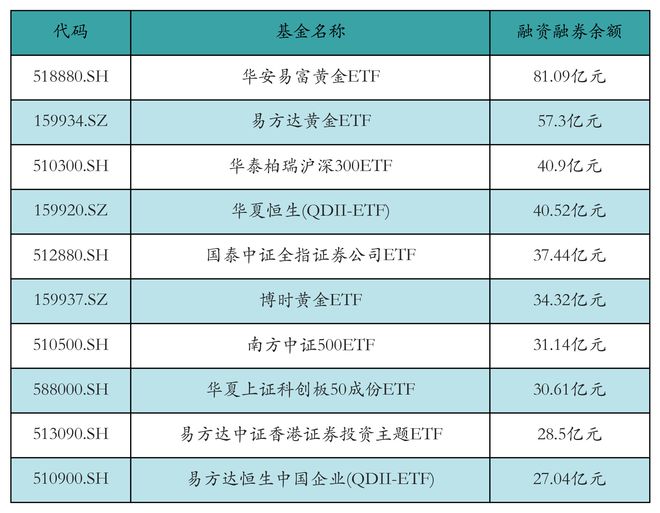
Market Overview - As of November 20, the total ETF margin balance in the two markets is 120.919 billion, a decrease of 2.821 billion from the previous trading day [1] - The financing balance is 113.28 billion, down by 2.566 billion, while the margin short balance is 7.639 billion, decreasing by 0.255 billion [1] - In the Shanghai market, the ETF margin balance is 84.407 billion, down by 2.443 billion, with a financing balance of 77.726 billion, decreasing by 2.172 billion [1] - The Shenzhen market's ETF margin balance is 36.512 billion, down by 0.379 billion, with a financing balance of 35.553 billion, decreasing by 0.394 billion [1] ETF Margin Balance - The top three ETFs by margin balance on November 20 are: - Huaan Yifu Gold ETF (8.109 billion) - E Fund Gold ETF (5.73 billion) - Huatai-PB CSI 300 ETF (4.09 billion) [2] - The detailed top 10 ETFs by margin balance are provided in the table [2] ETF Financing Amount - The top three ETFs by financing amount on November 20 are: - Huatai-PB Southbound Hang Seng Technology Index (1.467 billion) - E Fund CSI Hong Kong Investment Theme ETF (1.241 billion) - Bosera CSI Convertible Bonds and Exchangeable Bonds ETF (0.951 billion) [3] - The detailed top 10 ETFs by financing amount are provided in the table [4] ETF Net Financing Amount - The top three ETFs by net financing amount on November 20 are: - Huaxia Shanghai Stock Exchange Sci-Tech Innovation Board 50 ETF (88.5893 million) - Huatai-PB Southbound Hang Seng Technology Index (58.9784 million) - Southern CSI 500 ETF (58.7087 million) [5] - The detailed top 10 ETFs by net financing amount are provided in the table [6] ETF Margin Short Selling Amount - The top three ETFs by margin short selling amount on November 20 are: - Southern CSI 500 ETF (37.8834 million) - Huatai-PB CSI 300 ETF (37.877 million) - Huaxia CSI A500 ETF (25.0182 million) [7] - The detailed top 10 ETFs by margin short selling amount are provided in the table [8]
4000亿资金腾笼!银行理财“排队抢购”摊余债基
2 1 Shi Ji Jing Ji Bao Dao· 2025-11-20 13:13
Core Viewpoint - The upcoming concentrated opening period for amortized cost method bond funds is becoming a significant variable in the bond market, with over 80 funds expected to open, totaling more than 400 billion yuan in scale by early 2026 [1][2][3] Group 1: Market Dynamics - As of November 14, there are a total of 190 amortized cost bond funds, with a peak opening period expected from November 2025 to the first quarter of 2026 [1][2] - The recent surge in interest for these funds is attributed to their ability to provide a stable yield in a low-interest-rate environment, making them an attractive option for institutional investors [4][6] - The shift in investment from bank proprietary trading to wealth management products is driving demand for these funds, as banks seek stable and predictable returns [7][8] Group 2: Investment Strategies - Amortized cost bond funds utilize a "buy and hold until maturity" strategy, which helps in matching the duration of the bonds with the fund's closed period, providing a stable investment experience [3][4] - The focus on 3-5 year credit bonds has increased, with significant net purchases observed in this segment, leading to a decrease in yields and a narrowing of credit spreads [6][11] - The anticipated influx of funds from the opening of these bond funds is expected to provide additional capital for 3-5 year credit bonds and policy financial bonds, potentially enhancing returns for investors [11][12] Group 3: Future Outlook - The bond market is expected to see continued interest in amortized cost bond funds, particularly in the 3-5 year credit segment, as these funds enter their next round of openings [10][11] - The market dynamics suggest that while there may be short-term gains, the overall impact on yield may be limited due to the relatively small scale of these funds compared to the broader market [9][12] - The upcoming months are likely to witness fluctuations in the bond market as high-interest fixed deposits mature, influencing the liquidity and investment strategies of wealth management products [12]
北信瑞丰更名为华银基金,高管频繁变动
Sou Hu Cai Jing· 2025-11-20 08:25
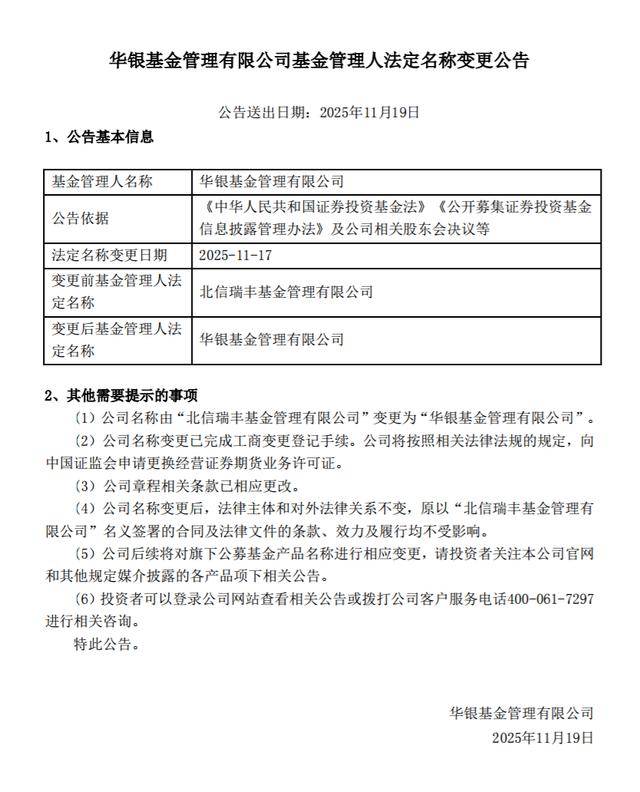
Core Viewpoint - The company formerly known as Beixin Ruifeng Fund Management Co., Ltd. has officially changed its name to Huayin Fund Management Co., Ltd. as of November 17, 2025, with the necessary business registration completed [1][5]. Company Name Change - The name change from Beixin Ruifeng Fund Management Co., Ltd. to Huayin Fund Management Co., Ltd. has been completed, and the company's website reflects this new name [3][5]. - The logo has also been updated to resemble the red and white logo of Huaxia Bank, although the public account logo remains unchanged [5]. Management Changes - The company has experienced significant management turnover, with the resignation of Deputy General Manager Wang Naili and the appointment of new executives, including Zhao Weijing as Chief Inspector and Wang Bo as Chief Information Officer [10][12][14]. - Both new executives have backgrounds in Beijing Bank, indicating a strategic shift towards leveraging expertise from the banking sector [12][14]. Financial Performance - The company reported a dramatic increase in public fund management scale, reaching 20.8 billion yuan by the end of the third quarter, a nearly 6.7-fold increase from mid-year [17]. - The fund "Beixin Ruifeng Dingsheng Short-term Bond" saw its scale surge from 0.14 billion yuan at mid-year to 17.115 billion yuan by the third quarter, indicating significant inflows from institutional investors [17]. Corporate Challenges - The company has faced various challenges, including labor disputes, compliance issues, and management factionalism, which have led to negative public sentiment [16]. - Previous reports indicated that the company had not issued year-end bonuses for three years and faced scrutiny from regulatory bodies regarding governance and compliance practices [16].
年内ETF发行规模突破2400亿份,增幅达91.83%
2 1 Shi Ji Jing Ji Bao Dao· 2025-11-20 02:36
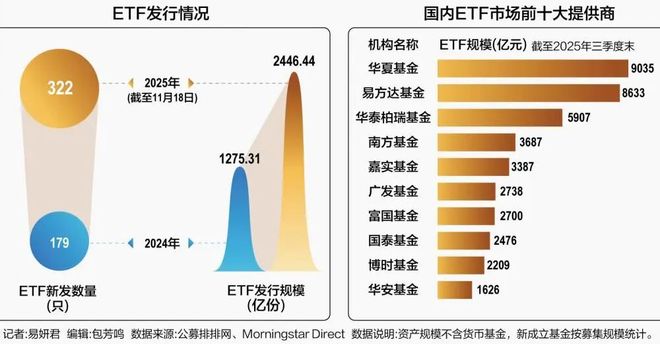
Core Insights - The domestic ETF market is experiencing a record issuance scale, indicating a comprehensive arrival of index investment trends [1][4] - The number and volume of newly issued ETFs have significantly surpassed last year's figures, with a 79.89% increase in the number of new ETFs and a 91.83% increase in issuance volume compared to 2024 [4] - The market is witnessing profound changes in ETF product structure, with thematic ETFs focusing on sectors like technology and free cash flow becoming popular among investors [1][6] Market Growth - As of November 18, 2025, a total of 322 ETFs have been issued this year, with a combined issuance volume of 2446.44 billion units, exceeding last year's totals of 179 ETFs and 1275.31 billion units [4] - The ETF market is expected to see explosive growth in 2025, driven by policy support and diverse investor demands [4][10] Product Types - Stock ETFs remain the backbone of the issuance market, with 283 stock ETFs accounting for 87.89% of total issuances and 1493.95 billion units, representing 61.07% of total volume [5] - Bond ETFs have also seen significant activity, with 32 new bond ETFs issued, making up 9.94% of total issuances, although they have experienced a decline in total volume post-issuance [5][6] Thematic ETFs - Among the newly issued ETFs, 66 products include "technology" in their names, representing 20.50% of total issuances, while 29 products include "free cash flow," accounting for 9.01% [6] - Free cash flow ETFs are gaining attention due to their adaptability in a low-interest environment and strong profitability of constituent stocks [6] Competitive Landscape - The ETF market is characterized by a significant head effect, with leading institutions dominating the issuance landscape [8][9] - The top three ETF providers hold a combined market share of 44%, while the top five and ten providers account for 57% and 78% respectively [9] - The competitive landscape is expected to intensify, with challenges in product innovation, cost control, and brand building for fund companies [10][11] Future Outlook - The concentration of the ETF market is likely to increase, as leading providers leverage their brand strength and resources to capture market share in popular sectors [10] - Fund companies must develop differentiated innovation capabilities and strong cost management to remain competitive in the evolving market [11]
年内ETF发行规模突破2400亿份,增幅达91.83%
21世纪经济报道· 2025-11-20 02:28
Core Viewpoint - The domestic ETF market is experiencing a record issuance scale, signaling the arrival of a comprehensive wave of index-based investment, with significant growth in both the number and volume of new ETFs compared to previous years [1][3]. Issuance Scale - As of November 18, 2025, a total of 322 ETFs have been issued this year, with a combined issuance volume of 2,446.44 billion shares, surpassing last year's totals of 179 ETFs and 1,275.31 billion shares [3]. - The number of new ETFs has increased by 79.89% and the issuance volume has risen by 91.83% compared to the entire year of 2024 [3]. - This year's issuance also exceeds the previous historical peak in 2021, which saw 310 ETFs issued with a total volume of 1,933.56 billion shares [3]. Product Structure Changes - The ETF product structure is undergoing significant changes, with thematic ETFs focusing on sectors like technology and free cash flow becoming popular among investors [4][5]. - In 2025, 20.50% of the newly issued ETFs included "technology innovation" in their names, accounting for 501.78 billion shares, while 9.01% included "free cash flow," totaling 167.71 billion shares [4]. Market Competition and Concentration - The competitive landscape is solidifying, with leading institutions establishing strong barriers through brand, product lines, and scale effects, indicating a potential increase in market concentration [1][6]. - The top institutions dominate the ETF issuance market, with 45 public fund institutions issuing the 322 ETFs this year, led by E Fund with 26 ETFs, followed by China Universal and Huaxia Fund [7]. - The top 10 ETF providers hold a combined market share of 78%, with the top three alone accounting for 44% [8]. Challenges for Fund Companies - The current competitive environment poses challenges for fund companies in areas such as product innovation, cost control, research and operations, and brand building [9]. - Companies need to focus on differentiated innovation, cost management, and stable research and operational support to remain competitive and attract investment [9].
福田金融亮相18个首创
Shen Zhen Shang Bao· 2025-11-19 23:23
Core Insights - The 19th Jinbo Conference will be held from November 19-21 at the Shenzhen Convention Center, featuring 288 global institutions and enterprises, with nine thematic exhibition areas focused on cross-border finance and financial technology [1] - The Futian District's financial industry added value reached 194.87 billion yuan with a growth rate of 21.4%, accounting for 48.87% of the city's financial industry, showcasing strong financial resource aggregation [1] Group 1: Financial Innovations - Futian has achieved seven national firsts in technology finance, including the first private venture capital enterprise's sci-tech bond and the first digital RMB "talent insurance," significantly boosting private equity financing and small business loans [2] - The district has issued 25 sci-tech bonds, totaling 37.9 billion yuan, representing 50% of the city's total issuance, demonstrating its leadership in financial support for enterprises [2] Group 2: Ecosystem Development - Five robust ecosystems have been established, facilitating financing for over 10,000 enterprises and supporting nearly 3,000 companies with listing services, while also creating innovative financial products like "Futian Capital Loan" [3] - The conference's theme highlights the dual-driven approach of "technology finance + financial technology," aiming to engage the public through interactive activities and educational initiatives [3]
Virtus Total Return Fund Inc. Announces Distributions and Discloses Sources of Distribution – Section 19(a) Notice
Businesswire· 2025-11-19 22:25
Core Points - Virtus Total Return Fund Inc. (NYSE: ZTR) announced monthly distributions of $0.05 for the upcoming months of December 2025, January 2026, and February 2026 [1][1][1] - The ex-date and record date for the distributions are set for December 11, 2025, December 30, 2025, January 12, 2026, January 29, 2026, February 12, 2026, and February 26, 2026 respectively [1][1][1] - A previous distribution of $0.05 was announced on August 27, 2025, with an ex-date of November 13, 2025 [1][1][1]

Virtus Artificial Intelligence & Technology Opportunities Fund Announces Distributions and Discloses Sources of Distribution – Section 19(a) Notice
Businesswire· 2025-11-19 21:25
HARTFORD, Conn.--(BUSINESS WIRE)--Virtus Artificial Intelligence & Technology Opportunities Fund (NYSE: AIO) today announced the following monthly distributions: Ticker Amount of Distribution Ex-Date/Record Date Payable Date AIO $0.15 December 11, 2025 December 30, 2025 AIO $0.15 January 12, 2026 January 29, 2026 AIO $0.15 February 12, 2026 February 26, 2026 The Fund previously announced the following monthly distribution on August 27, 2025: Ticker Amount of Distribution Ex-Date/Record Date. ...

The “Smart Money” Is Buying These 6%+ CEFs Trading At Discounts To NAV
Forbes· 2025-11-19 16:16
Core Viewpoint - The current economic environment is favorable for contrarian investors, with AI driving productivity despite fears of an AI bubble, leading to attractive opportunities in closed-end funds (CEFs) that offer high yields [2][4]. Economic Indicators - The Atlanta Fed's GDPNow indicator shows a robust 4% annualized growth in the economy for the third quarter, contrasting with the prevailing panic among mainstream investors as indicated by the CNN Fear & Greed index [4]. Investment Strategy - CEFs are preferred over index funds like the SPDR S&P 500 ETF (SPY) due to their management by human investors who can identify bargains, and the smaller market size of CEFs allows for more opportunities without institutional competition [5][6]. CEF Opportunities - Two CEFs are highlighted: - Gabelli Dividend & Income Trust (GDV), which has shown a 16.6% return year-to-date and is currently trading at a 10.4% discount to NAV, presenting a buying opportunity [8][10]. - Neuberger Berman Next Generation Connectivity Fund (NBXG), which offers a 9.7% dividend and has recently increased its payout, but is recommended to be considered only if its discount to NAV falls below 13% [11][12]. Sector Focus - GDV is diversifying beyond tech, with only three of its top holdings in AI, while NBXG focuses on major tech names, indicating a balanced approach to sector exposure [9][11].