
北信瑞丰鼎盛中短债

Search documents
公募基金规模环比大增 腰部机构黑马频现
Zhong Guo Zheng Quan Bao· 2026-01-22 22:42
Core Insights - The public fund management scale increased by over 1.3 trillion yuan in Q4 2025, driven mainly by money market funds, bond funds, commodity funds, and index funds [1][2] Group 1: Fund Management Scale - As of the end of Q4 2025, the total scale of public funds reached 37.26 trillion yuan, with significant contributions from various fund types: stock funds at 5.997 trillion yuan, mixed funds at 3.769 trillion yuan, bond funds at 10.907 trillion yuan, money market funds at 14.969 trillion yuan, overseas investment funds at 0.971 trillion yuan, commodity funds at 0.04268 trillion yuan, fund of funds (FOF) at 0.02188 trillion yuan, and other funds at 0.0001367 trillion yuan [2] - The largest growth in scale was seen in money market funds, which increased by 571.93 billion yuan, followed by bond funds with an increase of 446.94 billion yuan, and stock funds with an increase of 155.08 billion yuan, primarily from index stock funds [2] Group 2: Competitive Landscape - The top two fund companies, E Fund and Huaxia Fund, each managed over 2 trillion yuan, while eight other companies managed over 1 trillion yuan [3] - Among the top twenty fund companies by non-money management scale, most experienced growth in Q4 2025, with Guotai Fund leading the increase at 62 billion yuan, followed by Invesco Great Wall Fund at 53.11 billion yuan [3][4] Group 3: Emerging Players - The mid-tier fund companies saw significant changes, with several emerging as "dark horses" in Q4 2025, such as Changcheng Fund with over 20 billion yuan growth, and Dongcai Fund, Zhongjia Fund, Guotai Haitong Asset Management, Morgan Fund, and Rongtong Fund each growing by over 15 billion yuan [5] - Notably, Dongcai Fund's growth was driven by its bond fund, while Morgan Fund's growth was attributed to its index funds [5][6] Group 4: Small Fund Companies - Smaller public fund institutions like Shanzheng Asset Management, Huayin Fund, and Debang Fund also saw substantial growth in their non-money management scales [6] - Huayin Fund, after rebranding from Beixin Ruifeng Fund, achieved a scale of 26.753 billion yuan, with a significant contribution from a single product [6]
公募基金规模环比大增腰部机构黑马频现
Zhong Guo Zheng Quan Bao· 2026-01-22 20:56
Core Insights - The public fund management scale increased by over 1.3 trillion yuan in Q4 2025, driven primarily by money market funds, bond funds, commodity funds, and index funds [1][2] Fund Scale Growth - As of the end of Q4 2025, the total scale of public funds reached 37.26 trillion yuan, with significant contributions from various fund types: stock funds at 5.997 trillion yuan, mixed funds at 3.769 trillion yuan, bond funds at 10.907 trillion yuan, money market funds at 14.969 trillion yuan, overseas investment funds at 0.971 trillion yuan, commodity funds at 0.043 trillion yuan, fund of funds (FOF) at 0.022 trillion yuan, and other funds at 0.0000137 trillion yuan [1][2] - The largest growth was seen in money market funds, which increased by 571.93 billion yuan, followed by bond funds with an increase of 446.94 billion yuan, and stock funds with an increase of 155.08 billion yuan, primarily from index stock funds [2] Competitive Landscape - The top two fund companies, E Fund and Huaxia Fund, both managed over 2 trillion yuan, while eight other companies, including GF Fund and Southern Fund, managed over 1 trillion yuan [2] - The top twenty fund companies in non-money management scale saw most companies achieve growth, with Guotai Fund leading with an increase of 62 billion yuan, followed by Invesco Great Wall Fund with an increase of 53.12 billion yuan [3] Emerging Players - The mid-tier fund companies experienced significant changes, with several emerging as "dark horses" in Q4 2025, such as Changcheng Fund, which grew by over 20 billion yuan, and Dongcai Fund, among others, which saw increases exceeding 15 billion yuan [3][4] - Notably, Dongcai Fund's growth was primarily driven by its bond fund, while Morgan Fund's growth stemmed from its index funds [4] Small Fund Institutions - Smaller public fund institutions, including Shanzheng Asset Management and Huayin Fund, also experienced substantial growth in non-money management scale [4] - After rebranding, Beixin Ruifeng Fund, now known as Huayin Fund, saw rapid growth, reaching a non-money management scale of 26.75 billion yuan, with a significant contribution from a single product [4]
规模狂飙下的冷思考:37万亿公募基金如何答好“回报”考题?
Sou Hu Cai Jing· 2025-12-02 18:20
Core Insights - The public fund management industry in China is experiencing rapid growth, with total net assets nearing 37 trillion yuan as of October 2025, but there is a notable imbalance in development among fund management companies [1] - The industry is witnessing a "Matthew effect," where a small number of companies dominate the market, while many others struggle to reach significant asset management levels [1] - Recent performance data reveals that some funds have experienced extreme volatility, raising concerns about their long-term viability and investor returns [4] Industry Scale and Growth - As of October 2025, there are 165 public fund management institutions in China, including 150 fund management companies and 15 asset management institutions with public qualifications, managing a total of 36.96 trillion yuan in assets [1] - The rapid increase in fund sizes is exemplified by Huayin Fund, which saw its management scale surge from 27 million yuan in Q2 2025 to 208 million yuan in Q3 2025, a nearly sevenfold increase [2] Performance Concerns - Despite significant asset growth, some funds, like the Beixin Ruifeng Ding Sheng Short-Duration Bond Fund, have poor historical performance, ranking low among peers despite a dramatic increase in size [2][3] - The Wanji Fund's Wanji CSI Hong Kong Stock Connect Innovative Drug ETF achieved a 117.13% return in 2025 but has a negative tracking error of over 50%, indicating poor long-term performance [4] - The Dongfanghong China Advantage Mixed Fund, once a benchmark for value investing, has seen a decline of 30.64% over three years, significantly underperforming its benchmark [4] High-Quality Development Initiatives - The China Securities Regulatory Commission (CSRC) has introduced a plan to promote high-quality development in the public fund industry, focusing on transitioning from a scale-driven approach to one that emphasizes returns [5][6] - The Beijing Securities Industry Association has issued a development initiative that encourages public fund institutions to prioritize investor returns and align with national strategies [5][7] Strategic Directions for Improvement - The industry is urged to adopt an "investor-centric" philosophy, integrating investor return metrics into core assessment systems to foster long-term value creation [7] - Fund companies are encouraged to focus on supporting national strategies, such as technology and green investments, while avoiding short-term speculation [7] - Compliance and risk management are emphasized as essential for protecting investor interests and ensuring industry integrity [7][9] Collaborative Efforts for Industry Growth - The high-quality development of the public fund industry requires a collaborative effort among regulators, institutions, and investors to foster a healthy market environment [8] - Regulatory bodies are called to enhance oversight and establish comprehensive evaluation systems focused on long-term performance and compliance [8] - Fund companies must improve their research capabilities and risk management practices to enhance competitiveness and better serve investor needs [8][9]
今年要被债基玩死了……
Sou Hu Cai Jing· 2025-12-02 10:02
Core Viewpoint - The article discusses the performance of various bond funds in 2023, highlighting significant losses in certain categories, particularly in government bond funds and long-term bond funds, due to rising yields and market conditions. Group 1: Index Bond Funds - The 30-year government bond ETF has declined by approximately 4%, while the benchmark market-making government bond ETF has dropped by 0.65% [2] - The main contributors to the decline are the rising yields of government bonds, with the 5-year government bond yield increasing from 1.41% to 1.61%, a rise of 19 basis points, and the national development bond yield increasing from 1.47% to 1.79%, a rise of 32 basis points [2] - The "Dacheng Interbank Certificate of Deposit Index 7-Day Holding" has a small scale of only 4 million yuan, leading to losses as investment returns do not cover fund expenses [2] Group 2: Short-term Bond Funds - Short-term bond funds have averaged a return of 1.4%, with two funds reporting losses and 16 funds yielding less than 0.5% [3] - The two funds that lost money are small in scale, and their low size has led to high expense ratios eating into profits [3] Group 3: Long-term Bond Funds - Among 2019 long-term bond funds, 257 have reported losses, accounting for 12.7% of the total [4] - Long-term bond funds have averaged a return of 0.97%, which is about 0.4% lower than short-term bond funds [4] - The primary reason for the losses is the heavy investment in long-duration government bonds and policy financial bonds [5] Group 4: Market Conditions - The yield on 30-year government bonds is currently at 2.2%, with a low of 1.8% earlier this year, resulting in an average annual coupon yield of around 2% [6] - The maximum drawdown for the 30-year government bond index has been 16.75%, with a maximum drawdown of 6.41% this year, indicating a low investment value for long-duration government bonds [6] - Fund managers have been increasing the duration of their bond funds, which is seen as a risky move given the current yield environment [6] Group 5: Overall Market Sentiment - The overall market is still in an adjustment phase, with recent weak rebounds not indicating an end to the adjustment [11] - There is a lack of excitement in the market, with many sectors experiencing declines after previous rebounds, suggesting a cooling of market sentiment [11] - Despite the potential for further declines, there may be limited downside due to external funds eyeing investment opportunities [12]
北信瑞丰更名为华银基金,高管频繁变动
Sou Hu Cai Jing· 2025-11-20 08:25
Core Viewpoint - The company formerly known as Beixin Ruifeng Fund Management Co., Ltd. has officially changed its name to Huayin Fund Management Co., Ltd. as of November 17, 2025, with the necessary business registration completed [1][5]. Company Name Change - The name change from Beixin Ruifeng Fund Management Co., Ltd. to Huayin Fund Management Co., Ltd. has been completed, and the company's website reflects this new name [3][5]. - The logo has also been updated to resemble the red and white logo of Huaxia Bank, although the public account logo remains unchanged [5]. Management Changes - The company has experienced significant management turnover, with the resignation of Deputy General Manager Wang Naili and the appointment of new executives, including Zhao Weijing as Chief Inspector and Wang Bo as Chief Information Officer [10][12][14]. - Both new executives have backgrounds in Beijing Bank, indicating a strategic shift towards leveraging expertise from the banking sector [12][14]. Financial Performance - The company reported a dramatic increase in public fund management scale, reaching 20.8 billion yuan by the end of the third quarter, a nearly 6.7-fold increase from mid-year [17]. - The fund "Beixin Ruifeng Dingsheng Short-term Bond" saw its scale surge from 0.14 billion yuan at mid-year to 17.115 billion yuan by the third quarter, indicating significant inflows from institutional investors [17]. Corporate Challenges - The company has faced various challenges, including labor disputes, compliance issues, and management factionalism, which have led to negative public sentiment [16]. - Previous reports indicated that the company had not issued year-end bonuses for three years and faced scrutiny from regulatory bodies regarding governance and compliance practices [16].

北信瑞丰基金更名 上季跻身两百亿公募阵营
Zhong Guo Zheng Quan Bao· 2025-11-19 21:38
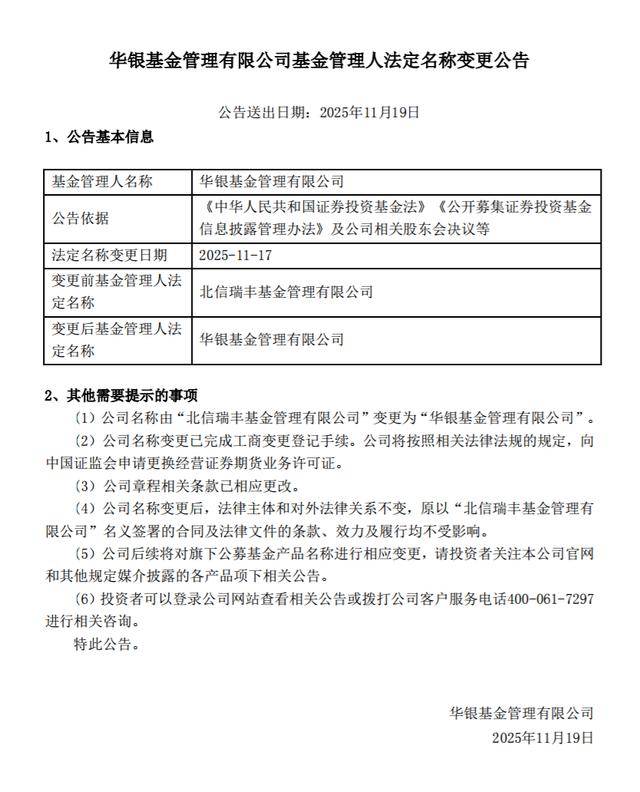
Core Viewpoint - Beixin Ruifeng Fund has rebranded to Huayin Fund Management Co., Ltd. following significant growth in assets under management, reaching over 20 billion yuan, driven by a single fund attracting 17.1 billion yuan in the third quarter [1][2][5]. Group 1: Company Name Change - The company officially announced its name change on November 19, completing the necessary registration procedures and planning to apply for a new securities and futures business license [2]. - The name change is primarily aimed at brand upgrading and positioning, reflecting changes in management and operational structure [3]. Group 2: Management Changes - Significant management changes occurred just before the rebranding, with multiple senior executives resigning and new appointments made, including Zhao Weijing as the new supervisor and Wang Bo as the new Chief Information Officer [4]. - The new management team is focused on enhancing the research and investment structure, shifting towards a platform-based approach [3]. Group 3: Asset Growth - In the third quarter, the fund's management scale surged to 20.79 billion yuan, up from 2.7 billion yuan at the end of the previous half-year, with over 160 billion yuan in subscriptions [5]. - The Beixin Ruifeng Ding Sheng Short-term Bond Fund contributed significantly, attracting over 17 billion yuan, with nearly 100% of its shares held by individual investors [6]. Group 4: Future Development Strategy - The company aims to focus on four core development directions: boutique, market-oriented, digital, and compliant operations, to strengthen its foundation for future growth [6].
北信瑞丰基金更名上季跻身两百亿公募阵营
Zhong Guo Zheng Quan Bao· 2025-11-19 20:13
Core Viewpoint - The company has experienced significant growth in assets under management, reaching 207.9 billion yuan in Q3, driven by a single fund attracting 17.1 billion yuan in subscriptions, leading to a rebranding from Beixin Ruifeng Fund to Huayin Fund [1][3][4] Company Name Change - On November 19, the company officially announced its name change to "Huayin Fund Management Co., Ltd." after completing the necessary registration procedures [1] - The name change is primarily aimed at brand upgrading and positioning, with no impact on existing contracts or legal relationships [2][3] Management Changes - The company underwent a significant management overhaul just before the name change, with multiple senior executives resigning and new appointments made [2][3] - The new management is focused on transforming the investment research structure and enhancing collaboration with traditional banking channels and internet platforms [2][4] Asset Growth - In Q3, the company saw its assets under management surge from 2.7 billion yuan at the end of the first half to 207.9 billion yuan by the end of Q3, with 22 funds and 6 fund managers [3][4] - The "Beixin Ruifeng Ding Sheng Short-term Bond Fund" was a major contributor, accounting for over 17 billion yuan of the total, with nearly 100% of its shares held by individual investors [3][4] Strategic Focus - The company has identified four core development directions: boutique, market-oriented, digitalization, and compliance, to strengthen its foundation for future growth [4]
华夏银行入主节奏加速!北信瑞丰基金正式更名“华银基金”
2 1 Shi Ji Jing Ji Bao Dao· 2025-11-19 11:48
Core Viewpoint - The company formerly known as Beixin Ruifeng Fund has rebranded to Huayin Fund Management, effective November 17, 2023, with plans to change the names of its public fund products accordingly [1][4]. Group 1: Company Name Change and Ownership - The company has completed the legal name change and will apply to the China Securities Regulatory Commission for a new securities and futures business license [4]. - Huayin Fund is still controlled by Beijing Trust, despite the name change, and there are indications of a potential acquisition interest from Huaxia Bank [4][5]. - The management structure has seen significant changes, with multiple high-level departures and appointments, indicating a strategic shift under Huaxia Bank's influence [5][6]. Group 2: Management Scale and Performance - As of the end of Q3 2023, Huayin Fund's management scale has dramatically increased to 20.79 billion yuan, up from 2.706 billion yuan at the end of Q2 2023, marking a significant recovery in its industry ranking to 117th [6][7]. - The growth in management scale is primarily attributed to the performance of a fixed-income product, which saw its total scale rise from 0.14 billion yuan to 17.115 billion yuan due to new institutional investments [7]. - The company has a diverse product line across various fund types, although many of its funds remain small, with most under 50 million yuan, and it has not launched new products since October 2021 [8].

华银基金来了!规模突增上百亿
Zhong Guo Zheng Quan Bao - Zhong Zheng Wang· 2025-11-19 04:20
Core Viewpoint - The company formerly known as Beixin Ruifeng Fund has officially changed its name to Huayin Fund Management Co., Ltd. primarily for brand upgrading and positioning needs [1][4]. Company Name Change - The name change was announced on November 19, with the new name being "Huayin Fund Management Co., Ltd." [2]. - The change has completed the necessary business registration procedures and will apply to the China Securities Regulatory Commission for a new securities and futures business license [3]. - The legal entity and external legal relationships remain unchanged, and existing contracts signed under the previous name will still be valid [3]. Management Changes - Prior to the name change, the company underwent a management reshuffle, with several key positions, including Vice General Manager and Chief Information Officer, being adjusted [1][5]. - New management aims to focus on four core development directions: boutique, market-oriented, digitalization, and compliance [5]. Shareholding Structure - Currently, there is no equity relationship between Huayin Fund and Huaxia Bank, although Huaxia Bank provides significant support in business development and research cooperation [4]. - The largest shareholder remains Beijing International Trust Co., Ltd., holding 60%, followed by Laizhou Ruihai Investment Co., Ltd. with 40% [4]. Fund Growth - The fund's management scale saw a significant increase, growing from 2.7 billion yuan at the end of the first half to 20.79 billion yuan by the end of the third quarter, with a total of 22 funds managed [6]. - The Huayin Ding Sheng Short-term Bond Fund contributed 17.112 billion yuan to this growth, with nearly 100% of its shares held by individual investors [6]. - The Huayin Stable Income Fund also contributed 2.951 billion yuan to the overall scale, managed by the same fund manager [7].
首批基金三季报出炉:科技赛道仍是“核心仓位”
Guo Ji Jin Rong Bao· 2025-10-17 14:21
Core Insights - Multiple public fund companies, including Beixin Ruifeng and Tongtai, have disclosed their Q3 reports, primarily focusing on equity funds, with a notable emphasis on technology and military sectors [1][2] Group 1: Fund Performance - The top-performing fund, Quan Guo Xu Yuan, reported a scale of 19.069 billion yuan, benefiting from heavy investments in technology and military sectors, leading to significant growth in both performance and scale [1] - Tongtai Digital Economy A achieved a net value increase of over 70% in Q3, focusing on domestic computing power and reducing exposure to overseas supply chains [2] - Beixin Ruifeng Advantage Industry fund saw a net value increase of over 50%, concentrating on strategic emerging industries represented by artificial intelligence [2] - Quan Guo Xu Yuan reported a net value increase of over 45%, driven by heavy investments in technology, new energy, and military sectors [2] Group 2: Market Trends - The technology sector has shown significant growth, with funds focusing on computing power, artificial intelligence, robotics, and semiconductors achieving good returns [2] - The market style has shifted towards growth, with traditional value sectors remaining weak [4] - Fund managers continue to view technology innovation, particularly artificial intelligence, as a core investment theme for the future [4][5] Group 3: Investment Strategies - Some funds, like Tongtai Huize, have focused on niche markets such as the pet economy, despite underperforming compared to broader indices [2] - The Huafu CSI Artificial Intelligence Industry ETF reported a net value increase of over 70%, highlighting the complexity and diversity of the AI sector as a favorable investment avenue [3] - Fund managers express optimism about the long-term potential of the pet economy, despite short-term setbacks [2] Group 4: Bond Market Outlook - The bond market experienced weak fluctuations in Q3, with a notable increase in the yield of 10-year government bonds by 20 basis points [6] - Fund managers anticipate a favorable economic backdrop for the bond market in Q4, supported by moderate monetary policy easing and improving market sentiment [6]