养老服务

Search documents
报告:中国城市养老从“基础覆盖”迈向“质量提升”新阶段
Jing Ji Guan Cha Wang· 2025-11-24 04:34
Core Insights - The seminar on innovative development in China's elderly care sector highlighted the release of the "2025 China Urban Residents Elderly Care Research Findings" report, which integrates various data sources to construct an evaluation system for urban elderly care [1] - The report indicates that while urbanization in China has surpassed 67% with a resident population of 940 million, there are significant regional and demographic disparities in elderly care levels [1] - The transition from "basic coverage" to "quality improvement" in urban elderly care is noted, with a call for a collaborative ecosystem involving government, market, society, and individuals to achieve a harmonious elderly care vision [1] Summary by Categories Elderly Care Index - The report innovatively constructs the "China Urban Residents Elderly Care Index" based on four dimensions: elderly wealth reserve, elderly service system, age-friendly environment, and silver economy development [1] Urbanization and Demographics - China's urbanization rate has exceeded 67%, with a permanent urban population of 940 million, making cities the primary battleground for addressing aging issues [1] Regional and Group Disparities - There are notable regional and group differences in elderly care levels, indicating that while public service equalization has made significant progress, there is still room for improvement in overall quality [1] Market Demand - The report identifies five core care needs in the market: medical services, meal assistance, cultural and recreational activities, health education, and domestic services, driven by the diverse and large elderly population [1] Targeted Services - The findings suggest that the "vibrant elderly" aged 60 to 70 focus on independence, health, and social participation, while those aged 80 and above have a more urgent need for care and rehabilitation services [1]
新疆乌苏市市场监管局为养老服务机构“把脉问诊”
Zhong Guo Shi Pin Wang· 2025-11-24 03:56
截至目前,检查养老机构、日间照料中心17家。针对发现的问题,执法人员当场提出整改意见,要求限 期整改到位,并将开展"回头看"跟踪督导。 下一步,乌苏市市场监督管理局将持续发挥职能优势,将食品安全宣传教育融入日常监管与服务之中, 切实筑牢老年人食品安全防线。(杜志锋、李超然、于馨) 近日,新疆维吾尔自治区乌苏市市场监管局强化党建引领,积极践行"实干争先"理念,组织"市场卫士 先锋服务队"对全市养老机构、日间照料中心食堂开展食品安全全覆盖检查,排查风险隐患,进一步保 障老年人饮食安全。 检查过程中,该局执法人员重点检查食品安全管理制度是否健全,是否制定食物中毒应急处置预案,食 堂设施设备、布局流程是否合理,环境卫生、原料采购查验和索证索票、食品储存、加工制作、食品留 样等是否符合规范要求。此外。执法人员现场查看食堂食品安全情况,并督促机构负责人严格落实食品 安全主体责任,强化从业人员培训,确保食材来源可溯、加工过程规范。 ...
视频丨硬件升级+服务扩容 农村养老更优质更有温度
Yang Shi Xin Wen Ke Hu Duan· 2025-11-24 03:19
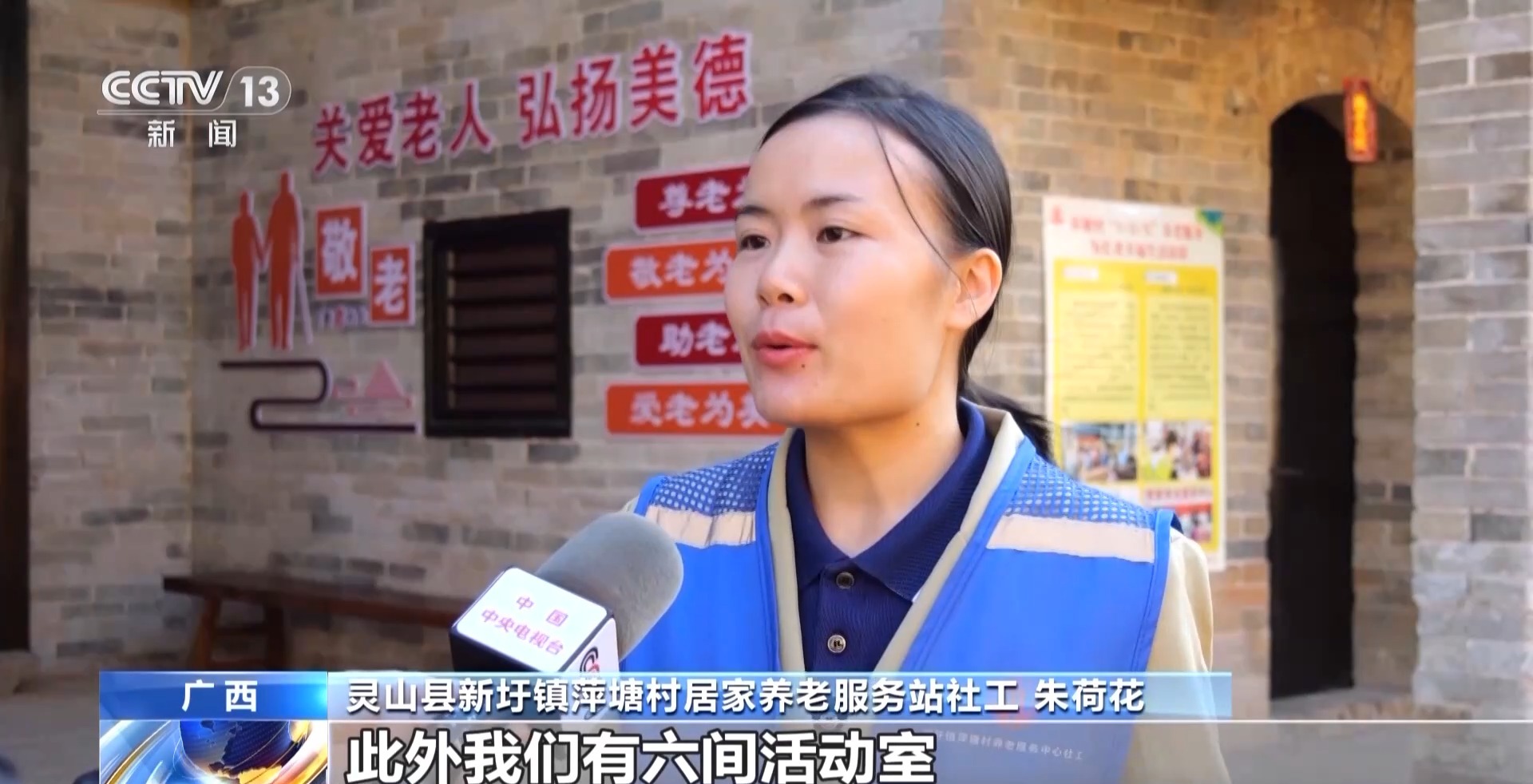
农村养老是我国养老服务体系中的短板,设施缺位、服务零散、医养脱节,老人"吃饭难、无人照顾、就医难"等问题突出,如何完善县、乡、村三级养老服 务网络,让优质养老服务更大面积、更具温度地覆盖广大农村? 建设农村养老服务站 优质养老更有温度 0:00 广西灵山县是一个农村人口占比80%的革命老区县,走进灵山县萍塘村,不久前新增的居家养老服务站里格外热闹。这个利用闲置民居建起的站点面积不 大,但图书阅览、老年助餐、日间照料、理疗康复等功能设施一应俱全,成为附近老年人的快乐驿站。 0:00 "十五五"规划建议提出,"优化基本养老服务供给,完善城乡养老服务网络",相比"十四五"规划纲要里的"健全基本养老服务体系",从"健全"到"优化"的变 化,对我国养老服务体系建设提出了更高的要求。 灵山县新圩镇萍塘村居家养老服务站社工 朱荷花:有长者饭堂可以去就餐,此外我们有六间活动室,他们可以到各个活动室去参加活动,下象棋和打麻 将、绘画等。 "十四五"期间,我国加快建设县乡村三级养老服务网络,在村(社区)层面采取"中心+站点"模式发展嵌入式设施和互助型站点,已建成农村互助养老服务 设施约14.5万个。目前,灵山县正在整合村里的闲置 ...

从“健全”到“优化” 农村老年人的事有专人管 优质享老托起民生“温度”
Yang Shi Wang· 2025-11-24 03:10
央视网消息:"十五五"规划建议提出,"优化基本养老服务供给,完善城乡养老服务网络"。相比"十四五"规划纲要里的"健全基本养老服务体 系",从"健全"到"优化"的变化,对我国养老服务体系建设提出了更高的要求。 农村养老是我国养老服务体系中的短板,设施缺位、服务零散、医养脱节,老人吃饭难、无人照顾、就医难等问题突出。如何完善县、乡、村 三级养老服务网络,让优质养老服务更大面积、更具温度地覆盖广大农村,各地各部门正在积极想办法。 广西灵山县是一个农村人口占比80%的革命老区县。走进灵山县萍塘村,不久前新增的居家养老服务站里格外热闹。这个利用闲置民居建起的 站点面积不大,但图书阅览、老年助餐、日间照料、理疗康复等功能设施一应俱全,成为附近老年人的快乐驿站。 "十四五"期间,我国加快建设县、乡、村三级养老服务网络,在村(社区)层面采取"中心+站点"模式发展嵌入式设施和互助型站点,已建成 农村互助养老服务设施约14.5万个。目前,灵山县正在整合村里的闲置房屋、幸福院等设施,改造升级为村级养老服务站。 广西灵山县人民政府副县长利远远介绍,他们把福彩公益金等多种资金通过多渠道共同投入,为农村居家养老服务站建设提供了稳定的资金 ...

报告称中国养老产业市场规模快速增长
Zhong Guo Xin Wen Wang· 2025-11-24 02:52
Core Insights - The report highlights the rapid growth of China's elderly care industry, indicating a shift from individual family matters to public social affairs [2] - China is currently in a moderately aging society, with an increasing proportion of elderly population and rising old-age dependency ratio [2] - The development of the elderly care industry has made initial progress but is still in its early stages, facing challenges such as insufficient collaboration between the elderly care industry and services, uneven development, and a lack of talent [2][5] Industry Overview - The policy environment for the elderly care industry in China is continuously improving, leading to a rapid expansion of the market and increased social capital investment [5] - As of May 2025, there are over 470,000 registered entities related to elderly care in China [5] - The elderly care industry encompasses various sectors, including elderly products, rehabilitation equipment, elderly finance, integrated medical care, smart elderly care, and leisure travel [5] Development Strategies - The report emphasizes that developing the elderly care industry is crucial for optimizing and expanding elderly service supply, which is essential for addressing the challenges of population aging [5] - Cultivating effective demand is key to developing the silver economy, and high-quality sustainable development of the elderly care industry requires attracting more high-quality talent [5][6] - Establishing a comprehensive industry standard and regulatory system is vital for the high-quality development of the elderly care industry [5][6] Future Directions - Future efforts should focus on promoting the coordinated development of the elderly care industry and services to meet diverse elderly care needs [6] - The industry should leverage leading enterprises to drive balanced development and enhance the talent pool through vocational education and industry-education integration [6] - Strengthening standardization and monitoring platforms, along with fostering age-friendly technological innovations, will empower the high-quality development of the elderly care industry [6]

银发医养如何多赢
Jing Ji Ri Bao· 2025-11-22 21:57
Core Viewpoint - The "Silver Hair Medical and Nursing Action" aims to support retired medical personnel in providing medical services in integrated medical and nursing institutions, addressing the growing demand for elderly care amid a shortage of professional medical resources [1][2]. Group 1: Background and Rationale - The initiative is a response to the accelerating aging population in China, which has led to an increasing demand for elderly care services while professional medical resources remain insufficient [1]. - The action is expected to create a win-win situation for elderly care institutions, retired medical personnel, and elderly residents, enhancing the quality of care provided [1]. Group 2: Benefits for Stakeholders - For elderly care institutions, the involvement of retired medical personnel can effectively fill the gap in professional medical talent, improving the standard of care and ensuring timely medical services for the elderly [1]. - Retired medical personnel can continue to utilize their expertise, gain social recognition, and achieve self-worth through participation in the initiative, embodying the concept of "retiring but not resting" [1]. Group 3: Macro-Level Implications - The increase in elderly care institutions can strengthen professional medical care capabilities, alleviate pressure on hospitals, and reduce overall social medical costs [1]. - The mentorship role of retired medical personnel can contribute to talent cultivation within the industry, fostering a more capable and well-structured integrated medical and nursing service system [1]. Group 4: Implementation Considerations - To realize the vision of the initiative, precise institutional design and social cooperation are necessary, including the establishment of policy guidance and incentive mechanisms [2]. - Specific implementation details are needed regarding professional registration, compensation, and tax incentives to alleviate concerns about the risks of retired medical personnel re-entering the workforce [2]. - The creation of information platforms and recruitment activities can facilitate the matching of supply and demand between medical and nursing institutions and retired medical personnel [2].
社区养老暖意浓!智慧康养设备加速融入银发生活
Yang Shi Xin Wen· 2025-11-22 05:36
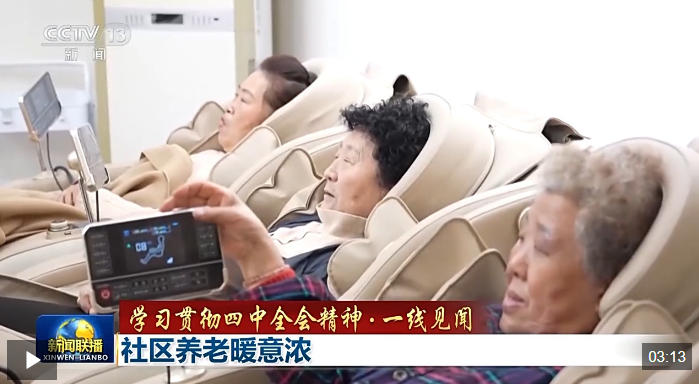
Core Insights - The article emphasizes the proactive measures taken to address the aging population in China, particularly through the development of community-based elderly care services and the integration of new technologies in these services [2][3]. Group 1: Policy and Infrastructure Development - The "14th Five-Year Plan" aims to establish a national basic elderly care service system and accelerate the construction of a three-tier elderly care service system covering urban and rural areas [2]. - By the end of the "14th Five-Year Plan" period, 2,990 elderly-friendly communities and 500 community-based elderly care service networks have been established, with a total of 40,600 elderly care institutions and facilities [2]. - 224,000 households of elderly individuals with special difficulties have completed home modifications for aging in place, and 86,000 meal service points serve over 3 million elderly individuals daily [2]. Group 2: Community Initiatives and Technological Integration - In Lianyungang's Kuihua Community, a resource integration effort led to the establishment of an 800 square meter intergenerational care center, which includes a community canteen, rehabilitation therapy, and cultural activities [2]. - The community has equipped homes of elderly individuals with wheelchairs, nursing beds, smoke detectors, and fall alert devices, showcasing the integration of smart home technology [2]. - New technologies such as smart calling systems and elderly care robots are increasingly entering households, with a growing number of professionals engaging in the silver economy [3]. Group 3: Resident Experiences and Expectations - Residents of Kuihua Community report significant improvements in their quality of life, with affordable smart home installations enhancing their living conditions [3]. - The availability of various interest classes and advanced sports facilities has greatly satisfied the physical and mental needs of the elderly [3]. - There is a strong anticipation for the future of elderly care, with expectations for more information technology and high-tech solutions to be implemented in the community [3][4].
深圳:“老有颐养”激活银发经济活力
Yang Shi Wang· 2025-11-21 13:18
Core Viewpoint - Shenzhen is leveraging its reputation as a "young" city to lead the development of elderly care services, integrating government, market, and social forces to create a comprehensive elderly care ecosystem that enhances public welfare and stimulates domestic demand and industry growth [1][4] Group 1: Elderly Care Services Development - Shenzhen conducts a biannual survey on elderly care service demand, dynamically adjusting a list of 27 basic elderly care services [1] - The city has implemented 51 supportive policies, including planning and tax incentives, to attract significant social capital investment in the elderly care industry, with 85.5% of elderly care institutions being privately operated [1] - There are 6,842 enterprises involved in elderly care across various sectors, including information technology, high-performance materials, and healthcare, forming a complete industrial and supply chain [1] Group 2: Technological Integration in Elderly Care - Shenzhen is seizing opportunities from the new technological revolution to promote the coordinated development of elderly care services and industries [2] - Smart devices, such as AI monitoring systems and portable bathing aids, are being integrated into elderly care facilities to enhance safety and health monitoring [2] - The city is fostering the integration of new technologies and products into elderly care services, thereby invigorating the industry [2] Group 3: Cultural and Financial Empowerment - Shenzhen is transforming the concept of elderly care from "care" to "enjoyment," enabling the elderly to engage in artistic activities through technology [3] - The city has introduced 17 supportive measures to advance financial services related to pensions and elderly care, exploring a path that combines public welfare and marketization [3] - A special fund of 200 million yuan is being utilized for home modifications to enhance elderly living conditions, resulting in 250 million yuan in consumption for elderly-friendly products [3] Group 4: Comprehensive Elderly Care System - Shenzhen is building a comprehensive elderly care service system that includes home, community, and institutional support [4] - The city is enhancing its smart monitoring systems and community service stations to provide timely responses and specialized care for the elderly [4] - The integration of medical and nursing services is prioritized, with a focus on improving the quality of elderly care services across various dimensions [4]
“十四五”以来河北累计投入4.5亿元专项资金支持环京养老服务高质量发展
Zhong Guo Xin Wen Wang· 2025-11-21 09:15
Group 1 - Hebei Province has invested a total of 450 million RMB in special funds to support the high-quality development of elderly care services around Beijing since the start of the 14th Five-Year Plan [1] - During the 14th Five-Year Plan period, 21 cooperation agreements have been signed in the civil affairs sector among Beijing, Tianjin, and Hebei, promoting mutual support and collaborative development [1] - The "same quality and standard" principle is being implemented to advance the coordinated development of elderly care services in the Beijing-Tianjin-Hebei region across six aspects: projects, policies, talent, medical care, regional, and industry [1] Group 2 - The Xiong'an New Area is becoming a key part of the coordinated development of the Beijing-Tianjin-Hebei region, with a solid foundation for people's livelihoods being established [2] - Nine national social organizations, including the China Aerospace Information and Satellite Internet Innovation Alliance, have settled in Xiong'an, driving the gathering of technology, industry, and talent [2] - The aerospace information industry has become the first relatively complete innovation chain in Xiong'an, with 184 project cooperation intentions reached through the "Xiong'an Tour" of 100 social organizations from the Beijing-Tianjin-Hebei region [2]
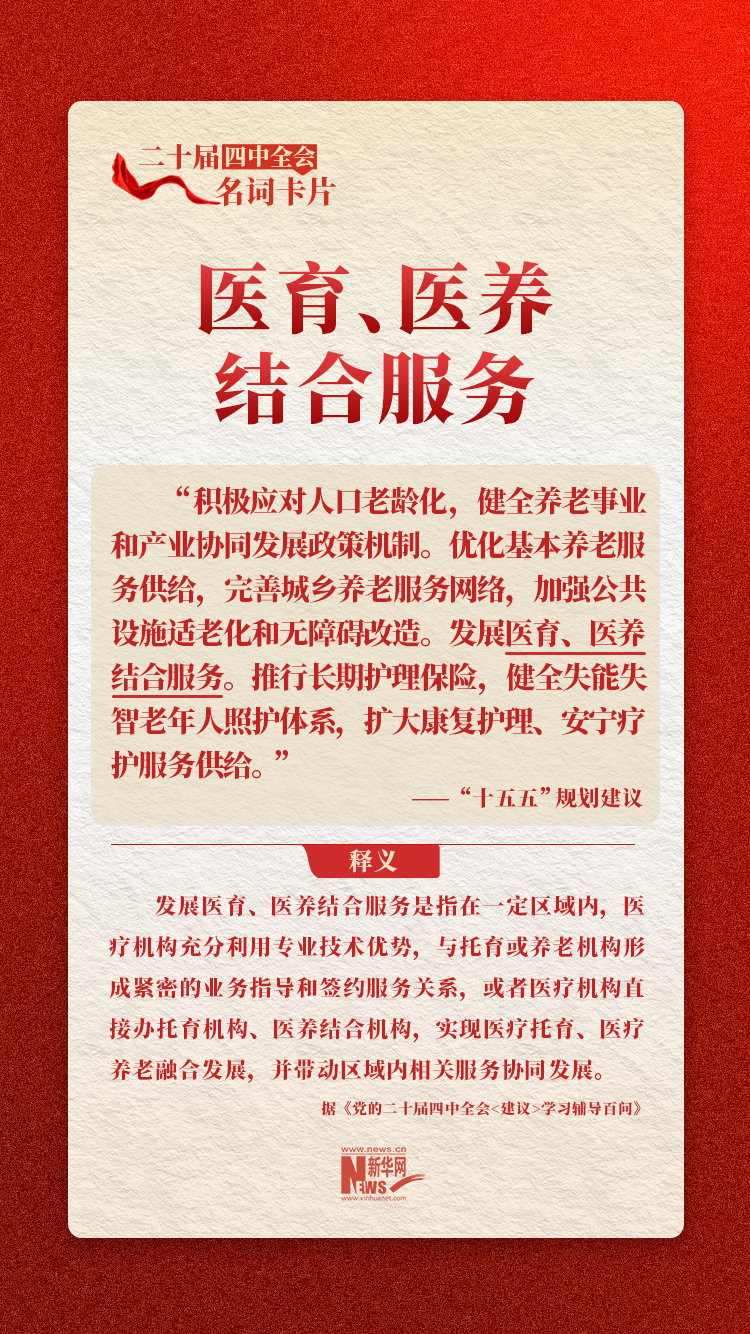
二十届四中全会名词卡片:医育、医养结合服务
Xin Hua Wang· 2025-11-21 05:44
Core Viewpoint - The article emphasizes the importance of developing integrated medical and elderly care services to address the challenges posed by an aging population, highlighting the need for a coordinated policy framework and collaborative service networks [2][4]. Group 1: Development Strategies - The "14th Five-Year Plan" suggests enhancing the quality of childcare and elderly care services through various measures, including improving basic service supply and optimizing the urban-rural elderly care service network [2][4]. - It advocates for the establishment of a collaborative service network involving multiple healthcare institutions to share resources and enhance service efficiency [5][6]. - The plan includes the formation of clear operational management mechanisms to define responsibilities and ensure effective service delivery [5][6]. Group 2: Implementation Measures - The article outlines the need for inter-departmental collaboration among various government sectors, such as health, education, and social services, to create supportive policies and expand service availability [4][5]. - It highlights the importance of integrating medical services with community health initiatives, ensuring that healthcare providers can offer comprehensive support to both children and the elderly [6]. - The establishment of a safety net for service delivery is crucial, involving regulatory oversight and quality assessment to maintain high standards in integrated care facilities [6].