
清洁能源

Search documents
俄乌战火烧出能源 “三权” 阴谋!转型时刻,中国要当新话事人?
Sou Hu Cai Jing· 2025-09-20 11:48
Core Insights - The article discusses the geopolitical dynamics of energy, emphasizing the "three rights" framework: resource rights, channel rights, and market rights, which are central to energy control and influence [1][3][5] - The ongoing conflict between Russia and Ukraine highlights the interplay of these rights, with Russia holding resource rights, Ukraine controlling transit channels, and the EU and the US exerting market influence [3][5] - The rise of clean energy is reshaping the traditional energy landscape, suggesting a shift in the core competitive advantage from resource ownership to manufacturing capabilities, particularly for China [7][13] Energy Geopolitics - The "three rights" framework simplifies the complex nature of energy trade, which often involves ideological and military alliances, but remains a crucial lens for understanding energy interactions [3][5] - The conflict's roots lie in geopolitical security issues, with energy rights acting as a significant factor in the escalation of tensions [3][5] Clean Energy Transition - Clean energy is not expected to replace traditional energy sources instantly but is seen as a long-term trend that will gradually alter the geopolitical landscape [7][13] - The cost of clean energy technologies has significantly decreased, with China's photovoltaic electricity cost dropping over 90% since 2010, indicating a shift in competitive dynamics [7][9] Manufacturing Capabilities - China's manufacturing capabilities in clean energy are extensive, covering the entire supply chain from raw materials to finished products, which provides resilience against potential supply chain disruptions [8][9] - Despite concerns about reliance on imported core materials, China's increasing self-sufficiency in polysilicon and wind turbine components indicates progress in reducing vulnerabilities [9][10] US Energy Landscape - The US maintains a strong position in traditional energy with significant investments in oil and gas, but its clean energy manufacturing capabilities lag behind China's [10][11] - The US faces challenges in transitioning to a clean energy-centric model due to entrenched interests in fossil fuels and a lack of domestic manufacturing capacity for clean energy technologies [11][13] Future Outlook - The article posits that China's ability to adapt to the new energy landscape and overcome technological challenges will be crucial for enhancing its geopolitical influence in the clean energy sector [13] - The historical context of energy transitions suggests that adaptability to new energy paradigms will determine future competitive advantages [13]

2025山东清洁能源产业博览会圆满闭幕 打造产业发展新引擎
Qi Lu Wan Bao· 2025-09-20 09:52
Core Insights - The 2025 Shandong Clean Energy Industry Expo successfully concluded, focusing on "Developing Clean Energy and Sharing a Low-Carbon Future," and served as a significant platform for innovation and collaboration in the clean energy sector [1][5] - The expo attracted over 300 exhibitors, covering an area of 50,000 square meters, showcasing advanced technologies and equipment across the entire clean energy value chain [2] Industry Overview - The event was co-hosted by various governmental and industrial organizations, highlighting its importance in the clean energy landscape of Northern China [2] - Major industry players, including China National Nuclear Corporation and China Huaneng Group, participated, demonstrating advancements in wind, solar, storage, offshore energy, hydrogen, and nuclear energy [2] Networking and Collaboration - The expo featured 12 professional exchange meetings and matchmaking activities, facilitating discussions on key topics such as green innovation and battery storage technology [3] - Nearly 800 representatives from government, academia, and enterprises participated, leading to multiple cooperation intentions in new energy systems and technology transfer [3] Public Engagement and Education - The expo incorporated a "Science + Popularization" dual-drive concept, with a focus on nuclear energy education, effectively bridging the gap between the public and clean energy [4] - Yantai has initiated a five-year plan for nuclear energy public education, hosting over 30 events to promote awareness and understanding of nuclear energy [4] Future Directions - The expo reinforced Yantai's position as a hub for clean energy in Northern China, aiming to accelerate the development of a new energy system focusing on nuclear, wind, solar, hydrogen, and storage [4][5] - The outcomes of the expo are expected to support the dual carbon goals and contribute to the green transformation of traditional industries in Shandong [5]
美媒:清洁能源,美国缺少中国的制胜法宝
Huan Qiu Shi Bao· 2025-09-20 05:50
Core Insights - China is leading the global clean energy sector, with significant advancements in solar, wind, and electric vehicle manufacturing, while the U.S. is lagging behind due to outdated energy policies [1][2] - The competitive gap between U.S. and Chinese companies in clean energy is likened to an NBA game where the U.S. is trailing by 30 points in the fourth quarter [1] - China's dominance is supported by a coherent policy framework that fosters domestic demand and supply chain innovation, controlling over 50% of global electric vehicle production, 70% of wind turbine capacity, and 80% of solar panel manufacturing [1][2] Industry Analysis - The U.S. energy policy is characterized by political volatility, leading to inconsistent support for clean energy initiatives, which contrasts with China's stable approach [2][3] - The International Energy Agency notes a significant increase in clean energy transition spending over the past five years, driven by energy security concerns rather than solely climate issues [2] - China's efforts to reduce dependence on oil and gas imports while leading in new technologies are reshaping the global energy landscape [2] Future Implications - As the U.S. withdraws from international climate agreements, China is expected to take a dominant role in future global climate initiatives, potentially strengthening its climate commitments [2] - The political landscape in the U.S. may hinder substantial progress in clean energy, while China's lack of ideological division in energy policy allows for more consistent advancements [3]
美股牛市逻辑依然稳固?业绩指引稳步上调,财报季有望继续赚足“预期差”
Zhi Tong Cai Jing· 2025-09-19 11:13
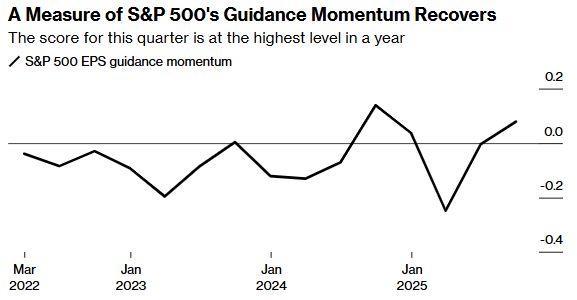
Group 1 - The US stock market is currently at historical highs, with improved expectations for corporate profit growth indicating that the upward trend may continue [1][3] - Over 22% of S&P 500 companies providing Q3 earnings guidance expect to exceed analyst expectations, the highest level in a year, while the proportion of companies issuing lower-than-expected profit guidance is at a four-year low [1][3] - Analysts predict a 6.9% growth in earnings for S&P 500 companies in Q3, up from 6.7% at the end of May, reflecting increased confidence in companies' ability to withstand the impact of tariffs [3] Group 2 - Factors driving profit growth include the Federal Reserve's upcoming interest rate cuts, which are expected to enhance corporate profit margins and performance [4][5] - Historical data shows that in the second year of a rate-cutting cycle, the S&P 500 index typically sees an average increase of nearly 27%, compared to 14% in the first year, assuming no economic recession occurs [4] - Lower interest rates historically support earnings by promoting consumer spending, capital investment, mergers and acquisitions, and stock buybacks [5] Group 3 - Companies in capital equipment, transportation, and building materials are viewed as the biggest beneficiaries of lower interest rates, with additional upside potential in the automotive, clean energy, utilities, real estate, and technology sectors [5] - Most industries are expected to receive broad support for stock valuations, particularly those with high debt leverage, interest-sensitive operations, or capital-intensive business models [5]
广东建工(002060) - 002060广东建工投资者关系管理信息20250919
2025-09-19 09:38
Group 1: Company Strategy and Operations - The company emphasizes a dual main business strategy of construction and clean energy investment, aiming for synergistic development [3] - It plans to leverage its qualifications to increase project undertakings and expand its clean energy generation business [3] - The company is committed to improving operational performance and increasing shareholder returns through effective management and communication with investors [4] Group 2: Investor Relations and Communication - The company prioritizes cash dividends and actively engages with investors to communicate its investment value [4] - It conducts regular investor activities, including online Q&A sessions, to address investor concerns and enhance transparency [2] - The company acknowledges the impact of macroeconomic policies and provincial government projects on its market value management [3] Group 3: Market Performance and Shareholder Concerns - There has been a noted decline in company performance and shareholder dividends since the merger with Guangdong Water and Electricity [3] - The company is aware of stock price fluctuations influenced by industry trends and macroeconomic conditions, and it has not engaged in stock buybacks [4] - The upcoming release of 2.191 billion restricted shares is anticipated to affect the stock price [4]

中国科学院院士张人禾:1.5℃温控目标下 气候变化加快行业格局重塑
2 1 Shi Ji Jing Ji Bao Dao· 2025-09-19 06:34
Core Insights - Extreme weather is becoming a new economic variable, with 2024 projected to be the first year to exceed the 1.5℃ target set by the Paris Agreement [1][6] - Human activities are directly linked to the significant rise in carbon dioxide concentrations and climate warming over the past century, necessitating stronger emission reduction measures to meet climate goals [3][6] Group 1: Climate Change and Human Activity - The rapid increase in carbon dioxide levels over the last century is unprecedented in Earth's history, confirming a direct correlation with human activities [3][4] - Distinguishing between natural climate variability and human-induced changes is crucial for accurate climate assessments and effective policy decisions [5][6] Group 2: Impact on Industries - The energy sector is most affected by climate change, with fossil fuel combustion accounting for over 80% of total carbon emissions, driving a shift towards clean energy [8][9] - Other sectors like transportation, retail, and manufacturing are also significantly impacted, particularly by extreme weather events that alter demand patterns [9][10] Group 3: Risk Management and Opportunities - Companies can mitigate risks from climate change by transitioning to clean energy and utilizing weather forecasts to adjust production and supply chain strategies [10][12] - Enhanced weather prediction capabilities are essential for industries to anticipate extreme weather and optimize resource allocation [10][12] Group 4: Technological Advancements - Key technological developments in monitoring and forecasting are necessary to accurately assess atmospheric carbon levels and predict extreme weather events [11][12] - Improved forecasting for renewable energy sources like solar and wind is critical for optimizing energy production and usage [13]

英欢呼“2500亿英镑横跨大西洋”
Huan Qiu Shi Bao· 2025-09-19 02:57
Group 1: Agreement Overview - The US and UK signed a "Technology Prosperity Agreement" to enhance cooperation in advanced technology fields such as artificial intelligence, quantum computing, and nuclear energy [1][2] - The agreement is described as the largest investment plan of its kind in UK history, with a total investment of £250 billion, which includes both US investments in the UK and UK investments in the US [1][2] Group 2: Investment Details - Approximately £150 billion of investment is expected from US companies, with Blackstone Group committing £90 billion over the next decade, including £10 billion for AI data centers [2] - The agreement is projected to create over 7,600 high-quality jobs across various sectors in the UK, including clean energy and biotechnology [2] Group 3: Company Contributions - Microsoft announced a £22 billion investment in AI infrastructure in the UK, marking its largest investment commitment outside the US [3] - Nvidia plans to deploy 120,000 advanced GPU chips in the UK, its largest deployment in Europe to date [3] - Google is set to open a data center in Hertfordshire as part of a £5 billion investment plan over two years [3] Group 4: Economic Context and Reactions - The investments are seen as a testament to the UK's economic strength and a signal of its ambition and leadership [2] - There are criticisms regarding the substance of these investments, with some viewing them as pre-existing plans rather than new commitments [3] - A recent poll indicated that 45% of the UK population viewed Trump's visit negatively, highlighting the political context surrounding the economic discussions [3]


英国欢呼:2500亿英镑横跨大西洋
Huan Qiu Shi Bao· 2025-09-19 01:29
Group 1 - The core agreement signed between the US and UK is the "Technology Prosperity Agreement," aimed at enhancing cooperation in advanced technology fields such as artificial intelligence, quantum computing, and nuclear energy [1][2] - The total investment announced is reported to be £250 billion, which includes both US investments in the UK and UK investments in the US, marking it as a record-breaking investment initiative [1][2] - The agreement is expected to create over 7,600 high-quality jobs across various sectors in the UK, with significant contributions from major US companies like Blackstone, Google, and Microsoft [2][3] Group 2 - Blackstone has committed to investing £90 billion in the UK over the next decade, with £10 billion specifically allocated for building AI data centers [2] - Microsoft plans to invest £22 billion in the UK's AI infrastructure, marking its largest investment outside the US to date [3] - Nvidia will deploy 120,000 advanced GPU chips in the UK, representing its largest deployment in Europe [3] Group 3 - There are concerns regarding the actual impact of these investments, with critics suggesting that they may not significantly alter the current lack of external funding driving economic growth in the UK [3] - The UK government is actively promoting the economic benefits of this visit to counter negative public sentiment towards Trump's presence, as a recent poll indicated that 45% of the British public viewed the invitation as a mistake [3][4] - Discussions between Trump and UK Prime Minister Starmer also included contentious topics such as tariffs on steel and aluminum, as well as geopolitical issues like the situation in Ukraine and the recognition of Palestine [4]
地缘经济论 | 第三章 能源:地缘的“三权演义”
中金点睛· 2025-09-18 23:37
Core Viewpoint - The article discusses the complex interplay between energy resources and geopolitical factors, particularly focusing on the "three rights" framework: resource rights, channel rights, and market rights, and how these dynamics are influenced by events like the Russia-Ukraine conflict and U.S. energy policies under Trump [2][3]. Group 1: Three Rights Framework - The three rights framework consists of resource rights (control over resources), channel rights (control over transportation routes), and market rights (influence over market behavior and pricing) [5][12]. - Resource rights are derived from the geographical concentration of energy resources, with a few countries holding significant shares, leading to geopolitical tensions [7][8]. - Channel rights are crucial due to the reliance on international trade for resource distribution, with geopolitical issues often affecting transportation routes [9][10]. - Market rights encompass pricing power and trade rights, with historical shifts in control between supplier and consumer nations impacting global energy markets [12][13]. Group 2: Impact of Russia-Ukraine Conflict - The Russia-Ukraine conflict has roots in energy disputes, particularly regarding natural gas, with Russia, Ukraine, the EU, and the U.S. engaged in a prolonged struggle for the three rights [20][23]. - The conflict has led to significant changes in energy supply dynamics, with Europe seeking to diversify its energy sources away from Russian gas [27][28]. - Post-conflict, Russia has shifted its focus to Asian markets, particularly China, which has become a major customer for Russian oil, altering the global energy trade landscape [28][29]. Group 3: U.S. Energy Policy under Trump - Trump's energy policy aimed to enhance U.S. energy dominance by increasing oil and gas production, thereby consolidating resource, channel, and market rights [32][34]. - The policy included measures to reduce regulations on energy production and to leverage energy exports as a tool for geopolitical influence [35][36]. - The impact of these policies has been mixed for China, potentially lowering energy costs while also creating competitive pressures on Chinese energy projects abroad [37][38]. Group 4: Clean Energy and Future Opportunities - The transition to clean energy is seen as a critical factor for future geopolitical dynamics, with countries that can secure cheap and abundant energy likely to gain competitive advantages [40][41]. - China's advancements in clean energy technology and manufacturing capabilities position it favorably in the upcoming energy revolution, potentially reshaping its role in global energy markets [40][41].

赫美集团:2025年上半年公司深化“清洁能源”和“零售消费”双轨战略
Zheng Quan Ri Bao Wang· 2025-09-18 11:13
Core Viewpoint - The company is focusing on a dual strategy of "clean energy" and "retail consumption" in the first half of 2025, aiming to enhance its operational capabilities and profitability through strategic project advancements [1] Group 1: Clean Energy Strategy - The energy business will concentrate on advancing projects related to wind and solar energy for green hydrogen and green alcohol production [1] - The optimization of integrated energy station operations and the refined management of hydrogen-powered shared bicycles are key components of the strategy [1] - The progression of these clean energy projects is expected to improve the company's industrial structure and strategic layout in the renewable energy sector [1] Group 2: Retail Consumption Strategy - The commercial retail business will primarily focus on the domestic consumer market, engaging in the retail of international brand apparel, footwear, bags, and other goods [1] - The emphasis on the domestic market is aimed at capitalizing on consumer demand and enhancing the company's market presence [1] Group 3: Future Outlook - The company anticipates that if market conditions align with expectations, it will further enhance its sustainable operational capabilities and profitability [1] - The overall goal is to achieve healthy and sustainable development for the company in the long term [1]
