
人工智能

Search documents
为何这一轮硬科技独角兽背后,都有美团?
Sou Hu Cai Jing· 2026-03-30 03:01
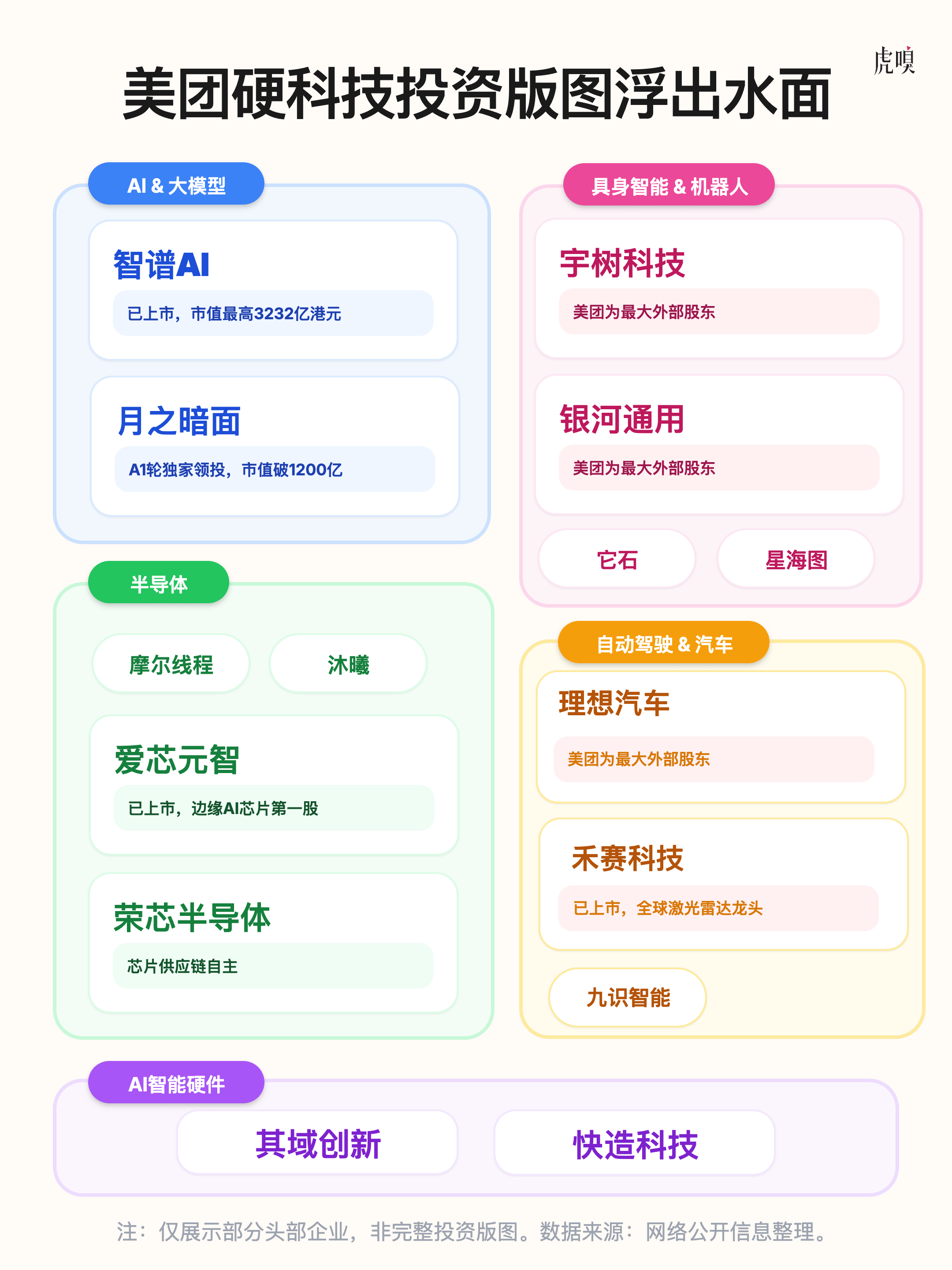
Group 1 - The core focus of Meituan's investment strategy has shifted from "Food + Platform" to "Retail + Technology," with a significant emphasis on hard technology investments since 2020 [15][16] - Meituan has consistently invested in hard technology projects, with over half of its annual investments directed towards this sector [15][16] - The company has established a comprehensive AI robotics landscape through sustained investments in leading firms such as Yushutech, Galaxy General, and various AI model companies [14][16] Group 2 - Meituan's investment approach is characterized by early and continuous funding in emerging sectors, rather than waiting for market trends to dictate involvement [16] - The company aims to leverage AI as a strategic opportunity to enhance its core local services, rather than merely pursuing financial returns from investments [16][17] - Meituan's CEO has articulated a vision to create an "AI foundation for the physical world," emphasizing an offensive strategy in the AI revolution [16][17]


「龙虾之父」吐槽人类互联网后,终于有人把这当个事儿办了
机器之心· 2026-03-30 03:00
Core Viewpoint - The article discusses the evolving role of AI in internet usage, emphasizing the need for infrastructure that is friendly to AI agents, as current systems are not optimized for their operation [1][5][19]. Group 1: Current Internet Challenges for AI Agents - The current internet infrastructure is not designed for AI agents, leading to inefficiencies such as low success rates in tool usage and high operational costs [4][16]. - AI agents face significant hurdles, including verification processes and a lack of seamless tool integration, which hampers their ability to perform tasks efficiently [4][15]. - The success rate of AI agents in calling external tools is only 60%, and this drops to below 30% with multiple steps, highlighting the inadequacy of current systems [4][16]. Group 2: The Need for Agent-Friendly Infrastructure - Peter Steinberger's insights indicate that the next generation of internet infrastructure must be rebuilt to accommodate AI agents, addressing issues like access restrictions and tool compatibility [5][19]. - The concept of "Agent Internet Infra" is introduced, focusing on creating a network that allows AI agents to discover, connect, and collaborate effectively [17][19]. - Companies like Cloudflare and Google are beginning to address these challenges, but the overall market for agent-friendly infrastructure remains in its early stages [17][19]. Group 3: AgentEarth's Approach - AgentEarth, led by Liu Hongtao, aims to create a robust infrastructure that prioritizes AI agents as the primary users, shifting the focus from human-centric design to task efficiency [19][28]. - The company plans to implement a single gateway for external service access, ensuring that AI agents can utilize pre-selected, high-quality tools without trial and error [23][24]. - AgentEarth's proprietary transmission protocol is designed to significantly enhance data transfer speeds, outperforming existing solutions like Google's QUIC by 2-10 times [24][25]. Group 4: Market Potential and Future Outlook - The emergence of the Agent Internet is expected to redefine market dynamics, allowing for the deployment of numerous AI agents capable of running multiple tasks simultaneously [27][28]. - The potential for new companies to arise in this space is significant, as foundational issues remain unaddressed, creating opportunities for innovative solutions [27][28]. - AgentEarth has positioned itself well in this nascent market, leveraging its unique team expertise and early recognition of the need for agent-focused infrastructure [28][29].

AI虚拟代谢:西湖大学李子青团队联合上海人工智能实验室、百图生科和上海创智学院提出AI虚拟细胞代谢研究范式
合成生物学与绿色生物制造· 2026-03-30 02:56
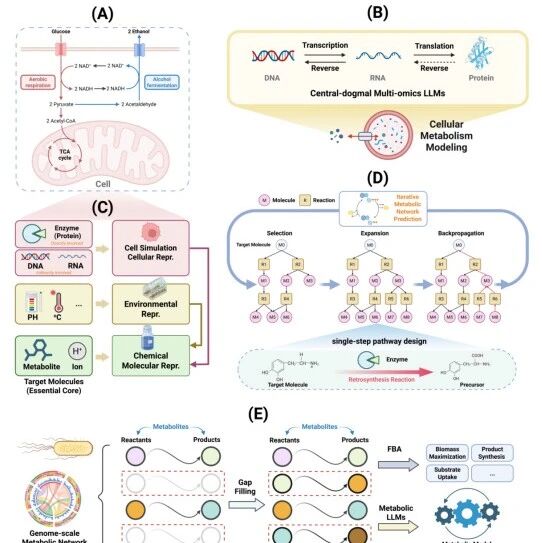
Core Viewpoint - The article introduces the groundbreaking concept of "AI Virtual Metabolism" (AIVM), establishing a new research paradigm driven by "AI + multi-omics" for reconstructing metabolic networks, which fills a significant gap in the field of virtual metabolism research [4][5]. Group 1: Challenges in Metabolic Pathway Reconstruction - The traditional biochemical reconstruction methods are limited by the scarcity of experimental data, making it difficult to address highly branched metabolic pathways and complex regulatory mechanisms [5]. - Existing AI methods primarily focus on static, template-based chemical reaction predictions and fail to simulate the dynamic processes within living organisms [5]. - A major challenge is enabling AI to not only predict chemical bond formations and breakages but also to understand enzyme specificity, thermodynamic boundaries, and complex system regulations [5]. Group 2: AIVM Core Paradigm - AIVM is a novel conceptual framework that integrates three dimensions: 1. Deep integration of AI and multi-omics, utilizing large language models trained on genomic, transcriptomic, proteomic, and metabolomic data for hierarchical representation of cellular functions [7]. 2. Strict biological constraint filters that ensure generated metabolic pathways are biologically feasible by incorporating enzyme specificity and thermodynamic feasibility [7]. 3. Expansion from single-pathway design to whole-genome models, allowing dynamic simulation and optimization of entire cellular metabolic networks [7]. Group 3: Future Vision - The introduction of AIVM signifies a shift in metabolic engineering research from "rule-driven" to "discovery-driven," positioning AI as a true "AI metabolic scientist" rather than just a supportive tool [8]. - By coupling multi-omics features with the topology of genome-scale metabolic models (GEMs), AI agents can autonomously propose new metabolic pathway hypotheses and recommend enzyme modification strategies [8]. - This paradigm is a crucial step towards achieving a complete virtual cell, providing new perspectives for understanding life processes and supporting microbial chassis optimization, green manufacturing of high-value compounds, and precision medicine [8]. Group 4: Conclusion - The work demonstrates the immense potential of AI for Science in the life sciences, marking a transition from data scarcity to paradigm establishment [9]. - Although fully replacing wet lab experimentation will take time, AIVM has outlined a future vision of a programmable, modular, and biologically compliant "virtual cell" [9]. - The article emphasizes the importance of integrating gene regulatory capabilities validated by the Virtual Cell Challenge (VCC) with the metabolic reconstruction capabilities defined by AIVM to approach a "living" digital twin of a cell [9].
深度|马斯克万字访谈豪言:明年实现AGI,人形机器人数量将十倍于人类,我们将迎来全民高收入时代
Z Potentials· 2026-03-30 02:54
Core Insights - The conversation between Elon Musk and Peter Diamandis focuses on advancements in AI, robotics, and the future economic landscape, emphasizing the potential for a post-scarcity society with universal high income driven by technological progress [4][8][26]. Group 1: AI and Robotics Developments - Elon Musk indicates that the field of AI is currently in a "hard takeoff" phase, with significant breakthroughs occurring rapidly, potentially leading to AGI (Artificial General Intelligence) by 2027 [8][12]. - The Optimus 3 robot is nearing completion and is expected to be the most advanced robot globally, with production starting in the summer of this year and scaling up to mass production by next summer [24][25]. - Musk highlights that Grok, their AI model, is performing exceptionally well, particularly in predictive capabilities, and aims to enhance coding abilities by mid-year [13][24]. Group 2: Economic Predictions - Musk predicts that the global economy could grow tenfold within the next ten years, contingent on the absence of major global conflicts [19][20]. - The anticipated economic growth is expected to lead to a scenario where the production of goods and services far exceeds the money supply, resulting in deflation and a potential shift towards a post-capitalist society where currency loses its significance [27][28]. Group 3: Future of Work and Society - The discussion suggests that as AI and robotics take over production, humans may find themselves with less work to do, leading to a need for new economic models that support universal basic income or similar systems [26][27]. - Musk expresses optimism about the future, suggesting that the advancements in AI and robotics could significantly improve quality of life, including healthcare, and that the challenges ahead will require a balance of optimism and realism [35][36].


“杭州六小龙”群核科技通过港交所聆讯 2025年已实现盈利
Zheng Quan Ri Bao Wang· 2026-03-30 02:48
Core Viewpoint - Manycore Tech Inc. has successfully passed the Hong Kong Stock Exchange listing hearing, marking a significant step towards its IPO process, with Morgan Stanley and CCB International as joint sponsors [1] Group 1: Company Overview - Manycore Tech Inc. is recognized as a "unicorn" in the space intelligence sector and is set to become the first technology company among the "Hangzhou Six Little Dragons" to complete an IPO if successful [2] - The company owns the world's largest space design platform "CoolJia" and its overseas version "Coohom," along with the next-generation space intelligence solution "SpatialVerse," which caters to both real-world and virtual environments [3][4] Group 2: Business Model and Strategy - Manycore Tech has developed a business flywheel system consisting of "space editing tools - space data - space large models," transitioning from a cloud-native space design software provider to a space intelligence service provider [4] - The company is positioned at the forefront of the emerging trend of AI extending from 2D to 3D interactions, with a focus on the digitalization of the physical world as a crucial foundation for deep AI and real-world interactions [4] Group 3: Financial Performance and Projections - Manycore Tech has shown steady revenue growth over the past three years, projecting a revenue of 820 million yuan in 2025, with a gross margin of 82.2% [5] - The company anticipates a significant turning point in 2025, achieving adjusted net profits of 57.1 million yuan, marking its transition from loss to profitability [5] Group 4: Research and Development - From 2023 to 2025, Manycore Tech plans to invest over 1 billion yuan in R&D to strengthen its technological capabilities, significantly enhancing development efficiency and productivity through deep AI applications [5] - The company has launched various AI-related vertical solutions, including a 3D AI design tool that replaces traditional photography for cross-border e-commerce, projected to see a 123% revenue increase in 2025 [5] Group 5: IPO Fund Utilization - The net proceeds from the IPO will primarily be used for international expansion, enhancing existing product functionalities, launching new products, domestic sales and marketing, investing in core technologies, and general corporate purposes [6]

STAR-Magic 突变:富士通团队提出高效逻辑模拟旋转门协议,加速早期容错量子计算进程
GUOTAI HAITONG SECURITIES· 2026-03-30 02:45
Investment Rating - The report does not explicitly provide an investment rating for the industry Core Insights - The technology industry experienced a total of 124 financing events from March 21 to March 27, 2026, with 98 events in the domestic market and 30 in the international market, highlighting significant activity in advanced manufacturing, artificial intelligence, and enterprise services [10] - The semiconductor, automotive electronics, artificial intelligence, and metaverse indices saw declines of 2.29%, 2.17%, 2.44%, and 3.60% respectively, indicating a downward trend in these sectors [24] - Notable advancements in semiconductor technology include the development of medium-scale integrated circuits based on p-type 2D semiconductors, which could enhance the performance and integration of future electronic devices [33][34][37] Summary by Sections Financing Overview - A total of 124 financing events occurred, with advanced manufacturing leading at 53 events, followed by artificial intelligence with 32 events, and enterprise services with 8 events [10] IPO Updates - Zhejing Electronics listed on the Hong Kong main board on March 24, 2026, focusing on automotive visual interaction systems, ranking second in the Chinese HUD market by sales volume [12][13] - Guomint Technology also listed on the Hong Kong main board on March 23, 2026, specializing in integrated circuit design for smart terminals, ranking third in the global 32-bit MCU market among Chinese companies [16][17] - Star Ring Technology submitted an IPO application on March 25, 2026, aiming to become a leading provider of AI infrastructure software in China [19][20] - Extreme Fly Technology submitted an IPO application on March 26, 2026, focusing on agricultural robotics and ranking second in the global agricultural robot market [22][23] Market Performance Tracking - The overall market indices showed declines, with the Shanghai Composite Index down 1.09% and the Shenzhen Component Index down 0.76% [24] - The semiconductor index had a PE ratio of 137.13, while the automotive electronics index had a PE of 33.22, both reflecting a decrease from the previous week [28][29] Advanced Semiconductor Developments - Research from Hunan University on p-type 2D semiconductors indicates potential for medium-scale integrated circuits, addressing challenges in manufacturing scale and device performance [33][34] - Khalifa University demonstrated a microwave synthesis method for α-MoO3 crystals, which could enhance the efficiency and scalability of semiconductor production [39][40] - A study from the Netherlands on microfluidic cooling solutions for power devices suggests significant improvements in thermal management for high-density applications [45]
20万条4D交互数据+运动学锚定,南洋理工让生成式仿真不再「脑补」机器人动作
量子位· 2026-03-30 02:35
Core Viewpoint - The article discusses the development of Kinema4D, a high-fidelity 4D embodied simulator created by NTU MMLab, which aims to enhance robot-environment interaction modeling by overcoming the limitations of traditional simulators and 2D video generation models [2][3]. Background and Challenges - Robot-environment interaction simulation is crucial for data augmentation, policy evaluation, and reinforcement learning in embodied intelligence. Traditional physical simulators face challenges such as insufficient visual realism and reliance on preset physical rules, making them difficult to scale to complex new scenarios [7]. - Recent efforts have utilized video generation models to synthesize robot-environment interactions, bypassing cumbersome physical modeling [8]. - Existing generative simulation methods have key deficiencies, including: 1. Dimensional limitations, as most models are confined to 2D pixel space, lacking the necessary 4D spatiotemporal constraints. 2. Insufficient accuracy due to reliance on high-level language instructions and static environment priors, leading to imprecise control and dynamic guidance [9]. Core Method - Kinema4D's core motivation is to ensure precise robot control while restoring the 4D spatiotemporal essence of interactions. It employs a "simulation decoupling" design philosophy, breaking down the interaction process into robot control and resulting environmental changes [13]. - The two supporting insights are: 1. Kinematics-driven precise 4D action representation, ensuring that robot actions in 4D space are physically deterministic and not predicted by the generative model [13]. 2. Controllable generative modeling of environmental responses in 4D, allowing the model to focus on synthesizing dynamic environmental responses rather than modeling the robot's own kinematics [13]. Dataset - The article introduces Robo4D-200k, the largest 4D robot interaction dataset, comprising 201,426 high-fidelity interaction sequences. This dataset integrates diverse real-world demonstration data and synthetic data to provide robust reasoning capabilities for embodied foundational models [17]. Experimental Analysis - Kinema4D has been benchmarked across three dimensions: video generation quality, geometric quality, and downstream policy evaluation. It achieved leading results in video generation quality, outperforming existing models [18]. - In terms of geometric quality, Kinema4D demonstrated superior performance compared to another 4D generative simulator, accurately replicating real trajectory execution effects [22]. - The simulator's results align closely with actual execution performance, showcasing its ability to synthesize successful execution trajectories and accurately identify failure cases, even under out-of-distribution conditions [29]. Summary and Outlook - Kinema4D represents a significant advancement in robot simulation, transitioning from traditional 2D pixel generation to 4D spatiotemporal reasoning. It successfully integrates deterministic mechanical control with dynamic environmental feedback [30]. - The article highlights the potential for Kinema4D to bridge the gap between virtual and real-world applications, showcasing strong zero-shot generalization capabilities. Future exploration may focus on incorporating explicit physical laws into generative networks to address challenges in extreme physical scenarios [30].

软银集团加大对OpenAI的投资,凸显其在AI领域的激进押注
Huan Qiu Wang· 2026-03-30 02:25
Group 1 - SoftBank Group announced a $40 billion bridge loan to increase investment in OpenAI and for general corporate purposes [1] - The bridge loan is unsecured and has a maturity date of March 2027, arranged by banks including JPMorgan, Goldman Sachs, Mizuho Bank, Sumitomo Mitsui Banking Corporation, and MUFG Bank [1] - Following this additional investment, SoftBank's total investment in OpenAI will reach $64.6 billion, with a 13% ownership stake [1] Group 2 - OpenAI has several development locations in the U.S., including a project in Wisconsin in collaboration with Oracle [3] - Microsoft will take over the AI data center expansion project in Abilene, Texas, which OpenAI has abandoned, leading to continued competition between the two companies in adjacent large AI operational facilities [3]


北美电网扩容投资将超750亿美元,中国电力设备迎机遇期【投资前瞻3.30—4.3】
Sou Hu Cai Jing· 2026-03-30 02:09
Macro and Financial - The draft of the Financial Law of the People's Republic of China has been publicly solicited for opinions, marking the first comprehensive foundational law in the financial sector, which aims to enhance coordination among various financial regulations [2] - China's average daily token usage has surged to over 140 trillion, indicating a significant growth in the AI data supply system as the market for data elements continues to evolve [3] - The central government has disclosed financial subsidies for childcare for the first time, with provinces like Guangxi, Guizhou, Hebei, Hunan, and Yunnan receiving between 4 billion to 5 billion yuan, while others received less than 3 billion yuan [3] Capital Market - Rising energy prices have led to expectations of stagflation, prompting central banks to reconsider interest rate hikes, which could negatively impact major asset classes such as stocks, bonds, and gold [5] - The World Gold Council has noted a significant drop in gold prices, reminiscent of the crises in 2008 and 2020, with current market conditions reflecting a risk-averse phase driven by rising bond yields and market volatility [7] - A total of 29 stocks will have their lock-up periods lifted next week, with a total market value of 37.29 billion yuan, indicating a concentrated release of shares [6] Business and Industry - Huawei's Pangu model leader Wang Yunhe has announced his departure, potentially to pursue entrepreneurship in the Agent sector [8] - The International Energy Agency (IEA) has issued a memorandum suggesting measures to conserve oil, including remote work and reduced driving speeds, in response to supply disruptions caused by geopolitical tensions [9] - China Telecom is shifting towards a token-based business model, aiming to integrate technology, talent, and channels to enhance its AI service offerings [10] - Hanwang Technology's chairman has discussed the future of bionic flight technology, emphasizing its potential applications in various sectors and the development of a comprehensive technology platform [11] - The report indicates that the U.S. power grid's decentralized structure is insufficient, pushing for the construction of a 765kV ultra-high voltage network to enhance stability and capacity [12]


未知机构:财联社3月29日电海南自由贸易港民营企业座谈会在海口召开-20260330
未知机构· 2026-03-30 01:40
Summary of the Conference Call Industry Overview - The conference focused on the Hainan Free Trade Port and its development, particularly in the context of artificial intelligence (AI) applications [1] Key Points and Arguments - The provincial departments provided updates on the progress of the Hainan Free Trade Port construction and discussed relevant AI development [1] - The financial and tax policies of the Hainan Free Trade Port were explained, highlighting the supportive regulatory environment for businesses [1] - The first batch of AI application scenarios in Hainan was announced, indicating a commitment to integrating AI into various sectors [1] - Representatives from 15 private enterprises, including SF Express, Dongchao Technology, BGI, and SenseTime, participated in discussions aimed at enhancing the application of AI technologies [1] - The focus was on strengthening scenario-driven approaches, deepening ecological collaboration, and accelerating the implementation of AI technologies to improve industry quality and efficiency [1] Additional Important Content - The conference emphasized the importance of collaboration among private enterprises to leverage AI for industrial enhancement [1] - The discussions underscored the role of AI in driving innovation and efficiency within the Hainan Free Trade Port [1]