
电力行业

Search documents
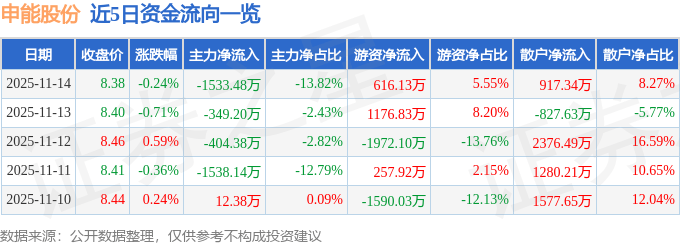
股票行情快报:申能股份(600642)11月14日主力资金净卖出1533.48万元
Sou Hu Cai Jing· 2025-11-14 11:51
Group 1 - The core point of the news is the performance and financial metrics of Sheneng Co., Ltd. (stock code: 600642), highlighting its stock price, trading volume, and capital flow on November 14, 2025 [1] - On November 14, 2025, Sheneng Co., Ltd. closed at 8.38 yuan, down 0.24%, with a trading volume of 132,100 hands and a total transaction amount of 111 million yuan [1] - The net outflow of main funds was 15.33 million yuan, accounting for 13.82% of the total transaction amount, while retail investors had a net inflow of 9.17 million yuan, representing 8.27% of the total transaction amount [1] Group 2 - Sheneng Co., Ltd. has a total market value of 41.012 billion yuan, which is lower than the industry average of 42.62 billion yuan, ranking 18th out of 83 companies in the power industry [2] - The company reported a net profit of 3.315 billion yuan for the first three quarters of 2025, showing a year-on-year increase of 1.04%, while its main revenue decreased by 6.44% to 20.932 billion yuan [2] - The third quarter of 2025 saw a single-quarter net profit of 1.238 billion yuan, up 13.64% year-on-year, despite a decline in main revenue by 8.27% to 7.974 billion yuan [2] Group 3 - In the last 90 days, eight institutions have rated Sheneng Co., Ltd., with four buy ratings and four hold ratings, and the average target price set by institutions is 9.84 yuan [3] - The capital flow analysis indicates that the stock price's upward or downward movement influences the net capital inflow or outflow, with main funds defined as large orders, while retail funds are categorized as smaller orders [3]


双融日报-20251114
Huaxin Securities· 2025-11-14 01:33
Core Insights - The report indicates that the current market sentiment score is 85, categorizing it as "overheated," suggesting a strong upward trend in the market [6][8][20] - The report highlights three key investment themes: outdoor sports, electric power equipment, and energy storage, each supported by recent government initiatives and market trends [6][8] Outdoor Sports Theme - The National Development and Reform Commission, along with five other departments, has announced support for 49 regions, including Beijing's Pinggu District, to develop high-quality outdoor sports destinations, aiming to enhance the outdoor sports industry nationwide [6] - Related stocks include Sanfu Outdoor (002780) and Ying Shi Innovation (688775) [6] Electric Power Equipment Theme - The International Energy Agency (IEA) predicts that global data center electricity consumption will double by 2030, with China's State Grid's fixed asset investment exceeding 420 billion yuan in the first nine months of this year, a year-on-year increase of 8.1% [6] - The annual investment scale is expected to surpass 650 billion yuan for the first time [6] - Related stocks include Guodian Nanzi (600268) and China Western Electric (601179) [6] Energy Storage Theme - The domestic "New Energy Storage Special Action Plan" aims for an installed capacity of 180 million kilowatts by 2027, attracting direct investments of 250 billion yuan [6] - Policies are expected to raise project IRR to over 8%, shifting investment from "mandatory storage" to "proactive profit" [6] - Overseas orders are projected to surge by 220% year-on-year in the first half of 2025, reaching 160 GWh [6] - Related stocks include CATL (300750) and Sungrow Power (300274) [6] Market Capital Flow - The report lists the top ten stocks with the highest net inflow, with CATL leading at approximately 264.67 million yuan [9] - The top ten stocks with the highest financing net purchases also feature CATL, indicating strong investor confidence [11] Industry Trends - The report provides insights into the net inflow and outflow of funds across various industries, highlighting significant inflows in electric power equipment and non-ferrous metals, while sectors like electronics and pharmaceuticals experienced notable outflows [15][21]

双融日报-20251113
Huaxin Securities· 2025-11-13 01:31
Market Sentiment - The current market sentiment score is 48, indicating a "neutral" state. Historical trends suggest that when the sentiment score is below or close to 50, the market tends to receive some support, while scores above 90 may indicate resistance [5][7]. Hot Themes Tracking - **Outdoor Sports Theme**: The National Development and Reform Commission and other departments have announced support for 49 regions, including Beijing's Pinggu District, to become high-quality outdoor sports destinations. This initiative aims to enhance the outdoor sports industry nationwide. Related stocks include Sanfu Outdoor (002780) and Yingshi Innovation (688775) [5]. - **Electric Power Equipment Theme**: The intersection of global energy and digital transformation is accelerating AI penetration in the power industry. The International Energy Agency (IEA) predicts that global data center electricity consumption will double by 2030. In China, the State Grid's fixed asset investment exceeded 420 billion yuan from January to September, with an expected annual investment of over 650 billion yuan. Related stocks include Guodian Nanzi (600268) and China West Electric (601179) [5]. - **Energy Storage Theme**: The domestic "New Energy Storage Special Action Plan" aims for an installed capacity of 180 million kilowatts by 2027, attracting 250 billion yuan in direct investment. Policies are expected to raise project IRR above 8%. Overseas orders in the first half of 2025 surged by 220% to 160 GWh. Related stocks include CATL (300750) and Sungrow Power (300274) [5]. Capital Flow Analysis - The top net inflow stocks include Luxshare Precision (002475) with 953.73 million yuan, CATL (300750) with 830.59 million yuan, and Shannon Chip (300475) with 772.48 million yuan [8]. - The top net buy stocks in financing include Zhongji Xuchuang (300308) with 1.06 billion yuan, China Aluminum (601600) with 546.49 million yuan, and Dongshan Precision (002384) with 394.23 million yuan [10]. - The top net outflow stocks include Sungrow Power (300274) with -1.38 billion yuan, ZTE Corporation (000063) with -824.03 million yuan, and Dongfang Fortune (300059) with -711.48 million yuan [11]. Industry Insights - The report highlights significant capital inflows in the outdoor sports, electric power equipment, and energy storage sectors, indicating potential investment opportunities in these industries [5][10].
双融日报鑫融讯-20251111
Huaxin Securities· 2025-11-11 01:35
Core Insights - The report indicates a "relatively hot" market sentiment with a composite score of 77, suggesting a positive outlook for the market [5][8] - Key themes identified include outdoor sports, power equipment, and energy storage, which are expected to drive investment opportunities [5] Outdoor Sports Theme - The National Development and Reform Commission, along with five other departments, has announced support for 49 regions, including Beijing's Pinggu District, to develop high-quality outdoor sports destinations, aiming to enhance the outdoor sports industry [5] - Related companies include Sanfu Outdoor (002780) and Yingshi Innovation (688775) [5] Power Equipment Theme - The intersection of global energy transition and digital transformation is accelerating AI penetration in the power industry [5] - The International Energy Agency (IEA) predicts that global data center electricity consumption will double by 2030 [5] - In China, the State Grid's fixed asset investment exceeded 420 billion yuan from January to September, with a year-on-year increase of 8.1%, and is expected to reach 650 billion yuan for the year [5] - Related companies include Guodian Nanzi (600268) and China Western Power (601179) [5] Energy Storage Theme - The domestic "New Energy Storage Special Action Plan" aims for an installed capacity of 180 million kilowatts by 2027, attracting 250 billion yuan in direct investment [5] - Policies such as capacity compensation and spot price differences are expected to raise project IRR to over 8%, shifting investment from "mandatory storage" to "proactive profitability" [5] - Overseas orders for energy storage are projected to surge by 220% year-on-year in the first half of 2025, reaching 160 GWh [5] - Related companies include CATL (300750) and Sungrow Power (300274) [5]
灿能电力龙虎榜数据(11月6日)
Zheng Quan Shi Bao Wang· 2025-11-06 10:19
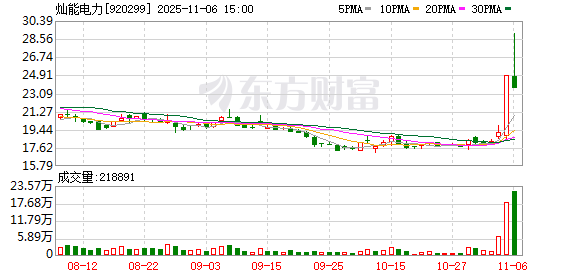
Core Viewpoint - Canaan Power (920299) experienced a decline of 5.06% today, with a turnover rate of 49.67% and a trading volume of 565 million yuan, indicating significant market activity and investor interest [2] Trading Activity - The stock was listed on the龙虎榜 due to its high turnover rate, with a net selling amount of 9.419 million yuan from brokerage seats [2] - The top five brokerage seats accounted for a total transaction volume of 113 million yuan, with buying transactions amounting to 51.7935 million yuan and selling transactions totaling 61.2125 million yuan, resulting in a net sell of 9.419 million yuan [2] - The largest buying brokerage was Guojin Securities Shenzhen Branch, with a purchase amount of 17.369 million yuan, while the largest selling brokerage was Guosheng Securities Ningbo Sangtian Road Branch, with a selling amount of 12.0696 million yuan [2] Historical Performance - Over the past six months, Canaan Power has appeared on the龙虎榜 five times, with an average price drop of 1.36% the day after being listed and an average decline of 6.27% over the following five days [2]
北交所股票成交概况:182股上涨 94股下跌
Zheng Quan Shi Bao Wang· 2025-11-05 09:24
Core Points - The total trading volume of stocks on the Beijing Stock Exchange reached 1.007 billion shares, with a total transaction value of 22.218 billion yuan, a decrease of 7.31 billion yuan compared to the previous trading day [1] - Among the traded stocks, 182 stocks closed higher, accounting for 65.00% of the total, with notable gainers including Caneng Power, Yinen Power, and Guangxin Technology, which rose by 29.96%, 20.79%, and 13.30% respectively [1] - Conversely, 94 stocks closed lower, with Fujida, Digital Human, and Tietuo Machinery experiencing declines of 7.68%, 6.42%, and 5.16% respectively [1] Trading Activity - A total of 62 stocks had transaction values exceeding 100 million yuan, with Fujida, Better Ray, and Kerun Intelligent Control leading at 662.36 million yuan, 588.52 million yuan, and 522.41 million yuan respectively [1] - The trading activity showed that 27 stocks had a turnover rate exceeding 10%, with 7 stocks exceeding 20%. Additionally, 48 stocks had turnover rates between 5% and 10%, while 192 stocks had turnover rates between 1% and 5% [1] - The stocks with the highest turnover rates included Danna Biology, Caneng Power, and Yinen Power, with rates of 44.61%, 41.10%, and 32.40% respectively [1] Stock Performance - The closing prices and performance of notable stocks included: - Fujida: 37.00 yuan, down 7.68%, turnover rate 9.66%, transaction value 662.36 million yuan [1] - Better Ray: 35.74 yuan, up 0.17%, turnover rate 1.49%, transaction value 588.52 million yuan [1] - Kerun Intelligent Control: 13.13 yuan, up 5.63%, turnover rate 30.08%, transaction value 522.41 million yuan [1] - Guangxin Technology: 110.00 yuan, up 13.30%, turnover rate 16.59%, transaction value 516.98 million yuan [1] - Caneng Power: 24.90 yuan, up 29.96%, turnover rate 41.09%, transaction value 402.04 million yuan [1] - Yinen Power: 17.95 yuan, up 20.79%, turnover rate 32.40%, transaction value 352.46 million yuan [1]
这个板块大面积涨停,重磅消息传来
Zheng Quan Shi Bao· 2025-11-05 08:07
Core Viewpoint - A significant surge in the electrical equipment sector was triggered by a UBS report predicting a 10-year super cycle in China's electricity market, with electricity demand growth expected to double from previous estimates, reaching an annual growth rate of 8% between 2028 and 2030 [1][8]. Group 1: Market Reaction - The electrical equipment sector saw a notable increase, with nearly 30 stocks experiencing a limit-up or over 10% rise, including Can Energy and Yinen Power, which reached a 30% and over 20% increase respectively [1][3]. - The overall market sentiment reflects a strong bullish trend in the electrical equipment sector, driven by the UBS report [1][8]. Group 2: Demand Forecast - UBS forecasts that the annual growth rate of electricity demand in China will surge to 8% from 2028 to 2030, marking the beginning of a sustained 5-10 year super cycle in the domestic electricity industry [1][8]. - The report highlights that structural changes in demand, driven by new production capacities, traditional industry upgrades, and rising consumer spending, will be the core drivers of this super cycle [8][9]. Group 3: Supply Dynamics - The supply side is undergoing significant restructuring under the dual carbon goals, with predictions that the share of renewable energy in domestic power generation will rise from 31% to over 50% in the next five years [10]. - Traditional coal power is expected to transition into a stabilizing role within the power system, with integrated projects combining coal power and energy storage becoming mainstream [10][11]. Group 4: Policy Support - The strong policy attributes of the electricity sector provide a solid foundation for the super cycle, with national plans and funding mechanisms supporting renewable energy and grid construction [11]. - The State Grid's investment plan of over 1.2 trillion yuan in the next three years for the construction of ultra-high voltage and smart grids addresses the supply-demand mismatch between renewable energy sources and consumption centers [11].



天风证券晨会集萃-20251105
Tianfeng Securities· 2025-11-04 23:41
Group 1 - The report highlights the overall stability of the A-share market in October, with the Shanghai Composite Index slightly increasing by 1.85%, while the ChiNext Index decreased by 1.56% [3] - In the fixed income market, the central bank maintained a tight balance in October, with a net withdrawal of funds amounting to 25.3 billion yuan, and liquidity remained stable towards the end of the month [3] - Commodity prices showed a rebound in October, with non-ferrous metals and precious metals increasing, while pork prices continued to decline [3] - The report anticipates a continuation of stable and flexible policies in the second half of the year, focusing on economic construction and addressing potential geopolitical risks [3][30] Group 2 - The bond market showed signs of recovery in October, with improved trading sentiment and a noticeable decrease in interest rate fluctuations compared to September [5] - Large banks increased their net purchases of short-term bonds, while insurance companies and rural commercial banks shifted their selling focus towards shorter-term bonds [5][31] - The report suggests that the year-end "rush for allocation" may not occur this year due to the volatile bond market and accumulated losses for some institutional investors [5][34] Group 3 - The report emphasizes the importance of understanding the lifecycle of new materials for investment, indicating that many new materials are in the development or introduction phase [6][8] - It suggests that short-term excess returns in new materials investment are closely tied to market trends, and emotional factors play a significant role in theme-based investments [8] - The report recommends focusing on solid-state batteries and electronic fabrics as key investment areas within the new materials sector [8] Group 4 - Haier Smart Home reported a revenue of 234.05 billion yuan for the first three quarters of 2025, reflecting a year-on-year growth of 10%, with a net profit of 17.37 billion yuan, up 14.7% [10] - The company’s domestic air conditioning segment drove growth, while overseas markets showed resilience, particularly in North America and Europe [10] - Midea Group achieved a revenue of 1119.3 billion yuan in Q3 2025, with a net profit of 11.87 billion yuan, indicating strong performance in domestic sales [11][17] Group 5 - The report on environmental utilities indicates that ChuanTou Energy's Q3 revenue was 429 million yuan, down 11.3% year-on-year, with a net profit of 176 million yuan, down 16.96% [18] - The report notes that the company is developing multiple renewable energy projects to enhance future profitability [18] - Guotou Power's Q3 revenue was 14.88 billion yuan, down 14% year-on-year, but the overall performance remained stable due to the coal price decline [19]





亚联发展:10月27日召开董事会会议
Mei Ri Jing Ji Xin Wen· 2025-10-27 13:29
Group 1 - The core point of the article is that Yalian Development (SZ 002316) announced a board meeting to discuss a proposal for capital reduction and equity transfer of its subsidiary [1] - The meeting took place on October 27, 2025, in Dalian, Liaoning Province, combining on-site and remote voting methods [1] - As of the report, Yalian Development has a market capitalization of 2.1 billion yuan [1] Group 2 - For the first half of 2025, Yalian Development's revenue composition is as follows: transportation accounted for 42.73%, electricity industry 41.53%, biocellulose substrate industry 7.75%, agriculture and animal husbandry 7.66%, and other businesses 0.34% [1]

申银万国期货早间策略-20251027
Shen Yin Wan Guo Qi Huo· 2025-10-27 05:58
Report Industry Investment Rating - Not provided in the report Core View of the Report - After the high - level oscillation in September, the stock index is expected to enter a direction - selection phase again. The domestic liquidity environment is expected to remain loose, and residents may increase their allocation of equity - based assets. With the Fed's interest rate cut and RMB appreciation, external funds are also expected to flow into the domestic market. In terms of market style, although technology growth has been the core theme in the current upward market trend, considering the potential increase in Q4's growth - stabilizing policies and the resonance of global monetary and fiscal policies, the market style in Q4 may shift towards value and become more balanced compared to Q3 [2] Summary by Relevant Catalogs 1. Stock Index Futures Market - **Futures Price and Volume**: For IF contracts, the previous day's closing prices of IF current month, next month, next quarter, and far - quarter were 4648.40, 4634.80, 4604.00, and 4567.40 respectively, with increases of 68.60, 68.00, 62.40, and 66.80 and increases of 1.50%, 1.49%, 1.37%, and 1.48%. Similar data are provided for IH, IC, and IM contracts. The trading volumes and open interests of each contract are also presented, along with the changes in open interests [1] - **Inter - month Spread**: The current values of the inter - month spreads of IF next month - IF current month, IH next month - IH current month, IC next month - IC current month, and IM next month - IM current month are - 13.60, 0.20, - 52.00, and - 71.20 respectively, compared with previous values of - 12.80, - 0.80, - 51.40, and - 69.80 [1] 2. Stock Index Spot Market - **Index Performance**: The previous value of the CSI 300 index was 4660.68, with a previous two - day value of 4606.34 and an increase of 1.18%. Similar data are provided for the SSE 50, CSI 500, and CSI 1000 indices. The total trading amounts and trading volumes are also given [1] - **Industry Performance**: Different industries showed different growth rates. For example, the energy industry decreased by 0.42%, while the telecommunications business increased by 5.50% [1] 3. Futures - Spot Basis - The previous values of the basis of IF current month - CSI 300, IF next month - CSI 300, IF next quarter - CSI 300, and IF far - quarter - CSI 300 were - 12.28, - 25.88, - 56.68, and - 93.28 respectively, compared with previous two - day values of - 12.74, - 25.54, - 52.54, and - 89.54. Similar data are provided for IH, IC, and IM contracts [1] 4. Other Domestic and Overseas Indices - **Domestic Indices**: The Shanghai Composite Index, Shenzhen Component Index, Small and Medium - sized Board Index, and ChiNext Index had previous values of 3950.31, 13289.18, 8139.58, and 3171.57 respectively, with increases of 0.71%, 2.02%, 1.81%, and 3.57% [1] - **Overseas Indices**: The Hang Seng Index, Nikkei 225, S&P, and DAX Index had certain previous values and growth rates, such as the Hang Seng Index increasing by 0.74% [1] 5. Macroeconomic Information - **Sino - US Economic and Trade Consultation**: From October 25th to 26th, Sino - US economic and trade consultations were held in Kuala Lumpur, Malaysia. The two sides reached a basic consensus on important economic and trade issues [2] - **Central Bank Operations**: The People's Bank of China carried out 900 billion yuan of MLF operations on October 27th, with a net investment of 200 billion yuan this month. It also conducted 1.7 trillion yuan of outright reverse repurchases, resulting in a net investment of 400 billion yuan after hedging the matured ones. The total net investment of medium - term liquidity this month is 600 billion yuan [2] - **APEC Meeting**: President Xi Jinping will attend the 32nd APEC Economic Leaders' Meeting in South Korea from October 30th to November 1st [2] 6. Industry Information - **Fund Industry**: The draft regulatory guidelines for the performance comparison benchmarks of public funds may be released soon. As of October 26th, 176 funds have adjusted their performance comparison benchmarks this year [2] - **Banking Industry**: Since October, many banks have raised the minimum investment threshold for gold accumulation. Short - term gold price fluctuations may become the norm [2] - **Power Industry**: As of the end of September, the cumulative installed power generation capacity in China was 3.72 billion kilowatts, with solar power and wind power showing significant year - on - year growth [2]

