私募

Search documents
私募上半年成绩单出炉 事件应对成致胜关键
Zhong Guo Zheng Quan Bao· 2025-08-08 07:16
Core Insights - The A-share market in the first half of 2025 experienced significant volatility, leading to a stark performance divergence among private equity firms, with some capitalizing on new trends while others faced losses [1][2] - The focus of investment strategies shifted towards sectors such as artificial intelligence (AI), new consumption, innovative pharmaceuticals, and dividend assets as firms actively adjusted their portfolios [1][5] Performance of Private Equity Firms - Notable private equity firms showed significant performance variation, with firms like Tongben Investment achieving substantial positive returns due to the rise of the new consumption sector, shifting their focus from "big consumption" to "new consumption" since November 2024 [2] - Conversely, some well-known private equity firms faced losses exceeding 20% due to heavy investments in the oil and gas sector [2] Market Reflections - The market's main theme in the first half of 2025 was characterized by "wide fluctuations combined with structural opportunities," leading many investors to struggle with decision-making during periods of volatility [3] - Key events included the "DeepSeek moment" before the Spring Festival and overseas disturbances in early April, which influenced investment strategies and market dynamics [3] Outlook for the Second Half - Private equity firms expressed optimism for the second half of the year, maintaining focus on AI, new consumption, innovative pharmaceuticals, and dividend assets [5][6] - Investment strategies are expected to emphasize a dual focus on "technology + consumption," with an increased emphasis on sectors like financial technology and biotechnology as well as new consumption leaders [6] - Firms like Qinghequan Capital anticipate that the Chinese market remains attractive to foreign capital due to relatively low valuations, with expectations of a positive market sentiment driven by global capital flows [6]
市场风格快速切换 私募量化指增策略操作难度增加
Zhong Guo Zheng Quan Bao· 2025-08-08 07:15
Core Insights - The A-share market experienced significant structural trends in the first half of 2025, driven by macroeconomic fluctuations and a rebound in market sentiment [1] - Quantitative private equity strategies showed strong overall performance, with a notable internal divergence among different funds [2][3] - The average return of large quantitative private equity funds reached 13.72%, with all achieving positive returns [2] - The performance gap among popular private equity products exceeded 20 percentage points, indicating a competitive landscape characterized by "strong head, weak tail" dynamics [2][3] Performance Metrics - The average excess return for the CSI 500 quantitative enhancement strategy was approximately 11%, while the CSI 1000 strategy achieved 14% [2] - The average return for quantitative neutral strategies was around 5% [2] - The top-performing quantitative private equity products in the CSI 500 strategy had a return of 27.97%, with a performance gap of 20.33% among the top and bottom funds [2][3] Market Dynamics - The market structure was described as a "dumbbell" shape, with strong performances in both large-cap bank stocks and small-cap indices, while the mid-range stocks underperformed [4] - The small-cap sector is becoming a fertile ground for excess returns, with strategies focusing on small-cap stocks showing significant potential [5] - The loosening of merger and acquisition policies has led to an increase in major asset restructuring events, boosting market confidence and liquidity [5] Fundraising Trends - The number of newly registered private equity funds significantly increased in the first half of 2025, with quantitative strategies dominating the fundraising landscape [6] - The overall scale of the quantitative strategy industry is expected to grow by approximately 20% to 30% compared to the same period last year [6] - Notable fundraising success was observed among both leading and mid-tier managers, with innovative strategy products contributing to this growth [6] Future Outlook - The mainstream quantitative private equity firms maintain an optimistic outlook for the A-share market in the second half of the year, anticipating a volatile upward trend [7] - Key sectors expected to provide structural return opportunities include innovative pharmaceuticals, consumer electronics, robotics, military, computing, and photovoltaics [7] - The current proportion of quantitative strategies in A-share trading is about 30%, indicating a reasonable range for enhancing market pricing efficiency, but caution is advised regarding the risks of strategy homogeneity [8]
西安本土私募再度出手 1.15亿元拍下曲江文旅1200万股股份
Zheng Quan Shi Bao Wang· 2025-08-08 05:49
Group 1 - Qujiang Cultural Tourism (曲江文旅) disclosed that Shaanxi Runyan Technology won a judicial auction for 12 million shares, representing 4.70% of the company's total shares, at an average price of approximately 9.57 yuan per share, totaling about 115 million yuan [1] - Following the share transfer, Qujiang Tourism Investment's stake in Qujiang Cultural Tourism will decrease to 37.06%, as it is currently facing a debt crisis with all its shares frozen [1] - The auction attracted significant interest, with one block of 4 million shares starting at a price of 29.4952 million yuan and receiving 261 bids before being won by Shaanxi Runyan for 39.1152 million yuan [1] Group 2 - Shaanxi Runyan was established in July 2021 with a registered capital of 5 million yuan and is fully controlled by Hong Kong Junyan Investment [2] - Li Bozheng, the actual controller of Junyan Capital, serves as the executive director and general manager of Shaanxi Runyan [2] - Junyan Investment has developed a large investment system, focusing on private equity funds, private securities, and real estate asset management [3] Group 3 - Junyan Investment has previously engaged in asset integration for local listed companies, including a significant asset restructuring involving the sale of 100% equity of two companies for a total of 8.84 billion yuan [4] - The companies involved in the restructuring have reported continuous losses since 2022, with significant net losses recorded [5] - Despite these efforts, the restructuring did not save the listed status of Renrenle, which was delisted in July 2023 [6] Group 4 - Qujiang Cultural Tourism has been experiencing continuous losses, with a projected loss of 13 million to 16.9 million yuan for the first half of 2025, and a projected non-net profit loss of 69 million to 72.9 million yuan [6]

幻方、九坤、天演、蒙玺等18家百亿私募旗下产品悉数创新高!超7成百亿私募产品创了新高!
私募排排网· 2025-08-08 03:52
Market Overview - In July, A-shares experienced a strong upward trend, with the Shanghai Composite Index rising by 3.74%, the Shenzhen Component Index by 5.20%, and the ChiNext Index by 8.14% [1] - The total market turnover remained above 1.5 trillion, indicating active trading, while the financing balance climbed to 1.9 trillion by late July, reflecting a positive market sentiment [1] Private Equity Performance - A total of 379 private equity products reached historical highs in July, representing 71.64% of the total number of billion-yuan private equity products with performance data available for nearly one year [1] - Among these, 289 were quantitative products and 90 were non-quantitative, with stock strategy products being the most prevalent, accounting for approximately 83.38% [1] Top Performing Private Equity Firms - 28 billion-yuan private equity firms had all their products reach historical highs in July, with 18 firms having more than three products achieving this milestone [2] - Notable firms include Junzhijian Investment, Rido Investment, and Tianyan Capital, with a significant number of their products achieving new highs [2] Performance Rankings - The average returns for private equity firms from January to July were led by Wobo Investment, Abama Investment, Tianyan Capital, Rido Investment, and Ningbo Huanfang Quantitative [3] - Over the past three years, the top five firms based on average returns were Junzhijian Investment, Rido Investment, Abama Investment, Tianyan Capital, and Maoyuan Quantitative [3] Notable Products - The top products achieving historical highs in the past year included those from Heiyi Asset, Longqi Technology, and Rido Investment, with the threshold for the top 20 products exceeding a certain percentage [7] - The leading product was "Heiyi Wind 2 B Class" from Heiyi Asset, with a recent scale of approximately *** million and nearly ***% return over the past year [9] Long-term Performance - Over the past five years, the top products were from Rido Investment, Fusheng Asset, and Jiukun Investment, with Rido Investment holding three of the top five positions [14] - The champion product was "Rido Qian Niu Value No. 1" from Rido Investment, with a recent scale of approximately *** billion and over ***% return in the past five years [16] Investment Insights - Rido Investment's chairman expressed optimism about the A-share market, suggesting it is in a historical opportunity for value reassessment, particularly favoring the entertainment and financial sectors [17]

内斗升级,知名私募靖奇投资紧急声明!
Zhong Guo Jing Ji Wang· 2025-08-08 01:20
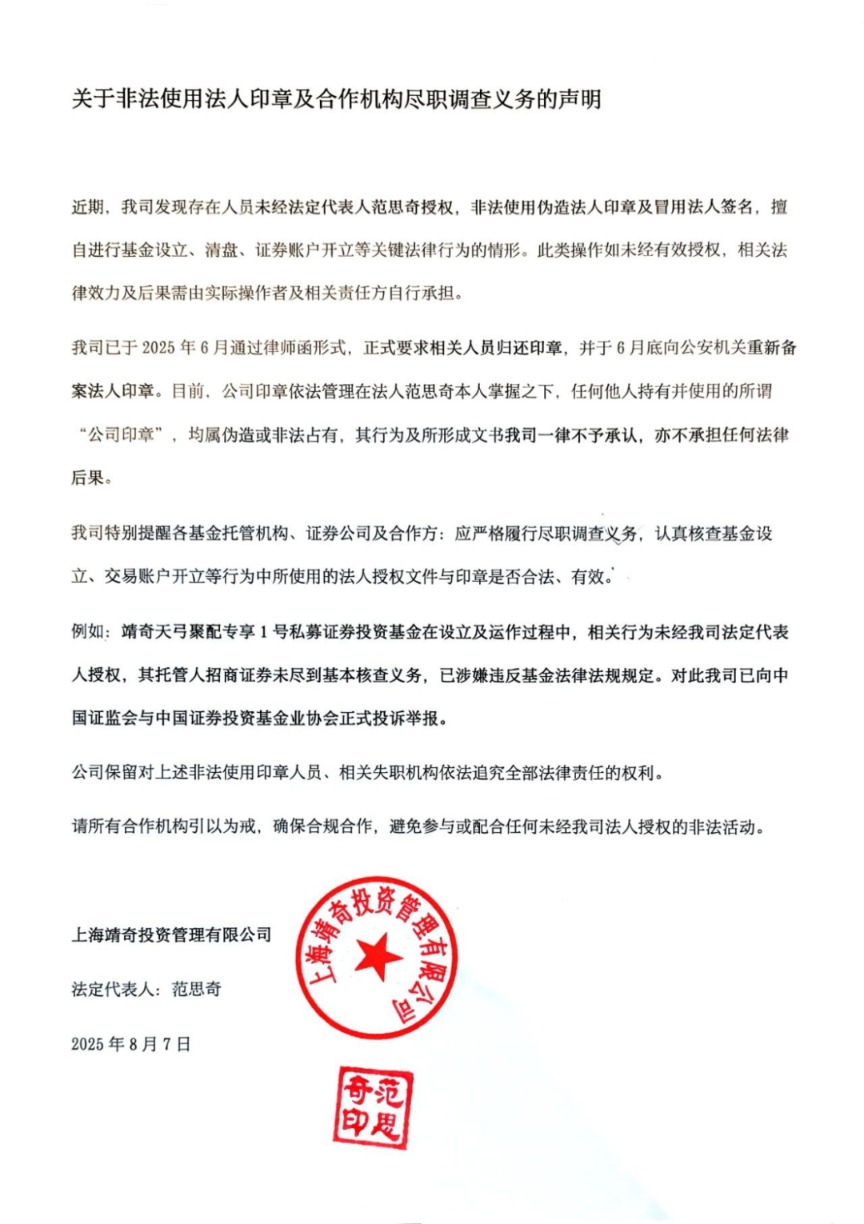
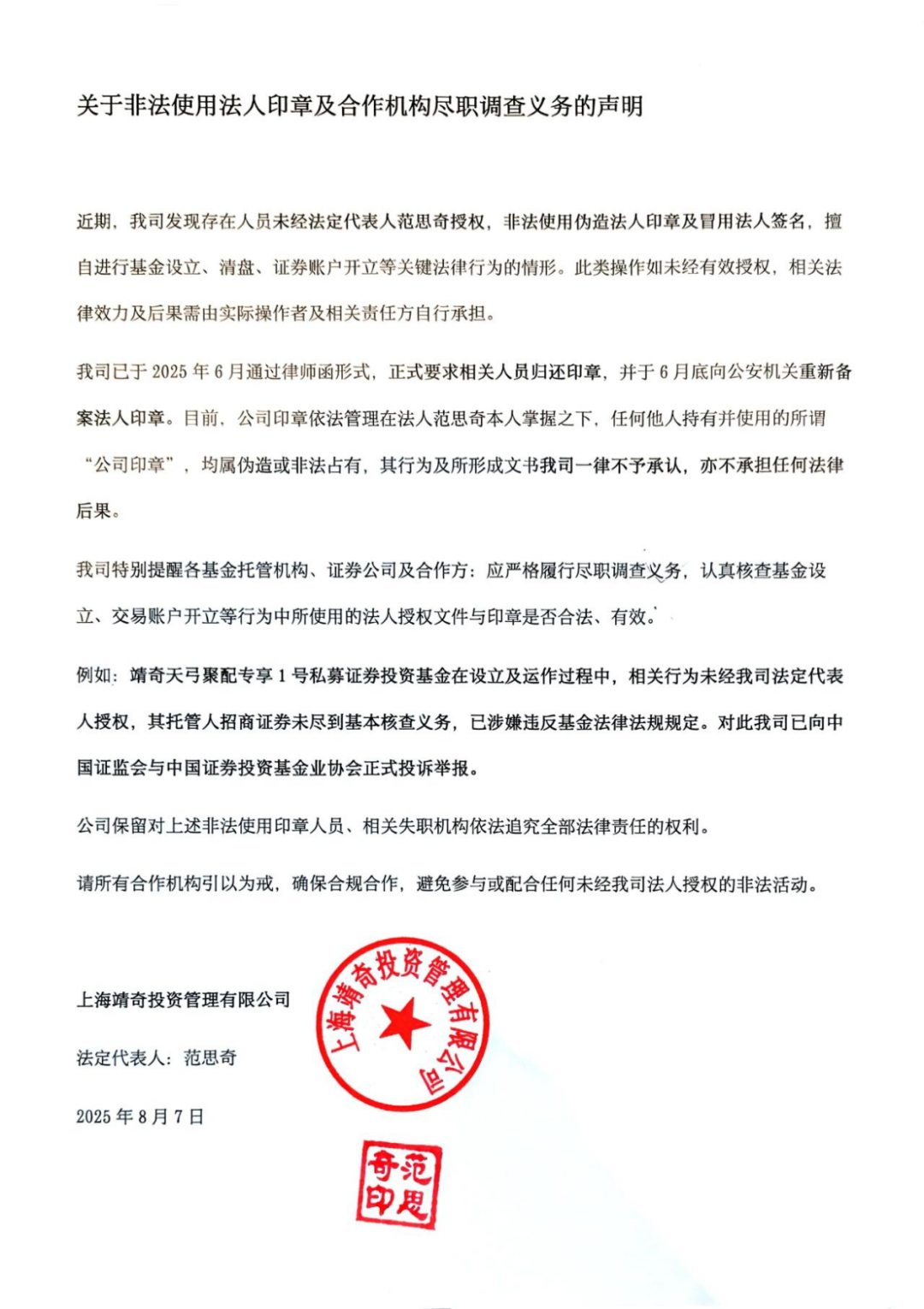
Core Viewpoint - The recent internal conflict within Jingqi Investment has escalated, with allegations of unauthorized use of the company's legal seal and signature, leading to potential legal ramifications for those involved [1][7]. Group 1: Company Allegations and Legal Actions - Jingqi Investment has discovered that individuals have illegally used a forged legal seal and signature without authorization from the legal representative, Fan Siqi, to conduct critical legal actions such as fund establishment and account opening [2][7]. - The company has formally requested the return of the seal through a lawyer's letter and has re-registered the legal seal with the police [2][8]. - Jingqi Investment emphasizes that any documents created using unauthorized seals will not be recognized, and the company will not bear any legal consequences for such actions [2][3]. Group 2: Compliance and Due Diligence - The company has urged all fund custodians, securities firms, and partners to strictly fulfill their due diligence obligations and verify the legality and validity of the authorization documents and seals used in fund establishment and account opening [2][4]. - The company has filed a formal complaint with the China Securities Regulatory Commission and the Asset Management Association of China regarding the alleged negligence of the custodian, China Merchants Securities, in failing to verify the authorization [2][7]. Group 3: Internal Conflict and Management Changes - Fan Siqi, the legal representative, announced his resignation from the fund manager position in June, leading to a conflict over the management and operation of the company [9][10]. - The company is currently facing a split between its partners, with accusations of unauthorized actions and mismanagement being exchanged [9][10]. - The company has stated that all asset management products are operating normally and that the recent conflicts have not materially affected the company's overall operations [9].
震惊!私募下场拍短剧:我靠期货走上复仇之路!(附最新私募期货业绩榜单)
私募排排网· 2025-08-08 00:00
Core Viewpoint - The article discusses the emergence of private equity firms engaging in creative projects, specifically the production of a short drama centered around futures trading, highlighting the challenges and uncertainties in the futures investment landscape [1] Group 1: Short Drama Production - Three private equity firms, Waying Investment, Shanhai Fund, and Shenhan Capital, have produced a short drama titled "Rebirth in the Millennium: My Revenge Path through Futures" [1] - The drama features a billionaire private equity boss who faces significant losses due to market volatility and personal tragedy, ultimately leading to a second chance in the year 2000 [1] Group 2: Performance of Private Equity Products - As of July 25, 2025, there are 603 futures and derivatives strategy products with a total scale of approximately 34.33 billion, with an average return of 8.73% this year [3] - Among these, 339 quantitative CTA products have an average return of 8.31%, while 156 subjective CTA products have an average return of 12.15% [3] Group 3: Top Performing Products - The top three futures and derivatives strategy products for the year are led by Fuhua Zixin's product, with a return of ***% [9] - In the category of private equity firms with a scale below 5 billion, the top three products are from Fuhua Zixin, Jingsheng Investment, and Ruixin Investment [10] Group 4: Recent Performance Trends - Over the past year, 573 products have shown an average return of 20.66%, with quantitative CTA products averaging 19.07% and subjective CTA products averaging 28.76% [9] - The leading products in this category are managed by Xuming Investment and Fuhua Zixin [10] Group 5: Long-Term Performance - Over the past three years, 345 products have an average return of 61.65%, with quantitative CTA products averaging 30.18% and subjective CTA products averaging 74.70% [14] - The top three products in this category are from Fuying Investment, Xuming Investment, and Ruixin Tiansuan [15]

招商证券部门总被曝与幻方总监存返佣腐败 两方均沉默
Zhong Guo Jing Ji Wang· 2025-08-07 23:11
中国经济网北京8月8日讯(记者 徐自立) 财新网6日报道《幻方量化市场总监涉案原委 牵扯老东家多 人被查》指出,招商证券(600999)股份有限公司财富管理及机构业务总部机构业务部总经理高翔涉嫌 严重违纪违法接受调查一案,与去年幻方量化市场总监李橙案有直接关联。 南粤清风网此前于5月30日发布消息,招商证券股份有限公司财富管理及机构业务总部机构业务部总经 理高翔涉嫌严重违纪违法,目前正接受招商局集团纪委纪律审查和中山市监委监察调查。 新浪证券也于6日发布报道《招商证券机构业务部总经理高翔被查 或牵出幻方量化亿元返佣腐败链》, 据各方报道,其涉案线索或直指此前量化巨头幻方量化市场总监李橙的亿元返佣案。调查显示,高翔案 与2024年11月幻方量化市场总监李橙被查存在直接关联:李橙在2018-2023年间,伙同招商证券深南东 路营业部原总经理孟鹏飞,通过虚构经纪人身份,将幻方量化交易导入指定营业部,套取券商"交易佣 金40%提成" 制度下的绩效奖金,6年累计1.18亿元。孟鹏飞案发后曾向时任深圳分公司负责人高翔行贿 300万元黄金以求脱罪,高翔虽退还财物,仍因涉嫌渎职被查。目前相关几名涉案人员已移交司法。 中国经济 ...

内斗升级,知名私募紧急声明
Zhong Guo Ji Jin Bao· 2025-08-07 22:35
Core Viewpoint - The recent internal conflict at Jingqi Investment has escalated, with allegations of unauthorized use of the company's legal seal and signature, leading to potential legal ramifications for the involved parties [1][2][7]. Group 1: Company Allegations - Jingqi Investment has discovered that individuals have illegally used a forged legal seal and signature without authorization from the legal representative, Fan Siqi, to conduct critical legal actions such as fund establishment and account opening [2][7]. - The company has formally requested the return of the seal through a lawyer's letter and has re-registered the legal seal with the police [2][7]. - Jingqi Investment emphasizes that any documents created using unauthorized seals will not be recognized, and the legal consequences will fall on the actual operators and responsible parties [2][3][7]. Group 2: Compliance and Due Diligence - The company has urged all fund custodians, securities firms, and partners to strictly fulfill their due diligence obligations and verify the legality and validity of the authorization documents and seals used in fund establishment and account opening [2][4][7]. - The company has filed a formal complaint with the China Securities Regulatory Commission and the Asset Management Association of China regarding the alleged failure of the custodian, China Merchants Securities, to perform basic verification duties [2][7]. Group 3: Internal Conflict - The internal conflict has been marked by accusations between partners, with Fan Siqi claiming he was ousted from the company through a hastily arranged shareholders' meeting, while the other partners accuse him of unauthorized actions [10][11][12]. - The company has been managing assets between 1 billion to 2 billion yuan, with Fan Siqi holding a 36.36% stake, while other partners hold 27.27% each [10]. - Legal actions are being pursued by both parties to resolve the ongoing disputes [8][11].
内斗升级,知名私募紧急声明!
Zhong Guo Ji Jin Bao· 2025-08-07 17:03
Core Viewpoint - The recent internal conflict at Jingqi Investment has escalated, with allegations of unauthorized use of a forged corporate seal and signature by personnel, leading to potential legal implications for the involved parties [1][3]. Group 1: Company Statement - Jingqi Investment issued a statement on August 7, revealing that unauthorized personnel have been using a forged corporate seal and signature without the legal representative Fan Siqi's authorization for critical legal actions such as fund establishment and account opening [3]. - The company has formally requested the return of the seal through a lawyer's letter and has re-registered the corporate seal with the public security bureau [3]. - Jingqi Investment emphasized that any documents created using the unauthorized seal will not be recognized, and the legal consequences will fall on the actual operators and responsible parties [3]. Group 2: Management and Ownership - Jingqi Investment, a quantitative private equity firm established for 10 years, manages assets between 1 billion to 2 billion yuan [6]. - Fan Siqi holds a 36.36% stake in the company, while Tang Ranjing and Mao Noping each hold 27.27%, and Shanghai Jing'erqi Enterprise Management Partnership holds 9.09% [6]. - In June, Fan Siqi announced his resignation as fund manager and initiated the liquidation process for certain self-managed products, which represent a small portion of the total asset management scale [6]. Group 3: Legal Disputes - The internal conflict has led to accusations from both sides, with Fan Siqi claiming he was unfairly removed from the company, while Tang Ranjing accused him of unauthorized liquidation and data deletion [6][4]. - Both parties have indicated intentions to resolve the disputes through legal channels, with ongoing claims and counterclaims regarding the management and operations of the firm [6][4].
内斗升级 知名私募紧急声明!
Zhong Guo Ji Jin Bao· 2025-08-07 16:28
【导读】靖奇投资官微发布声明:存在人员非法使用伪造法人印章 从今年6月至今,知名私募内斗升级。 8月7日下午,靖奇投资官微突然发布《关于非法使用法人印章及合作机构尽职调查义务的声明》(以下简称《声明》)。对此,公司相 关合伙人回应了中国基金报记者。 靖奇投资官微发布声明 在《声明》中,靖奇投资表示,近期,公司发现存在人员未经法定代表人范思奇授权,非法使用伪造法人印章及冒用法人签名,擅自进 行基金设立、清盘、证券账户开立等关键法律行为的情形。此类操作如未经有效授权,相关法律效力及后果需由实际操作者及相关责任 方自行承担。 靖奇投资强调,公司已于今年6月通过律师函形式,正式要求相关人员归还印章,并于6月底向公安机关重新备案法人印章。目前,公司 印章由法人范思奇依法管理,任何他人持有并使用的所谓"公司印章",均属伪造或非法占有,其行为及所形成文书,公司一律不予承 认,亦不承担任何法律后果。 公司还特别提醒各基金托管机构、证券公司及合作方,应严格履行尽职调查义务,认真核查基金设立、交易账户开立等行为中所使用的 法人授权文件与印章是否合法、有效。 靖奇投资风险控制官唐人靖称,公司公众号于8月6日被人挂失了,找回需要权限 ...