
建筑装饰

Search documents
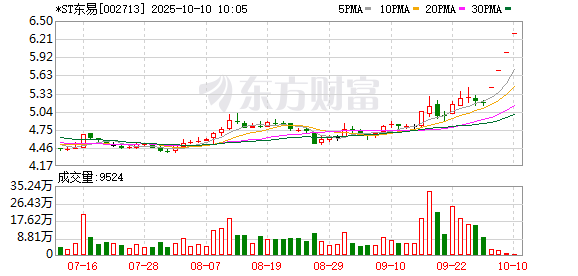
*ST东易连收4个涨停板
Zheng Quan Shi Bao Wang· 2025-10-10 02:04
Core Viewpoint - *ST Dongyi has experienced a significant surge in stock price, achieving a total increase of 21.66% over the past four trading days, indicating strong market interest and potential investor confidence [2] Group 1: Stock Performance - The stock reached a price of 6.29 yuan with a trading volume of 757,400 shares and a turnover amount of 4.764 million yuan as of 9:25 AM [2] - The stock has recorded a cumulative turnover rate of 1.88% during the consecutive trading days of price increase [2] - The stock's limit-up order amount reached 231 million yuan, reflecting strong buying interest [2] Group 2: Market Capitalization - The total market capitalization of the stock in the A-share market is 2.639 billion yuan, with a circulating market capitalization of 2.588 billion yuan [2] Group 3: Trading Data - The stock has been listed on the Dragon and Tiger List due to a cumulative price deviation of 12% over three consecutive trading days [2] - Institutional investors have net sold 2.7362 million yuan, while total net selling from brokerage seats amounted to 1.6383 million yuan [2] Group 4: Company Background - Dongyi Risheng Home Decoration Group Co., Ltd. was established on November 28, 1996, with a registered capital of 419.53698 million yuan [2]

【9日资金路线图】两市主力资金净流出超250亿元 有色金属等行业实现净流入
证券时报· 2025-10-09 14:34
Market Overview - The A-share market indices performed strongly today, with the Shanghai Composite Index rising by 1.32%, the Shenzhen Component increasing by 1.47%, and the ChiNext Index up by 0.73%. The total trading volume reached 2.67 trillion yuan, compared to 2.2 trillion yuan in the previous trading day [1]. Capital Flow - The net outflow of main funds from the Shanghai and Shenzhen markets exceeded 255.37 billion yuan today, with an opening net outflow of 96.89 billion yuan and a closing net outflow of 65.82 billion yuan [2][3]. - The CSI 300 index saw a net outflow of 137.82 billion yuan, while the ChiNext index experienced a net outflow of 121.83 billion yuan [2][4]. Sector Performance - The non-ferrous metals sector led the market with a net inflow of 143.63 billion yuan and a price increase of 5.23%. Other sectors with significant inflows included computers (70.68 billion yuan) and public utilities (68.68 billion yuan) [5]. - Conversely, the automotive sector faced a net outflow of 45.52 billion yuan, with a slight decline of 0.26%. The pharmaceutical and media sectors also saw outflows of 34.69 billion yuan and 32.29 billion yuan, respectively [5]. Institutional Activity - Notable institutional buying included Ganfeng Lithium, which saw a net purchase of 52.11 million yuan, and Tianji Co., with a net purchase of 44.19 million yuan. Other significant purchases were made in companies like Canxin Technology and Meili Technology [7][8].

海鸥住工:累计回购公司股份2723500股
Zheng Quan Ri Bao Wang· 2025-10-09 13:46
证券日报网讯 10月9日晚间,海鸥住工(002084)发布公告称,截至2025年9月30日,公司通过股票回 购专用证券账户以集中竞价交易方式实施回购股份,累计回购公司股份数量2,723,500股,约占公司 目前总股本的0.4216%。 ...

9.06亿元主力资金今日抢筹钢铁板块
Zheng Quan Shi Bao Wang· 2025-10-09 09:39
Core Viewpoint - The Shanghai Composite Index rose by 1.32% on October 9, with 23 industries experiencing gains, particularly in non-ferrous metals and steel, which increased by 7.60% and 3.38% respectively [1] Industry Summary Non-Ferrous Metals - The non-ferrous metals industry saw the highest net inflow of funds, totaling 5.36 billion yuan, contributing to its 7.60% increase [1] Steel Industry - The steel industry increased by 3.38%, with a net inflow of 906 million yuan. Out of 44 stocks in this sector, 38 rose, and 2 hit the daily limit [2] - The top three stocks by net inflow were: - Baogang Co., with an inflow of 880 million yuan and a rise of 8.40% - Hebei Steel Resources, with an inflow of 92.96 million yuan and a rise of 9.99% - Jiuli Special Materials, with an inflow of 59.17 million yuan and a rise of 8.04% [2][3] - The steel industry had 19 stocks with net outflows, with the largest being: - Hangang Co., with an outflow of 165 million yuan - Maanshan Steel, with an outflow of 29.82 million yuan - Shougang Co., with an outflow of 29.49 million yuan [2][3]


10月9日主力资金流向日报
Zheng Quan Shi Bao Wang· 2025-10-09 09:38
Market Overview - On October 9, the Shanghai Composite Index rose by 1.32%, the Shenzhen Component Index increased by 1.47%, the ChiNext Index went up by 0.73%, and the CSI 300 Index gained 1.48% [1] - Among the tradable A-shares, 3,115 stocks rose, accounting for 57.48%, while 2,186 stocks declined [1] Capital Flow - The main capital saw a net outflow of 19.966 billion yuan throughout the day [1] - The ChiNext experienced a net outflow of 11.198 billion yuan, while the STAR Market had a net outflow of 4.835 billion yuan, and the CSI 300 constituents saw a net outflow of 9.622 billion yuan [1] Industry Performance - Out of the 23 first-level industries classified by Shenwan, the top-performing sectors were non-ferrous metals and steel, with increases of 7.60% and 3.38%, respectively [1] - The sectors with the largest declines were media and real estate, which fell by 1.43% and 1.39% [1] Industry Capital Inflow - Twelve industries saw net inflows of main capital, with the non-ferrous metals sector leading at a net inflow of 5.361 billion yuan and a daily increase of 7.60% [1] - The construction and decoration industry followed with a daily increase of 2.17% and a net inflow of 1.868 billion yuan [1] Industry Capital Outflow - Nineteen industries experienced net outflows, with the non-bank financial sector leading at a net outflow of 6.725 billion yuan, despite a slight increase of 0.10% [1] - The automotive sector had a decline of 0.39% and a net outflow of 4.325 billion yuan, with significant outflows also seen in media, electronics, and banking sectors [1] Individual Stock Performance - A total of 2,264 stocks saw net inflows, with 913 stocks having inflows exceeding 10 million yuan, and 153 stocks with inflows over 100 million yuan [2] - The stock with the highest net inflow was ZTE Corporation, which rose by 9.51% with a net inflow of 3.753 billion yuan, followed by Northern Rare Earth and Hikvision with net inflows of 2.969 billion yuan and 1.417 billion yuan, respectively [2] - Stocks with net outflows exceeding 100 million yuan included Sailis, CITIC Securities, and SMIC, with outflows of 2.351 billion yuan, 2.197 billion yuan, and 2.053 billion yuan, respectively [2]




18.68亿元资金今日流入建筑装饰股
Zheng Quan Shi Bao Wang· 2025-10-09 09:30
Market Overview - The Shanghai Composite Index rose by 1.32% on October 9, with 23 out of the 28 sectors in the Shenwan classification experiencing gains. The top-performing sectors were non-ferrous metals and steel, with increases of 7.60% and 3.38% respectively. The construction and decoration sector also saw a rise of 2.17%. The sectors that declined were media and real estate, with decreases of 1.43% and 1.39% respectively [1]. Construction and Decoration Sector - The construction and decoration sector experienced a net inflow of 1.868 billion yuan in capital on the same day. Out of 156 stocks in this sector, 88 stocks rose, with 10 hitting the daily limit, while 62 stocks fell, including 1 hitting the lower limit [1]. - Among the stocks with significant capital inflow, China Railway led with a net inflow of 428.14 million yuan, followed by Taiji Industry and Xinjiang Communications Construction with net inflows of 366.37 million yuan and 288.68 million yuan respectively [1]. - The stocks with the highest capital outflow included Huajian Group, with a net outflow of 229.45 million yuan, followed by Huilv Ecology and Sichuan Road and Bridge with net outflows of 105.58 million yuan and 73.94 million yuan respectively [2]. Key Stocks Performance - Notable gainers in the construction and decoration sector included: - China Railway: +5.44% with a turnover rate of 2.14% and a capital flow of 428.14 million yuan - Taiji Industry: +9.95% with a turnover rate of 7.84% and a capital flow of 365.64 million yuan - Xinjiang Communications Construction: +9.99% with a turnover rate of 8.23% and a capital flow of 287.67 million yuan [1]. - Stocks with significant capital outflow included: - Huajian Group: -1.36% with a turnover rate of 11.96% and a capital flow of -229.45 million yuan - Huilv Ecology: -6.31% with a turnover rate of 6.40% and a capital flow of -105.58 million yuan - Sichuan Road and Bridge: -0.74% with a turnover rate of 0.99% and a capital flow of -73.94 million yuan [2].




海鸥住工(002084.SZ):累计回购0.4216%股份
Ge Long Hui A P P· 2025-10-09 08:50
Group 1 - The core point of the article is that Seagull Housing (002084.SZ) has announced a share buyback program, repurchasing 2,723,500 shares, which accounts for approximately 0.4216% of the company's total share capital [1] - The buyback was conducted through a special securities account for stock repurchase via centralized bidding, with the highest transaction price being 3.93 yuan per share and the lowest at 2.84 yuan per share [1] - The total amount spent on the buyback was 9,903,410 yuan, excluding transaction fees, and the buyback complies with relevant laws and regulations as well as the company's buyback plan [1]
A股,新纪录!9月份市场月度成交额创出历史新高
Zheng Quan Shi Bao Wang· 2025-10-05 00:05
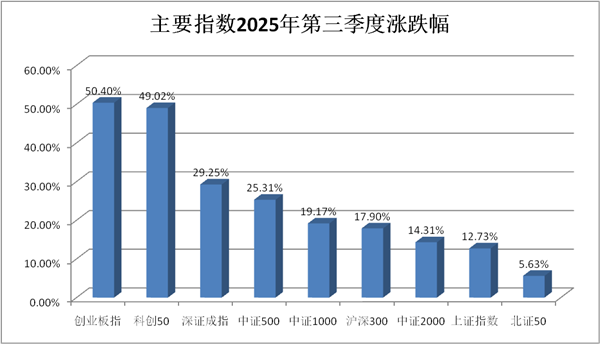
Market Performance - In September and the third quarter of this year, the A-share market showed strong performance, with the ChiNext Index and the STAR 50 Index particularly standing out, as the ChiNext Index recorded a cumulative increase of over 50% in the third quarter [1][2] - The ChiNext Index rose by 12.04% in September, while the STAR 50 Index increased by 11.48%. The Shenzhen Component Index and the Shanghai Composite Index rose by 6.54% and 0.64%, respectively, with the North Exchange 50 Index declining by 2.90% [2] Trading Volume - September saw a record monthly trading volume in the A-share market, with a total trading volume of approximately 53.2 trillion yuan, marking a historical high [5] - The daily trading volume has consistently exceeded 2 trillion yuan since August 13, indicating a new normal for market activity [6][7] Sector Performance - The third quarter witnessed a broad increase across major sectors, with most sectors showing positive performance. Notably, the electronics, non-ferrous metals, and power equipment sectors saw increases exceeding 20% [8][9] - In September, sector performance was more mixed, with power equipment, real estate, electronics, automotive, and non-ferrous metals leading the gains, while sectors like defense, banking, and food and beverage experienced declines [9] Individual Stock Performance - Over 3,800 stocks rose in the third quarter, with more than 1,000 stocks increasing by over 30%, and over 90 stocks doubling in value. Notable performers included Upwind New Materials, Tianpu Co., and Chunzong Technology, with increases exceeding 200% [10][11] - In September, over 2,000 stocks increased in value, while more than 3,000 stocks declined, indicating significant differentiation among individual stocks [12]





2元以下低价股,仅剩31只
Zhong Guo Zheng Quan Bao· 2025-10-03 23:21
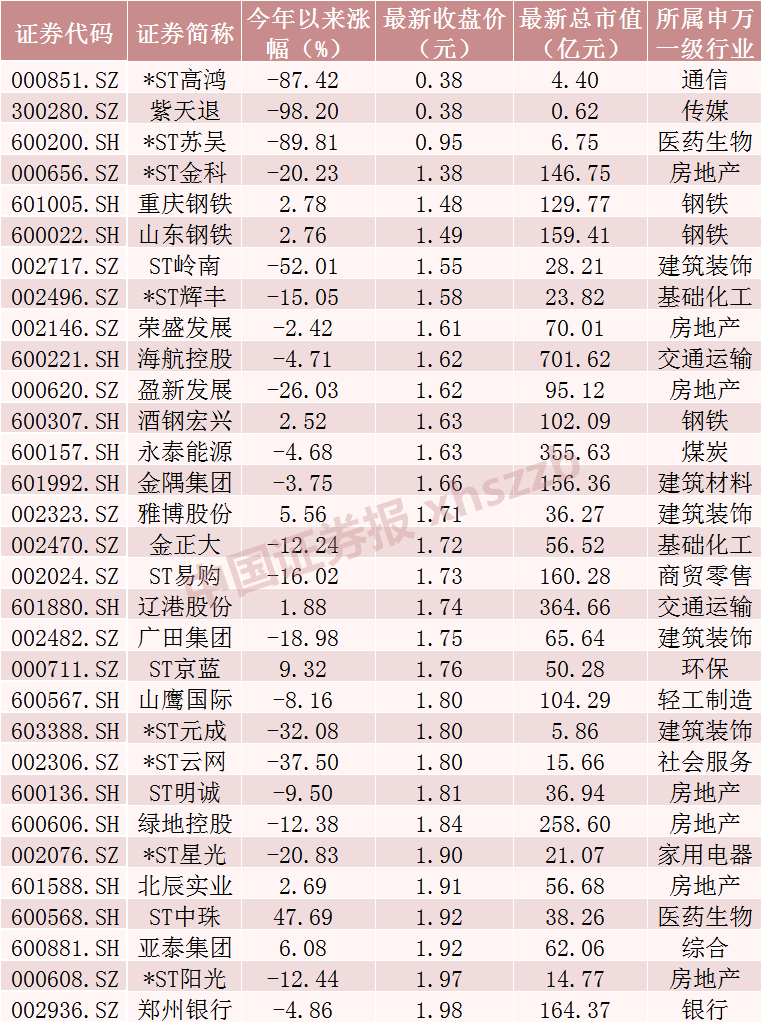
Market Performance - As of September 30, the Shanghai Composite Index, Shenzhen Component Index, and ChiNext Index have increased by 15.84%, 29.88%, and 51.20% respectively this year [1] - The number of low-priced stocks (below 2 yuan) has decreased to 31 [2] Low-Priced Stocks - Among the 31 low-priced stocks, the lowest is *ST Gao Hong with a closing price of 0.38 yuan [2] - The real estate sector has the highest number of low-priced stocks at 7, followed by construction decoration with 4, and steel with 3 [2] - 19 out of the 31 low-priced stocks have a market capitalization below 10 billion yuan, accounting for over 60% [2] - 21 low-priced stocks are expected to report losses in net profit for the first half of 2025, indicating poor overall performance [2] - 22 low-priced stocks have seen a decline in share price this year, representing over 70% of the total [2] Stock Performance - A total of 446 stocks have increased by over 100% this year, with 4356 stocks showing positive growth, which is over 80% of the total [5][6] - The mechanical equipment and electronics sectors have the highest number of stocks with over 100% growth, at 74 and 52 respectively [6] Sector Performance - The mechanical equipment sector has a year-to-date increase of 37.31% with 74 stocks rising over 100% [7] - The electronics sector has a year-to-date increase of 53.51% with 52 stocks rising over 100% [7] - Other sectors with significant growth include electric equipment, automotive, and basic chemicals, each with over 30 stocks showing substantial increases [6] Top Performing Stocks - The top ten stocks with the highest growth this year have all increased by over 390%, with *ST Yu Shun and Tian Pu Co. among them [8] - The highest growth stock is Shangwei New Materials, which has increased by 1891.60% [8] - The top performing stocks are primarily from the basic chemicals, electronics, automotive, and light manufacturing sectors [8]


2元以下低价股,仅剩31只!
Zhong Guo Zheng Quan Bao· 2025-10-03 14:44
Group 1 - The Shanghai Composite Index, Shenzhen Component Index, and ChiNext Index have increased by 15.84%, 29.88%, and 51.20% respectively as of September 30 this year [1] - The number of low-priced stocks (closing price below 2 yuan) has decreased to 31, with the lowest being *ST Gao Hong at 0.38 yuan [2] - The real estate sector has the highest number of low-priced stocks at 7, followed by construction decoration with 4, and steel with 3 [2] Group 2 - A total of 446 stocks have increased by over 100% this year, with the majority coming from the machinery and electronics sectors [3] - The top ten stocks with the highest increase have all exceeded 390%, with significant representation from the basic chemical, electronics, automotive, light manufacturing, and machinery sectors [4][5] - Among the top ten stocks, three belong to the electronics industry, indicating strong performance in this sector [5]