
电池

Search documents
传艺科技:预计2025年净利润为7800万元–1.03亿元
Xin Lang Cai Jing· 2026-01-29 09:45
Core Viewpoint - The company expects a net profit of 78 million to 103 million yuan for the fiscal year 2025, a significant recovery from a loss of 73.47 million yuan in the same period last year [1] Group 1: Financial Performance - The company's main business in the consumer electronics sector has shown steady growth, leading to a significant improvement in operational efficiency [1] - The impairment losses related to sodium-ion battery business assets have decreased compared to the same period last year [1]

豪鹏科技:公司长期关注包括钠离子电池在内的新一代电池技术的演进与产业化动态
Zheng Quan Ri Bao Wang· 2026-01-29 09:43
Core Viewpoint - The company is actively engaged in the development and industrialization of next-generation battery technologies, particularly sodium-ion batteries, and has made early investments in research and technical reserves in this field [1] Group 1: Company Initiatives - The company has a long-term focus on the evolution and industrialization dynamics of new battery technologies, including sodium-ion batteries [1] - The company has established a partnership with the Siraizhe team, which specializes in the research and optimization of sodium-ion battery materials [1] - The company aims to enhance the performance and commercial viability of sodium-ion batteries through ongoing research and development efforts [1] Group 2: Market Strategy - The company acknowledges the volatility in raw material markets and the opportunities presented by diverse technological pathways [1] - The company plans to maintain a cautious yet open approach to tracking industry trends and assessing the maturity of technologies and market suitability [1] - The company is committed to steadily advancing its technical reserves and exploring industrialization opportunities related to sodium-ion batteries [1]
白酒板块强势爆发,科技题材普遍回调,两市成交额再超3万亿元!| 华宝3A日报(2026.1.29)
Xin Lang Cai Jing· 2026-01-29 09:05
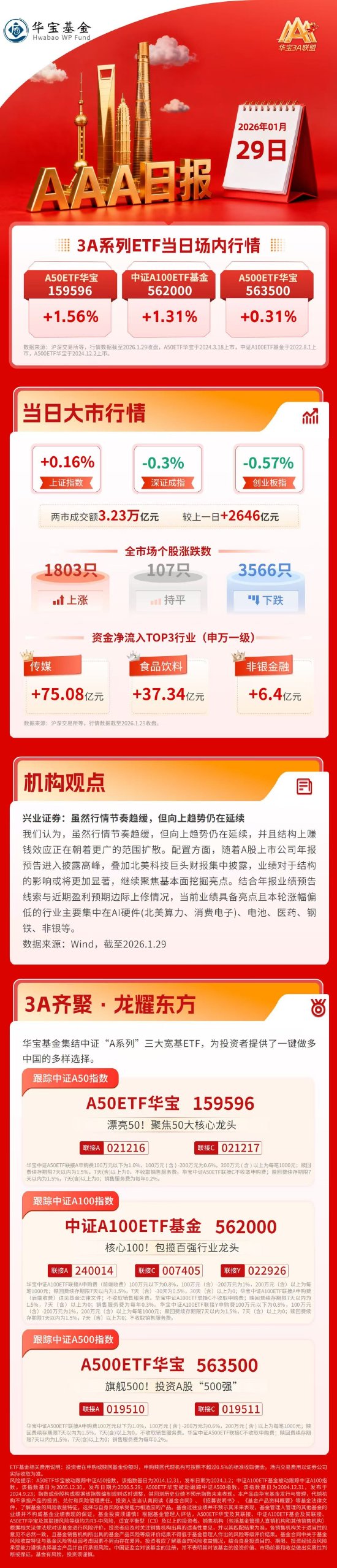
Market Overview - The A-share market showed a slight increase with the Shanghai Composite Index up by 0.16% and the Shenzhen Component Index down by 0.57% on January 29, 2026 [1][6] - The total trading volume across both markets reached 3.23 trillion yuan, an increase of 264.6 billion yuan compared to the previous day [1][6] - The number of stocks that rose was 3,566, while 1,803 remained unchanged, and 1,071 declined [1][6] Institutional Insights - Industrial Securities noted that although the market's pace has slowed, the upward trend continues, with a broadening profit effect across sectors [2][4] - The focus is shifting towards the earnings reports of A-share companies and major North American tech firms, which are expected to have a significant impact on market structure [2][4] - Key sectors with promising earnings and relatively low recent gains include AI hardware (North American computing power, consumer electronics), batteries, pharmaceuticals, steel, and non-bank financials [2][4] ETF Products - Huabao Fund has launched three major broad-based ETFs tracking the China A50 Index, China A100 Index, and A500 Index, providing diverse investment options for investors [2] - The A50 ETF (159596) focuses on 50 leading companies, while the A100 ETF (562000) encompasses the top 100 industry leaders [2] - The A500 ETF is set to launch on December 2, 2024, further expanding investment opportunities in the Chinese market [1][2]


厦钨新能(688778):业绩快速增长,固态电池材料布局持续推进
Guoxin Securities· 2026-01-29 09:05
Investment Rating - The investment rating for the company is "Outperform the Market" [7][5] Core Views - The company is expected to achieve a net profit attributable to shareholders of 755 million yuan in 2025, representing a year-on-year increase of 42%. Revenue is projected to reach 20.03 billion yuan, up 48% year-on-year [2] - The company maintains a leading position in lithium cobalt oxide, with sales expected to reach 65,300 tons in 2025, a 41% increase year-on-year, and a market share of 51%, up 7 percentage points year-on-year [3] - The company is accelerating the industrialization of solid-state battery materials and new structural materials, with significant investments planned for high-performance battery materials and hydrogen energy materials [4] Financial Projections - The company is projected to achieve revenues of 20.03 billion yuan in 2025, with a net profit of 755 million yuan, and an EPS of 1.50 yuan. The dynamic PE ratio is expected to be 60.8 [5][6] - The financial forecast for 2025 includes a revenue increase of 50.7% and a net profit increase of 52.8% compared to 2024 [6] - The company plans to invest 1.525 billion yuan in a project to produce 50,000 tons of high-performance battery materials annually [4]

电池板块1月29日跌0.92%,骄成超声领跌,主力资金净流出39.27亿元
Zheng Xing Xing Ye Ri Bao· 2026-01-29 09:03
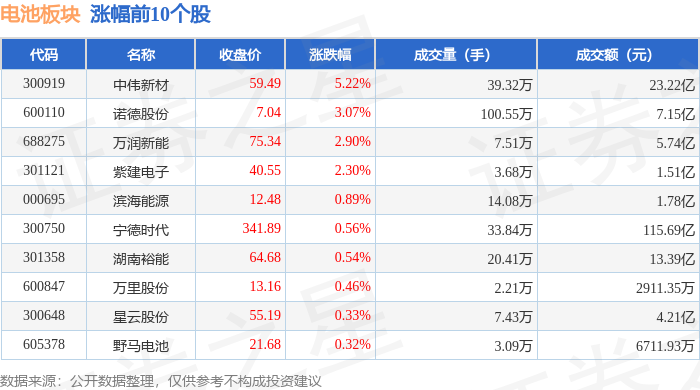
Market Overview - The battery sector experienced a decline of 0.92% compared to the previous trading day, with Jiao Cheng Ultrasonic leading the drop [1] - The Shanghai Composite Index closed at 4157.98, up 0.16%, while the Shenzhen Component Index closed at 14300.08, down 0.3% [1] Stock Performance - Notable gainers in the battery sector included: - Zhongwei New Materials: closed at 59.49, up 5.22% with a trading volume of 393,200 shares [1] - Nord Shares: closed at 7.04, up 3.07% with a trading volume of 1,005,500 shares [1] - Wanrun New Energy: closed at 75.34, up 2.90% with a trading volume of 75,100 shares [1] - Major decliners included: - Jiao Cheng Ultrasonic: closed at 141.00, down 7.54% with a trading volume of 30,300 shares [2] - Jin Yinhe: closed at 51.40, down 6.82% with a trading volume of 154,300 shares [2] - Daoshi Technology: closed at 29.91, down 5.94% with a trading volume of 758,300 shares [2] Capital Flow - The battery sector saw a net outflow of 3.927 billion yuan from institutional investors, while retail investors contributed a net inflow of 2.931 billion yuan [2][3] - Key stocks with significant capital flow included: - Ningde Times: net inflow of 16.9 million yuan from institutional investors, but a net outflow of 1.57 billion yuan from retail investors [3] - Nord Shares: net inflow of 1 billion yuan from institutional investors, with a net outflow of 46.646 million yuan from retail investors [3] - Wukuang New Energy: net inflow of 79.102 million yuan from institutional investors, with a net outflow of 1.2041 million yuan from retail investors [3]


策略专题研究:2026年牛市展望系列3:哪些领域反内卷更值得期待?
Guoxin Securities· 2026-01-29 07:58
证券研究报告 | 2026年01月29日 哪些领域"反内卷"更值得期待?——2026 年牛市展望系列 3 策略专题研究 证券分析师:吴信坤 021-61761046 wuxinkun@guosen.com.cn S0980525120001 核心结论:①本次反内卷较 16 年供改背景更复杂,需求端内弱外强,供给 端受制造实力与地方非经济决策驱动。②26 年反内卷仍是经济工作重点,参 考 25 年及 16 年行情经验,反内卷行情或仍有可观上行空间。③政策干预角 度看,关注企业配合度高、地方、落地动力强的行业(如钢铁、油服工程、 水泥等)。④从行业自身周期看,关注供需两旺的景气行业(贵金属、化学 原料等),以及供需格局优化领域(养殖业、能源金属等)。 本轮反内卷背景更复杂,行情节奏相对波折。相较于供改,本轮反内卷再供 需背景上更复杂:需求端看,不同于供给侧结构性改革时期,棚改货币化等 强政策刺激快速拉动总需求,本次内需不足的特征更为突出,但外需支撑或 相对有韧性;供给端看,本次供给扩张与我国制造业实力提升有关,地方政 府"非经济"决策进一步加剧产能过剩。在此背景下,从行业结构看,本轮 呈"涉及面广、新兴行业多、民 ...
豪鹏科技(001283.SZ):已通过参股公司系统性深化对钠离子电池技术的探索与产业化储备
Ge Long Hui· 2026-01-29 07:25
Core Viewpoint - The company emphasizes technological innovation and forward-looking strategies as core drivers of its development, focusing on both consumer batteries and energy storage systems while exploring next-generation battery technologies [1] Group 1: Strategic Focus - The company is committed to consolidating its main business in consumer batteries and energy storage systems while actively monitoring and investing in next-generation battery technologies [1] - The company has invested in Beijing Sirizhe New Energy Technology Co., Ltd. to deepen its exploration and industrialization of sodium-ion battery technology [1] Group 2: Technological Development - Sirizhe serves as a crucial platform within the company's ecosystem, focusing on the research and industrial application of sodium-ion battery technology, aligning closely with the company's overall technological roadmap [1] - The company adheres to a dual approach guided by market demand and technological maturity, employing a cautious and pragmatic principle to advance research and evaluation of diverse technological routes, including sodium batteries [1] Group 3: Future Outlook - The aim is to establish a solid technological foundation for the extension of future product matrices and the expansion of energy solutions [1]
指数调整,个股反弹!赚钱方向要变了,还有哪些投资机会?
Sou Hu Cai Jing· 2026-01-29 06:59
Group 1 - The A-share technology sector is experiencing fluctuations primarily due to adjustments in leading AI stocks in the US market, along with the year-end institutional fund yield lock-in and a decrease in leveraged trading momentum during a policy vacuum period [1] - The technology sector is significantly influenced by US AI leaders, with recent discussions about overvaluation leading to market volatility and a decline in stock prices, despite Nvidia's better-than-expected performance [1] Group 2 - The Ministry of Finance and the State Taxation Administration announced adjustments to the export tax rebate policy for battery products, which is a strong measure to prevent "involution" and promote competitiveness for leading Chinese battery companies in the global market [3] - The white liquor industry is at a "five-bottom stage," indicating a potential turning point for the sector as capital market expectations align with the upcoming Spring Festival, presenting a bottoming opportunity for investment [3] Group 3 - A shift in capital flow between stocks and bonds has begun, with significant redemptions in bond funds and increased subscriptions for equity ETFs, indicating a potential "spring rally" in the market [5] - Domestic copper prices have surpassed 100,000 yuan per ton, signaling strong market dynamics and a potential new upward trend in copper prices by 2026 due to supply-demand expectations [6] Group 4 - The Shanghai Composite Index is adjusting in line with the Federal Reserve's announcement of no interest rate cuts in January, with a potential for increased market activity as risk appetite improves due to currency appreciation and supportive policies [12] - The ChiNext Index is experiencing sideways movement, with recent market interest focused on gold and rare metals, suggesting opportunities may arise as previous hot sectors re-emerge [12]

光控资本:A股春季行情仍有望延续 整体将以结构性行情为主
Sou Hu Cai Jing· 2026-01-29 06:31
Group 1 - The A-share market experienced narrow fluctuations, with a focus on potential interest rate cuts by the Federal Reserve and the possibility of a reserve requirement ratio reduction in China [1][4] - The macroeconomic improvement and rising corporate earnings are seen as the main drivers for the market's mid-term upward trend, although a comprehensive bull market requires solid fundamental support [1][4] - The recent regulatory measures aim to temper speculative sentiment in the market, promoting a healthier and more sustainable "slow bull" market [4][5] Group 2 - The A-share market showed significant sector rotation, with resource-related cyclical stocks rising while technology-focused stocks experienced a decline [5] - The market is expected to maintain a small upward trend, with investors advised to closely monitor macroeconomic data and changes in overseas liquidity [4][5] - There are structural opportunities in the market despite the rapid rotation, and a cautious approach is recommended when the index rises too quickly or approaches support levels [5]

德赛电池(000049.SZ):公司正积极探索锂电池相关产品在新型智能终端、低空经济等前沿场景的应用机会
Ge Long Hui· 2026-01-29 04:02
Core Viewpoint - Desai Battery (000049.SZ) is primarily engaged in lithium battery-related businesses, with products widely used in various end products such as smartphones, laptops, smart wearable devices, power tools, energy storage, new energy vehicles, drones, and cleaning robots [1] Group 1 - The company is actively exploring application opportunities for lithium battery-related products in emerging smart terminals and low-altitude economy scenarios [1] - The company is making efforts to expand its related business [1]
