
信托

Search documents
国网英大(600517.SH):前三季度净利润22.33亿元,同比增长53.73%
Ge Long Hui A P P· 2025-10-28 12:24
格隆汇10月28日丨国网英大(维权)(600517.SH)发布三季报,2025年前三季度实现营业总收入78.7亿 元,同比增长2.3%;归属母公司股东净利润22.33亿元,同比增长53.73%;基本每股收益为0.39元。 ...

国网英大:前三季度归母净利润同比增长53.73% 产融协同效应持续释放
Zhong Zheng Wang· 2025-10-28 11:41
Core Insights - The company reported a total revenue of 7.87 billion yuan for the first three quarters of 2025, representing a year-on-year growth of 2.30% [1] - The net profit attributable to shareholders reached 2.23 billion yuan, showing a significant increase of 53.73% year-on-year [1] - Basic earnings per share were 0.390 yuan, up by 53.54% compared to the previous year [1] Financial Performance - Total assets as of the end of the third quarter stood at 49.30 billion yuan, reflecting a growth of 5.87% from the end of the previous year [1] - The company achieved high-quality growth in operational performance, with core profitability indicators showing impressive growth [1] Business Development - The company is actively promoting high-quality development and enhancing its financial services to support the dual carbon development strategy [2] - The subsidiary, Yingda Trust, has been recognized for its social responsibility and won the "Charity Trust Golden Bull Award" [1] - Yingda Securities has successfully completed its first large-scale short-term financing bond issuance, raising 1.4 billion yuan [1] Industry Contribution - The company is deepening green finance initiatives through its subsidiary, Yingda Carbon Assets, which has developed a comprehensive "carbon + finance" product system [2] - The company participated in drafting two enterprise standards aimed at optimizing carbon emission management in the power industry [2] Technological Advancements - The subsidiary, Zhixin Electric, is advancing the intelligent upgrade of equipment, with its Tianjin facility recognized as a national exemplary intelligent factory [2] - A total of two units under Zhixin Electric have received national recognition as exemplary intelligent factories [2] Future Outlook - The company aims to enhance its core competitiveness and governance structure while strengthening risk prevention measures [2] - The focus will remain on high-quality development, with a commitment to creating more value for society and shareholders [2]
华能信托破局25年期限:以绿色信托“敢为”与“可为”锚定产业价值
Jin Tou Wang· 2025-10-28 10:53
Core Viewpoint - The article discusses Huaneng Trust's launch of the "Tianhe Green Power Industry Investment No. 1" and "Ruixia Green Power No. 5" collective fund trust plans, marking a significant step in promoting green low-carbon development in line with national strategies [1][5]. Group 1: Project Overview - Huaneng Trust has introduced a 25-year actively managed green equity investment trust aimed at individual investors, focusing on long-term capital for the green energy sector [1]. - The project involves the acquisition of distributed photovoltaic power stations with a total capacity exceeding 450 MW, covering 16,000 rural households across five provinces, with a total investment exceeding 1.5 billion yuan [1]. - The project is expected to achieve an annual reduction of 364,800 tons of carbon dioxide emissions and has received the highest G-1 certification from China Chengxin Green Finance [1]. Group 2: Risk Management and Evaluation - A comprehensive evaluation system has been established, integrating "industry intelligence + professional intermediaries + project teams + risk control" to ensure asset quality [2]. - The project utilizes Huaneng New Energy's remote monitoring platform and AI early warning technology to track operational data in real-time, ensuring that every trust fund corresponds to traceable green assets [2]. - The risk control framework includes a full-process risk management system, focusing on pre-selection, in-process control, and post-mitigation strategies [3][4]. Group 3: Strategic Transformation - Huaneng Trust's shift towards green finance and its strategic transformation is a response to the broader economic transition in China, emphasizing the importance of professional capabilities over mere resource competition [5][6]. - The company has been focusing on green finance, inclusive finance, and industrial finance since 2018, with a cumulative scale of over 95 billion yuan in green trusts during the 14th Five-Year Plan period [5]. - The establishment of a team of industry experts with engineering backgrounds has enhanced the company's ability to identify investment opportunities in key sectors such as clean energy and electric vehicles [6]. Group 4: Future Outlook - Huaneng Trust aims to deepen its investment research capabilities and explore innovative trust products while applying its risk management experience to other financial services [7]. - The company emphasizes the need to balance its core mission of asset management with the responsibility of supporting the real economy and national strategies [7]. - The year 2025 is highlighted as a crucial milestone for Huaneng Trust, marking a new beginning in its commitment to professional integrity and social value creation [7].
第十九届HED中国峰会·深圳即将启幕
Xin Lang Ji Jin· 2025-10-28 10:03
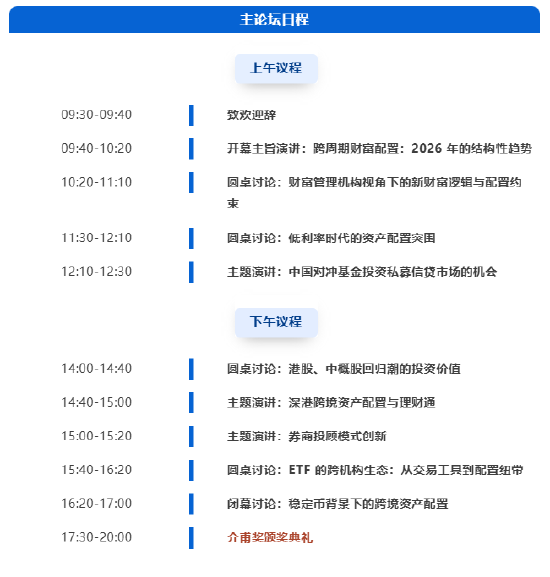
Core Insights - The 19th HED China Summit will be held in Shenzhen on January 15, 2026, focusing on the integration of private equity and wealth management [1] - The event will gather over 400 decision-makers from private equity funds, brokerages, banks, trusts, family offices, and wealth platforms to facilitate high-quality development in the asset management industry [1] Agenda Highlights - The morning session includes a welcome speech, keynote addresses on wealth allocation trends for 2026, and discussions on new wealth logic and asset allocation strategies in a low-interest-rate environment [2] - Afternoon sessions will cover topics such as investment value in Hong Kong and mainland stocks, cross-border asset allocation, and innovations in brokerage advisory services [2] - The event will conclude with discussions on the ecosystem of ETFs and cross-border asset allocation in the context of stablecoins [2] Additional Sessions - The agenda features discussions on innovative stock strategies, the application of AI in quantitative stock strategies, and the evolution of investment strategies in a low-interest-rate environment [4][5] - Keynote speeches will address the investment opportunities arising from the global interest rate decline and the challenges and opportunities for investment funds [5]

国网英大:2025年前三季度净利润约22.33亿元
Mei Ri Jing Ji Xin Wen· 2025-10-28 09:54
Group 1 - Company reported Q3 performance with revenue of approximately 7.87 billion yuan, a year-on-year increase of 2.3% [1] - Net profit attributable to shareholders was about 2.233 billion yuan, reflecting a year-on-year increase of 53.73% [1] - Basic earnings per share reached 0.39 yuan, up 53.54% year-on-year [1] Group 2 - The company's market capitalization is currently 32.8 billion yuan [2]
上市公司公告披露,这家国资信托2亿债权转让
Jing Ji Guan Cha Bao· 2025-10-28 09:02
Core Viewpoint - Zhonggong Education Technology Co., Ltd. has announced a debt restructuring plan involving a debt transfer agreement with Hu'nan Caixin Trust Co., Ltd. and CITIC Financial Asset Management Co., Ltd. Hunan Branch, which has drawn attention from the trust industry [1] Group 1: Debt Restructuring Details - As of the disclosure date, Zhonggong Education has a loan principal balance of 931 million yuan, with Hu'nan Caixin Trust transferring 205.8 million yuan of its debt to CITIC Financial Asset Management, extending the repayment period to 36 months and reducing the original interest rate from 9.5% per annum to 7.01% per annum [1] - Despite the transfer of 205.8 million yuan in debt, there remains an outstanding amount of 700 million yuan, which poses a significant burden for Hu'nan Caixin Trust [1] Group 2: Company Background - Hu'nan Caixin Trust, originally known as Hunan Trust, was established in 1985 and is a core subsidiary of Hunan Caixin Financial Holdings Group, with a registered capital of 4.38 billion yuan [1] - It is noteworthy that by the end of 2024, Hu'nan Caixin Trust was fined 3.3 million yuan by regulators for various violations, including risks associated with rigid repayment and inaccurate risk asset data [1]
18家信托高管变更,兴业、柏瑞债券产品表现靠前,国民信托分化
2 1 Shi Ji Jing Ji Bao Dao· 2025-10-28 04:24
Group 1: Trust Product Issuance - In September, a total of 1,336 trust products were issued, showing a slight month-on-month decrease of 6% [1] - Among the new issuances, 1,081 were securities investment trusts, accounting for 80.91% of the total, which is an increase of 6.65 percentage points from the previous month [1] - Other investment trusts accounted for 225 products (16.84%), while loan trusts were only 20 products (1.5%), reflecting a month-on-month decrease of 4.42% [1] Group 2: Performance of Securities Investment Products - The average return for equity trusts in the first three quarters reached 18.58%, despite a volatile market in September [2] - Bond trusts underperformed, with an average return of only 1.57% in the same period, and 15.64% of bond trusts reported losses [2] Group 3: Strategy Performance - Macro strategy trusts performed the best in the first three quarters, with an average return of 24.18% [3] - Quantitative long strategies led the stock strategies with an average return of 27.26%, while subjective long strategies followed with 13.66% [3] Group 4: Specific Product Performance - Four bond trusts exceeded a 30% return in the first three quarters, with "Qihang No. 12" achieving the highest return of 39.98% [4] - Among equity trusts, "Boyi Stable Phase 1" had the highest return at 203.77%, with three equity trusts doubling their returns [4] Group 5: Trust Company Performance - BaiRui Trust had the highest average return for bond trusts at 10.11%, while 41.07% of bond products had returns below 2% [5][6] - Huaren Trust led in equity trust returns at 32.37%, followed by Caixin Trust at 26.45% [7] Group 6: Major Events in the Trust Industry - The "Trust Company Management Measures" underwent its first major revision in 18 years, focusing on core business and risk management, effective from January 1, 2026 [9] - There have been significant changes in the core management of 18 trust companies this year, including key positions such as chairman and general manager [10] - Zhongyuan Trust received approval for a capital increase to 5 billion yuan, with a new general manager appointed recently [11]
机构风向标 | 联发股份(002394)2025年三季度已披露持仓机构仅9家
Xin Lang Cai Jing· 2025-10-28 01:42
Group 1 - The core point of the news is that 联发股份 (002394.SZ) reported its Q3 2025 results, highlighting significant institutional investor holdings and changes in public fund investments [1] - As of October 27, 2025, a total of 9 institutional investors hold 149 million shares of 联发股份, accounting for 45.93% of the total share capital, with an increase of 0.84 percentage points compared to the previous quarter [1] - The public fund sector saw a decrease in holdings from one fund, 南华丰睿量化选股混合A, while one new fund, 南华丰元量化选股混合A, was disclosed this quarter [1] Group 2 - Foreign institutional investors that were not disclosed in this quarter include BARCLAYS BANK PLC and 中信证券资产管理 (香港) 有限公司 [2]

晶澳科技签署2025年员工持股计划信托合同 委托云南国际信托实施
Xin Lang Cai Jing· 2025-10-27 14:47
Core Viewpoint - JinkoSolar Technology Co., Ltd. has officially initiated its 2025 employee stock ownership plan by signing a trust contract with Yunnan International Trust Co., Ltd. [1][2] Group 1: Employee Stock Ownership Plan Implementation - The company held board and supervisory meetings on August 22, 2025, to approve the draft of the employee stock ownership plan and its management guidelines [1] - A subsequent shareholders' meeting on September 8, 2025, further ratified these proposals, establishing a legal foundation for the plan [1] - On October 23, 2025, the company revised the plan's details, focusing on funding sources, management models, and rights distribution mechanisms to enhance efficiency [2] Group 2: Trust Agreement and Management - The signed trust contract designates the company as the trustor and Yunnan International Trust Co., Ltd. as the trustee, responsible for managing and operating the trust plan [2] - The company will continue to monitor the implementation of the employee stock ownership plan and comply with legal disclosure requirements [2] Group 3: Market Implications - Analysts suggest that the implementation of the employee stock ownership plan will align the interests of the core team, improve corporate governance efficiency, and potentially enhance operational stability in the long run [2]

国投资本:10月27日召开董事会会议
Mei Ri Jing Ji Xin Wen· 2025-10-27 14:27
Group 1 - The core point of the article is that Guotou Capital held its 29th board meeting on October 27, 2025, to discuss the adjustment of the members of the board's specialized committees [1] - For the year 2024, Guotou Capital's revenue composition is as follows: 71.62% from the securities industry, 9.9% from other businesses, 9.33% from the trust industry, and 9.16% from the fund industry [1] - As of the report date, Guotou Capital has a market capitalization of 51 billion yuan [1]
