网约车

Search documents
如祺出行上半年总收入增逾六成 毛利大增215.4%实现转正
Zheng Quan Shi Bao Wang· 2025-08-26 14:45
Core Insights - The company, 如祺出行, reported a significant increase in key financial metrics for the first half of 2025, with total revenue reaching 1.676 billion RMB, a year-on-year increase of 61.7% [1][2] - The company achieved its first positive gross margin, with a total gross profit of 37.438 million RMB, representing a 215.4% increase compared to the same period last year, and a gross margin of 2.2% [1][2] - The company's Robotaxi operations have seen substantial growth, with order volume increasing by over 470% year-on-year, and the monthly active user count rising by over 70% [1][6] Revenue Growth - The two core business segments, ride-hailing services and technology services, both experienced significant growth, contributing to the overall revenue increase [2] - Ride-hailing services, including both traditional ride-hailing and Robotaxi services, generated 1.636 billion RMB in revenue, an increase of 86% year-on-year [2] - Technology services, which include AI data and model solutions as well as high-precision mapping, saw a revenue increase of 207% year-on-year [2] Cost Management - The company successfully reduced various costs while achieving significant growth in order volume and revenue [3] - Financial costs decreased by 43.4% year-on-year, while general and administrative expenses, as well as sales and marketing expenses, were reduced by over 20% [3] Expansion Strategy - The company employs a unique "ripple model" for regional expansion, focusing on deepening its presence in the Guangdong-Hong Kong-Macao Greater Bay Area before expanding to adjacent regions [4] - As of August 26, the company's services have expanded to cover 94 cities nationwide [4] Robotaxi Development - Since its listing, the company has invested over 137 million HKD in research and development for autonomous driving and Robotaxi services, with plans to invest an additional 256 million HKD in 2026 and beyond [6] - The company announced the "Robotaxi+" strategy, aiming to expand its Robotaxi operations to 100 core cities and build a fleet of over 10,000 vehicles [6][7] - Following the announcement of the "Robotaxi+" strategy, the company's market value increased by nearly 25% within a month [7]
如祺中期业绩发布:收入增长61.7%,毛利首次转正且大幅提升215.4%,Robotaxi或成公司“第二增长曲线”
Xin Lang Cai Jing· 2025-08-26 13:40
Core Insights - The company, 如祺出行, reported significant growth in key financial metrics for the first half of 2025, including revenue, order volume, and transaction value, with a notable improvement in gross margin [1] Financial Performance - Total revenue for the first half of 2025 reached 1.676 billion RMB, representing a year-on-year increase of 61.7% [1] - The order volume for transportation services grew by 51.13% to 73.3 million orders, contributing to a transaction value increase of 56.83% to 2.032 billion RMB [1] - Revenue from transportation services, including ride-hailing and Robotaxi services, surged by 86%, while revenue from technology services, which includes AI data and high-precision mapping solutions, increased by 207% [1] Profitability - For the first time, the company recorded a positive gross margin, with total gross profit amounting to 37.438 million RMB, a 215.4% increase compared to the same period last year [1] - The gross margin improved significantly from -3.1% in the previous year to 2.2%, marking a substantial improvement of 170.97% [1] Strategic Outlook - The company plans to expand its Robotaxi operations to 100 core cities over the next five years, aiming to build a fleet of over 10,000 Robotaxi vehicles in collaboration with partners [1]
如祺出行发布中期业绩 股东应占亏损1.25亿元 同比收窄62.3%
Zhi Tong Cai Jing· 2025-08-26 13:23
Group 1 - The company reported a revenue of 1.676 billion RMB for the six months ending June 30, 2025, representing a year-on-year increase of 61.7% [1] - The loss attributable to equity shareholders narrowed to 125 million RMB, a decrease of 62.3% compared to the previous year [1] - The basic loss per share was 0.64 RMB [1] Group 2 - The increase in revenue was primarily driven by the growth in the company's mobility service income [1]
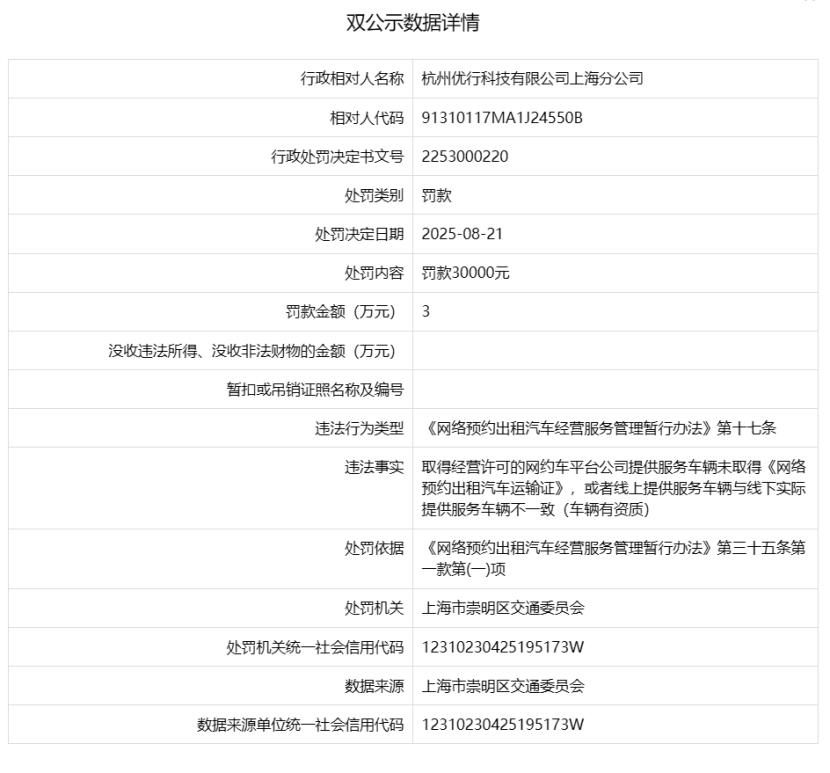
杭州优行科技有限公司上海分公司一天收三张罚单
Qi Lu Wan Bao· 2025-08-26 10:54
Core Points - Hangzhou Youxing Technology Co., Ltd. Shanghai Branch received three fines for operating vehicles without the required "Network Reservation Taxi Transport Certificate" [1][2][5] - The fines were issued by the Shanghai Chongming District Transportation Committee and the Shanghai Fengxian District Transportation Committee, each imposing a fine of 30,000 RMB [1][7] - The violations pertained to discrepancies between the vehicles listed online and those actually providing services, violating Article 17 of the "Interim Measures for the Administration of Network Reservation Taxi Operating Services" [1][5][7] Company Information - Hangzhou Youxing Technology Co., Ltd. Shanghai Branch is a subsidiary of Hangzhou Youxing Technology Co., Ltd., established in 2017, with Hu Xiangjun as the responsible person [1][8] - The parent company, Hangzhou Youxing Technology Co., Ltd., was founded in 2015 and is associated with the ride-hailing platform "Caocao Chuxing," with a registered capital of 478.5615 million RMB [1][8]

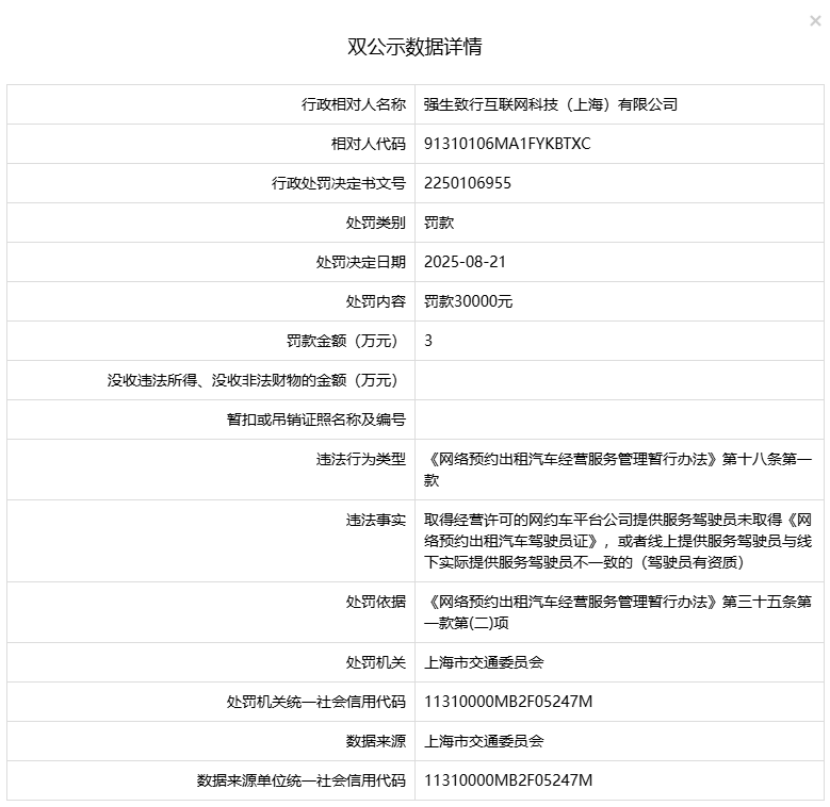
强生致行互联网科技(上海)有限公司被罚
Qi Lu Wan Bao· 2025-08-26 10:49
记者从信用中国(上海)获悉,8月21日,强生致行互联网科技(上海)有限公司因"驾驶员未取得《网络预约出租汽 车驾驶员证》"等,及"车辆未取得《网络预约出租汽车运输证》"等,被上海市交通委员会连续处以两笔罚款,合计六 万元人民币。 违法事实显示,8月21日,该公司存在"取得经营许可的网约车平台公司提供服务驾驶员未取得《网络预约出租汽车驾 驶员证》,或者线上提供服务驾驶员与线下实际提供服务驾驶员不一致的(驾驶员有资质)",违反《网络预约出租 汽车经营服务管理暂行办法》第十八条第一款,依据《网络预约出租汽车经营服务管理暂行办法》第三十五条第一款 第(二)项予以行政处罚,处罚决定文书号为2250106955。 | 行政相对人名称 | 强生致行互联网科技(上海)有限公司 | | --- | --- | | 相对人代码 | 91310106MA1FYKBTXC | | 行政处罚决定书文号 | 2250106955 | | 处罚类别 | 罚款 | | 处罚决定日期 | 2025-08-21 | | 处罚内容 | 罚款30000元 | | 罚款全额(万元) | 3 | | 没收违法所得、没收非法财物的金额(万元) | | | ...
为什么禁止网约车“一口价”既伤乘客,也伤司机?
虎嗅APP· 2025-08-26 10:39
Core Viewpoint - The income of ride-hailing drivers is ultimately determined by the income of people in other industries, and the pricing of ride-hailing services is dictated by market supply and demand rather than the drivers' labor input [4][12][16]. Regulatory Actions - Recently, Xi'an's transportation authority announced a ban on "fixed-price" and "discount orders" for ride-hailing services, effective from August 19, due to complaints from taxi drivers about unfair competition and market disruption [4][5]. - Other regions, including Jiangxi, Zhejiang, Henan, and Guangdong, have also taken steps to curb low-price competition to protect drivers' rights [4]. Market Dynamics - The ride-hailing market has seen significant competition, leading to a variety of service options and price points, which has resulted in a positive cycle of price reduction, market expansion, and product upgrading [10][19]. - The existence of "fixed-price" orders is not the only option for passengers, as ride-hailing apps offer a wide range of services at different price levels [10][21]. Misconceptions about Competition - The term "involution" has been misused to describe competitive pricing strategies, which can actually lead to market expansion and innovation rather than inefficiency [8][9]. - Low pricing can be a reflection of societal progress and can improve living standards for ordinary people [9][10]. Impact on Drivers and Passengers - Banning "fixed-price" orders may harm both passengers and drivers, as it reduces passenger choice and could lead to higher fares, ultimately decreasing demand for rides [12][14]. - Drivers' income is influenced by consumer demand; if fewer passengers use ride-hailing services due to higher prices, drivers may face reduced earnings [11][15]. Regulatory Perspective - Current regulatory approaches often view the ride-hailing market as an extension of the traditional taxi market, which overlooks the unique dynamics and technological advancements of ride-hailing platforms [18][19]. - The efficiency of "fixed-price" orders addresses key consumer concerns, such as price certainty and reduced disputes, benefiting both passengers and drivers [20][21]. Platform Commission Structure - Recent announcements from ride-hailing platforms indicate a reduction in commission rates, with some platforms lowering their maximum commission to 27% [22]. - The inconsistency in national policies complicates platform operations and may hinder the ability to lower commissions further [22].
为什么“禁止网约车一口价”既伤乘客,也伤司机?
Feng Huang Wang· 2025-08-26 10:27
Core Viewpoint - The income of ride-hailing drivers is ultimately determined by the income of individuals in other industries, while the pricing of ride-hailing services is dictated by market supply and demand rather than the drivers' labor input [1][12]. Regulatory Actions - Recently, Xi'an has banned "fixed-price" and "discount orders" in the ride-hailing market, effective from August 19, due to complaints from taxi drivers about unfair competition and disruption of market order [2]. - Other regions, including Jiangxi, Zhejiang, Henan, and Guangdong, have also taken steps to curb low-price competition to protect drivers' rights [2]. - Xi'an's decision is notable for its comprehensive ban on these pricing strategies, which is rare compared to other regions that have only issued warnings [2]. Market Dynamics - The ride-hailing market has been characterized by various "chaotic phenomena," but outright banning fixed-price orders is not seen as a viable solution [3]. - The term "involution" has been misused in discussions about competition, where low-price competition is often labeled as involution, obscuring the real issues [4][5]. - Low prices can lead to market expansion and are often a result of technological advancements and business model innovations [6][8]. Consumer and Driver Impact - Banning fixed-price orders may negatively impact both passengers and drivers, as passengers would face higher costs and reduced choices [9][10]. - The demand for ride-hailing services may decrease if prices rise, which could ultimately harm drivers' earnings despite higher fares [11]. - There is a divide among drivers regarding fixed-price orders, with some preferring them for their efficiency and others opposing them due to perceived lower earnings [11][17]. Regulatory Perspective - Current regulatory approaches often view the ride-hailing market as an extension of the traditional taxi market, which fails to recognize the distinct nature of ride-hailing services [14][15]. - The ride-hailing market operates on a two-sided platform model, where increased participation from both drivers and passengers leads to lower costs and prices, a dynamic not present in traditional taxi services [15][16]. - The existence of fixed-price orders is seen as a necessary feature of the ride-hailing market, providing efficiency and certainty for consumers [16]. Future Considerations - The recent reduction in commission rates by several ride-hailing platforms indicates a potential for improved earnings for drivers if regulatory burdens are eased [17]. - The inconsistency and variability of regulations across regions complicate operational efficiency for ride-hailing platforms, suggesting that a shift in regulatory thinking may be necessary for the industry's growth [17].

为什么禁止网约车“一口价”既伤乘客,也伤司机?
Hu Xiu· 2025-08-26 01:52
Core Viewpoint - The recent ban on "fixed price" and "discount orders" for ride-hailing services in Xi'an aims to address complaints from taxi drivers about unfair competition and to protect their rights, but it may have negative implications for both passengers and drivers [1][2][11][26]. Group 1: Regulatory Actions - Xi'an's transportation authority has mandated a complete suspension of low-price marketing activities starting from August 19, 2023, due to complaints from taxi drivers about unfair competition [1][2]. - Other cities, including Jiangxi, Zhejiang, Henan, and Guangdong, have also taken steps to curb low-price competition in the ride-hailing market [2]. - Xi'an's high density of ride-hailing drivers positions it as a potential trendsetter for similar regulatory actions in other regions [2]. Group 2: Market Dynamics - The ride-hailing market has seen significant price reductions, which have attracted more passengers, indicating that lower prices can lead to market expansion rather than "involution" [6][11][20]. - The existence of various pricing options in ride-hailing apps provides consumers with a wide range of choices, which was not available in traditional taxi services [9][12]. - The decline in ride-hailing prices is a key factor in the increasing number of users, suggesting that banning low-price options could harm overall demand [10][11]. Group 3: Driver Perspectives - There is a divide among drivers regarding "fixed price" orders; while some dislike them, many part-time drivers appreciate the volume of orders they provide [15][16]. - A full-time driver highlighted that the income of ride-hailing drivers is influenced more by the overall market demand than by individual pricing strategies [17]. - The argument against banning "fixed price" orders is that it could lead to reduced demand and fewer rides, ultimately harming drivers' earnings [13][15][26]. Group 4: Regulatory Implications - The current regulatory approach may be outdated, treating the ride-hailing market as an extension of the traditional taxi system, which overlooks the unique dynamics of the platform economy [19][20]. - The efficiency of "fixed price" orders benefits both passengers and drivers by reducing disputes and optimizing service delivery [24]. - A shift in regulatory thinking is necessary to better align with the realities of the ride-hailing market and to avoid unintended consequences from blanket bans on pricing strategies [26].
普通快车单笔抽21%至24%,月度平均抽成进一步下降
Mei Ri Jing Ji Xin Wen· 2025-08-25 13:10
Core Viewpoint - The ride-hailing industry is experiencing significant changes as major platforms adjust their commission rates, reflecting a shift from price competition to service and ecosystem enhancement [1][7]. Commission Rate Adjustments - Didi announced it will lower the maximum commission rate to 27% by the end of the year, with an average commission rate of 14% for all orders last year [1][3]. - Other platforms like Gaode and T3 are also implementing similar maximum commission limits of 27% [1][3]. - Current commission rates for regular ride orders range from 21% to 24%, with some drivers receiving rebates based on performance [1][4]. Policy Influence - The adjustment in commission rates is influenced by ongoing government policies aimed at regulating the ride-hailing industry, promoting transparency, and reducing excessive commission rates [6][7]. - Recent policies have emphasized the need for platforms to publicly disclose pricing and commission structures, with a maximum commission cap of 30% [6][7]. Driver Impact - Experts suggest that reducing the maximum commission to around 20% could significantly improve driver income [1][7]. - Many drivers express hope that these changes will lead to better earnings, although some remain skeptical based on past experiences with commission adjustments [4][7]. Industry Trends - The industry is transitioning towards a focus on service quality and ecosystem development rather than solely relying on commission income [8][9]. - Major platforms are exploring new business models and international markets to diversify revenue streams and alleviate competitive pressures in the domestic market [9][10]. Collaborative Efforts - The ride-hailing sector requires a collaborative approach involving policy guidance, platform innovation, driver participation, and public oversight to ensure fair treatment and improved working conditions for drivers [10].
前瞻全球产业早报:阿里发布编程平台Qoder
Qian Zhan Wang· 2025-08-25 11:59
Group 1 - Ride-hailing platforms such as Didi Chuxing, T3, and Cao Cao have announced a reduction in commission rates to improve driver rights [2] - Starbucks is expected to receive a non-binding acquisition offer for its China business within two weeks [3] - South Africa will launch its first new underground gold mine in 15 years, with West Wits Mining planning to start production next year [4] Group 2 - NIO's founder Li Bin stated that the pricing range for NIO vehicles aligns with the average prices of Mercedes-Benz, BMW, and Audi [5] - Yonghui Supermarket reported a revenue of 29.948 billion yuan for the first half of the year, a year-on-year decline of 20.73%, and a net loss of 241 million yuan [6][7] - Alibaba launched the Qoder programming platform, which can search 100,000 code files and significantly reduce development time for e-commerce websites [8] Group 3 - Bilibili achieved a total revenue of 7.34 billion yuan in the second quarter, marking a 20% year-on-year increase, and reported its first half-year profit since its IPO [10] - The South Korean government plans to increase R&D spending to a record 25.1 billion USD by 2026 [10] Group 4 - OpenAI announced plans to establish its first corporate office in India later this year [11] - Tesla raised the price of its Cyberbeast model from 99,990 USD to 114,990 USD, an increase of 15,000 USD [12] - Morgan Stanley predicts that OPEC may reduce production again in early 2026 due to expected oversupply in the oil market [13] Group 5 - Meta and Google have signed a six-year cloud agreement valued at over 10 billion USD [14][15] - OpenAI's Chief People Officer will leave the company to pursue personal goals related to the transition to general artificial intelligence [16] - Nvidia has joined the FugakuNEXT supercomputer project in Japan [16]