
乐器制造

Search documents
珠江钢琴:目前经营情况正常 不存在应披露而未披露的重大事项
Ge Long Hui A P P· 2025-10-29 10:40
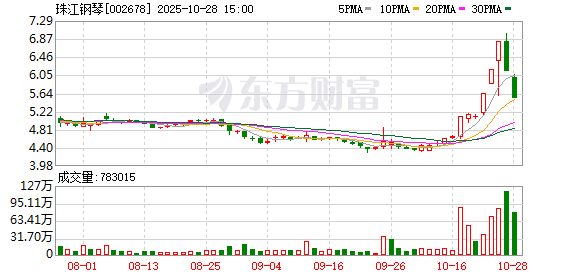
Core Viewpoint - The stock of Pearl River Piano has experienced a significant abnormal fluctuation, with a cumulative decline of over 20% in closing prices over three consecutive trading days [1] Summary by Relevant Sections - **Stock Performance** The company's stock has seen a cumulative decline of over 20% in closing prices over three consecutive trading days, indicating abnormal trading activity [1] - **Company Disclosure** The company has confirmed that there are no corrections or supplements needed for previously disclosed information. Additionally, there have been no significant changes in the company's operational situation or external business environment recently [1] - **Material Events** The company, its controlling shareholders, and actual controllers have stated that there are no undisclosed significant matters related to the company, nor are there any major matters in the planning stage that require disclosure [1]

海伦钢琴(300329.SZ):前三季度净亏损3985.84万元
Ge Long Hui A P P· 2025-10-29 09:37
Core Viewpoint - Helen Piano (300329.SZ) reported a significant decline in revenue and net profit for the first three quarters of 2025, indicating potential challenges in its financial performance [1] Financial Performance - The company achieved operating revenue of 88.5494 million yuan, a year-on-year decrease of 26.38% [1] - The net profit attributable to shareholders of the listed company was -39.8584 million yuan [1] - The net profit attributable to shareholders after deducting non-recurring gains and losses was -39.7357 million yuan [1] - The basic earnings per share were -0.1576 yuan [1]

海伦钢琴:第三季度归母净利润亏损1542.62万元
Xin Lang Cai Jing· 2025-10-29 08:17
Core Insights - Helen Piano reported a revenue of 31.9052 million yuan for Q3 2025, representing a year-on-year decline of 12.45% [1] - The company recorded a net loss attributable to shareholders of 15.4262 million yuan for the same quarter, with a basic earnings per share of -0.061 yuan [1] - For the first three quarters, the total revenue was 88.5494 million yuan, down 26.38% year-on-year [1] - The net loss attributable to shareholders for the first three quarters was 39.8584 million yuan, with a basic earnings per share of -0.1576 yuan [1]
珠江钢琴龙虎榜数据(10月28日)
Zheng Quan Shi Bao Wang· 2025-10-28 09:11
Core Points - Zhujiang Piano experienced a trading halt today, with a total turnover rate of 5.77% and a transaction volume of 440 million yuan, showing a fluctuation of 9.96% [2] - The stock was listed on the Shenzhen Stock Exchange's watch list due to a daily decline deviation of -9.77%, with a net selling amount of 27.68 million yuan from brokerage seats [2] - The top five brokerage seats accounted for a total transaction of 101 million yuan, with a buying amount of 36.54 million yuan and a selling amount of 64.23 million yuan, resulting in a net selling of 27.68 million yuan [2] Trading Activity - In the trading activity today, the largest buying brokerage was Dongfang Caifu Securities with a purchase amount of 6.55 million yuan, while the largest selling brokerage was Huaxin Securities with a selling amount of 9.80 million yuan [2][3] - Over the past six months, Zhujiang Piano has appeared on the watch list eight times, with an average price drop of 3.32% the day after being listed and an average drop of 12.26% in the following five days [3] - The stock saw a net outflow of 22.01 million yuan in main funds today, with a net inflow of 2.91 million yuan from large orders and a net outflow of 24.92 million yuan from major funds [3] Detailed Brokerage Transactions - The top five buying brokerages and their respective buying and selling amounts are as follows: - Dongfang Caifu Securities (Lhasa Tuanjie Road): Buying 6.55 million yuan, Selling 4.05 million yuan - Dongfang Caifu Securities (Lhasa Financial City): Buying 5.84 million yuan, Selling 5.18 million yuan - Dongfang Caifu Securities (Lhasa East Ring Road): Buying 5.29 million yuan, Selling 3.28 million yuan - Guoxin Securities (Zhejiang Internet Branch): Buying 4.89 million yuan, Selling 3.42 million yuan - Dongfang Caifu Securities (Changdu Liangjiang Avenue): Buying 4.73 million yuan, Selling 4.31 million yuan [3]

海伦钢琴股价涨5.54%,诺安基金旗下1只基金位居十大流通股东,持有133.92万股浮盈赚取116.51万元
Xin Lang Cai Jing· 2025-10-28 02:44
Group 1 - Helen Piano's stock increased by 5.54% to 16.57 CNY per share, with a trading volume of 85.76 million CNY and a turnover rate of 2.11%, resulting in a total market capitalization of 4.19 billion CNY [1] - The company, established on June 15, 2001, and listed on June 19, 2012, is based in Ningbo, Zhejiang Province, and specializes in the research, production, and sales of pianos and their core components [1] - The revenue composition of Helen Piano includes: upright pianos 54.12%, grand pianos 20.49%, smart electric pianos 12.46%, accessories 5.63%, others 4.86%, art training 1.56%, small instruments 0.73%, and components 0.16% [1] Group 2 - Noan Fund's Noan Multi-Strategy Mixed A (320016) entered the top ten circulating shareholders of Helen Piano in the second quarter, holding 1.3392 million shares, which is 0.53% of the circulating shares, with an estimated floating profit of approximately 1.1651 million CNY [2] - The Noan Multi-Strategy Mixed A fund was established on August 9, 2011, with a latest scale of 1.399 billion CNY, achieving a year-to-date return of 68.91% and a one-year return of 79.81% [2]
珠江钢琴10月27日龙虎榜数据
Zheng Quan Shi Bao Wang· 2025-10-27 09:17
Core Viewpoint - Zhujiang Piano experienced a significant drop in stock price, reaching the daily limit down, with a trading volume of 7.45 billion yuan and a turnover rate of 8.67% [2] Trading Performance - The stock's price fell by 11.26%, leading to its inclusion on the daily limit list, with net selling from the Shenzhen Stock Connect amounting to 15.12 million yuan [2] - The stock has been on the trading list for a total of 7 times in the past six months, with an average price drop of 2.21% the day after being listed and an average decline of 9.51% over the following five days [3] Capital Flow - Today's net outflow of main funds was 15.08 million yuan, with a significant outflow of 45.84 million yuan from large orders, while smaller orders saw a net inflow of 30.75 million yuan [3] - Over the past five days, the main funds have seen a net inflow of 94.56 million yuan [3] Trading Details - The top five buying and selling trading departments accounted for a total transaction amount of 170 million yuan, with buying totaling 63.14 million yuan and selling totaling 107 million yuan, resulting in a net selling of 43.83 million yuan [2] - Specific trading details show that the largest buying department was Huaxin Securities, while the largest selling department was Shenwan Hongyuan Securities, with significant net selling from the Shenzhen Stock Connect [3]
从“懂五线谱”到“会编程” 上海国际乐器展勾勒行业未来方向
Xin Hua She· 2025-10-26 06:03
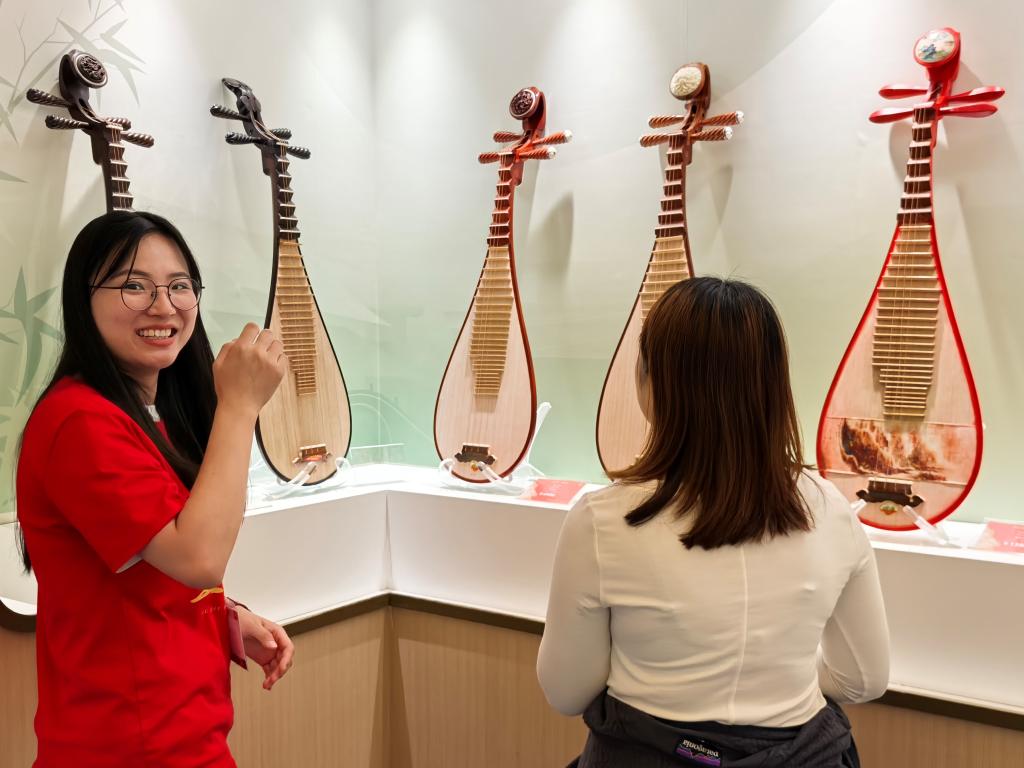
Core Insights - The China (Shanghai) International Musical Instruments Exhibition showcased the industry's core data and innovative achievements, highlighting the dual focus on traditional and smart musical instruments to maintain China's position as a global leader in manufacturing, consumption, and export of musical instruments [1][3]. Industry Overview - The exhibition attracted nearly 1,700 companies from 28 countries and regions, covering an exhibition area of 140,000 square meters [3]. - Smart musical instruments emerged as a focal point, featuring products like a headless electric guitar with built-in chips and audio algorithms, and a digital piano with advanced sampling sources and intuitive interfaces [3][5]. Financial Performance - According to the China Musical Instruments Association, the smart musical instrument sector is projected to achieve a revenue of 5.655 billion yuan in 2024, accounting for nearly 30% of the total revenue of large-scale musical instrument enterprises, with a profit of 361 million yuan and a profit margin of 6.39%, leading the industry [3][5]. Export Growth - In 2024, exports of musical instruments to ASEAN markets are expected to grow by 50%, while exports to countries involved in the Belt and Road Initiative are projected to increase by nearly 30%, reflecting strong recognition from over 20 major musical instrument producing and selling countries [3]. Future Trends - The integration of artificial intelligence in smart musical instruments allows for features like automatic accompaniment and real-time error correction, lowering the learning barrier and enhancing performance and creative sharing [5]. - Industry experts suggest that future professionals in the musical instrument sector will need to be proficient not only in traditional music notation but also in digital programming, indicating a shift in consumer interaction with musical instruments [5].
广州珠江钢琴集团股份有限公司股票交易异常波动的公告
Zhong Guo Zheng Quan Bao - Zhong Zheng Wang· 2025-10-24 21:07
Group 1 - The company's stock price experienced an abnormal fluctuation, with a cumulative increase of over 20% on October 22 and 23, 2025 [1] - The company conducted an internal review and found no need for corrections or supplements to previously disclosed information [2] - There were no significant changes in the company's operational situation or external business environment recently [2][4] Group 2 - The company confirmed that there were no undisclosed significant matters related to the company that should have been disclosed according to the Shenzhen Stock Exchange regulations [4] - During the period of stock price fluctuation, the controlling shareholder and actual controller did not engage in buying or selling the company's stock [3] - The company will release its Q3 2025 report on October 25, 2025, detailing its operational and financial performance [5]
珠江钢琴发布前三季度业绩,归母净亏损2.18亿元
Zhi Tong Cai Jing· 2025-10-24 14:31
Core Viewpoint - The company reported a significant decline in revenue and incurred substantial losses in the first three quarters of 2025 [1] Financial Performance - The company achieved an operating revenue of 386 million yuan, representing a year-on-year decrease of 26.72% [1] - The net loss attributable to shareholders of the listed company was 218 million yuan [1] - The net loss attributable to shareholders, excluding non-recurring gains and losses, was 220 million yuan [1]
珠江钢琴(002678.SZ)发布前三季度业绩,归母净亏损2.18亿元
智通财经网· 2025-10-24 14:14
Core Viewpoint - The company reported a significant decline in revenue and incurred substantial losses in the first three quarters of 2025 [1] Financial Performance - The company achieved an operating revenue of 386 million yuan, representing a year-on-year decrease of 26.72% [1] - The net loss attributable to shareholders of the listed company was 218 million yuan [1] - The net loss attributable to shareholders, excluding non-recurring gains and losses, was 220 million yuan [1]