空调

Search documents
上海一知名企业公告:创始人逝世!官网已变黑白,其子曾称“父亲生命一大半时间都泡在公司”
Mei Ri Jing Ji Xin Wen· 2025-12-07 08:30
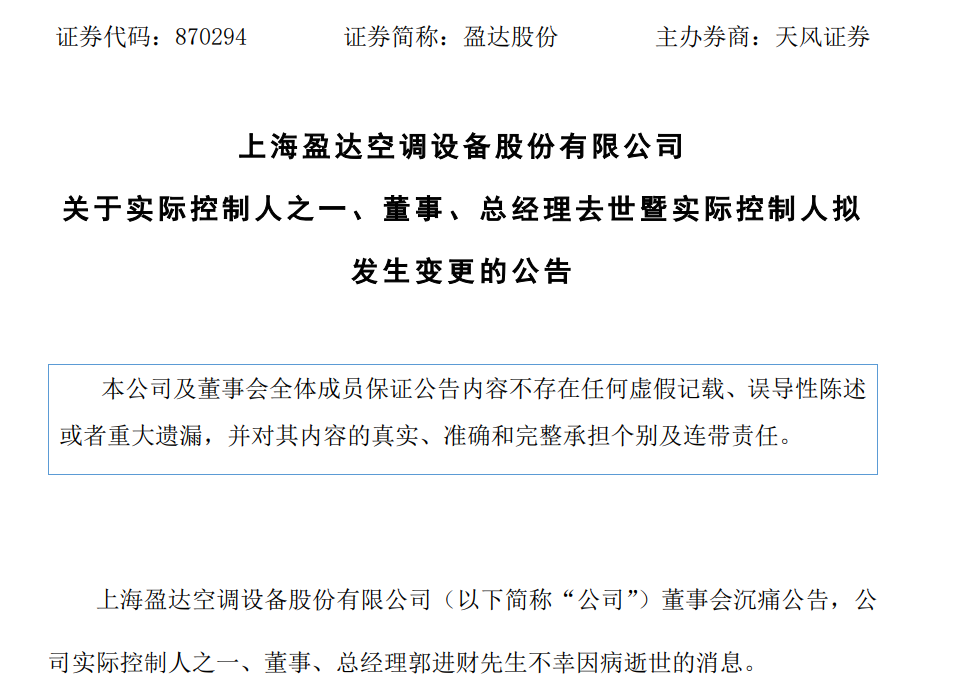
近日,新三板挂牌公司盈达股份公告称,公司实际控制人之一、董事、总经理郭进财不幸因病逝世。 每经编辑|程鹏 向江林 公开信息显示,郭进财出生于1956年,本科学历,高级经营师。郭进财长期从事空调行业,曾任上海盈帅风力发电机设备有限公司执行董事、江苏广盈机 电设备有限公司总经理、盈达股份董事长等职务。 2021年的相关报道中提到,江苏盈达机电科技有限公司(盈达股份子公司)主要从事通风与空气处理系统产品开发、制造与销售,为工业建筑及民用建筑 的中央空调系统提供配套产品,其"当家人"郭进财来自宝岛台湾,在大陆投资已有30多年。 郭进财之子郭昭明也曾在采访中表示,在他的家族里,尤其是以其父亲郭进财为代表,深刻演绎了"以厂为家",生命中的一大半时间都泡在公司里。 盈达股份称,郭进财作为公司的创始人之一,在担任公司总经理、董事期间,恪尽职守、勤勉尽责、忠实诚信地履行了董事应尽的职责和义务,为公司的 经营发展做出了重要贡献。 公司董事会对郭进财为公司的辛苦付出和所做的贡献表示衷心感谢。公司全体董事、监事、高级管理人员和全体员工,对郭进财的逝世致以沉痛哀悼,并 向其家人表示深切慰问。 记者查询发现,盈达股份的官网已变为黑白色调 ...

知名企业,创始人逝世!官网已变黑白
Zhong Guo Ji Jin Bao· 2025-12-07 03:15
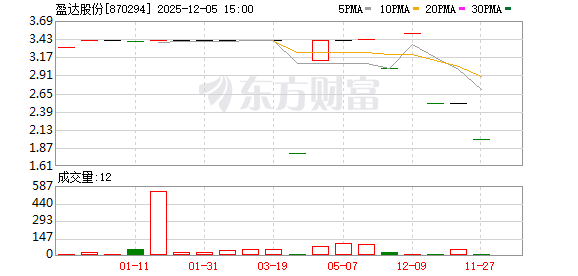
【导读】盈达股份总经理郭进财因病逝世 中国基金报记者晨曦 近日,新三板挂牌公司盈达股份公告称,公司实际控制人之一、董事、总经理郭进财不幸因病逝世。 盈达股份称,郭进财作为公司的创始人之一,在担任公司总经理、董事期间,恪尽职守、勤勉尽责、忠实诚信地履行了董事应尽的职责和义务,为公司的 经营发展做出了重要贡献。 公司董事会对郭进财为公司的辛苦付出和所做的贡献表示衷心感谢。公司全体董事、监事、高级管理人员和全体员工,对郭进财的逝世致以沉痛哀悼,并 向其家人表示深切慰问。 记者查询发现,盈达股份的官网已变为黑白色调。 2021年的相关报道中提到,江苏盈达机电科技有限公司(盈达股份子公司)主要从事通风与空气处理系统产品开发、制造与销售,为工业建筑及民用建筑 的中央空调系统提供配套产品,其"当家人"郭进财来自宝岛台湾,在大陆投资已有30多年。 郭进财之子郭昭明也曾在采访中表示,在他的家族里,尤其是以其父亲郭进财为代表,深刻演绎了"以厂为家",生命中的一大半时间都泡在公司里。 盈达股份2024年年报显示,截至2024年12月31日,公司第一大股东胡秋雪直接持有公司77.8476%的股权,公司实际控制人为胡秋雪、郭进财夫妇。 ...
知名企业,创始人逝世!官网已变黑白
中国基金报· 2025-12-07 03:12
【导读】盈达股份总经理郭进财因病逝世 近日,新三板挂牌公司盈达股份公告称,公司实际控制人之一、董事、总经理郭进财不幸因病 逝世。 盈达股份称,郭进财作为公司的创始人之一,在担任公司总经理、董事期间,恪尽职守、勤勉 尽责、忠实诚信地履行了董事应尽的职责和义务,为公司的经营发展做出了重要贡献。 中国基金报记者 晨曦 公司董事会对郭进财为公司的辛苦付出和所做的贡献表示衷心感谢。公司全体董事、监事、高 级管理人员和全体员工,对郭进财的逝世致以沉痛哀悼,并向其家人表示深切慰问。 记者查询发现,盈达股份的官网已变为黑白色调。 公开信息显示,郭进财出生于1956年,本科学历,高级经营师。郭进财长期从事空调行业, 曾任上海盈帅风力发电机设备有限公司执行董事、江苏广盈机电设备有限公司总经理、盈达股 份董事长等职务。 2021年的相关报道中提到,江苏盈达机电科技有限公司(盈达股份子公司)主要从事通风与 空气处理系统产品开发、制造与销售,为工业建筑及民用建筑的中央空调系统提供配套产品, 其"当家人"郭进财来自宝岛台湾,在大陆投资已有30多年。 郭进财之子郭昭明也曾在采访中表示,在他的家族里,尤其是以其父亲郭进财为代表,深刻演 绎了 ...

破局与重构:2025 空调行业趋势与消费需求白皮书
艾瑞咨询· 2025-12-07 00:05
Core Insights - The air conditioning industry is undergoing a critical phase of "breaking through and restructuring," driven by policies promoting low-carbon transformation and extreme high-temperature weather, which together release market demand [1] - The report aims to provide a comprehensive overview of industry trends, consumer market dynamics, and user needs, while analyzing benchmark cases of comfortable and healthy air conditioning [1] Policy and Technology - The dual drivers of policy guidance and technological innovation are reshaping the air conditioning market, promoting energy-efficient products and supporting the green transformation of the industry [2] - National and local policies, such as the "Accelerating Energy Conservation and Carbon Reduction in the Building Sector," provide strategic guidance and policy support for energy-saving renovations [2] Market Dynamics - The air conditioning market is entering a mature phase with a stable scale, where online sales account for 60% of the market, highlighting the dominance of traditional e-commerce as a core traffic entry point [5] - Price differentiation is evident in online sales, with low-priced (below 1599) and high-priced (above 3000) 1.5P wall-mounted units both seeing increased market share [5] Consumer Demand - Social media discussions reflect the evolving consumer demands for air conditioning, with energy efficiency, comfort, cooling performance, aesthetics, and health becoming the top topics for 2025 [9] - The shift from basic temperature regulation to a focus on comfort, health, and aesthetics indicates a significant evolution in consumer expectations [11] High-End Market Trends - The high-end air conditioning segment is evolving towards a comprehensive experience that integrates extreme comfort, health purification, aesthetic design, and smart connectivity [13] - The transition from "selling products" to "selling lifestyles" emphasizes the need for air conditioning solutions that cater to specific living scenarios and emotional needs [15] Consumer Segmentation - The main consumer groups for air conditioning are shifting, with post-00s and post-90s families becoming the primary buyers, particularly in first-tier cities where comfort is a top priority [19] - The motivations for purchasing air conditioning are evolving from basic needs to a desire for higher quality, better experiences, and compatibility with home environments [21] Purchase Channels and Influences - JD.com has established itself as the leading information channel and ordering platform for air conditioning, with social media and short video platforms playing a significant role in consumer decision-making [24] - Performance and quality are the foundational concerns for consumers, with comprehensive experience becoming a key factor in purchase decisions [28] Product Features and Consumer Feedback - High satisfaction rates (over 99%) for features like "no-wind" and "quiet operation" indicate strong consumer preference for comfort and health functionalities in air conditioning products [56] - The integration of health features, such as air purification and self-cleaning technologies, enhances the overall value proposition of air conditioning units [55] Collaborative Innovations - JD.com collaborates with major brands like Gree, Haier, and TCL to promote air conditioning products that emphasize comfort and health, responding to the trend of upgrading consumer experiences [59][61][63][67][69]







美博集团宣布空调提货价格上调5% 曾称“三年内登陆国内资本市场”
Zhong Guo Jing Ying Bao· 2025-12-05 16:29
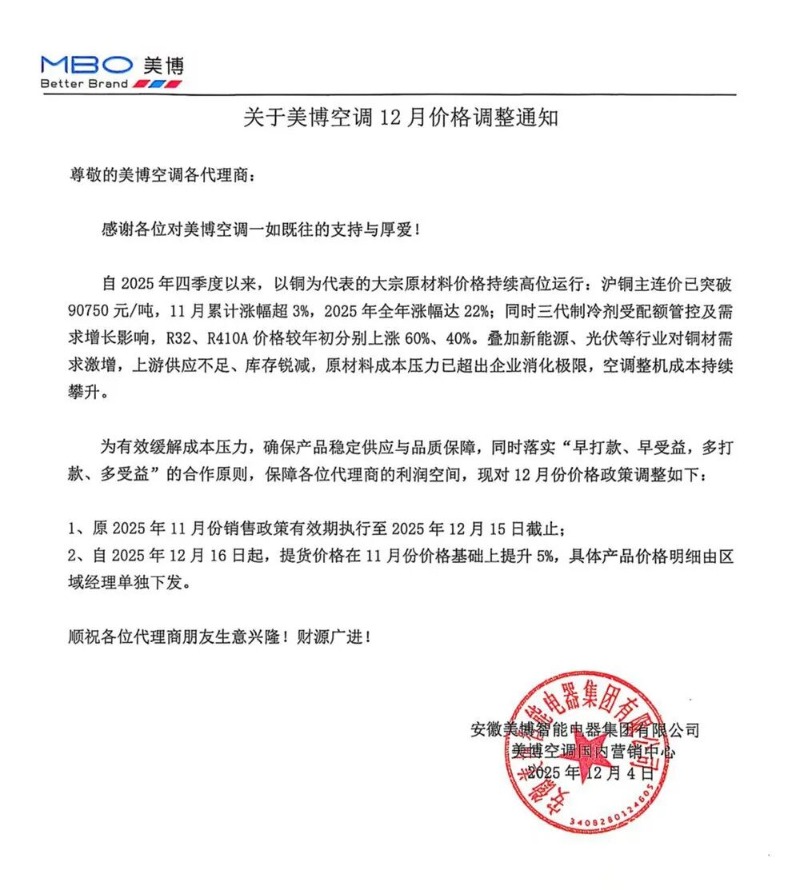
Core Viewpoint - The air conditioning industry is experiencing intensified competition and rising raw material costs, prompting companies like Meibo Group to raise their product prices, marking a significant shift in the market dynamics [2][4]. Price Adjustment - Meibo Group announced a 5% increase in the delivery price of air conditioning units starting December 16, based on November prices, to alleviate cost pressures and ensure product quality and supply [4][6]. - The price adjustment is attributed to the continuous rise in raw material costs, particularly copper, which has seen a price increase of over 22% for the year, with current prices exceeding 90,750 yuan per ton [4][5]. Market Conditions - The domestic air conditioning market is facing declining demand, with a reported 23.8% year-on-year drop in retail volume in October 2025, and a projected 29.9% decrease in production for December [6][7]. - The overall market sentiment is negative, with significant downward pressure on production levels [6]. Company Overview - Meibo Group, established in 2010, has developed a comprehensive presence in the refrigeration industry, with an annual production capacity of 8 million units across various brands [8]. - Despite having multiple brands, Meibo's market share in the domestic air conditioning sector is relatively low, at approximately 0.8% in 2023, with major competitors like Midea, Gree, and Haier dominating nearly 70% of the market [8][9]. Export Strategy - Meibo Group is focusing on expanding its overseas market presence, with a goal of reaching 300,000 units in overseas sales within five years [10]. - The company has reported consistent growth in its overseas sales, doubling its business scale for three consecutive years, with 2024 projected to see exports surpassing 150,000 units [10]. IPO Aspirations - Meibo Group has set a target to enter the domestic capital market within three years, with 2023 being the first year of its IPO guidance period, although no updates on the IPO progress have been disclosed [10].
席春迎:我的香港资本市场十五年
Jing Ji Guan Cha Bao· 2025-12-04 01:48
Core Insights - The article reflects on the challenges and lessons learned from the journey of a company in the Hong Kong capital market, emphasizing the importance of understanding market dynamics and the need for sustainable value creation through industry fundamentals [1][5][14]. Group 1: Company Journey and Market Challenges - The company began its journey in the automotive parts manufacturing sector, acquiring a struggling state-owned enterprise in 2005 and successfully listing on the Hong Kong Stock Exchange in 2011, despite facing a harsh market environment [2][3]. - Initial public offerings were difficult, with the company raising less than 100 million HKD, which was insufficient for its operational needs, leading to low trading volumes and market capitalization stagnation [2][4]. - A strategic shift occurred in 2015 when a strong investor joined, providing significant capital and resources, allowing the company to transition from manufacturing to the education sector, resulting in a dramatic increase in market capitalization from under 1 billion HKD to over 40 billion HKD by 2018 [3][4]. Group 2: Lessons on Value Creation and Management - The experience highlighted that rapid expansion without solid internal governance can lead to vulnerabilities, as seen when the company faced a crisis due to external factors and poor strategic decisions, resulting in a market value drop of over 90% [4][5]. - The article emphasizes that sustainable value creation is rooted in industry fundamentals, and that capital markets reward companies that respect these principles [6][9]. - A long-term perspective and compounding philosophy are crucial for both business growth and personal development, suggesting that true value growth comes from strategic focus and time [7][10]. Group 3: Strategic Insights for Future Growth - The company advocates for a shift from a "billion" mindset to a "trillion" vision, encouraging businesses to think beyond immediate profits and focus on long-term industry evolution and capital integration [12][14]. - Effective market management is described as a systematic approach that combines strategic planning, sustained growth, and robust governance, essential for navigating market cycles [13][14]. - The establishment of the Hong Kong Small and Medium-sized Enterprises Association aims to support companies in navigating the capital market, leveraging AI to enhance financing capabilities and market visibility [15][16].
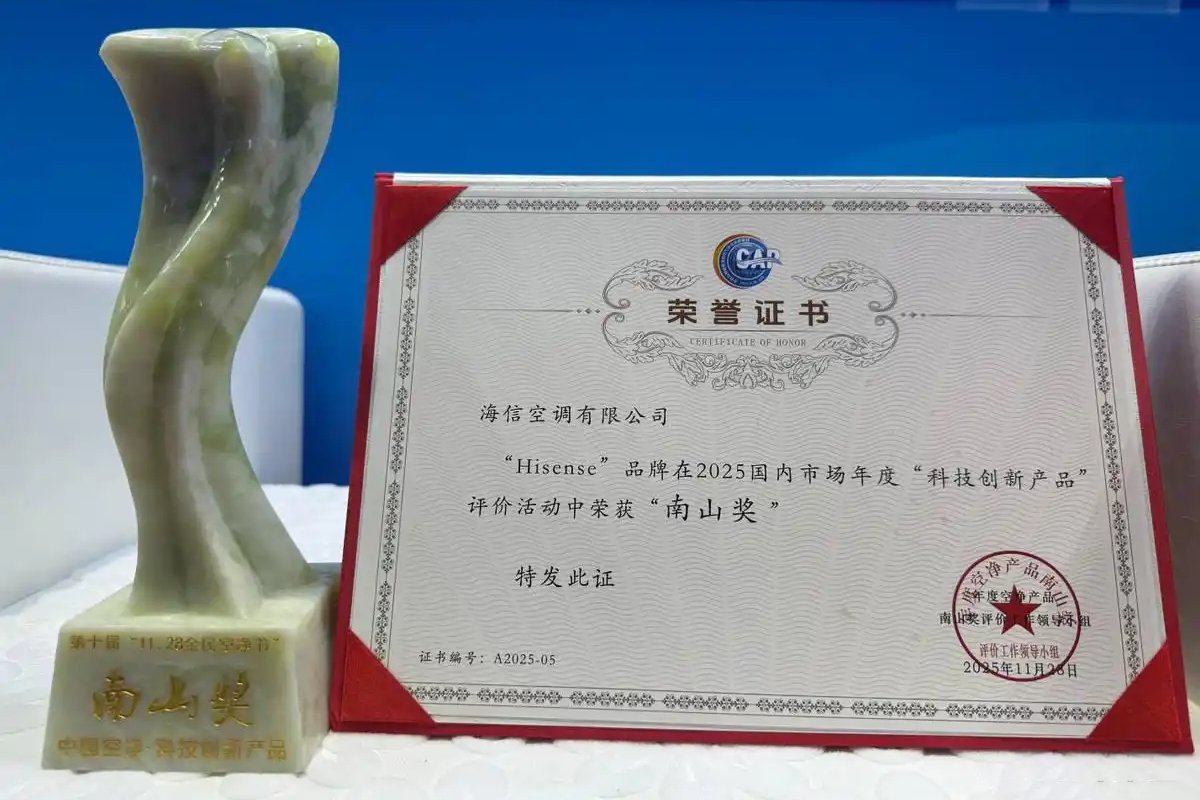
海信空调连续四年斩获“南山奖”
Xin Lang Cai Jing· 2025-12-03 13:21
Group 1 - Hisense Air Conditioning has won the "Nanshan Award" for four consecutive years, making it the only air conditioning brand to receive this honor [1][3] - The Hisense Fresh Air Conditioner X7Pro was recognized as a "Technology Innovation Product" for its dual-flow fresh air exchange and 360° air control system [1][3] - Hisense Air Conditioning Co., Ltd. was rated as a 2025 "AAAAA" enterprise for integrity, brand, quality, management, and service [1][3] Group 2 - Hisense pioneered the fresh air conditioning market by launching the first domestic fresh air conditioner in 2008 [1][3] - From January to October this year, Hisense's fresh air conditioner has achieved a market share of 44.47% in total sales across all channels, maintaining its position as the industry leader [1][3]

海尔空调全球3万+服务师技能比武落地服务标准化
Sou Hu Wang· 2025-12-03 06:08
Core Viewpoint - Haier Air Conditioning is advancing its digital service strategy globally through the "Haier Skill Cup" competition, emphasizing the importance of service quality and efficiency in customer experience [1][2] Group 1: Event Overview - The second "Haier Skill Cup" global service skills competition was held in Hefei, attracting over 30,000 service technicians from 14 countries and regions [1] - The competition serves as a practical implementation of Haier's digital service strategy, focusing on real-world service scenarios [1] Group 2: Digital Transformation in Service - Digital tools have been integrated into the entire service process, allowing technicians to diagnose issues in advance and allocate materials accurately, enhancing the overall service experience [1] - During the summer, Haier utilized a digital inventory system to facilitate rapid cross-regional inventory transfers, resulting in over 300 million yuan in sales growth [1] Group 3: Service Standards and Satisfaction - Haier has established a "Smart Service Brain" digital platform that covers the entire process of design, installation, and operation, enabling immediate response to customer needs [2] - The company aims for a service satisfaction rate of 99.99% and an appointment punctuality rate of 93.76% by 2024, with the "one-time success" service standard becoming a norm for users [2]
2025年1-9月中国房间空气调节器产量为21657.1万台 累计增长4.4%
Chan Ye Xin Xi Wang· 2025-12-02 03:04
Core Viewpoint - The report highlights the current state and future prospects of the air conditioning industry in China, indicating a slight decline in production while showing overall growth in the cumulative production figures from 2020 to 2025 [1] Industry Summary - In September 2025, the production of room air conditioners in China reached 18.1 million units, representing a year-on-year decrease of 3% [1] - From January to September 2025, the cumulative production of room air conditioners was 21.6571 million units, reflecting a cumulative growth of 4.4% [1] - The report is based on data from the National Bureau of Statistics and provides insights into the air conditioning market's trends and forecasts for the period from 2025 to 2031 [1] Company Summary - Key listed companies in the air conditioning sector include Gree Electric Appliances (000651), Midea Group (000333), Haier Smart Home (600690), Hisense Home Appliances (000921), TCL Technology (000100), and Harbin Air Conditioning (600202) [1] - The report by Zhiyan Consulting emphasizes the importance of these companies in the context of the overall market analysis and future development [1]

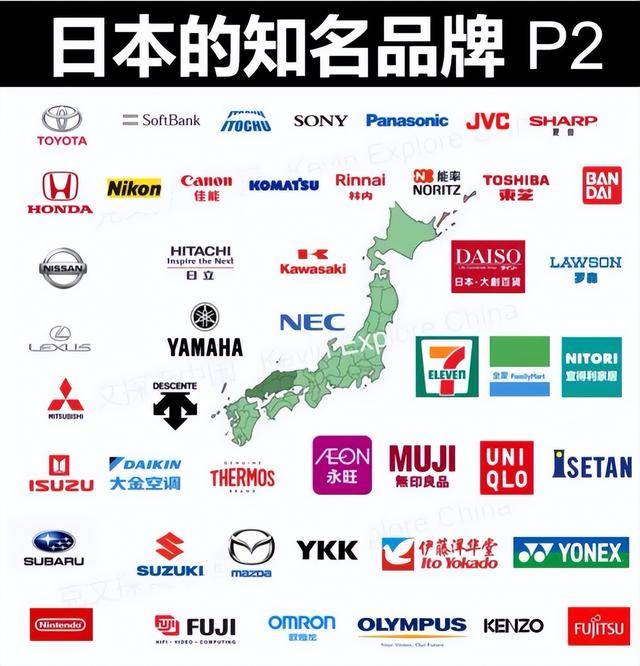
没有想到,原来这些都是潜伏在中国的日本货,个个赚的盆满钵满
Sou Hu Cai Jing· 2025-11-30 02:41
Core Viewpoint - The article discusses the contrasting performance of Japanese brands in China, highlighting the decline of traditional Japanese companies while some have successfully localized and adapted to the market, leading to a "K-shaped" economic recovery in 2025 [1][19]. Group 1: Decline of Japanese Brands - Japanese high-end department store Mitsukoshi Isetan and beauty giant Shiseido saw significant stock price drops following provocative statements from Japan's new Prime Minister [1]. - Japanese automotive brands, once holding 30% market share in China, have plummeted to a historical low of 10.8%, with companies like Mitsubishi withdrawing from the market [4][19]. - The decline is attributed to a lack of innovation and the rise of domestic competitors, with Chinese brands capturing nearly 90% of the electric vehicle market [19][21]. Group 2: Successful Localization Strategies - Companies like Suntory and Glico have effectively localized their products, with Suntory branding itself as a Chinese tea company and Glico introducing flavors appealing to local tastes [6][8]. - The restaurant chain Saizeriya, originally Japanese, has successfully positioned itself as a budget-friendly option for Chinese consumers, often mistaken for a local brand [9]. - The sanitary product brand Sofy has rebranded to appeal to Chinese women, distancing itself from its Japanese origins while maintaining high sales [9]. Group 3: Hidden Successes - Brands like Yakult and Tsugami Machine Tool have thrived in the Chinese market, leveraging their deep understanding of local consumer preferences and maintaining high profit margins despite broader market challenges [22][23]. - The article emphasizes the importance of recognizing these "invisible champions" that have integrated into daily life, contrasting them with the visible struggles of traditional Japanese companies [25][27]. Group 4: Capital and Ownership Changes - The acquisition of the Chinese traditional medicine brand Yuren Sheng by Japanese companies highlights the ongoing trend of foreign investment in local brands, shifting focus from traditional practices to more profitable health products [15][17].