中央空调

Search documents
海信家电(000921):Q4内销表现承压,年度分红率提升
Guotou Securities· 2026-04-01 05:52
Investment Rating - The investment rating for Hisense Home Appliances is "Buy-A" with a target price of 26.38 CNY for the next six months [4]. Core Views - Hisense Home Appliances reported a revenue of 87.93 billion CNY for 2025, a year-on-year decrease of 5.2%, and a net profit attributable to shareholders of 3.19 billion CNY, down 4.8% year-on-year. The Q4 performance showed a significant decline, with revenue of 16.4 billion CNY, down 26.0% year-on-year, and a net profit of 370 million CNY, down 32.5% year-on-year [1][2]. - The company is focusing on enhancing shareholder returns, proposing a cash dividend of 12.65 CNY per 10 shares, totaling approximately 1.75 billion CNY, which represents 54.9% of the net profit for 2025, an increase of 4.1 percentage points year-on-year [3]. Summary by Sections Financial Performance - Q4 gross margin improved to 22.3%, up 2.6 percentage points year-on-year, attributed to better capacity utilization in overseas factories and improved product mix [3]. - Q4 net profit margin was 2.3%, down 0.2 percentage points year-on-year, mainly due to increased expense ratios across sales, R&D, finance, and management [3][9]. - The company expects to improve profitability as operational efficiency in overseas factories increases and product structure continues to optimize [3]. Market Dynamics - Domestic sales were pressured in Q4 due to a sluggish real estate market, impacting central air conditioning revenue, which saw a decline of 2.9% year-on-year for domestic sales [2]. - The home air conditioning segment faced challenges with domestic sales down 21.7% and exports down 51.2% year-on-year [2]. - In contrast, the overseas markets showed promising growth, with revenue from white goods in South America, Europe, and the Asia-Pacific regions increasing by 28%, 22%, and 15% respectively [2]. Future Outlook - The company is accelerating its digital transformation and enhancing smart manufacturing capabilities, which are expected to lead to sustained improvements in production efficiency [4]. - EPS projections for 2026, 2027, and 2028 are 2.64 CNY, 2.89 CNY, and 3.12 CNY respectively, indicating a positive growth trajectory [4][10].
美的集团: 基本盘稳固,商业及工业成长更快
Zhong Guo Yin He Zheng Quan· 2026-03-31 07:45
Investment Rating - The report maintains a "Recommended" rating for Midea Group (stock code: 000333) [1] Core Insights - Midea Group's revenue for 2025 reached 456.5 billion yuan, a year-on-year increase of 12.1%, with a net profit attributable to shareholders of 43.9 billion yuan, up 14.0% year-on-year [5][7] - The company has a high return on equity (ROE) of 19.7%, indicating strong profitability [5] - Midea's cash flow supports a high dividend payout ratio of 73.6%, which has increased by 4.3 percentage points year-on-year [5] - The company is focusing on both domestic and international markets, with domestic revenue of 260.5 billion yuan and international revenue of 195.9 billion yuan, reflecting year-on-year growth of 9.4% and 15.9% respectively [10] Financial Performance - Midea Group's projected revenue for 2026-2028 is estimated at 489.6 billion yuan, 523.4 billion yuan, and 561.2 billion yuan, representing year-on-year growth rates of 6.8%, 6.9%, and 7.2% respectively [6] - The net profit for the same period is expected to be 47.0 billion yuan, 50.6 billion yuan, and 54.9 billion yuan, with growth rates of 6.9%, 7.7%, and 8.4% respectively [6] - The earnings per share (EPS) are projected to be 6.18 yuan, 6.66 yuan, and 7.22 yuan for 2026, 2027, and 2028 respectively [6] Business Segments - Midea's smart home business generated revenue of 299.9 billion yuan in 2025, growing by 11.3% year-on-year, maintaining a leading global market share [5][9] - The commercial and industrial solutions segment achieved revenue of 122.8 billion yuan, a year-on-year increase of 17.5%, becoming a significant growth driver for the company [5][9] - The company has successfully transitioned from a central air conditioning supplier to a provider of integrated smart building solutions, with significant market shares in various product categories [5][9] Market Position - Midea's market capitalization for circulating A-shares is approximately 494 billion yuan, with a corresponding dividend yield of 5.9% [2] - The company has implemented stock repurchase plans totaling over 116 billion yuan, enhancing shareholder value [5] - Midea's competitive positioning is strengthened by its extensive global supply chain and digital platform, which supports thousands of small retailers [5][10]

海信家电(00921) - 海外监管公告 海信家电集团股份有限公司2025年年度报告、海信家电集团...
2026-03-30 14:08
香港交易及結算所有限公司及香港聯合交易所有限公司對本公告的內容概不負責,對其準確 性或完整性亦不發表任何聲明,並明確表示,概不對因本公告全部或任何部份內容而產生或 因倚賴該等內容而引致的任何損失承擔任何責任。 HISENSE HOME APPLIANCES GROUP CO., LTD. 海信家電集團股份有限公司 (在中華人民共和國註冊成立的股份有限公司) (股份代號:00921) 海外市場監管公告 本公告乃根據香港聯合交易所有限公司證券上市規則第 13.10B 條而作出。 《海信家電集團股份有限公司 2025 年年度報告》、《海信家電集團股份有限公司 2025 年年度報告摘要》、《海信家電集團股份有限公司 2025 年年度審計報告》已刊載於深圳 證券交易所指定之信息披露網站:http://www.cninfo.com.cn,以供參閱。 承董事會命 海信家電集團股份有限公司 董事長 高玉玲 中國廣東省佛山市,2026 年 3 月 30 日 於本公告日期,本公司的執行董事為高玉玲女士、賈少謙先生、于芝濤先生、方雪玉女 士及代慧忠先生;本公司的獨立非執行董事為李志剛先生、蔡榮星先生及徐國君先生; 及本公司的職工代 ...
奥克斯电气:原材料价格波动和竞争扰动盈利能力-20260330
HTSC· 2026-03-30 05:50
Investment Rating - The investment rating for the company is maintained as "Buy" with a target price of HKD 12.04 [1][5][6] Core Views - The company achieved a revenue of RMB 30.049 billion in 2025, a year-on-year increase of 1.0%, while the net profit attributable to the parent company was RMB 2.235 billion, a decrease of 23.2% year-on-year. The performance aligns with previous earnings forecasts [1] - The decline in profit is attributed to factors such as US-China tariff disruptions and high channel inventory levels, leading to cautious ordering from overseas clients in the second half of 2025. Additionally, rising raw material prices and intensified domestic competition have pressured the gross margin [1] - Looking ahead, the company is expected to benefit from high manufacturing efficiency and cost control barriers, with rapid growth in overseas OBM (Original Brand Manufacturer) business contributing to revenue growth. The easing competition in the domestic air conditioning market is also anticipated to drive profit recovery [1] Revenue Analysis - Domestic sales in 2025 were RMB 15.308 billion, a year-on-year increase of 1.5%, while external sales were RMB 14.741 billion, a year-on-year increase of 0.4%. The decline in external sales in the second half of 2025 was primarily due to high channel inventory levels and cautious purchasing by overseas ODM clients [2] - The company established five new sales companies in Vietnam, Saudi Arabia, Dubai, Italy, and Spain in 2025, with plans to open 3-5 new sales companies annually to continue expanding into untapped markets [2] Product and Brand Performance - In terms of product performance, the revenue from household air conditioners and central air conditioners in 2025 increased by 1.3% and 1.9% respectively, with gross margins of 16.0% and 31.0%. The decline in household air conditioner gross margin was mainly due to intense market competition and rising raw material prices [3] - The main brand, AUX, generated revenue of RMB 15.91 billion in 2025, a year-on-year increase of 2.5%. The ODM business saw a revenue decline of 3.8% to RMB 11.78 billion, primarily due to a decrease in overseas ODM orders [3] Financial Metrics - The overall gross margin for 2025 decreased by 2.1 percentage points to 18.8%, mainly due to the decline in household air conditioner gross margin. The operating expense ratio increased by 1.1 percentage points to 11.2%, driven by increased expenses related to newly established overseas sales companies and promotional investments [4] - The net profit margin for 2025 was 7.4%, a decrease of 2.3 percentage points year-on-year [4] Profit Forecast and Valuation - The profit forecast for 2026-2028 has been adjusted downwards due to rising raw material prices and the pace of demand recovery. The expected net profits for 2026, 2027, and 2028 are RMB 2.412 billion, RMB 2.654 billion, and RMB 2.917 billion respectively [5] - The target price is set at HKD 12.04, based on a valuation of 7 times PE for 2026, reflecting a slight discount compared to leading brands like Midea Group and Gree Electric [5]
海尔智家(600690):快速进化应对市场压力,分红超预期
Yin He Zheng Quan· 2026-03-27 08:37
Investment Rating - The report maintains a "Recommended" rating for Haier Smart Home (stock code: 600690) [1] Core Insights - Haier Smart Home demonstrated resilience in the face of market pressures, achieving revenue growth despite challenges in the domestic and international markets [3] - The company reported a revenue of 302.35 billion yuan for 2025, a year-on-year increase of 5.7%, and a net profit of 19.55 billion yuan, up 4.4% year-on-year [3][5] - The dividend payout ratio increased to 55% for 2025, with plans to raise it to at least 58% in 2026 and 60% in 2027 and 2028 [3] - The company has completed a digital transformation across its entire supply chain, enhancing operational efficiency and marketing capabilities [3] - Haier's "Big HVAC" strategy and acquisitions are expected to drive future growth, with significant revenue contributions from the HVAC segment [3] Company Financial Performance - In 2025, Haier's revenue was 302.35 billion yuan, with quarterly revenues of 791.2 billion yuan, 773.8 billion yuan, 775.6 billion yuan, and 682.9 billion yuan, reflecting a decline in Q4 [5][13] - The company’s gross profit margin was 26.7%, a decrease of 1.1 percentage points year-on-year [13] - The net profit margin for 2025 was 6.5%, showing a slight decline compared to the previous year [13] Future Projections - Revenue is projected to reach 314.68 billion yuan in 2026, with a growth rate of 4.1%, and net profit is expected to be 19.95 billion yuan, reflecting a 2.0% increase [4] - The earnings per share (EPS) is forecasted to be 2.13 yuan in 2026, with a price-to-earnings (PE) ratio of 10.86 [4] Market Dynamics - The domestic air conditioning market showed a slight increase of 0.7% in 2025, but early 2026 saw a decline of 3.5% in sales [18] - The company is focusing on enhancing its global supply chain to mitigate risks associated with tariffs and fluctuating demand [22] - The HVAC segment is expected to become a significant revenue driver, with a reported revenue of 72.36 billion yuan in 2025, a 10% increase year-on-year [3]

2025年度消费新潜力白皮书!6大赛道洞察消费市场新趋势!
Sou Hu Cai Jing· 2026-02-11 08:08
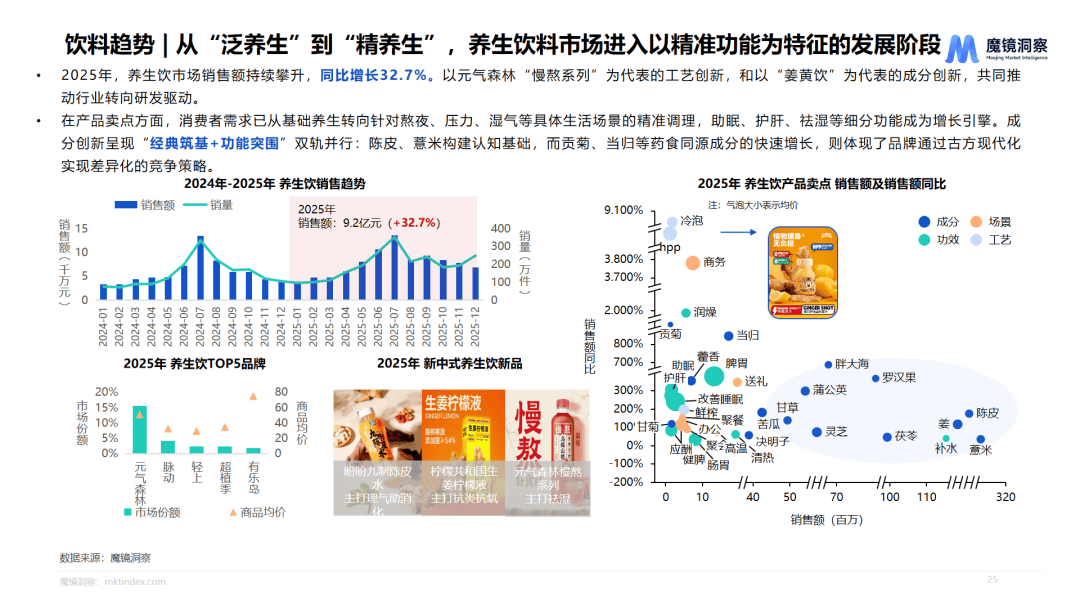
Core Insights - The Chinese consumer market in 2025 is characterized by "structural growth," with a shift from basic needs to precise health demands and personalized expressions [1][2] - Key trends include health, functionality, personalization, and intelligence, with consumers moving from "passive selection" to "active definition" of their needs [1] Group 1: Food and Beverage Sector - The food and beverage industry in China reached a market size of 593.67 billion yuan in 2025, with a sales growth of 7.8% and a volume increase of 6.3% [3] - Health-driven consumption is reshaping the industry, with premium products like fresh cakes and plant-based drinks gaining popularity [3] - The beverage market is transitioning from basic sugar reduction to targeted functionality and natural ingredients [3][6] Group 2: Health Sector - The health market achieved a sales figure of 304.38 billion yuan in 2025, growing by 15.8% year-on-year [10] - The largest segment, health supplements, saw sales of 124.48 billion yuan, with a growth rate of 19.9% [10] - The demand for products enhancing immunity is leading the market, with significant growth in categories addressing anemia and sleep management [10][14][17] Group 3: Home Appliances - The home appliance market reached a sales figure of 766.35 billion yuan in 2025, with an 18.1% year-on-year growth [20] - Major appliances dominate the market, while kitchen and lifestyle appliances show strong growth, with central air conditioning leading at a 52.1% increase [20] - The smart lock market is experiencing rapid growth, driven by consumer demand for safety features [25] Group 4: Beauty and Skincare - The beauty and skincare market reached 454.18 billion yuan in 2025, with a 9.7% increase in sales [29] - Anti-aging products are in high demand, with sales of 129.83 billion yuan, reflecting a growing focus on skincare across all age groups [29] - The beauty market is shifting towards health-oriented and high-quality products, moving away from basic offerings [32] Group 5: 3C Digital Products - The 3C digital market surpassed 1.1 trillion yuan in sales, with an 18.5% increase year-on-year [36] - The mobile power market is rapidly evolving, with certified products seeing explosive growth due to regulatory changes [36] - AI toys are experiencing significant market growth, with sales reaching 740 million yuan, reflecting a shift in consumer preferences [39] Group 6: Maternal and Infant Products - The maternal and infant market grew to 223.78 billion yuan in 2025, with a 12.6% increase [45] - The infant formula market is the largest segment, achieving sales of 50.93 billion yuan, with a growth rate of 18.1% [46] - There is a notable increase in demand for maternal nutrition products, particularly among pregnant women [46][49][52] Conclusion - The growth opportunities in 2025 are clear, focusing on the evolution of traditional demands and the deepening of consumer experiences [53] - Brands must transition from merely providing products to creating meaningful experiences that resonate with consumers' lifestyles [53][56]

2026开年中央空调行业集体涨价,谁来买单?
Xin Lang Cai Jing· 2026-02-05 12:18
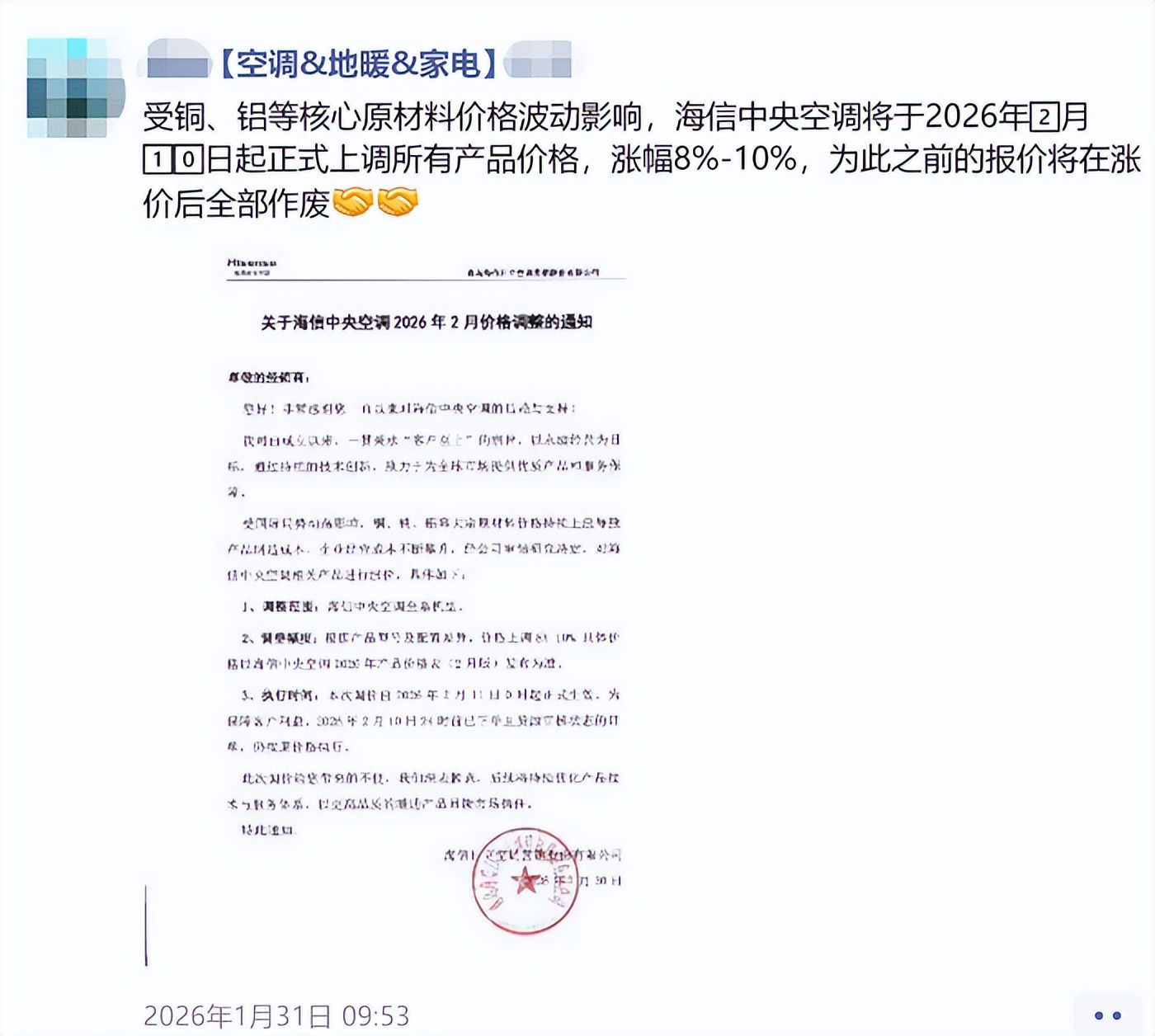
Group 1 - The core point of the article is that a collective price increase in the air conditioning industry is occurring due to rising costs of raw materials, with price hikes ranging from 3% to 10% across various brands [2][23][12] - Companies such as MEKER and iCongo announced a price increase of 5% starting January 1, 2026, followed by other brands like TCL and AUX, which also implemented price adjustments shortly thereafter [3][5][27] - The price adjustments are a response to the significant rise in the costs of key raw materials, including copper, aluminum, and refrigerants, which have seen substantial price increases since late 2024 [12][33][36] Group 2 - The increase in raw material costs is attributed to various factors, including a more than 30% rise in copper prices in 2025, which has led to higher manufacturing costs for essential components like compressors and piping [12][33][36] - Aluminum prices are also elevated due to tight global supply and increased production costs from stricter environmental standards, further exacerbating manufacturing cost pressures [36][38] - The shift in pricing strategy is seen as a necessary adjustment for the industry, moving from a focus on low prices to emphasizing product quality and service, driven by the need for sustainable profitability [39][40]



传统空调需求承压,格力、美的切入AI数据中心制冷领域
Di Yi Cai Jing· 2026-02-04 08:50
Core Insights - The data center cooling business is a significant growth point for the central air conditioning industry during its consolidation phase, but competition is intensifying, presenting both opportunities and challenges [1] Industry Overview - The central air conditioning industry is currently in an adjustment period due to weakening traditional engineering demand. Companies like Gree Electric Appliances (000651.SZ) and Midea Group (000333.SZ) are reallocating resources towards AI data center cooling and high-computing infrastructure to seek structural growth [3] - The data center temperature control market has high requirements for system design capabilities, project experience, and long-term operation and maintenance, posing challenges for traditional HVAC companies [3] Market Dynamics - Air conditioning still accounts for approximately 70% of Gree's revenue, with central air conditioning being a core segment. However, the industry faces pressure from a downturn in real estate, weak traditional engineering demand, and intensified price competition [4] - The Chinese central air conditioning market is projected to reach a sales scale of 138.68 billion yuan by 2025, with a year-on-year decline of 7.4% in the domestic market, while the export market is expected to grow by 12.7% [4] - Data centers are viewed as one of the few remaining sources of certain demand in the central air conditioning industry, although their contribution to Gree and Midea's central air conditioning revenue remains limited [4] Technological Trends - As AI computing power increases, the power density of server cabinets is rising rapidly, revealing limitations in traditional air-cooled solutions regarding efficiency and heat dissipation. Liquid cooling is becoming an important technology route for high-computing data centers [4] - Liquid cooling is not merely an equipment upgrade but involves comprehensive changes in system architecture, core components, and operational modes, requiring higher system integration and project experience [4] Competitive Landscape - The data center cooling market is primarily dominated by two types of companies: specialized temperature control manufacturers and foreign brands. Specialized firms have accumulated substantial project experience and customer loyalty, while central air conditioning manufacturers like Gree and Midea have advantages in manufacturing and global service networks but face competition in specialized cooling solutions [6] - Domestic central air conditioning companies see opportunities in the data center market due to incremental space and localization trends, but they also face challenges such as technology maturity and complex project delivery capabilities [6] Strategic Outlook - Overall, AI data center cooling presents a rare structural growth opportunity for the central air conditioning industry, but its scale, pace, and profit model differ significantly from traditional engineering markets. In the short term, data center business acts more as a buffer against the decline of traditional business rather than a decisive replacement [7] - The ability of Gree and Midea to establish stable engineering capabilities and long-term customer relationships in high-barrier technologies like liquid cooling will be crucial for their positioning in the computing infrastructure cycle [7]

家电行业周报20260131:错期扰动致2月排产承压,白电出口韧性优于内销-20260201
SINOLINK SECURITIES· 2026-02-01 09:17
Investment Rating - The report suggests a positive outlook for leading brands in the home appliance sector, indicating a potential for steady growth due to integrated advantages and strong pricing power [5]. Core Insights - The home appliance industry is currently facing short-term adjustments in both domestic and export sales due to high base effects and the timing of the Spring Festival, with air conditioning production experiencing significant declines [1][12]. - Domestic air conditioning production in February 2026 was 4.555 million units, down 38.1% year-on-year, while export production was 6.93 million units, down 26.5% year-on-year [1][12]. - Refrigerator production also saw a decline, with domestic production at 2.6 million units (down 17.1%) and exports at 3.4 million units (down 8%) [1][15]. - Washing machine production showed a slight increase in exports (up 1.5%), while domestic production fell to 3.1 million units (down 5.9%) [1][16]. - The report highlights that the real estate market's downturn continues to suppress demand for home appliances, although there are signs of a potential recovery in production post-holiday [3][5]. Summary by Sections Air Conditioning Production - February 2026 air conditioning production was impacted by the Spring Festival timing and high base effects, leading to a significant drop in both domestic and export figures [1][12]. - Domestic production was 4.555 million units, a year-on-year decrease of 38.1%, while exports were 6.93 million units, down 26.5% [1][12]. Refrigerator Production - Domestic refrigerator production in February 2026 was 2.6 million units, down 17.1%, with exports at 3.4 million units, down 8% [1][15]. - The decline in domestic sales was attributed to the Spring Festival holiday and weak macro demand, but a recovery is expected in March [1][15]. Washing Machine Production - Domestic washing machine production was 3.1 million units, down 5.9%, while exports increased slightly to 3.2 million units, up 1.5% [1][16]. - The domestic decline is linked to previous policy impacts and a sluggish real estate market, while exports benefited from stable overseas demand [1][16]. Market and Sector Performance - The report notes that the Shanghai and Shenzhen 300 Index increased by 0.08%, while the home appliance index decreased by 2.88% [2][19]. - Key companies showed varied performance, with Samsung New Materials up 23.72% and Tianyin Electromechanical down 18.66% [2][19]. Raw Material Prices - Recent trends show fluctuations in raw material prices, with copper prices up 1.32% and aluminum prices down 2.57% in the last week [2][23]. - Year-to-date, copper prices have increased by 6.35%, while aluminum has risen by 4.15% [2][23]. Real Estate Data - Real estate metrics indicate a continued decline, with new housing starts down 19.9% year-on-year, impacting long-term demand for home appliances [3][31]. Investment Recommendations - The report recommends leading brands such as TCL Electronics, Hisense Visual, Midea Group, and Haier Smart Home for their strong market positions and growth potential in both domestic and international markets [5][42].
2026年线上消费市场机遇洞察报告
Sou Hu Cai Jing· 2026-01-31 05:20
Group 1 - The core viewpoint of the report indicates that the online consumption market is transitioning from "incremental expansion" to a new normal characterized by "stock renewal" and "structural upgrading," with a solid market foundation but significant changes in growth momentum and consumer preferences [1] - The report highlights that rational decision-making, emotional resonance, health prioritization, and efficiency pursuit are the main driving forces in the current market [1] - E-commerce platforms show that growth highlights have shifted from traditional broad categories to emerging tracks driven by specific scenarios, segmented needs, and high-value experiences [1] Group 2 - The "self-care" economy is deepening in personal consumption, with the beauty and skincare market evolving beyond basic functionality to a dual satisfaction of "emotion + efficacy" [2] - The concept of "emotional skincare" is emerging, where brands convey emotional value through storytelling and sensory experiences, while professional skincare products gain high trust due to transparency and efficacy [2] - In the snack market, health has permeated daily consumption, with functional snacks and low-GI foods seeing explosive sales, and snacks also serving as low-threshold emotional regulation tools [2] Group 3 - The family unit remains the core consumption scene, evolving towards smarter, healthier, and more emotionally connected demands [3] - The home appliance industry is transitioning towards green and smart solutions, with strong consumer demand for health management features in products like air conditioners and refrigerators [3] - There is a notable rise in "pet-friendly appliances," reflecting the refined and humanized needs arising from pets being considered family members [3] Group 4 - Outdoor activities are no longer limited to professional adventures but are quickly integrating into urban daily life, with "light outdoor" becoming a mainstream lifestyle [4] - This shift is driving consumption characterized by "lightweight equipment" and "diverse scenarios," with traditional outdoor gear emphasizing convenience and aesthetics for urban commuting and leisure [4] - Consumers are seeking comfortable and convenient gear to easily experience nature and release emotions, leading to a closer integration of outdoor industries with everyday life [4] Group 5 - The report concludes that current opportunities in the online consumption market are deeply rooted in changing consumer perceptions, shifting from ownership to experience, and from price-performance focus to value-based considerations [5] - The essence of consumption is increasingly returning to the concrete construction of a better life, whether for personal health and happiness, creating a comfortable and intelligent home environment, or expanding diverse life experiences [5] - Market participants must deeply understand these subtle yet powerful shifts in demand to innovate products, communicate value, and explore scenarios effectively [5]