信托

Search documents
10.11犀牛财经晚报:信托公司摸排逆回购杠杆率情况 娃哈哈前三季度实际销售额下滑超3%
Xi Niu Cai Jing· 2025-10-11 10:28
Group 1 - Multiple trust companies received notifications to investigate their reverse repurchase leverage ratios and compliance with regulations [1] - The Chinese Passenger Car Association reported a 6% year-on-year increase in retail sales of passenger cars in September, totaling 2.239 million units [1] Group 2 - The Ministry of Industry and Information Technology announced the comprehensive promotion of electronic licenses for value-added telecommunications business, enhancing government service efficiency [2] - The electronic licenses will have the same legal effect as paper licenses and will be used in various business scenarios [2] Group 3 - Ray Dalio, founder of Bridgewater Associates, warned that the U.S. debt situation is at a dangerous turning point, with government spending significantly exceeding revenue [3] - The U.S. federal debt held by the public is projected to reach 99% of GDP in 2024, potentially rising to 116% by 2034 [3] Group 4 - UCB announced the approval of Zilucoplan for marketing in China, the world's first subcutaneously injectable C5 complement inhibitor for treating generalized myasthenia gravis [4] - China has achieved a major breakthrough in single-photon detection technology with the mass production of a four-channel ultra-low noise semiconductor single-photon detector [4] Group 5 - Wahaha Group appointed Xu Simin as General Manager, while the Chairman position remains vacant following the resignation of Zong Qinghou's daughter [5] - Wahaha's actual sales for the first three quarters of the year declined by approximately 3.46% year-on-year, totaling 27.9 billion yuan [5] Group 6 - Shimo Microelectronics completed over 100 million yuan in Series B financing, aimed at expanding product lines and market promotion [6] - Guolian Minsheng Securities successfully transitioned its centralized trading system, integrating 1.92 million clients seamlessly [6] - Weichai Heavy Machinery increased its registered capital from approximately 331 million yuan to about 464 million yuan, a 40% increase [6]
部分信托公司债券交易业务开展排查 正逆回购超限风险引关注
Zhong Guo Zheng Quan Bao· 2025-10-11 09:27
Core Viewpoint - Regulatory authorities are requiring trust companies to conduct internal assessments regarding their bond trading operations, specifically focusing on the limits of reverse and repurchase agreements [1][2]. Group 1: Regulatory Requirements - Trust companies are being asked to verify if they have established internal systems in accordance with the recent regulatory notice and whether they have set up monitoring indicators within their systems [1]. - Companies must check for any instances of exceeding limits on reverse repurchase agreements (90% and 100% of the previous day's net assets) and repurchase agreements (70% and 100% of the previous day's net assets) since the beginning of 2024 [1]. Group 2: Industry Context - The 2017 notice specified that non-publicly issued financial products, including trust plans and asset management products, must not exceed 100% of their previous day's net assets in terms of bond repurchase and reverse repurchase funding balances [2]. - Trust companies have increasingly managed significant amounts of bank wealth management funds, primarily engaging in cash management through government bond reverse repurchase agreements [2].
部分信托公司债券交易业务开展排查,正逆回购超限风险引关注
Zhong Zheng Wang· 2025-10-11 08:25
Core Insights - Regulatory authorities have mandated trust companies to conduct internal reviews regarding their bond trading operations and the limits on reverse and repurchase agreements [1][2] Group 1: Regulatory Requirements - Trust companies are required to assess whether they have established internal systems in accordance with the recent notification and whether they have set up relevant monitoring indicators in their systems [1] - The review focuses on two main aspects: the establishment of internal regulations and the occurrence of any excess in reverse repurchase agreements exceeding 90% and 100% of the previous day's net assets, and repurchase agreements exceeding 70% and 100% of the previous day's net assets [1] Group 2: Industry Practices - Trust companies have increasingly taken on a significant amount of bank wealth management funds, primarily engaging in cash management through government bond reverse repurchase agreements [2] - There is a discussion within the industry regarding the appropriateness of using "previous day's net assets" as a benchmark for monitoring, with suggestions that "same-day net assets" may better reflect actual market conditions [2]
多家信托公司收通知,要求排查反馈两项情况!
Xin Lang Cai Jing· 2025-10-11 05:04
上海证券报 记者 马嘉悦 华东地区一信托公司相关人士也向上证报记者坦言,公司9月收到通知进行了逆回购杠杆率情况的排 查。 公开资料显示,2017年12月,中国人民银行、原中国银行业监督管理委员会、中国证券监督管理委员 会、原中国保险监督管理委员会联合发布《通知》,明确要求,私募性质的非法人产品,包括但不限于 银行向私人银行客户、高资产净值客户和合格机构客户非公开发行的理财产品,资金信托计划,证券、 基金、期货公司及其子公司发行的客户资产管理计划,保险资产管理产品等,债券正回购资金余额或逆 回购资金余额超过其上一日净资产100%的债券市场参与者应及时向相关金融监管部门报告。 华东一信托公司相关人士称,近两年来,信托公司承接了较多理财子公司的资金,因此部分账户主要进 行国债逆回购的现金管理,在申赎过程中,部分交易账户容易出现逆回购金额超限情况。后续,信托公 司需加强债券交易账户管理,按照《通知》制定严格内控制度,避免触及监管红线。 一位信托业标品业务部门人士透露,近期收到监管通知,要求排查并反馈两项情况: 一是公司是否按照《通知》制定了内部制度,是否在系统内设置相应指标以进行监测; 二是公司2024年至今有无超限 ...
预登记新规实施首月,非标信托数据来了
Zheng Quan Shi Bao· 2025-10-10 02:56
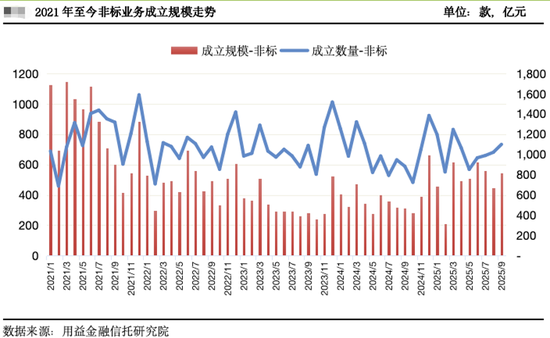
Core Viewpoint - The non-standard trust market showed significant recovery in September, with an increase in both the number and scale of products established, influenced by seasonal factors [1][3]. Summary by Category Market Performance - In September, 1,138 non-standard trust products were established, representing a month-on-month increase of 7.64%, with a total disclosed scale of 54.6 billion yuan, up 22.65% from the previous month [1][3]. Investment Areas - The scale of non-standard financial products reached 20.656 billion yuan in September, marking a month-on-month growth of 48.95%. This growth was largely driven by the transfer of credit asset rights, particularly at the end of the quarter when banks sought to adjust credit scales [6]. - The scale of trust products in the basic industry significantly increased to 30 billion yuan, reflecting an 18.55% month-on-month rise. This was attributed to performance pressures at quarter-end, local debt management improvements, and stable returns from infrastructure projects [5]. Regional Trends - In terms of regional investment, Jiangsu and Zhejiang provinces saw increases in trust establishment, while Shaanxi experienced a decline. Jiangsu's disclosed scale was 5.686 billion yuan (up 24.97%), Zhejiang's was 2.106 billion yuan (up 44.58%), and Shaanxi's was 2.255 billion yuan (down 9.94%) [7]. Average Expected Returns - The average expected return for non-standard trust products was 5.03% in September, a decrease of 0.13 percentage points from the previous month. This decline was influenced by new regulations requiring diversified investments and a broader monetary policy that kept financing costs low [8].

深耕绿色与民生 迈向高质量发展新阶段
Jin Rong Shi Bao· 2025-10-10 02:04
Core Viewpoint - The trust industry in China is evolving to become a significant financial force in supporting the real economy and enhancing people's quality of life, with a focus on high-quality development and social responsibility in the coming years [1] Green Trust Development - In 2024, the trust industry added 390 new green trust projects, marking a 21.50% year-on-year increase, with a total new scale of 177.944 billion yuan and a total existing scale of 325.388 billion yuan [2] - The green trust product system has diversified, moving beyond a single model to include green credit, green asset securitization, green equity, green bonds, and green funds [2] - By the end of 2024, the existing scale of green trust loans was 92.219 billion yuan, while green asset securitization had an existing scale of 64.479 billion yuan [2] - Trust companies are integrating green trust with regional development needs, exemplified by Xiamen International Trust's solar streetlight project and Shandong Guoxin's funding for clean energy heating [2] Institutional Development - The establishment of a Green Trust Professional Committee by the China Trust Industry Association in 2024 aims to enhance industry standards and service capabilities [3] Charitable Trust Growth - The trust industry is focusing on high-quality development by addressing social welfare and promoting charitable initiatives, with funds directed towards inclusive finance reaching 1.6 trillion yuan in 2024 [4] - In the elder care sector, 1,148 elder care trust projects were established, with an investment of 14.493 billion yuan, while 289 projects related to rural revitalization received 4.304 billion yuan [4] - The charitable trust sector saw a total of 2,244 registrations by the end of 2024, with a cumulative scale of 8.507 billion yuan, and 539 new registrations in 2024 alone, reflecting a strong growth trend [5] Talent and Mechanism Development - The trust industry is committed to high-quality development, with over 170,000 employees, more than 60% of whom are under 40 years old, and an increasing proportion of employees with master's degrees or higher [7] - The industry conducted over 2,600 training sessions in 2024, with nearly 300,000 participants, enhancing professional capabilities [7] - Regulatory bodies have introduced policies to support the industry's transformation, while the China Trust Industry Association has improved self-regulatory rules [7][8] Risk Management and Cultural Development - The industry is enhancing risk management and compliance, with a focus on cultivating a trust culture that emphasizes integrity and professionalism [8] - The trust industry is expected to continue growing in scale, improving risk resolution capabilities, and optimizing customer service experiences while contributing to national strategies and economic development [8]
国内首例!法院判决:托管银行对信托违约担4%连带责任
2 1 Shi Ji Jing Ji Bao Dao· 2025-10-10 00:32
首判托管银行担责 事情要从 2023 年的一场信托兑付危机说起。 彼时,多名投资者发现其认购的民生信托某集合资金信托计划出现兑付逾期,资金无法按时收回。在与信托公司沟通 无果后,投资者李某(化名)决定通过法律途径维权。 一位行业实务专家告诉本报记者,这是国内首例托管银行因未完全履行义务而被判承担赔偿责任的案件。 21世纪经济报道记者 郭聪聪 21世纪经济报道记者了解到,近期,北京金融法院对一起信托产品兑付纠纷作出二审判决:不仅要求信托受托人民生 信托公司对未兑付债务负责,还判令托管银行对信托公司应付债务的4%承担连带赔偿责任。 北京金融法院 二审判决书 托管银行只"管钱",不担"兑付责"? 管钱,是托管银行在信托计划中的"传统角色"。 北京信托法学研究会副秘书长张杨告诉21世纪经济报道记者,商业银行扮演者集合资金信托计划的"保管人"的角色。 "在我国信托监管框架下,保管人的主要职责在于账户独立与资金收付、指令合规性复核、账务核对与资料留存、定期 保管报告,并在发现重大异常时提示并按规定报告。"张杨解释道,托管人的职责边界很清晰,不负责项目尽职调查, 不参与投资决策,也不替代信托公司进行投后管理,并非"共同受托 ...

华闻传媒投资集团股份有限公司关于为全资子公司有关债务提供担保的进展公告
Shang Hai Zheng Quan Bao· 2025-10-09 20:25
登录新浪财经APP 搜索【信披】查看更多考评等级 证券代码:000793 证券简称:ST华闻(维权) 公告编号:2025-034 华闻传媒投资集团股份有限公司 关于为全资子公司有关债务提供担保的进展公告 本公司及董事会全体成员保证信息披露的内容真实、准确、完整,没有虚假记载、误导性陈述或重大遗 漏。 华闻传媒投资集团股份有限公司(以下简称"公司"或"华闻集团")分别于2021年3月10日、2024年1月23 日、2024年10月29日、2024年11月21日在《证券时报》《中国证券报》《上海证券报》及巨潮资讯网 (http://www.cninfo.com.cn)上披露了《关于为全资子公司有关债务提供担保的公告》(公告编号: 2021-010)、《关于全资子公司受让受益权并提供担保的公告》(公告编号:2024-003)、《关于公司 部分债务逾期的公告》(公告编号:2024-062)、《关于为全资子公司有关债务提供担保的进展公告》 (公告编号:2024-069)。 2025年10月9日,公司收到上海市嘉定区人民法院(以下简称"上海嘉定法院")送达的(2024)沪0114 民初24390号《民事判决书》,现对上述 ...

信托行业2024年成绩单披露,资产规模逼近30万亿元!盈利几近腰斩
Bei Jing Shang Bao· 2025-10-09 12:28
Core Insights - The report aims to enhance the awareness of social responsibility within the trust industry and promote harmonious development with the economy and society [1] Industry Overview - As of the end of 2024, there are 67 approved trust companies managing a total trust asset scale of 29.56 trillion yuan, marking a historical high [3][4] - The trust industry achieved operating income of 94.036 billion yuan and a total profit of 23.087 billion yuan in 2024, reflecting a significant decline in profit compared to the previous year [4] Business Structure and Trends - Under the new "three classifications" regulations, the trust industry is undergoing a transformation, leading to an optimization of business structure and a decline in traditional high-yield businesses [1][4] - The scale of capital trusts reached 22.25 trillion yuan by the end of 2024, a year-on-year increase of 28.02%, accounting for 75.27% of the total managed assets [3] - The allocation of capital trust funds has increasingly favored the securities market, which now represents over 46% of the total capital trust scale, with investments in this area growing by 55.61% year-on-year [3][4] Profitability Challenges - The trust industry's profit nearly halved, dropping by 45.52% from 2023, attributed to the impact of real estate risk project resolutions and the transition challenges posed by the new regulations [4][5] - The industry is experiencing a shift towards "light capital operation and heavy entrusted services," necessitating a focus on the development of transformation-related businesses and optimization of business structures [8] Regulatory Environment - The "three classifications" regulation, which categorizes trust business into asset service trusts, asset management trusts, and charitable trusts, is set to have a three-year transition period ending in June 2026 [7] - The new management measures for trust companies will take effect on January 1, 2026, requiring further adjustments in business scope, qualifications, governance, and risk management [7] Future Outlook - The trust industry is expected to continue its transformation, with a focus on enhancing service attributes and exploring niche opportunities for profit maximization [8] - Asset management trusts are anticipated to remain the primary source of profitability for trust companies in the foreseeable future, as the industry adapts to technological advancements and evolving market demands [8]
“三色”星火照三秦
Sou Hu Wang· 2025-10-09 12:22
缘起 华能贵诚信托公司曹地&张一鸣 黄土高原,这片承载着华夏文明厚重记忆的土地,历经千载风雨的洗礼,沟壑纵横,墚峁交错,宛如大 地的年轮,镌刻着岁月的沧桑。从古丝路的驼铃悠悠,到红色革命的星火燎原,再到新时代的能源变 革,这片土地见证了无数筚路蓝缕的历程,也记录了诸多兴灭继绝的转折。 当历史的长河奔涌至21世纪20年代,黄土高原之上,一场产融结合的探索正如春风化雨,悄然酝酿着改 变。在郑州东站,暮色中的候车大厅里,我和男哥并肩而立,望着窗外黄河的轮廓,满心迷茫。产融项 目历经大半年的奔波,却迟迟等不来叩醒玉门关的春风,前路仿若被迷雾笼罩着…… 这一年里,团队成员走遍河南、陕西、湖北等地,试图用金融工具为能源产业链注入活力。然而,现实 的困境让大家举步维艰,企业对金融需求的萎缩,以及信托融资高成本的难题,如同两座大山横亘在面 前。在某风电企业调研时,负责人苦涩的言语和厂外锈迹斑斑的龙门吊,都是传统制造业困顿的缩影, 也让我们对自身的产融之路越发困惑。 正当迷茫之际,一通电话,像一道划破迷雾的闪电,将我们的视线引向三秦大地。 我们深知,这或许是一次改变现状的关键契机,又或许会是又一次碰壁的开始。但无论如何,我们都 ...