电子商务

Search documents
华尔街对冲基金削减美股“七巨头”的持仓
Huan Qiu Wang· 2025-11-17 01:47
Group 1 - Major hedge funds on Wall Street reduced their holdings in the "Big Seven" U.S. stocks during the third quarter while increasing investments in software applications, e-commerce, and payment sectors [1] - Several funds lowered their risk exposure to well-known companies in the healthcare and energy sectors during the quarter ending September 30 [1] - Nomura Asset Management noted that technology stocks experienced significant declines due to their recent strong performance and relatively high valuations, but the growth trend in AI remains unchanged, and cloud service providers continue to increase capital expenditures [1]

2025年上饶·广丰马家柚推介暨冬之韵促消费活动启动
Sou Hu Cai Jing· 2025-11-16 16:29
11月15日,2025年上饶·广丰马家柚推介暨冬之韵促消费活动启动。市委书记陈云出席启动仪式并宣布活动启动,市委副书记、市长李建涛为2025年上饶· 广丰马家柚品鉴评比特等奖获奖单位颁奖。 省农业技术推广中心党委书记郑敏、阿里巴巴控股集团副总裁王威、市人大常委会副主任吴曙、副市长解鸳、市政协副主席廖健、市委秘书长孔先锋、市 政府秘书长毛祖宾等出席启动仪式。 此次活动是我市推动农文体旅商深度融合发展的又一有力举措,汇聚了上百家企业特色农产品与文旅产品,为群众提供一站式购物体验,进一步激发冬季 消费市场活力。活动将持续至12月,涵盖品鉴评比、线上线下联动营销、南昌、北京、上海等城市专场推介等内容。 活动期间,市民到现场参与丰富互动,通过打卡集章、社交分享等环节即可获得扭蛋币,有机会赢取烈儿宝贝签名周边、新鲜马家柚等精美礼品。现场还 设有柚子DIY雕刻、柚趣报纸机等趣味体验项目,让市民在购物之余感受别样乐趣。 启动仪式上,发布了上饶市区域公用品牌"饶享食刻",并与授权企业进行了签约,为消费者选购上饶特产提供了统一标识;宣布了2025上饶广丰马家柚品 鉴评比获奖名单;启动了上饶·广丰马家柚淘宝天猫"2025 寻味山河 ...

京东20251114
2025-11-16 15:36
Summary of JD.com's Earnings Call Company Overview - **Company**: JD.com - **Quarter**: Q3 2025 - **Key Metrics**: - Total revenue: 299.9 billion RMB, up 15% year-over-year - Active customers: Over 700 million, with a 40% increase in shopping frequency year-over-year - Non-GAAP net profit: 5.8 billion RMB Core Business Performance - **Retail Revenue**: Increased by 11% year-over-year to 251 billion RMB [2][6] - **Comprehensive Product Categories**: Achieved a 19% year-over-year revenue growth, with supermarkets, fashion, and health categories maintaining double-digit growth [2][6] - **Advertising Revenue**: Grew over 20%, indicating strong momentum [2][6] New Business Developments - **Food Delivery Business**: Daily active users saw double-digit growth quarter-over-quarter, with losses narrowing [2][7] - **International Retail**: Gradually establishing capabilities in Europe, including the UK, France, Germany, and Eastern Europe [2][7] Technology and AI Initiatives - **AI Roadmap**: Launched at the JD Discovery Conference, introducing products like the digital assistant TA and AI agent Join Inside [2][8] - **Retail Technology Infrastructure**: Upgraded to serve over 40,000 brands, reducing costs and enhancing sales performance [2][9] Logistics Performance - **Logistics Revenue**: Increased by 24% year-over-year, but non-GAAP operating income fell by 39% to 1.3 billion RMB due to continued investments in customer experience and service capabilities [2][12] Profitability and Margins - **Gross Margin**: Increased by 1.3 percentage points to 19.3%, driven by a shift towards higher-margin businesses and optimized procurement costs [2][11] - **Operating Profit Margin**: Rose by 76 basis points to 5.9% [2][11] Future Outlook - **Strategic Focus**: JD.com aims to enhance supply chain capabilities and operational efficiency across all business lines, including food delivery and international expansion [2][10] - **Sustainable Growth**: Plans to maintain long-term profitability while optimizing the ecosystem for deeper synergies [2][22] User Engagement and Merchant Activity - **Active Customers**: Over 700 million, with a significant increase in shopping frequency [2][4] - **Merchant Growth**: Active merchants increased by over 200%, contributing to a 24% growth in commission and advertising revenue [2][23][24] Investment Strategy - **Future Investments**: Focused on supply chain capabilities, including food delivery and international business, to enhance performance and service [2][28] - **Long-term Goals**: Maintain unit digital profit margins while expanding the overall business ecosystem [2][28] Conclusion JD.com demonstrated robust growth in Q3 2025, driven by strong performance in core retail and new business segments, alongside significant investments in technology and logistics. The company is well-positioned for sustainable growth through strategic investments and operational enhancements.

海量财经丨史上最长“双11”落幕:天猫剔除退款后成交达新高 获四年来全周期最好增长
Sou Hu Cai Jing· 2025-11-16 11:43
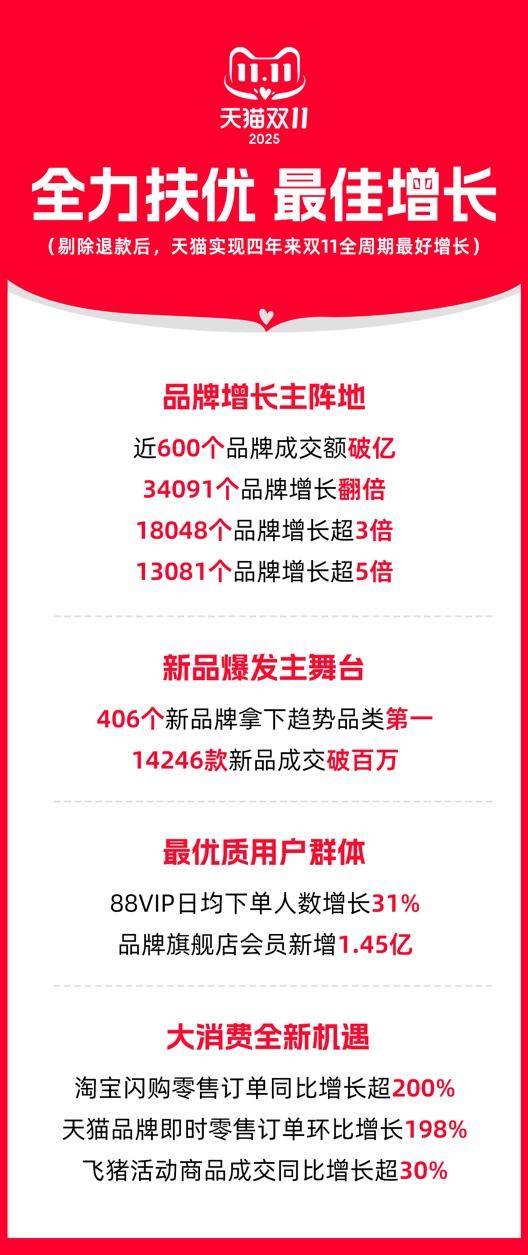
Group 1 - Tmall's "Double 11" event in 2025 achieved record growth, with nearly 600 brands surpassing 100 million in sales and 34,091 brands doubling their sales compared to last year [1][4] - Tmall's president, Jialuo, stated that the growth was driven by support for quality brands and original merchants, along with the largest consumer investment in the platform's history [1] - The event provided a significant platform for new and original brands, with 406 new brands ranking first in trending categories, and 26 new brands achieving over 100 million in sales [4] Group 2 - A total of 14,246 new products surpassed 1 million in sales during "Double 11," with 30% of products that exceeded 100 million in sales being new [4] - Tmall's 88VIP membership reached a new high, with daily order numbers increasing by 31% year-on-year, and 14.5 million new members added to brand flagship stores [4] - This year's "Double 11" marked the first event with full participation from Taobao's upgraded consumer platform and the comprehensive application of AI, leading to significant increases in sales and user engagement [5]

2025年天猫“双11”:剔除退款后成交额创新高 四年来全周期最好增长
Zheng Quan Ri Bao Wang· 2025-11-16 10:13
Core Insights - Tmall's "Double 11" event in 2025 achieved the best growth in four years, driven by strong consumer investment and support for quality brands and original merchants [3][5] Sales Performance - Nearly 600 brands achieved sales exceeding 100 million yuan, with 34,091 brands doubling their sales compared to last year, and 18,048 brands seeing sales growth of over 300% [1] - 13,081 brands experienced sales growth exceeding 500% compared to the previous year [1] - Major brands such as Apple, Haier, Midea, Xiaomi, and Nike surpassed 1 billion yuan in sales [1] Brand Development - Tmall provided a significant platform for the growth of quality original brands, with 406 new brands ranking first in trending categories [4] - 26 new brands achieved sales over 100 million yuan, and 188 new brands surpassed 10 million yuan in sales [4] - Notable new products like iPhone 17 Pro Max and Clarins' Golden Serum achieved over 1 billion yuan in sales during their debut [4] Consumer Engagement - Tmall's 88VIP membership reached a new high, with daily order numbers increasing by 31% year-on-year [4] - The number of new members in brand flagship stores increased by 14.5 million [4] Technological Integration - This year's "Double 11" marked the first full participation of Taobao's upgraded consumer platform and the comprehensive application of AI [5] - The use of AI "Smart Benefit Engine" significantly boosted daily order numbers, with an 86% increase in daily users compared to last year [5] - Tmall's consumer investment this year was the largest in its history, contributing to the overall growth of the event [5]
近600品牌成交破亿,超3万品牌增长翻倍!天猫“双11”四年来增长最佳
Sou Hu Cai Jing· 2025-11-16 09:38
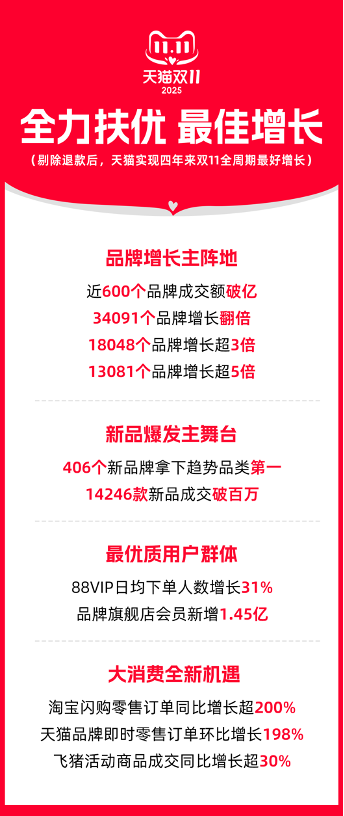
Core Insights - Tmall's "Double 11" event in 2025 achieved its best growth in four years, with nearly 600 brands surpassing 100 million in sales and 34,091 brands doubling their sales compared to last year [1][3] - The event highlighted the success of new and original brands, with 406 new brands ranking first in trending categories and 26 new brands exceeding 100 million in sales [3][4] Brand Performance - Major brands such as Apple, Haier, Midea, Xiaomi, and Nike each surpassed 1 billion in sales during the event [1] - A total of 14,246 new products achieved over 1 million in sales, with a significant portion of these being new launches [3] Consumer Engagement - Tmall's 88VIP membership reached a new high, with daily order numbers increasing by 31% year-on-year and 1.45 million new members added to brand flagship stores [3][4] - The event saw the largest consumer investment in Tmall's history, with AI-driven strategies significantly boosting user engagement and order volume [4] Platform Innovations - This year's "Double 11" marked the first participation of Taobao's upgraded consumption platform and the full application of AI technologies [4] - Tmall's integration with Taobao led to record-breaking sales for travel services and a substantial increase in retail orders through Taobao Flash Sale [4]





双十一急需增长:蒋凡有野心,淘天有压力
Xin Lang Cai Jing· 2025-11-16 08:59
Core Insights - The "Double 11" shopping festival is at a crossroads, transitioning from a focus on Gross Merchandise Volume (GMV) to a more value-oriented approach, with platforms like Taobao adopting simpler promotional strategies [2][3] - Instant retail has emerged as a significant growth area, with Taobao's flash purchase feature attracting over 100 million new users, indicating a shift towards becoming a comprehensive consumption platform [2][3] - The competitive landscape is changing, with JD.com gaining market share in the apparel sector, highlighting Taobao's ongoing growth challenges [3][4] Group 1: Strategic Shifts - Platforms are moving away from "scale worship" to "value return," simplifying promotional rules and focusing on quality competition [2][3] - Instant retail is becoming a key battleground, with Taobao's flash purchase service integrating over 37,000 brands and 400,000 stores, enhancing its ecosystem [2][3] - The integration of AI and big data is a major focus, optimizing product matching and enhancing the synergy between online and offline retail [2][3] Group 2: Performance Metrics - This year's Double 11 saw total online retail sales reach approximately 2.4 trillion yuan, a year-on-year growth of over 10%, with Taobao and Tmall's market share declining to 37% [3][4] - JD.com has outpaced Taobao in the apparel sector with a 27% growth rate, indicating a competitive threat [3][4] - Taobao has set an ambitious target of 600 billion yuan in sales for this Double 11, aiming for a 20% growth rate [6][7] Group 3: Internal Challenges - The rapid organizational changes within Alibaba's e-commerce division have increased internal pressure, with employees facing heightened workloads and stress [8][10] - Conflicts between business independence and the need for collaboration have emerged, complicating the execution of strategic initiatives [10][11] - Employees report significant psychological pressure due to high performance expectations, leading to a competitive internal environment [11][12] Group 4: Opportunities and Future Directions - The current pressure presents an opportunity for Taobao to solidify its position in the instant retail market and enhance its operational efficiency [12][13] - The integration of the flash purchase feature with the new membership system and AI technology is expected to drive sustainable growth [12][13] - The use of "Tao Coins" has significantly increased transaction volumes, indicating a successful strategy to attract consumers [16][17]

欧盟准备对中国出手,结束零关税时代,德国财长竟大言不惭:不要中国垃圾!
Sou Hu Cai Jing· 2025-11-16 06:12
克林拜尔在欧盟财长会议上推动的加快对中国小额进口包裹征税的决议,引起了外界的广泛关注。这一举措被许多人视为德国对中国采取的主动 挑战。根据欧盟委员会的数据显示,2024年,欧洲市场上将接收46亿件小包裹,而其中高达91%的包裹来自中国。这一数据不仅展示了中国电商 在欧洲市场的强势崛起,也暗示着市场竞争正在变得日益激烈。 作为推动该决议的核心人物之一,克林拜尔更是公开宣称"不要中国垃圾",并高喊"我们需要尽快保护自己的市场"。他的言辞直白而充满攻击 性,似乎意图通过提高关税来保护本土产业免受竞争。然而,这样的政策真能实现预期的效果吗? 即将于本月17日在北京举行的中德高级别财金对话,表面上看是中德双方进一步加强经贸合作的一次重要机会,但在此之前,德国副总理克林拜 尔却在公众舆论上火上加油,公开表达了对中国电商的强烈不满。这一举动引发了我们对当前中欧关系、经济形势以及未来发展趋势的深思。 自中德两国建立全面战略伙伴关系以来,双方在经济、政治等多个领域的合作逐步加深。中国已成为德国最大的贸易伙伴,而德国也在中国市场 中占据着重要地位。然而,随着全球化进程的变化和国际局势的复杂化,中德关系逐渐出现了更多的摩擦与矛盾。 ...
近600个品牌成交破亿元,超3万个品牌增长翻倍 天猫实现4年来“双11”最好增长
Shen Zhen Shang Bao· 2025-11-16 05:38
Core Insights - Tmall's "Double 11" event in 2025 achieved its best growth in four years, with nearly 600 brands surpassing 100 million yuan in sales [1][2] - The event saw significant participation from new brands, with 406 new brands ranking first in trending categories and 26 new brands exceeding 100 million yuan in sales [1] - Tmall's strategy focused on supporting quality brands and original merchants, leading to substantial consumer investment and enhanced sales performance [2] Group 1: Sales Performance - Tmall's "Double 11" event recorded a total of 34,091 brands with sales doubling compared to the previous year, and 18,048 brands saw sales growth exceeding three times [1] - Notable brands such as Apple, Haier, and Xiaomi each achieved over 1 billion yuan in sales during the event [1] - The event marked a historic high for Tmall, with the best overall growth in four years after excluding refunds [1][2] Group 2: New Product Launches - A total of 14,246 new products achieved sales exceeding 1 million yuan, with 30% of products surpassing 100 million yuan in sales [2] - High-profile new products like iPhone 17 Pro Max and Lululemon's Wunder Puff jacket made their debut during the event, achieving over 100 million yuan in sales [2] Group 3: Technological Integration and Consumer Engagement - This year's "Double 11" was the first to fully integrate AI applications, with the AI "Smart Benefit Engine" driving a significant increase in daily orders [2] - Tmall's consumer investment was the largest in its history, resulting in an 86% increase in daily active users for brands [2] - The event also saw a 30% year-on-year growth in transactions for Fliggy, Tmall's travel platform, indicating a broader impact on the consumer ecosystem [2]
谁能想到?京东双11不拼价格拼"花活",结果73%消费者首单给了它
Sou Hu Cai Jing· 2025-11-16 01:07
Core Insights - The highlight of this year's Double 11 shopping festival was JD.com, which successfully captured consumer attention through innovative marketing strategies and celebrity collaborations [1][3][17] Group 1: Marketing Strategies - JD.com employed a diverse marketing strategy featuring popular celebrities like Liu Yuning, Zhang Yixing, and Lei Jiayin, creating a unique experience for fans and consumers [3][5] - The "Galaxy on Earth" campaign linked high-end home appliances with cosmic themes, enhancing the emotional connection consumers have with products [5][7] - The marketing approach resonated particularly well with Gen Z consumers, who prioritize emotional value and personal happiness in their purchasing decisions [7][8] Group 2: Consumer Engagement - JD.com introduced eight surprise days during Double 11, targeting various consumer interests and transforming shopping into an enjoyable experience [8][10] - The "Price Comparison Live" event featured JD's sales personnel, who gained popularity for their genuine approach and commitment to price transparency, attracting millions of viewers [10][12] Group 3: Performance Metrics - JD.com reported a significant increase in annual active users, surpassing 700 million in October, and achieved record-breaking sales during the Double 11 event, with a 40% increase in the number of buyers and nearly 60% growth in order volume [14][17] - The company successfully transitioned from a focus on electronic products to a collaborative strategy across all categories, with notable revenue growth in daily necessities and apparel [15][17] - JD's investment in supply chain infrastructure, totaling 174.3 billion yuan, and its commitment to technological advancements have contributed to its impressive performance [15][17]