
信托

Search documents
信托概念下跌0.97%,主力资金净流出22股
Zheng Quan Shi Bao Wang· 2025-09-30 09:00
Group 1 - The trust concept sector declined by 0.97% as of the market close on September 30, ranking among the top declines in concept sectors, with notable declines in companies such as COFCO Capital, Aijian Group, and Sinopec Capital [1] - The top-performing concept sectors included zinc metal, which rose by 3.62%, and lead metal, which increased by 3.61%, while the trust concept sector experienced a significant outflow of funds [1] - The trust concept sector saw a net outflow of 608 million yuan, with 22 stocks experiencing net outflows, and 8 stocks having outflows exceeding 30 million yuan, led by Pudong Development Bank with a net outflow of 133 million yuan [1] Group 2 - The companies with the highest net outflows included Jianyuan Trust, COFCO Capital, and New Huangpu, with net outflows of 69.67 million yuan, 66.21 million yuan, and 51.84 million yuan respectively [1] - The trading volume for Pudong Development Bank was 0.30%, while Jianyuan Trust had a turnover rate of 1.95% [2] - Other companies with notable net outflows included Huaguang Huaneng, Jiangsu Guoxin, and Wukuang Capital, with outflows of 36.89 million yuan, 35.91 million yuan, and 32.55 million yuan respectively [2]



首批4单业务落地!这地不动产信托财产登记,来了
Zheng Quan Shi Bao Wang· 2025-09-30 07:54
Core Viewpoint - Tianjin has launched a pilot program for real estate trust property registration, following similar initiatives in cities like Beijing, Shanghai, and Guangdong, aiming to enhance asset management and promote economic development [1][6]. Group 1: Pilot Program Details - The pilot program involves multiple government departments in Tianjin, including the local financial management bureau and tax authorities, to facilitate the registration of real estate trusts [1][3]. - The program allows for the transfer of real estate ownership through a trust mechanism, where the trustee manages the property on behalf of the client [2][5]. Group 2: Innovations in Trust Services - The pilot expands application scenarios by emphasizing "revitalizing existing assets" as a core focus, encouraging trust institutions to design services around various needs such as elderly care and social welfare [4][6]. - New methods for establishing real estate trusts have been introduced, including the option for clients to commission the purchase of new properties [5][6]. Group 3: Initial Successes - The first four real estate trust projects have been successfully implemented in Tianjin, with North Trust leading the way by launching the "Tianjin Real Estate No. 1" project aimed at asset revitalization [6][7]. - The successful establishment of these trusts is expected to enhance the depth and breadth of trust services in supporting the real economy, providing safer and more professional asset management tools [6][8].
企业资产支持证券产品报告(2025年8月):发行规模有所收缩,融资成本下行态势趋缓,二级市场活跃度走低但同比仍呈提升趋势
Zhong Cheng Xin Guo Ji· 2025-09-30 07:31
Group 1: Report Overview - The report is titled "Enterprise Asset - Backed Securities Product Report (August 2025)" and is a regular report from CCXI [5]. Group 2: Industry Investment Rating - No industry investment rating is provided in the report. Group 3: Core Viewpoints - In August 2025, the issuance scale of enterprise asset - backed securities shrank, with a 8.81% decline compared to the previous month and a 20.69% decline compared to the same period last year. The trading activity in the secondary market decreased month - on - month but still increased year - on - year. The downward trend of financing costs slowed down [5][23]. Group 4: Issuance Situation - In August 2025, 125 single enterprise asset - backed securities were issued, with a total issuance scale of 117.181 billion yuan. Compared with the previous month, the number of issuances increased by 3, but the scale decreased by 8.81%. Compared with the same period last year, the number decreased by 10, and the scale decreased by 20.69% [5][6]. - In terms of issuance venues, the Shanghai Stock Exchange issued 81 products with an amount of 80.279 billion yuan (68.51% of the total), and the Shenzhen Stock Exchange issued 44 products with an amount of 36.902 billion yuan (31.49% of the total) [6]. - The top five original equity holders in terms of issuance scale were China Railway Capital Co., Ltd. (7.465 billion yuan, 6.37%), China Great Wall Asset Management Co., Ltd. (7.32 billion yuan, 6.25%), China Railway Trust Co., Ltd. (6.611 billion yuan, 5.64%), Huaxin International Trust Co., Ltd. (5.4 billion yuan, 4.61%), and China National Foreign Trade Trust Co., Ltd. (5.165 billion yuan, 4.41%). The total issuance scale of the top five was 31.961 billion yuan, accounting for 27.27% [7]. - The top five managers in terms of new management scale were Shanghai Guotai Haitong Securities Asset Management Co., Ltd. (17.66%), Ping An Securities Co., Ltd. (10.61%), CITIC Securities Co., Ltd. (10.33%), China International Capital Corporation Limited (8.23%), and Shenwan Hongyuan Securities Asset Management Co., Ltd. (6.98%). The total new management scale of the top five was 63.05 billion yuan, accounting for 53.81% [9][10]. - The underlying asset types mainly included personal consumer finance, accounts receivable, enterprise financial leasing, CMBS, and micro - loans. Personal consumer finance accounted for 22.74% of the scale, accounts receivable accounted for 19.13%, and enterprise financial leasing accounted for 14.13% [12]. - The highest single - product issuance scale was 5.1 billion yuan, and the lowest was 0.51 billion yuan. The products with a single - issuance scale in the range of (5, 10] billion yuan had the largest number and scale, with 53 products and an amount accounting for 36.84% [15]. - The shortest term was 0.71 years, and the longest was 39.02 years. The products with a term in the range of (1, 3] years had the largest number and scale, with 67 products and an amount accounting for 44.37% [16][17]. - In terms of grade distribution, AAAsf - rated securities accounted for 90.95% [17]. - The lowest issuance interest rate of one - year - around AAAsf - rated securities was 1.71%, and the highest was 2.48%. The interest rate center was approximately between 1.70% and 1.90%, with the median decreasing by about 2BP month - on - month and about 28BP year - on - year [20]. Group 5: Filing Situation - In August 2025, 99 single enterprise asset - backed securities were filed with the Asset Management Association of China, with a total scale of 87.592 billion yuan [5][24]. Group 6: Secondary Market Trading Situation - In August 2025, enterprise asset - backed securities traded 3,566 times on the exchange market, with a total transaction amount of 77.112 billion yuan. The number of transactions decreased by 743 month - on - month and increased by 1,076 year - on - year. The transaction amount decreased by 24.39% month - on - month and increased by 47.56% year - on - year. The Shanghai Stock Exchange accounted for 79.09% of the amount, and the Shenzhen Stock Exchange accounted for 20.91% [5][25]. - The more active underlying asset types in the secondary market were class REITs (27.38%), CMBS (12.44%), supply chain (11.89%), accounts receivable (11.83%), and personal consumer finance (9.53%) [25]. Group 7: Maturity Situation in September 2025 - In September 2025, 172 outstanding enterprise asset - backed securities were due for repayment, with a total scale of 49.737 billion yuan. The main underlying assets were accounts receivable (46.63%), supply chain (16.31%), policy loan (11.26%), and personal consumer finance (8.35%) [27]. - In terms of original equity holders, China Railway Capital Co., Ltd. had 7 due securities with a repayment scale of 6.583 billion yuan (13.24%), China Railway Trust Co., Ltd. had 4 due securities with a repayment scale of 6.012 billion yuan (12.09%), and China Pacific Life Insurance Co., Ltd. had 6 due securities with a repayment scale of 5.602 billion yuan (11.26%) [27].
金谷信托荣获第十一届介甫奖“优秀ABCP发行人”和“杰出绿色ABN产品”
Sou Hu Cai Jing· 2025-09-30 05:50
Core Insights - The 11th Structured Financing and Asset Securitization Forum was held in Shanghai, where the "Outstanding ABCP Issuer" and "Outstanding Green ABN Product" awards were presented to Jingu Trust, highlighting its excellence in the asset securitization field [2][3] - Jingu Trust focuses on innovation in enterprise securitization products, emphasizing its core philosophy of "craftsmanship and green empowerment," which aligns with the dual carbon goals and promotes sustainable finance [2][3] Company Achievements - Over the past decade, Jingu Trust has received multiple accolades, including "Outstanding Member of the Annual Chinese Bond Market" and "Outstanding ABS Issuer," showcasing its continuous breakthroughs in product innovation and issuance capabilities [3] - The recent dual awards affirm the company's comprehensive strength and commitment to excellence, reflecting industry recognition of its efforts in asset securitization [3] Strategic Direction - The awards signify the deepening of Jingu Trust's regional cultivation strategy 2.0 in the asset securitization sector, aiming to harmonize commercial value with social responsibility [3] - Moving forward, Jingu Trust plans to leverage this recognition as a new starting point, focusing on innovation and professionalism to contribute to the prosperity and sustainability of the Chinese financial market [3]


信托业社会责任报告出炉 2024年投向实体经济超16万亿元
Shang Hai Zheng Quan Bao· 2025-09-30 05:23
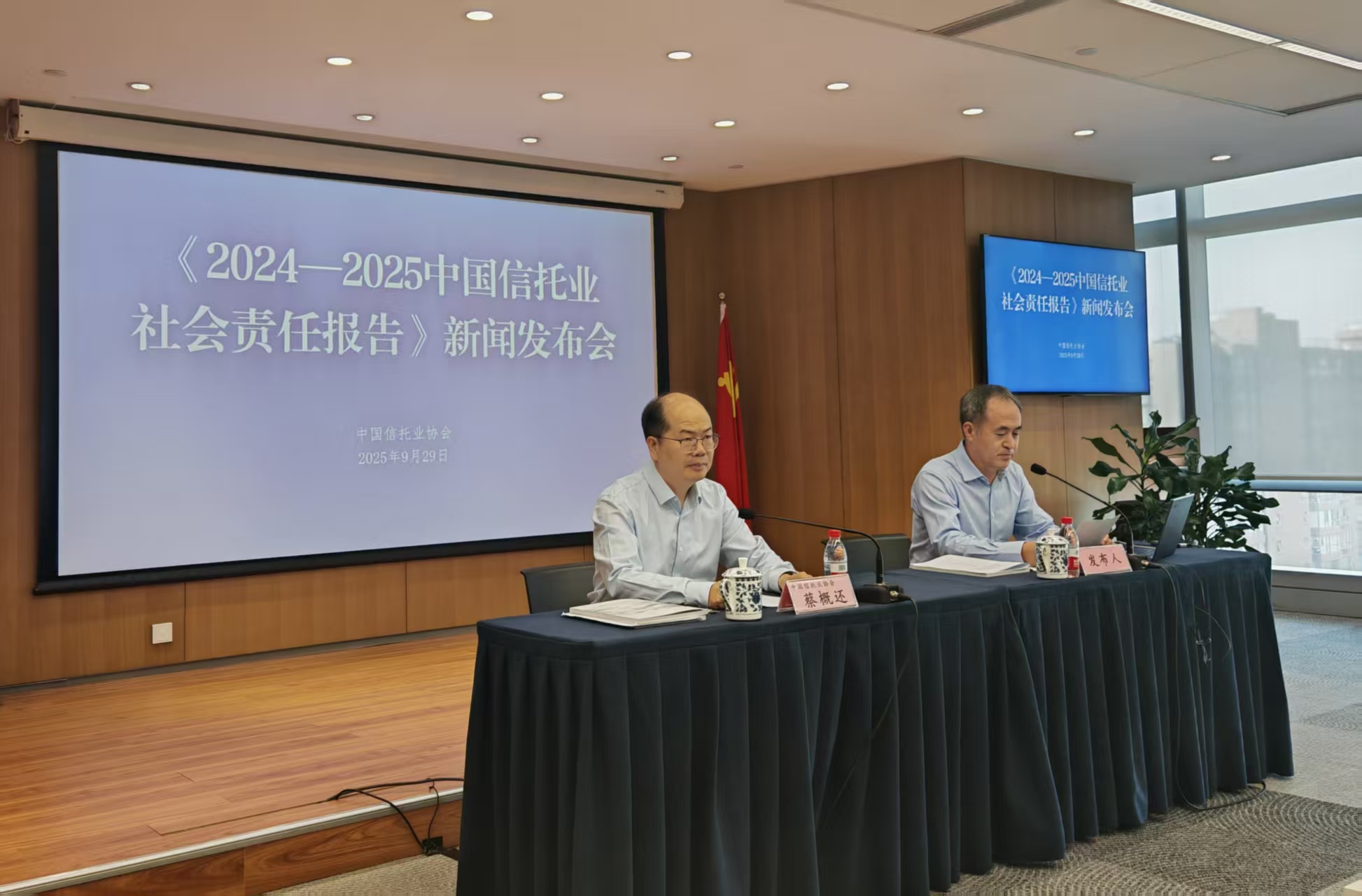
Core Insights - The China Trust Industry Association released the "2024-2025 China Trust Industry Social Responsibility Report," highlighting the industry's commitment to supporting economic development through targeted financial resource allocation [1] Group 1: Financial Support to the Real Economy - By the end of 2024, 28.81% of the 22.25 trillion yuan in trust assets will be directly invested in the real economy, while 46.17% will indirectly support it through capital markets, totaling 16.68 trillion yuan [1] - The trust industry will provide significant funding for national strategic projects, including 1.12 trillion yuan for the Belt and Road Initiative, 0.77 trillion yuan for the Beijing-Tianjin-Hebei coordinated development, 2.67 trillion yuan for the Yangtze River Economic Belt, 2.14 trillion yuan for the Yangtze River Delta integration, and 0.76 trillion yuan for the Guangdong-Hong Kong-Macau Greater Bay Area [1] Group 2: Social Responsibility and Community Support - In 2024, the trust industry invested 4.304 billion yuan in rural revitalization, implementing 289 projects, and registered 539 new charitable trusts with a total scale of 1.661 billion yuan, both reaching historical highs [2] - By the end of 2024, the cumulative number of charitable trusts reached 2,244, with a total scale of 8.507 billion yuan [2] Group 3: Industry Talent and Infrastructure Development - As of the end of 2024, the total number of employees in the trust industry reached 17,884, with over 60% being under 40 years old, indicating a youthful workforce [3] - The proportion of employees with a master's degree or higher is steadily increasing, reflecting an enhancement in the talent quality within the industry [3] - The trust industry has seen an increase in the number of employees from 17,563 at the end of 2023 to 17,884 in 2024, indicating ongoing structural optimization [3]
信托业积极履行社会责任 服务国计民生显行业担当
Zheng Quan Ri Bao· 2025-09-30 03:08
Core Viewpoint - The 2024-2025 China Trust Industry Social Responsibility Report highlights the trust industry's commitment to social responsibility and its transformation towards high-quality development, emphasizing its role in supporting the real economy and enhancing people's lives [1][3]. Group 1: Industry Transformation and Development - Since its restoration in 1979, the trust industry has evolved from "scale expansion" to "compliance development," and now to "high-quality development," becoming a significant financial force in serving the real economy [3]. - The trust industry is set to deepen its new classification regulations in 2024 and enter a new phase of high-quality development by 2025 [3]. Group 2: Social Responsibility Achievements - The report outlines achievements in social responsibility across eight areas: party building, livelihood, economic, legal, environmental, public welfare, human-centered, and responsibility management [3]. - By the end of 2024, the trust industry managed a total trust asset scale of 29.56 trillion yuan, a year-on-year increase of 23.58% [4]. Group 3: Financial Support for the Real Economy - Of the 22.25 trillion yuan in funds managed by the trust industry, 28.81% was directly invested in the real economy, while 46.17% supported it indirectly through capital markets, totaling 16.68 trillion yuan [4]. - In 2024, the trust industry allocated 1.6 trillion yuan to inclusive finance, established 1,148 pension service trust projects with an investment of 14.493 billion yuan, and funded 289 rural revitalization projects with 4.304 billion yuan [5]. Group 4: Charity and Green Development - The charity trust sector saw a total of 2,244 registered cases with a cumulative scale of 8.507 billion yuan by the end of 2024, with new registrations increasing by 18.72% year-on-year [5]. - The green trust sector experienced rapid growth, with 390 new projects and a new scale of 177.944 billion yuan, bringing the total to 325.388 billion yuan [5]. Group 5: Talent Development - The trust industry emphasizes talent as a core driver of high-quality development, with a total workforce of 17,884 employees by the end of 2024, over 60% of whom are under 40 years old [6]. - The proportion of employees with master's degrees or higher is steadily increasing, reflecting the enhancement of talent quality within the industry [6]. Group 6: Future Outlook - The trust industry aims to continue enhancing its ability to serve national strategies and improve people's lives while maintaining a focus on compliance and innovation [6].
探索对企业闲置不动产进行“激活”
Jin Rong Shi Bao· 2025-09-30 02:51
Core Viewpoint - The recent launch of the real estate trust property registration pilot in Tianjin marks the fifth city in China to implement such a program, aimed at revitalizing idle real estate assets and improving the efficiency of state-owned asset management [1][2]. Group 1: Significance of Real Estate Trust Registration - The pilot program aims to clarify the legal status of trust properties, thereby effectively revitalizing a large volume of idle assets [2]. - The "Tianjin Real Estate No. 1" project involves a state-owned enterprise entrusting its commercial real estate valued at 3 million yuan to a trust company, showcasing the potential for asset isolation and revitalization [2]. - The initiative is expected to enhance liquidity and value of previously idle assets, transforming them into tradable financial assets [2][3]. Group 2: Trust Industry Transformation - The pilot program aligns with national policies aimed at promoting high-quality development in the trust industry, encouraging innovation and a return to core business functions [3]. - The recent trials in various cities signal a strong push towards building the infrastructure of the trust system, allowing companies to move away from traditional financing dependencies [3][6]. - Trust companies are encouraged to develop differentiated competitive advantages by focusing on specialized products and services tailored to local economic needs [6]. Group 3: Market Opportunities and Challenges - The ongoing trials are expected to expand to more regions, presenting opportunities for trust companies to capitalize on favorable policies while managing risks [6]. - Trust companies should cultivate a skilled workforce proficient in real estate investment and management to meet the complexities of real estate trust operations [6]. - The focus on niche markets, such as industrial logistics and elder care real estate trusts, is recommended for trust companies to enhance their market positioning [6].
天津试点不动产信托登记 探索对企业闲置不动产进行“激活”
Jin Rong Shi Bao· 2025-09-30 01:13
Core Insights - The recent announcement of the pilot program for real estate trust property registration in Tianjin marks the fifth city in China to implement such a program, following Beijing, Shanghai, Guangzhou, and Xiamen [1] - The "Tianjin Real Estate No. 1" trust project involves a company registering its commercial real estate for operation by a trust company, differing from previous practices that focused on individual property ownership [1][2] - This initiative aims to activate idle real estate assets, enhance the efficiency of state-owned asset management, and represents a significant breakthrough in asset management [1][2] Summary by Sections Pilot Program Significance - The pilot program for real estate trust registration clarifies the legal status of trust property, facilitating the activation of substantial idle assets [2] - Experts believe that the trust registration will enable professional operation, centralized planning, risk isolation, and dedicated revenue management for real estate assets [2] Case Study: "Tianjin Real Estate No. 1" - The project involves a state-owned enterprise entrusting a two-story commercial property valued at 3 million yuan to a trust company, demonstrating the potential for asset activation [2] - The activation of this 3 million yuan asset is seen as significant for state-owned asset management, transforming previously idle properties into liquid and valuable assets [2][3] Trust Industry Transformation - The recent pilot programs signal a shift in the trust industry towards high-quality development and a return to core business functions [3] - Trust companies are encouraged to innovate and transition towards asset isolation, wealth planning, and management services [3][6] Diverse Applications of Real Estate Trusts - Recent real estate trust cases show that they can meet various demographic needs, including retirement security and intergenerational wealth transfer [4][5] - The integration of trust systems with retirement needs provides new solutions for elder financial security [5] Competitive Landscape for Trust Companies - With five cities now piloting real estate trust registration, more regions are expected to follow suit, presenting opportunities for trust companies [6] - Trust companies should focus on developing specialized teams with expertise in real estate investment and management to enhance their competitive edge [6] - Companies are advised to explore niche markets and tailor products to local economic characteristics, such as logistics and real estate related to free trade zones [6]
北方信托落地全国首单法人资产盘活场景不动产信托
Zhong Zheng Wang· 2025-09-30 01:08
Core Insights - The implementation of the real estate trust property registration pilot policy in Tianjin significantly expands the practical pathways for trust services in the real economy, enriching the business types and operational space for trust companies [1][2] - The successful launch of "Tianjin Real Estate No. 1" marks a significant practice in utilizing trust tools to address the challenges of asset revitalization, exploring a replicable new path for "value awakening" [1][3] Company Initiatives - Northern Trust effectively utilized the real estate self-benefit trust model in this project, focusing on asset bankruptcy isolation, flexible planning, and professional management, laying a solid foundation for market-oriented operations and asset securitization [2] - The company collaborated closely with the Tianjin Free Trade Zone Innovation Development Bureau to leverage the advantages of institutional innovation, achieving breakthroughs in real estate trust property registration [2] Future Outlook - Northern Trust aims to deepen the application of trust tools in asset revitalization, wealth management, and public service, providing efficient and flexible financial solutions to transform "asset stock" into "development increment" [3] - The company is committed to upholding the values of integrity, prudence, professionalism, diligence, compliance, and service, while fulfilling its mission as a state-owned financial institution [3]
中国信托业社会责任报告出炉 去年投向实体经济超16万亿元
Zheng Quan Shi Bao· 2025-09-29 18:23
Core Insights - The China Trust Industry Association released the "2024-2025 China Trust Industry Social Responsibility Report," marking the 13th consecutive year of publication, highlighting the industry's commitment to social responsibility and high-quality development [1] Group 1: Industry Development and Financial Support - By the end of 2024, the trust industry managed 22.25 trillion yuan in funds, with 28.81% directly invested in the real economy and an additional 46.17% indirectly supporting it through capital markets, totaling 16.68 trillion yuan [2] - The trust industry provided significant funding for national strategic projects, including 1.12 trillion yuan for the "Belt and Road" initiative, 0.77 trillion yuan for the "Beijing-Tianjin-Hebei" coordinated development, 2.67 trillion yuan for the "Yangtze River Economic Belt," 2.14 trillion yuan for the "Yangtze River Delta Integration," and 0.76 trillion yuan for the "Guangdong-Hong Kong-Macau Greater Bay Area" [2] Group 2: Social Responsibility and Community Support - In 2024, the trust industry invested 4.304 billion yuan in rural revitalization, implementing 289 projects, and recorded a historical high of 539 new charitable trust registrations with a total scale of 1.661 billion yuan [2] - Cumulatively, charitable trusts reached 2,244 registrations with a total scale of 8.507 billion yuan by the end of 2024 [2] Group 3: Focus Areas and Financial Innovations - The trust industry is focusing on five key areas to serve the economy: technology finance, green finance, inclusive finance, pension finance, and digital finance [3][4] - In technology finance, the industry supported innovation projects with a scale of 337.6 billion yuan, while in green finance, 390 new green trust projects were established, with a total scale of 177.944 billion yuan [3] - The trust industry invested approximately 1.6 trillion yuan in inclusive finance, targeting small and micro enterprises and rural areas [3] Group 4: Industry Infrastructure and Human Resources - The trust industry is returning to its core functions, with the Trust Guarantee Fund's total assets reaching 199.368 billion yuan by the end of 2024, distributing 2.436 billion yuan in earnings to trust companies [5] - The workforce in the trust industry increased to 17,884 employees by the end of 2024, reflecting a balanced gender ratio and a significant proportion of young professionals [7]