
互联网和相关服务

Search documents
浪潮卓数申请公平贸易信息联查系统构建专利,提供政策影响分析、风险预警及趋势预测
Sou Hu Cai Jing· 2026-01-06 03:56
Core Viewpoint - Inspur Zhaoshu Big Data Industry Development Co., Ltd. has applied for a patent for a system that constructs a fair trade information cross-checking system, indicating a focus on enhancing trade policy analysis and risk assessment for foreign trade enterprises [1] Group 1: Patent Application Details - The patent, titled "A Method, Device, and Medium for Constructing a Fair Trade Information Cross-Check System," was published with the application number CN121257912A and filed on August 2025 [1] - The method involves collecting original information on trade policies and trade friction policies from multiple data sources, preprocessing this data to obtain structured data [1] - A pre-trained large language model is utilized for semantic analysis, sentiment analysis, and correlation analysis of the structured data, which is then matched with local foreign trade enterprises based on country, industry, and enterprise size [1] Group 2: Evaluation Report Features - The system generates evaluation reports based on the analysis and matching results, which are then pushed to the matched enterprises [1] - These evaluation reports include policy impact analysis, risk warnings, and trend forecasts, providing valuable insights for businesses [1] Group 3: Company Background - Inspur Zhaoshu Big Data Industry Development Co., Ltd. was established in 2017 and is located in Wuxi City, primarily engaged in internet and related services [1] - The company has a registered capital of 361.97 million RMB and has invested in 12 enterprises, participated in 862 bidding projects, and holds 1,029 patent pieces of information [1] - Additionally, the company has 12 trademark information entries and 19 administrative licenses [1]
茅台最近动作多,背后的资金逻辑你看懂了吗?
Sou Hu Cai Jing· 2026-01-06 02:16
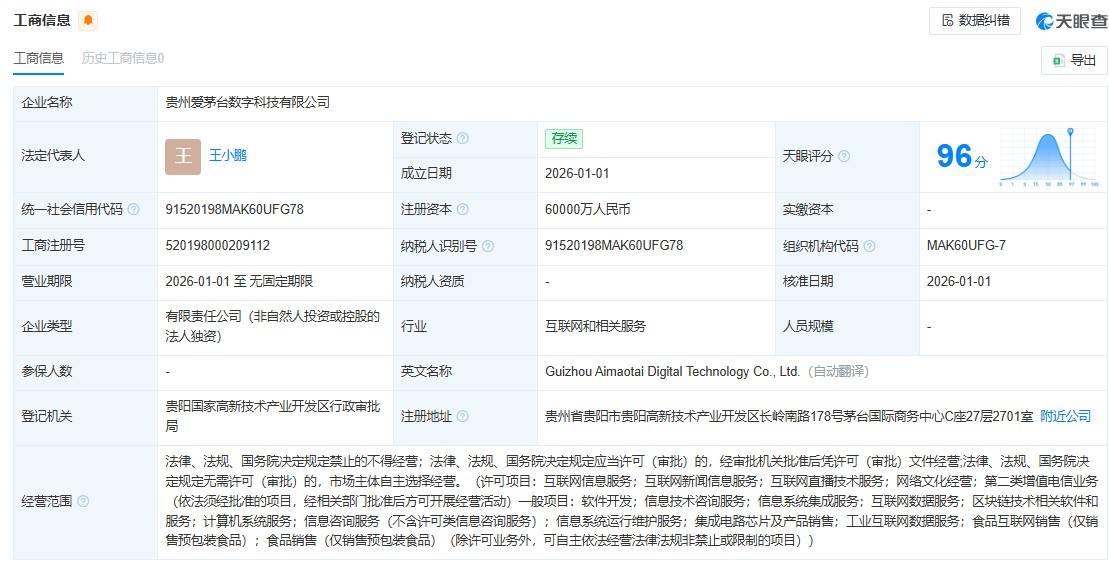
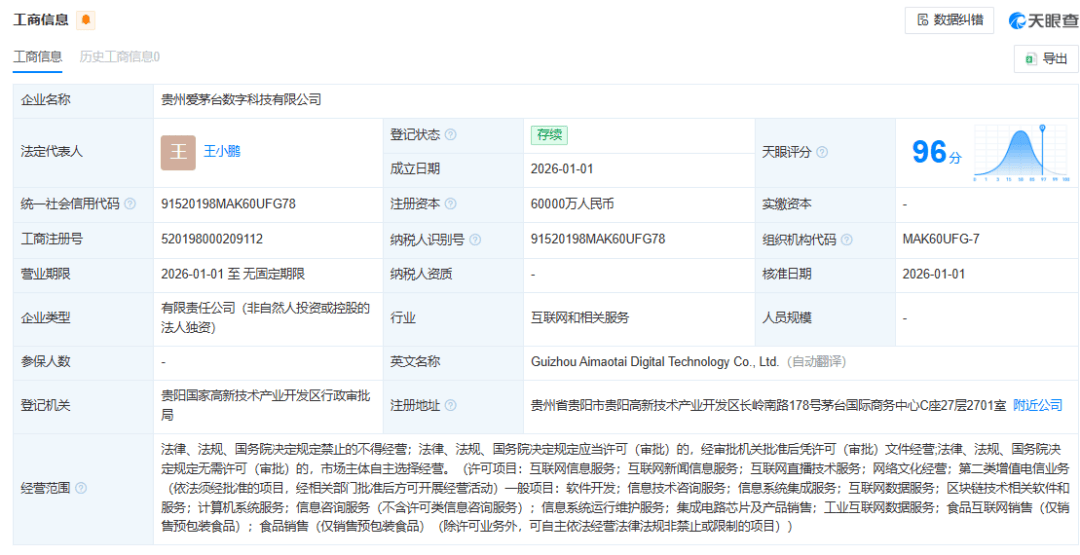
Group 1 - Kweichow Moutai has established a new digital technology company, Guizhou Aimaotai Digital Technology Co., Ltd., with a registered capital of 600 million RMB, focusing on internet live streaming, blockchain technology, and integrated circuit chip sales [1] - The purchasing rules for Moutai's products on the iMoutai platform have changed rapidly, with initial limits of 12 bottles per day reduced to 6 bottles, indicating high demand and market volatility [1] - Over the New Year holiday, more than 100,000 users successfully purchased Moutai products, reflecting strong consumer interest and potential sales growth [1] Group 2 - The article emphasizes that news events act as catalysts for market fluctuations, but the true determinant of stock price movements is the attitude of institutional investors towards trading [1] - The concept of "funding attitude" is highlighted, suggesting that the willingness of institutional and retail investors to engage in trading is crucial for stock performance [3][10] - Quantitative data is presented as a valuable tool for investors to assess market conditions and avoid impulsive decisions based on news, focusing on the activity of institutional and retail investors [11]

茅台成立数字科技公司
盐财经· 2026-01-05 10:23
Group 1 - Guizhou Moutai has established a new subsidiary, Guizhou Aimaotai Digital Technology Co., Ltd., with a registered capital of 600 million RMB, focusing on digital transformation and technology services [2][3] - The new company will engage in various services including internet live streaming technology, blockchain-related software and services, integrated circuit chip sales, and industrial internet data services [2][3] - The official announcement from iMoutai revealed that starting January 1, 2026, a limited quantity of 53% vol 500ml Flying Moutai will be available for purchase, with a price set at 1499 RMB and a daily purchase limit of 12 bottles per user [3][4] Group 2 - Following the initial launch, iMoutai adjusted the purchase limit to 6 bottles per user on January 3, 2026, yet the app continued to show "restocking" on January 4, indicating high demand [4] - Over the New Year holiday, more than 100,000 users successfully purchased Moutai products, demonstrating strong consumer interest [4] - Moutai distributors, such as Chengdu Chuantang Supply Chain Management Co., Ltd., have also initiated promotional activities, allowing customers to pre-order up to 5 bottles of Flying Moutai at the same price [4]


茅台新动作:成立数字科技公司
Sou Hu Cai Jing· 2026-01-05 05:23
Group 1 - Guizhou Moutai has established a new subsidiary, Guizhou Aimaotai Digital Technology Co., Ltd., with a registered capital of 600 million RMB, focusing on digital transformation and technology services [1][2] - The new company will engage in various activities including internet live streaming, blockchain technology services, integrated circuit chip sales, and industrial internet data services [1] - Guizhou Moutai holds 100% ownership of the new subsidiary, indicating a strategic move towards enhancing its digital capabilities [2] Group 2 - The iMoutai app has recently changed its purchasing rules, reducing the daily purchase limit from 12 bottles to 6 bottles per person, which has led to continued high demand and stock shortages [3] - On January 4, the day the new policy was implemented, the iMoutai app showed "out of stock" status, despite over 100,000 users successfully purchasing Moutai products during the New Year holiday [3] - Moutai distributors are also promoting sales, with a recent campaign offering pre-orders for the Flying Moutai at 1499 RMB, allowing customers to order up to 5 bottles, further stimulating market demand [3]
平安智慧城取得基于信息粒度的信息导出方法专利
Sou Hu Cai Jing· 2026-01-02 11:08
声明:市场有风险,投资需谨慎。本文为AI基于第三方数据生成,仅供参考,不构成个人投资建议。 天眼查资料显示,平安国际智慧城市科技股份有限公司,成立于2018年,位于深圳市,是一家以从事互 联网和相关服务为主的企业。企业注册资本100000万人民币。通过天眼查大数据分析,平安国际智慧城 市科技股份有限公司共对外投资了2家企业,参与招投标项目696次,财产线索方面有商标信息44条,专 利信息1372条,此外企业还拥有行政许可14个。 国家知识产权局信息显示,平安国际智慧城市科技股份有限公司取得一项名为"基于信息粒度的信息导 出方法、装置、设备及介质"的专利,授权公告号CN114491196B,申请日期为2022年2月。 来源:市场资讯 ...
路通数联取得基于人工智能的冷链运输温控监测方法及系统专利
Sou Hu Cai Jing· 2026-01-02 06:15
铜仁北科科技有限公司,成立于2022年,位于深圳市,是一家以从事软件和信息技术服务业为主的企 业。企业注册资本2000万人民币。通过天眼查大数据分析,铜仁北科科技有限公司共对外投资了2家企 业,专利信息6条,此外企业还拥有行政许可2个。 声明:市场有风险,投资需谨慎。本文为AI基于第三方数据生成,仅供参考,不构成个人投资建议。 来源:市场资讯 国家知识产权局信息显示,路通数联(北京)信息技术有限公司;铜仁北科科技有限公司取得一项名 为"基于人工智能的冷链运输温控监测方法及系统"的专利,授权公告号CN120746427B,申请日期为 2025年6月。 天眼查资料显示,路通数联(北京)信息技术有限公司,成立于2025年,位于北京市,是一家以从事互 联网和相关服务为主的企业。企业注册资本955.5万人民币。通过天眼查大数据分析,路通数联(北 京)信息技术有限公司专利信息6条。 ...
晓数点丨2025年十大牛股出炉:上纬新材逾1820%涨幅问鼎榜首
Di Yi Cai Jing· 2026-01-02 02:37
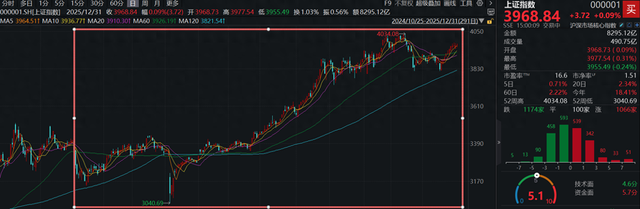
Market Performance - In 2025, the Shanghai Composite Index closed at 3968.84 points, marking an annual increase of 18.41%, and returning to the 4000-point level for the first time in ten years; the ChiNext Index saw a significant rise of 49.57% [1] Top Performing Stocks - The top-performing stock in 2025 was Shangwei New Materials, with a staggering cumulative increase of 1820.29%, followed by Tianpu Co., which rose by 1645.35%. Both stocks were part of the top ten gainers, all of which had gains exceeding 500% [3][4] Shangwei New Materials - Shangwei New Materials became the first tenfold stock in A-shares for 2025, with a notable rise of 1820.29%, achieving 20% daily limit increases on 16 trading days. The company, established in 1992 and listed on the Sci-Tech Innovation Board in September 2020, specializes in high-performance corrosion-resistant materials and other innovative materials. The stock price surged following the announcement of a takeover plan by Zhiyuan Robotics on July 8, 2025, which aimed to acquire at least 63.62% of the company [6][7] Tianpu Co. - Tianpu Co. experienced a remarkable increase of 1645.35%, with its stock price rising from 12 yuan to a peak of 218 yuan. The surge began after a takeover bid by Zhonghao Xinying, which was announced on August 21, 2025. The stock hit the daily limit for 15 consecutive trading days following the announcement, and by December 22, 2025, the acquisition was completed, with the acquirer controlling 68.29% of the company [7][8] *ST Yushun - *ST Yushun recorded a 719.38% increase, with 70 daily limit increases throughout the year. The stock price rose from 3.56 yuan in January 2025 to 29.17 yuan. The significant price increase was attributed to a major asset restructuring plan announced on April 22, 2025, involving a cash acquisition of a data center project, which is expected to enhance the company's asset quality and profitability [9][10]

宣亚国际出资1000万元成立上海宣亚网络科技有限公司,持股100%
Sou Hu Cai Jing· 2026-01-01 17:22
Group 1 - XuanYa International Marketing Technology (Beijing) Co., Ltd. has invested 10 million RMB to establish Shanghai XuanYa Network Technology Co., Ltd., holding 100% ownership [1] - Shanghai XuanYa Network Technology Co., Ltd. was founded on April 11, 2025, with a registered capital of 10 million RMB and is located in Shanghai [1] - The company will engage in various services including technology services, software development, marketing planning, and advertising [1]

江西科盛数字技术有限公司成立,注册资本1000万人民币
Sou Hu Cai Jing· 2025-12-31 16:51
Group 1 - The establishment of Jiangxi Kesheng Digital Technology Co., Ltd. has been registered with a capital of 10 million RMB, fully owned by Suichuan Chuanglian Industrial Co., Ltd. [1] - The legal representative of Jiangxi Kesheng Digital Technology Co., Ltd. is Huang Wei [1] - The company operates in the information transmission, software, and information technology services industry, specifically focusing on internet information services and related services [1] Group 2 - The business scope includes internet information services, technology consulting, industrial internet data services, and artificial intelligence application software development [1] - The company is located in the Suichuan Industrial Park, East District, Jingshan Avenue, Ji'an City, Jiangxi Province [1] - The company is classified as a limited liability company with no fixed term of operation, registered until December 31, 2025 [1]
2025年前11月中国规上互联网企业完成互联网业务收入超1.8万亿元
Zhong Guo Xin Wen Wang· 2025-12-31 13:57
Core Insights - The internet and related services sector in China achieved a revenue of 1.8 trillion yuan in the first eleven months of 2025, with a year-on-year growth rate of 1% [1][2] - The profitability of large-scale internet enterprises declined, with total profits amounting to 137.8 billion yuan, reflecting an 11.7% decrease compared to the previous year [1] - Research and development expenditure growth slowed, totaling 95.74 billion yuan, with a year-on-year increase of 6.7% [1] Regional Performance - The Beijing-Tianjin-Hebei region led the key areas with an internet business revenue of 591.3 billion yuan, marking a significant year-on-year growth of 9.1% [1] - The Yangtze River Delta region reported an internet business revenue of 616.3 billion yuan, experiencing a year-on-year decline of 2.7% [1] - The eastern region of China generated 1.6214 trillion yuan in internet business revenue, representing a year-on-year growth of 2.9% and accounting for 89.9% of the national total [2] Concentration of Revenue - The top five regions, including Beijing, Guangdong, and Shanghai, contributed to 84.5% of the internet business revenue, highlighting a significant concentration effect [2] - Eight provinces achieved positive growth in internet business revenue, with Hebei and Zhejiang exceeding a growth rate of 10% [2]