外汇管理

Search documents
“陆家嘴”声音传递金融开放信号
Shang Hai Zheng Quan Bao· 2025-06-18 20:07
Core Viewpoint - Shanghai is set to implement eight policy measures aimed at enhancing its status as an international financial center, focusing on financial openness and innovation in response to global economic trends [1][4][6]. Group 1: Policy Measures - Establishment of an interbank market transaction reporting database [6] - Creation of a digital RMB international operation center [6] - Formation of a personal credit agency [6] - Launch of a comprehensive reform pilot for offshore trade finance services in the Lingang New Area [6] - Development of offshore bonds in the free trade zone [6] - Optimization and upgrading of free trade account functions [6] - Innovation of structural monetary policy tools through "first trial" initiatives [6] - Collaboration with the China Securities Regulatory Commission to promote RMB foreign exchange futures trading [6] Group 2: Financial Openness and Cooperation - Emphasis on attracting foreign financial institutions and long-term capital to Shanghai, enhancing its role as a financial hub [2][11] - Commitment to expanding institutional financial openness and improving the business environment for foreign investments [11][13] - Focus on creating a more inclusive international financial system and enhancing global financial stability [11][10] Group 3: Technological and Market Development - Promotion of the integration of technological innovation and industrial innovation, particularly in the capital market [3] - Support for the development of a technology finance service system to facilitate the transformation of technological achievements into new productive forces [3][17] - Continuous improvement of the financial market structure and internationalization to enhance global resource allocation capabilities [2][3] Group 4: Risk Management and Regulatory Framework - Strengthening financial regulation and risk prevention measures to ensure stability in the financial sector [3][20] - Implementation of a more convenient, open, secure, and intelligent foreign exchange management system [16][21] - Introduction of supportive policies to stabilize employment, enterprises, and market expectations amid changing external environments [21][22]

国家外汇局:缩减资本项目收入使用负面清单,取消资本项目外汇收入及其结汇所得人民币资金不得用于购买非自用住宅性质房产的限制。
news flash· 2025-06-18 09:11
Core Viewpoint - The State Administration of Foreign Exchange (SAFE) has reduced the negative list for the use of capital account income, specifically removing restrictions on the use of foreign exchange income and its converted RMB funds for purchasing non-self-use residential properties [1] Group 1 - The adjustment allows for greater flexibility in the use of foreign exchange income, which may encourage investment in the real estate sector [1] - The removal of restrictions is expected to stimulate demand in the housing market, particularly for non-self-use residential properties [1] - This policy change reflects a broader trend towards liberalizing capital account transactions in China [1]
重磅!外汇局拟施行一揽子新政
Jin Rong Shi Bao· 2025-06-18 08:58
Core Viewpoint - The State Administration of Foreign Exchange (SAFE) has drafted a notice to deepen the reform of foreign exchange management for cross-border investment and financing, aiming to optimize the business environment and support high-quality economic development [1] Group 1: Cross-Border Investment Policies - The notice cancels the registration of basic information for foreign direct investment (FDI) pre-investment expenses, allowing foreign investors to open accounts directly at banks without prior registration [2] - Foreign investment enterprises can now reinvest in China without the need for registration, streamlining the process and improving efficiency [3] - The notice clarifies that foreign exchange profits generated by foreign investment can be reinvested domestically, providing a clear policy basis for foreign enterprises [3] Group 2: Financing for High-Tech and Specialized Enterprises - The notice raises the foreign debt facilitation limit for high-tech, "specialized and innovative," and technology-based small and medium-sized enterprises to the equivalent of $1 million, with certain qualified enterprises able to access up to $2 million [4][5] - The simplification of signing and registration requirements for cross-border financing will reduce financial costs and improve financing efficiency for enterprises [6] Group 3: Real Estate Sector Adjustments - The notice reduces the negative list for capital project income usage, allowing foreign exchange income to be used for purchasing non-self-occupied residential properties [7] - The notice facilitates the process for foreign individuals to exchange funds for property purchases in China, allowing them to complete transactions without prior registration [8]
朱鹤新陆家嘴论坛重磅发声,外汇政策礼包呼之欲出
Di Yi Cai Jing· 2025-06-18 06:19
Core Viewpoint - The People's Bank of China and the State Administration of Foreign Exchange announced a comprehensive package of foreign exchange policies aimed at supporting foreign trade enterprises and facilitating cross-border investment and financing, reflecting a commitment to deepen reforms and serve the real economy [1][7]. Foreign Trade Support - A series of facilitation policies will be implemented to deepen trade foreign exchange business management reform, including optimizing foreign exchange fund settlement for foreign trade comprehensive service enterprises and supporting the centralized management of overseas funds for compliant engineering contracting enterprises [7]. - The new policies will also encourage banks to include more new trade entities in the trade facilitation policy [7]. Cross-Border Investment Facilitation - The package includes measures to support research institutions in attracting foreign investment, expand cross-border financing for technology enterprises, and reduce the negative list for capital project income usage [7]. - The promotion of a cross-border integrated fund pool policy for multinational companies will facilitate the collection and use of funds within the group [7]. QDII Investment Quotas - As of May 31, 2025, the cumulative approved quota for Qualified Domestic Institutional Investors (QDII) reached $167.79 billion, with 189 institutions approved, including banks, securities firms, insurance companies, and trust companies [8]. - A new batch of QDII investment quotas will be issued to meet the reasonable demand for overseas investment by domestic entities [7][8]. Market Resilience - Despite global economic uncertainties, China's foreign exchange market has maintained overall stability, with the RMB appreciating by 1.6% against the USD this year and foreign investment in domestic bonds reaching a net increase of $10.9 billion in April [2][3]. - The foreign exchange market's resilience is attributed to a more mature and rational participation from entities, with the proportion of enterprises using foreign exchange hedging increasing significantly [4]. Regulatory Framework - The foreign exchange management reform emphasizes four key aspects: "more convenient, more open, more secure, and smarter" [4][5]. - The focus on enhancing the foreign exchange policy system will provide stronger support for high-quality economic development [5][6].
朱鹤新:健全外汇管理政策评估机制和外汇生态评估机制
news flash· 2025-06-18 03:41
国家外汇管理局局长朱鹤新6月18日在陆家嘴论坛上表示,将加强外汇管理改革创新,持续提升跨境贸 易和投融资便利化水平;推动银行外汇展业改革,全面优化事前尽职调查、事中差异化审核、事后监测 报告的管理框架;健全外汇管理政策评估机制和外汇生态评估机制,以是否符合国家发展战略定位、是 否符合地方发展实际、是否符合便企利民为标准,不断增强政策含金量。 ...
聚焦主题 坚持“深”“严”“实” 国家外汇管理局重庆市分局开展深入贯彻中央八项规定精神学习教育
Jin Rong Shi Bao· 2025-06-18 02:05
一是定位问题对照"靶向"。对标党中央部署要求,结合履行外汇管理职责,全面梳理近年来巡视巡察、 审计监督、调查研究、信访反映的问题,刀刃向内,明确深入查找贯彻中央八项规定及其实施细则精神 方面问题对照清单,为问题查摆工作奠定基础、提供"靶向"。二是推动找准查实问题。对照《违反中央 八项规定及其实施细则精神问题清单》《隐形变异的作风问题清单》及梳理问题,局领导带头从严查摆 问题,通过自我对照检视、听取群众意见等方式,组织各党支部、处级干部及青年党员等认真剖析问题 及具体表现,组织年轻干部对是否存在玩心重、混日子,精神空虚、贪图享乐,社会交往复杂、生活不 检点以及网络言行方面问题进行查摆,形成一揽子问题清单,帮助党员干部清清楚楚掌握"工作差距在 哪里"。三是强化问题整治监督。建立学习教育集中整治台账,明确整改措施和整改责任,推动以点带 面抓实整改。定期督导问题整治情况,避免问题查摆不深不透、集中整治应付了事。聚焦外汇服务重点 领域,持续纠治损害群众利益的不正之风,强化外汇窗口服务高效化、规范化、标准化管理,落实"首 问负责制",优化服务热线接听、网站留言办理工作流程,更新外汇业务办理指引,进一步提升群众诉 求响应速 ...
最新公布!截至5月末,我国外汇储备规模为32853亿美元!央行连续第7个月增持黄金
Mei Ri Jing Ji Xin Wen· 2025-06-07 02:54
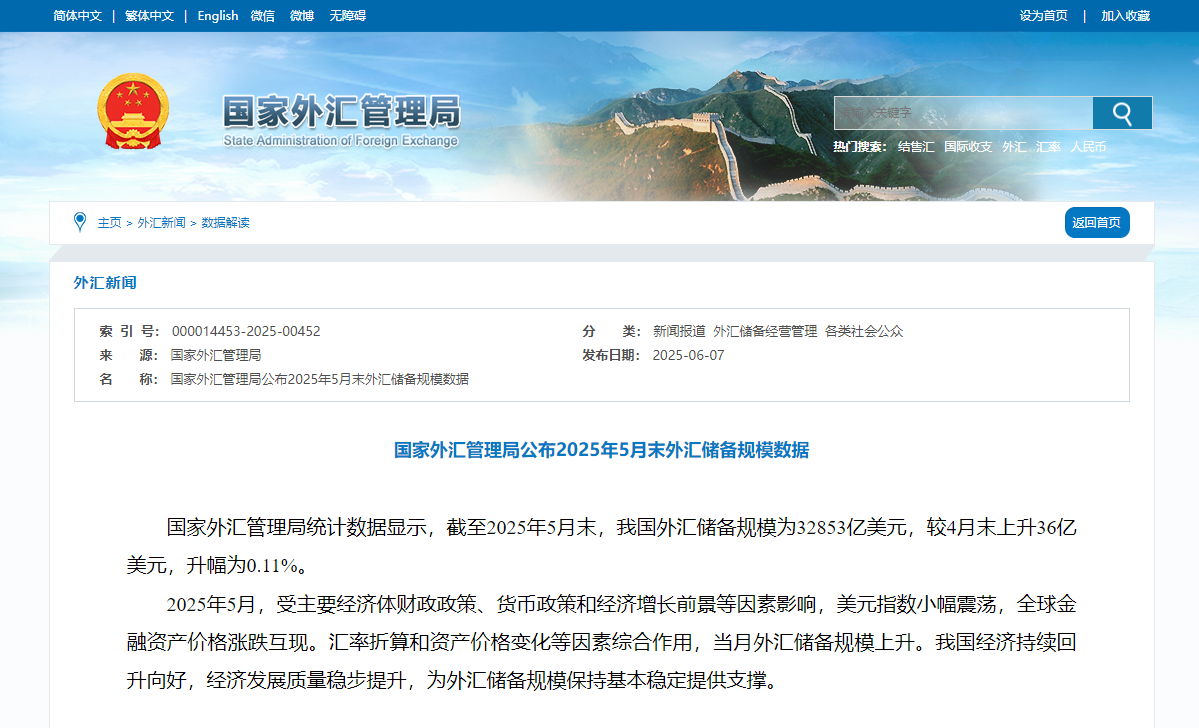
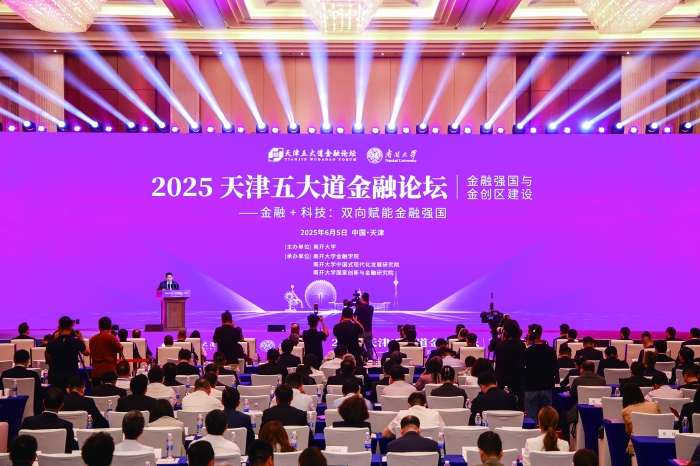
据国家外汇管理局网站6月7日消息,国家外汇管理局统计数据显示,截至2025年5月末,我国外汇储备规模为32853亿美元,较4月末上升36亿美元,升幅为 0.11%。 2025年5月,受主要经济体财政政策、货币政策和经济增长前景等因素影响,美元指数小幅震荡,全球金融资产价格涨跌互现。汇率折算和资产价格变化等 因素综合作用,当月外汇储备规模上升。我国经济持续回升向好,经济发展质量稳步提升,为外汇储备规模保持基本稳定提供支撑。 图片来源:国家外汇管理局网站 据中国证券报,国家外汇管理局副局长李斌6月5日在2025天津五大道金融论坛上表示,国家外汇局将不断促进科技企业跨境贸易和投资、融资便利化,扩大 外汇领域高水平制度型开放,以科技赋能推动外汇管理高质量发展。 李斌说,要坚持金融服务实体经济的根本宗旨,充分发挥金融在支持科技创新和新质生产力发展中的重要作用。金融是国民经济的血脉,实现跨时间、跨空 间的资源配置是金融的本质属性和基本功能,而科技创新活动恰恰具有未来性和不确定性特征,其发展需要金融为其提供资金支持、风险分担和激励机制安 排。 "随着人工智能技术的应用,智能化进一步增强,金融业发展将为科技创新提供广阔的应用 ...

金融管理部门发声“金融+科技”
Shang Hai Zheng Quan Bao· 2025-06-05 18:51
Core Insights - The forum focused on the dual empowerment of finance and technology to build a strong financial nation and innovation zones [2] - Key challenges in achieving effective interaction between technology and finance were highlighted, particularly the mismatch in financial supply and the varying risk characteristics of tech enterprises at different lifecycle stages [2][3] Financial Institutions and Support - The People's Bank of China emphasized the need to enhance bank credit services, particularly for small and medium-sized tech enterprises, to promote rapid growth in tech loans [3] - A proposal was made to establish a "technology board" in the bond market to support the issuance of technology innovation bonds by financial institutions, tech companies, and equity investment institutions [4] - The Financial Regulatory Bureau is pushing for the establishment of specialized tech finance departments within financial institutions and has set up 2,178 tech branches nationwide [5] Financial Products and Services - The knowledge property pledge loan balance in the banking sector has exceeded 300 billion yuan, reflecting a year-on-year growth of 33.7% [5] - Financial institutions are encouraged to develop specialized financial products that consider the innovation capabilities and intellectual property values of enterprises [5] Insurance and Risk Management - The Financial Regulatory Bureau is optimizing insurance services for tech enterprises, including risk guarantees for major national tech tasks and pilot programs for insurance compensation [6] Foreign Exchange Management - The State Administration of Foreign Exchange is leveraging technology to enhance trade and investment facilitation for tech enterprises, including the use of blockchain for cross-border financial services [7] - Digital technologies are being utilized to streamline processes and improve regulatory efficiency in foreign exchange management [8][10] - The integration of big data and AI is aimed at enhancing the identification and crackdown on foreign exchange violations [9]
国家外汇管理局副局长李斌:重视科技赋能外汇管理,以科技提升外汇管理与服务水平
2 1 Shi Ji Jing Ji Bao Dao· 2025-06-05 13:04
Core Insights - The National Foreign Exchange Administration (NFA) is focusing on the integration of finance and technology to promote high-quality development and address external risks [1][2][3] - The NFA is implementing policies to facilitate cross-border financing for high-tech and specialized enterprises, enhancing the efficiency of capital utilization [1][2] - The NFA is leveraging digital technologies, including blockchain and big data, to improve foreign exchange management and services, thereby supporting the real economy [2][3] Group 1: Policy Initiatives - The NFA is promoting cross-border financing facilitation policies to support high-tech and "specialized, refined, unique" enterprises [1] - The NFA has expanded trade facilitation policies to benefit more specialized enterprises, improving capital efficiency [1] - The NFA is conducting pilot programs in cities like Beijing, Shanghai, and Tianjin to enhance foreign investment in scientific research [1] Group 2: Technological Integration - The NFA has established a cross-border financial service platform using blockchain technology, assisting over 100,000 enterprises in obtaining more than $410 billion in financing [2] - The NFA is optimizing business processes between itself and banks through digital technology, enhancing regulatory effectiveness [2] - The NFA is utilizing big data and AI to strengthen monitoring capabilities and combat illegal foreign exchange activities [2][3] Group 3: Future Outlook - The NFA emphasizes the mutual promotion of technology and finance as essential for achieving high-level technological self-reliance and supporting the real economy [3] - The NFA aims to enhance cross-border trade and investment facilitation for technology enterprises while expanding high-level institutional openness in the foreign exchange sector [3] - The NFA is committed to improving administrative efficiency and effectiveness through technological empowerment in foreign exchange management [3]
哪些情形需要办理37号文登记?
Sou Hu Cai Jing· 2025-06-04 10:20
Core Points - Compliance is a critical principle that companies must strictly adhere to, especially in China where regulatory changes are frequent [1] - The 37th document, issued by the State Administration of Foreign Exchange (SAFE) in 2014, regulates the foreign exchange registration process for domestic residents investing through Special Purpose Vehicles (SPVs) [1] - The 37th document registration is a form of record management for specific types of enterprises or projects, primarily involving limited liability companies and partnerships [1] Applicable Groups - The applicable groups for the 37th document registration include "domestic residents," which consist of domestic institutions and individual residents holding valid Chinese identification [1] Situations Requiring Registration - New project investments, especially in construction or expansion, require 37th document registration to ensure compliance with national economic policies [3] - Changes to project content, such as scale or investment amount, necessitate registration to ensure legal compliance [3] - Certain industries, like energy and environmental sectors, may require additional registration due to their specific nature [3] - Applications for specific licenses or qualifications, such as construction permits, also require corresponding 37th document registration [3] - Significant changes in market policies or economic conditions may necessitate re-registration to align with new regulations [3] Registration Process - The preparation phase involves establishing a domestic equity company and planning a reasonable company structure, including the establishment of an SPV [4] - The establishment and registration phase includes registering an SPV abroad and completing the initial 37th document registration with necessary materials [4] - The operational phase involves using a Wholly Foreign-Owned Enterprise (WOFE) as a return investment vehicle and utilizing the SPV for overseas financing activities [4] - Changes to the SPV's basic information or shares require timely 37th document change registration, and cancellation must follow the proper sequence of deregistering the foreign company first [4]