
钟表

Search documents
西普尼(02583)9月19日至9月24日招股 预计9月29日上市
智通财经网· 2025-09-18 22:57
Group 1 - The company, Xipuni (02583), plans to conduct a global offering of 10.6 million shares from September 19 to September 24, 2025, with a price range of HKD 27.0 to HKD 29.6 per share [1] - The company specializes in the design, manufacturing, and branding of gold-cased and gold-bezel watches, primarily under its flagship brand "HIPINE" [1][2] - The company has established long-term stable supply relationships with several well-known domestic jewelry brands, including Laofengxiang, China Jewelry, and Zhou Dasheng, through its ODM manufacturing services [1][2] Group 2 - The product portfolio centers around the flagship brand HIPINE, which has been recognized as a "Shenzhen Famous Brand" since 2022 and ranked among the top 100 brands in Shenzhen in 2024 [2] - The company employs a direct transaction distribution strategy through a network of over 3,000 offline retail points, enhancing market penetration and brand awareness [2] - The company has begun overseas expansion in collaboration with a Malaysian partner and aims to extend its presence in the Middle East in the coming years [2] Group 3 - The estimated net proceeds from the global offering, assuming a median price of HKD 28.3 per share, is approximately HKD 255 million [3] - The company plans to allocate approximately 40.28% of the proceeds to enhance production capacity, 17.11% to establish a research and development center in Putian, and 33.24% to expand and optimize the sales network and brand influence [3] - About 9.37% of the proceeds will be used for working capital or general corporate purposes [3]
外媒:反击美加征39%关税,瑞士品牌Swatch推出美国关税限量版手表
Sou Hu Cai Jing· 2025-09-15 12:18
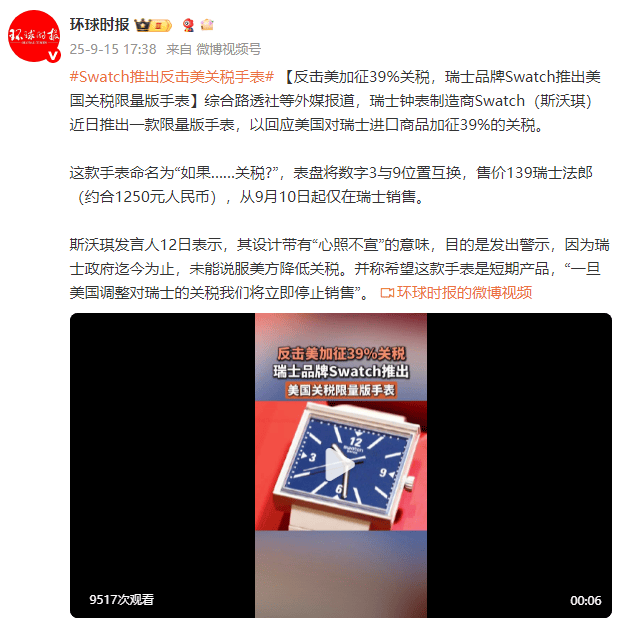
综合路透社等外媒报道,瑞士钟表制造商Swatch(斯沃琪)近日推出一款限量版手表,以回应美国对瑞 士进口商品加征39%的关税。 这款手表命名为"如果……关税?",表盘将数字3与9位置互换,售价139瑞士法郎(约合1250元人民 币),从9月10日起仅在瑞士销售。 斯沃琪发言人12日表示,其设计带有"心照不宣"的意味,目的是发出警示,因为瑞士政府迄今为止,未 能说服美方降低关税。并称希望这款手表是短期产品,"一旦美国调整对瑞士的关税我们将立即停止销 售"。 ...

斯沃琪:以时间为线,在传统空间创造新的世界
Di Yi Cai Jing· 2025-09-05 04:57
Core Insights - Swatch has received positive market feedback for its collaboration with Tate Gallery, particularly the Turner watch, which has resonated well in the Chinese market, leading to increased production to meet demand [1] - The brand recognizes the need for humility and localization in its marketing strategies to connect with the digital-native generation, particularly in China, where young consumers have a strong cultural identity [1] - Swatch's CEO Alain Villard acknowledged a recent mistake and emphasized the importance of cultural sensitivity and inclusivity in the brand's operations [4] Group 1 - Swatch's collaboration with artists and the establishment of the Swatch Peace Hotel Art Center in Shanghai aim to create a unique residency program for creative individuals, enhancing the brand's connection with contemporary art [6][7] - The Swatch Peace Hotel Art Center has become a cultural landmark, promoting diversity and innovation through its artist residency projects, which have yielded surprising results over the past 14 years [9] - The upcoming AI-DADA initiative will allow consumers to create personalized designs, merging technology and art, and reflecting the brand's commitment to innovation and consumer engagement [12][18] Group 2 - Swatch has positioned itself as a pioneer in embracing new technologies within the traditional watch industry, promoting the idea that watches can be a form of fashion rather than just luxury items [12] - The brand's focus on personalization aligns with current market trends, particularly among younger consumers in China, who seek to express their individuality through products [12][13] - Swatch's successful MoonSwatch series, launched in collaboration with Omega, has maintained popularity and is part of a broader strategy to attract consumers back to physical stores post-pandemic [14][16] Group 3 - Swatch's ongoing collaboration with global cultural institutions aims to democratize art access, transforming retail spaces into public aesthetic venues [16][18] - The brand plans to launch new collaborations with Chinese cultural institutions, with significant events anticipated in 2026, coinciding with the Year of the Horse [16] - Swatch's journey reflects a commitment to blending Eastern and Western cultures, creating new trends and experiences that resonate with the younger generation [18]

辽宁助力纳税信用标杆企业走稳成长之路
Sou Hu Cai Jing· 2025-08-29 12:18
Core Viewpoint - Compliance management is essential for the survival and development of enterprises, providing tangible "integrity dividends" through enhanced tax credit management and support from tax authorities [1][2]. Group 1: Compliance and Internal Control - Companies are shifting from a mindset of "I have to strive for A" to "I want to strive for A," enhancing their internal control mechanisms to drive compliance [2]. - Internal audits and proactive measures, such as maintaining a "risk list + responsibility list," help companies like Liaoning Yufeng Chemical Co., Ltd. avoid tax risks and credit losses [1][2]. - The integration of tax compliance requirements into all business processes, including contract reviews and tax filings, is crucial for preventing tax-related risks [3]. Group 2: External Support and Services - Tax authorities in Liaoning have established a green channel service model for A-level taxpayers, expediting processes like tax refunds and enhancing companies' market competitiveness [4][5]. - Continuous guidance and support from tax departments help companies navigate tax compliance, ensuring timely and accurate submissions [5][6]. Group 3: Benefits of Good Tax Credit - A-level tax credit status provides companies with easier access to tax services and financial products, reducing funding costs significantly [6]. - Companies with strong tax credit ratings, such as Liaoning Tianyi Industrial Co., Ltd., benefit from enhanced market reputation and opportunities, including successful bids in competitive procurement processes [6][7]. - The positive impact of tax credit on supplier relationships and market expansion is evident in companies like Liaoning Tianan Biopharmaceutical Co., Ltd., which enjoys stable raw material supply due to its good credit standing [6]. Group 4: Future Directions - Liaoning tax authorities will continue to focus on building a tax credit system, guiding more enterprises to transition from passive compliance to proactive management [7][8].

时计宝(02033)认购1000万美元KKR基金II的有限合伙权益
智通财经网· 2025-08-29 09:45
Group 1 - The company, 时计宝 (02033), has entered into a subscription agreement with KKR Associates Asia Tactical Credit GP SCSp to invest a total of $10 million in KKR Fund II [1] - KKR Fund II aims to build a diversified investment portfolio focusing on high-conviction, core, and event-driven sectors, targeting attractive and liquid credit opportunities in the Asia-Pacific region [1] - The fund primarily invests in various types of credit, including but not limited to high-yield bonds, term loans, self-originated loans, and structured products, employing a strict capital allocation strategy across regions and industries to provide attractive risk-adjusted returns [1] Group 2 - The company is primarily engaged in watch manufacturing, retail, and e-commerce in China [1] - The board believes that the subscription will allow the company to prudently and effectively allocate its idle funds, thereby enhancing overall capital returns [1] - The subscription also provides the company with investment opportunities in the Asia-Pacific market while reducing direct investment risks through participation in a professionally managed fund structure [1]

依波路(01856)发布中期业绩 股东应占亏损2175万港元 同比扩大307.53%
Zhi Tong Cai Jing· 2025-08-28 11:20
Core Viewpoint - The company reported a significant increase in losses for the interim period ending June 30, 2025, indicating financial challenges and a decline in revenue [1] Financial Performance - The group's revenue for the six months was HKD 38.06 million, representing a year-on-year decrease of 5.15% [1] - The loss attributable to shareholders was HKD 21.75 million, which is a substantial increase of 307.53% compared to the previous year [1] - The loss per share was reported at HKD 0.0604 [1]
依波路(01856.HK)中期拥有人应占亏损增加至约2180万港元
Ge Long Hui· 2025-08-28 11:18
Summary of Key Points Core Viewpoint - The company reported a decline in revenue and profitability for the first half of the fiscal year ending June 30, 2025, compared to the same period in the previous year, indicating significant financial challenges ahead [1]. Financial Performance - Revenue decreased from approximately 40.1 million HKD to about 38.0 million HKD [1] - Gross margin fell from approximately 48.5% in the first half of the 2024 fiscal year to around 16.5% in the first half of the 2025 fiscal year [1] - Gross profit dropped from approximately 19.4 million HKD to about 6.3 million HKD [1] - Loss attributable to owners increased from approximately 5.3 million HKD to about 21.8 million HKD [1]
依波路发布中期业绩 股东应占亏损2175万港元 同比扩大307.53%
Zhi Tong Cai Jing· 2025-08-28 11:18
Group 1 - The company reported a revenue of HKD 38.06 million for the six months ending June 30, 2025, representing a year-on-year decrease of 5.15% [1] - The loss attributable to shareholders was HKD 21.75 million, which expanded by 307.53% compared to the previous year [1] - The loss per share was HKD 0.0604 [1]
瑞士联邦议会联邦院议长:中瑞关系不断深化,两国贸易飞速发展
2 1 Shi Ji Jing Ji Bao Dao· 2025-08-28 10:01
Group 1 - The event celebrated the 75th anniversary of diplomatic relations between China and Switzerland, highlighting the deepening economic ties and the role of Swiss companies in China [1][2] - Switzerland has become China's sixth largest trading partner in Europe, while China is Switzerland's largest trading partner in Asia, with significant trade growth since the 2014 free trade agreement [1][2] - In the first half of 2025, the trade volume between China and Switzerland was $23.33 billion, with a notable decrease of 42.9%, while exports from China to Switzerland increased by 20.3% [1] Group 2 - The Swiss Federal Council President emphasized the transformation of trade relations over the past decades, noting that Swiss exports to China have nearly doubled since the free trade agreement [1] - The China-Switzerland Business Awards aim to recognize outstanding contributions to bilateral business cooperation, focusing on innovation, sustainability, digital transformation, and talent development [2] - The event also introduced a new Heritage Award for companies with significant Swiss branding that have operated in China for over 20 years [2][3]
飞亚达股价跌5.03%,鹏华基金旗下1只基金重仓,持有105.63万股浮亏损失97.18万元
Xin Lang Cai Jing· 2025-08-28 03:04
Group 1 - The stock of Feiyada Precision Technology Co., Ltd. dropped by 5.03% on August 28, closing at 17.38 yuan per share, with a trading volume of 150 million yuan and a turnover rate of 2.32%, resulting in a total market capitalization of 7.052 billion yuan [1] - The company, established on March 30, 1990, and listed on June 3, 1993, is primarily engaged in watch brand management and luxury watch retail [1] - The revenue composition of the company's main business includes: comprehensive luxury watch services at 75.36%, watch brand business at 17.66%, precision technology business at 3.39%, leasing business at 3.24%, and other at 0.35% [1] Group 2 - According to data from the top ten heavy stocks of funds, one fund under Penghua Fund holds a significant position in Feiyada [2] - The Penghua Innovation Power Mixed Fund (LOF) (501076) held 1.0563 million shares in the second quarter, accounting for 4.96% of the fund's net value, ranking as the fifth largest heavy stock [2] - The fund has experienced a floating loss of approximately 971,800 yuan today [2] Group 3 - The fund manager of Penghua Innovation Power Mixed Fund (LOF) (501076) is Li Yunyi, who has a cumulative tenure of 10 years and 40 days, with the fund's total asset size at 385 million yuan [3] - During Li Yunyi's tenure, the best fund return was 75.19%, while the worst return was -9.45% [3] - Co-manager Xiao Jiaqi has a cumulative tenure of 6 years and 114 days, with the fund's total asset size at 429 million yuan, achieving a best return of 85.02% and a worst return of -23.86% during the tenure [3]
