
啤酒

Search documents
重庆啤酒最新公告:拟使用不超过30亿元闲置自有资金进行委托理财
Sou Hu Cai Jing· 2025-11-12 11:13
Core Viewpoint - Chongqing Brewery (600132.SH) announced that its controlling subsidiary, Carlsberg Chongqing Brewery Co., Ltd., along with its subsidiaries, plans to invest up to RMB 3 billion in short-term bank wealth management products and money market funds using idle self-owned funds [1] Investment Details - The total investment amount is capped at RMB 3 billion [1] - The maximum investment limit for a single bank wealth management product and a single money market fund is set at RMB 500 million [1]

重庆啤酒:控股子公司拟使用不超30亿元闲置资金委托理财
Zheng Quan Shi Bao Wang· 2025-11-12 11:07
Core Viewpoint - Chongqing Brewery (600132) announced plans to invest up to 3 billion yuan of idle funds into short-term bank wealth management products and money market funds [1] Investment Details - The maximum investment limit for a single bank wealth management product and a single money market fund is set at 500 million yuan [1]
珠江啤酒:目前公司产品以国内销售为主,出口业务较少
Mei Ri Jing Ji Xin Wen· 2025-11-12 09:22
Core Viewpoint - The company primarily focuses on domestic sales with limited export activities [1] Group 1 - The company has confirmed that its products are mainly sold in the domestic market [1] - Export business is minimal, indicating a potential area for growth if the company decides to expand internationally [1] - The company is committed to improving its marketing network to enhance sales performance [1]

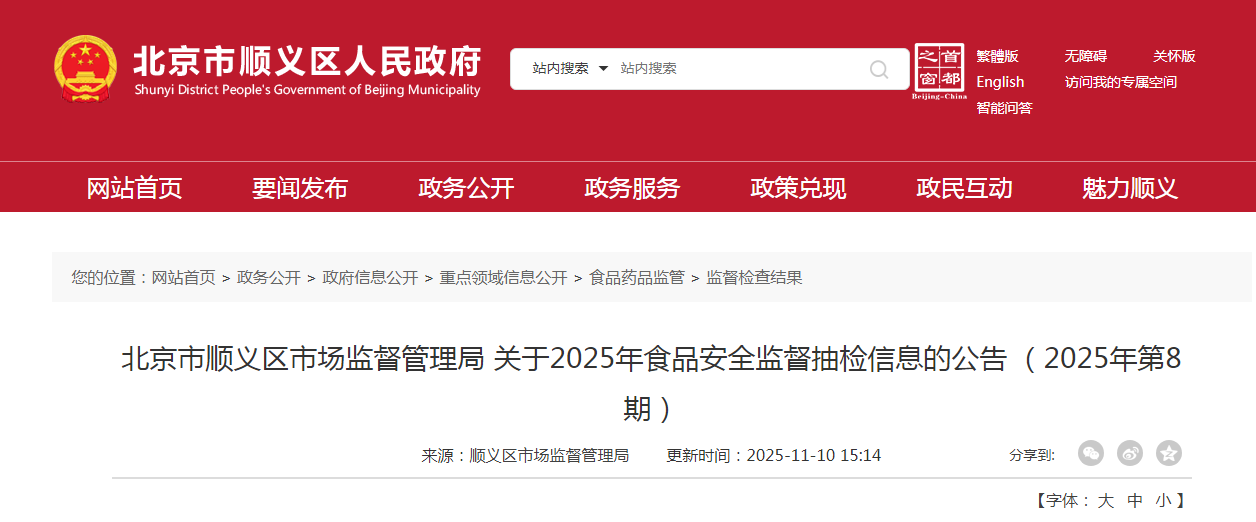
北京市顺义区市场监督管理局关于2025年食品安全监督抽检信息的公告 (2025年第8期)
Zhong Guo Zhi Liang Xin Wen Wang· 2025-11-12 08:46
Overall Situation - The announcement from the Shunyi District Market Supervision Administration indicates that all 279 samples from 15 categories of food products tested were compliant with national food safety standards [2]. Food Categories - Starch and starch products: 1 batch, all compliant [2] - Soy products: 3 batches, all compliant [2] - Convenience foods: 1 batch, all compliant [2] - Pastries: 41 batches, all compliant [2] - Alcoholic beverages: 38 batches, all compliant [2] - Frozen drinks: 9 batches, all compliant [2] - Grain processing products: 28 batches, all compliant [2] - Other foods: 36 batches, all compliant [2] - Meat products: 26 batches, all compliant [2] - Dairy products: 10 batches, all compliant [2] - Food additives: 11 batches, all compliant [2] - Sugar: 1 batch, all compliant [2] - Frozen foods: 19 batches, all compliant [2] - Seasonings: 41 batches, all compliant [2] - Beverages: 14 batches, all compliant [2]


大和:百威亚太第四季中国业务仍审慎 评级“买入”
Zhi Tong Cai Jing· 2025-11-12 08:23
Core Viewpoint - Daiwa's report indicates that Budweiser APAC (01876) is facing challenges in its China business for Q3 2025, with management maintaining a cautious outlook for Q4 sales despite lower channel inventory levels compared to industry averages [1] Group 1: Financial Performance - Budweiser APAC's revenue in China for Q3 decreased by 15.1% year-on-year, primarily due to a 11.4% drop in sales volume and a 4.1% decline in average selling price [1] - The decline in performance is attributed to weak dining channel sales, a deteriorating product mix, and discounts offered to certain distributors to enhance penetration in Chinese household channels [1] Group 2: Management Outlook - Management expects that inventory levels will not be quickly replenished, despite being lower than the industry average [1] - The cautious stance for Q4 sales performance reflects ongoing challenges in the market [1]

大和:百威亚太(01876)第四季中国业务仍审慎 评级“买入”
智通财经网· 2025-11-12 08:21
Core Viewpoint - Despite challenges in the third quarter of 2025 for Budweiser APAC's (01876) China operations, the management remains cautiously optimistic about sales performance in the fourth quarter [1] Group 1: Financial Performance - Budweiser APAC's revenue in China declined by 15.1% year-on-year in the third quarter, primarily due to a 11.4% drop in sales volume and a 4.1% decrease in average selling price [1] - The decline in performance is attributed to weak restaurant channels, a deteriorating product mix, and discounts offered to certain distributors to accelerate penetration into Chinese household channels [1] Group 2: Inventory and Sales Outlook - The management believes that channel inventory levels are even below the industry average, but they do not expect a rapid replenishment of inventory [1] - The management's cautious stance on fourth-quarter sales performance reflects ongoing challenges in the market [1]
银行扛大旗,科技凉凉!创业板3连阴,还有哪些投资机会?
Sou Hu Cai Jing· 2025-11-12 06:45
Group 1: Hong Kong Stock Market and A+H Listings - The total amount raised from IPOs in the Hong Kong stock market has exceeded HKD 190 billion this year, ranking first among global exchanges [1] - Notable A-share companies such as CATL, Hengrui Medicine, and Haitian Flavoring have successfully listed on the Hong Kong Stock Exchange, driving the A+H listing trend [1] - As of October 21, 11 A-share companies have listed in Hong Kong this year, with 78 more in the queue, indicating a strong interest in the A+H listing model [1] - Major companies with market capitalizations exceeding RMB 100 billion, such as Luxshare Precision and Sungrow Power, are among those queued for listing [1] - The surge in A-share companies listing in Hong Kong is attributed to policy support and a recovering capital market, suggesting a long-term improvement in the structure of the Hong Kong stock market [1] Group 2: Solid-State Battery Industry - The solid-state battery sector has seen significant breakthroughs, accelerating its industrial progress [3] - Related stocks in the A-share market have experienced substantial gains this year, with funds heavily invested in solid-state battery stocks achieving impressive returns [3] - Fund institutions believe that the solid-state battery industry's development is progressing faster than market expectations, with vast potential for market scale and investment value [3] Group 3: Pharmaceutical Industry Performance - In the pharmaceutical sector, CROs and CDMOs are expected to continue their positive performance from the first half of the year [4] - Other segments such as traditional Chinese medicine, medical devices, and raw pharmaceuticals are also showing promising performance [4] - Recent data disclosures from the ESMO conference and ongoing business development transactions indicate a continued positive outlook for innovative sectors within the industry [4] Group 4: Coal and Alcohol Industry Insights - The supply and demand dynamics for thermal coal are favorable, with prices expected to continue rising due to production and transportation constraints [6] - As the heating season approaches, demand from non-electric industries is increasing, leading to heightened market activity and bullish sentiment [6] - The alcohol industry is anticipated to face significant pressure in Q3, but a gradual recovery trend is expected, presenting bottom-fishing opportunities [6] - The beer sector is experiencing stable pre-holiday stocking, but competitive intensity and regulatory impacts may pressure Q3 performance [6] Group 5: Market Trends and Indices - The Shanghai Composite Index has experienced irrational declines, highlighting the management's control over market dynamics [11] - The market is expected to favor large-cap stocks in October, with growth stocks likely to continue performing well [11] - The ChiNext Index has shown a downward trend, indicating a retreat of small-cap funds amid concerns about market peaks [11] - Commodity prices, particularly precious metals, have seen significant increases, while industrial metals have also risen due to supply disruptions [11] - The bond market has reacted to interest rate cuts, with a slight decrease in U.S. Treasury yields and a corresponding rise in domestic bonds [11]


三季报数据填错!“西北啤酒王”紧急更正
Shen Zhen Shang Bao· 2025-11-12 04:27
Core Viewpoint - *ST Lanhuang has disclosed a correction announcement for its Q3 2025 report, revealing errors in the securities investment section due to staff mistakes [1] Group 1: Financial Performance - For the first three quarters of 2025, the company achieved total operating revenue of 219 million yuan, a year-on-year increase of 23.35% [5] - The net profit attributable to the parent company was 10.93 million yuan, marking a turnaround from losses [5] - The net cash flow from operating activities was -134 million yuan, compared to -220.59 million yuan in the same period last year [5] Group 2: Business Challenges - The company faces significant challenges in maintaining its listing status, as it was flagged for delisting risk due to negative profits and low revenue [3][4] - 2025 is identified as a critical year for the company to avoid delisting, as it must not repeat the negative financial performance of the previous year [5] Group 3: Operational Insights - The beer production volume for the first half of 2025 was 18,800 kiloliters, a decrease of 39.95% compared to the first half of 2024 [5] - Beer sales volume also declined by 37.66% to 19,600 kiloliters in the same period [5] - The company is investing 65 million yuan in a new juice beverage project in Chongqing to diversify its product offerings and improve financial performance [5] Group 4: Market Performance - As of November 12, the stock price of *ST Lanhuang increased by 1.49%, closing at 8.85 yuan per share, with a total market capitalization of 1.644 billion yuan [5]


国信证券:酒类渠道包袱加速去化 大众品品类表现分化
智通财经网· 2025-11-12 02:48
Group 1 - The core viewpoint of the report indicates that the liquor industry is entering a phase of adjustment, with a consensus on reduced growth rates for 2024 and an expansion of performance declines in Q3 reports [1][2] - The food and beverage sector is expected to show stable overall volume and structural differentiation by 2025, with Q1/Q2/Q3 revenues growing by +2.5%/+2.4%/-4.77% year-on-year, and net profits declining by +0.3%/-2.1%/-14.6% [1] - The report highlights that the macroeconomic policies in Q4 could catalyze stock price increases due to low expectations in the capital market and low institutional holdings [1] Group 2 - The liquor sector is recommended for investment, particularly companies with pricing power and regional influence, such as Luzhou Laojiao, Shanxi Fenjiu, and Kweichow Moutai, which are expected to achieve greater growth [2] - The consumer goods sector is anticipated to stabilize and improve in 2025, driven by inventory reduction and macroeconomic policy support, with leading companies in segments like sugar-free tea and functional beverages showing strong revenue growth [3] - The snack food segment reported a revenue increase of +22.4% and an 8.6% rise in profits in Q3 2025, despite rising costs from certain raw materials [3]

燕京啤酒涨2.01%,成交额4458.02万元,主力资金净流入328.53万元
Xin Lang Zheng Quan· 2025-11-12 01:45
Core Viewpoint - Yanjing Beer has shown a positive stock performance with a 2.01% increase on November 12, 2023, and a year-to-date stock price increase of 7.09% [1] Financial Performance - For the period from January to September 2025, Yanjing Beer reported a revenue of 13.433 billion yuan, representing a year-on-year growth of 4.57%, and a net profit attributable to shareholders of 1.770 billion yuan, which is a 37.45% increase compared to the previous year [2] Shareholder Information - As of November 10, 2023, the number of shareholders for Yanjing Beer decreased by 7.96% to 52,100, while the average circulating shares per person increased by 8.65% to 48,206 shares [2] Dividend Distribution - Yanjing Beer has cumulatively distributed 4.509 billion yuan in dividends since its A-share listing, with 1.043 billion yuan distributed over the past three years [2] Institutional Holdings - As of September 30, 2025, the second-largest circulating shareholder is Hong Kong Central Clearing Limited, holding 74.5763 million shares, a decrease of 21.0157 million shares from the previous period [2]