
医药工业等

Search documents
重点支持仪器仪表,中小微企业贷款贴息政策落地
仪器信息网· 2026-01-21 03:55
Core Viewpoint - The article discusses a joint policy issued by five government departments to support small and micro enterprises (SMEs) through a loan interest subsidy program, specifically targeting the instrumentation industry, with a subsidy rate of 1.5% per annum for eligible fixed asset loans, capped at 50 million yuan per enterprise and with a maximum term of 2 years [1][2]. Group 1: Policy Overview - The policy aims to stimulate investment and production expansion among SMEs, enhancing the vitality of the private economy and promoting high-quality economic development [2][3]. - The interest subsidy is specifically designed for SMEs in key sectors, including instrumentation, and aims to reduce financing costs and improve capital efficiency [2][4]. Group 2: Eligible Sectors and Loan Details - The policy supports various key industries, including new energy vehicles, industrial mother machines, pharmaceuticals, medical equipment, and instrumentation, among others [4]. - The subsidy applies to fixed asset loans issued from January 1, 2026, with a maximum subsidy of 1.5% per annum for a term not exceeding 2 years, and a loan cap of 50 million yuan per enterprise [4][5]. Group 3: Implementation Mechanism - The implementation involves a "total-to-total" model where financial departments coordinate directly with banks to streamline the process of subsidy allocation and management [6]. - Eligible enterprises can apply for loans directly from designated banks, which will assess applications based on market principles and legal frameworks [7]. Group 4: Monitoring and Reporting - Banks are required to report monthly on the execution of the policy, including loan issuance and subsidy usage, to ensure transparency and accountability [10][11]. - The Ministry of Finance will conduct joint inspections to monitor compliance and address any violations related to the subsidy program [11].


中小微企业贷款贴息来了!新能源、医药等重点领域产业链迎针对性支持
Sou Hu Cai Jing· 2026-01-20 11:45
Core Viewpoint - The Chinese government has introduced a loan interest subsidy policy for small and micro enterprises to lower their financing costs and stimulate investment, with a focus on specific industries and efficient management [1][4]. Group 1: Policy Details - The policy provides a 1.5% annual interest subsidy on eligible fixed asset loans for small and micro private enterprises, with a maximum loan size of 50 million yuan per entity [3]. - The subsidy applies to loans issued by banks starting from January 1, 2026, and is initially set for one year, with the possibility of extension [3]. - Targeted industries include advanced manufacturing, productive services, and emerging sectors such as artificial intelligence, with a focus on enhancing the national industrial chain [3][4]. Group 2: Expected Impact - The policy is expected to directly reduce the fixed asset investment costs for small and micro enterprises, thereby stimulating private investment and supporting industrial upgrades [4]. - Approximately 1 million small and micro enterprises are eligible, with an estimated subsidy scale of 150 billion to 180 billion yuan based on a 20% application rate [4]. - The policy is part of a broader initiative to support private investment and reduce financing barriers for enterprises [5]. Group 3: Future Adjustments - There is potential for future adjustments to the policy, including extending the implementation period, increasing loan limits, and expanding the scope to include working capital loans [6]. - A differentiated, tiered subsidy mechanism may be introduced to enhance funding efficiency, linking subsidies to employment and innovation outcomes [6].
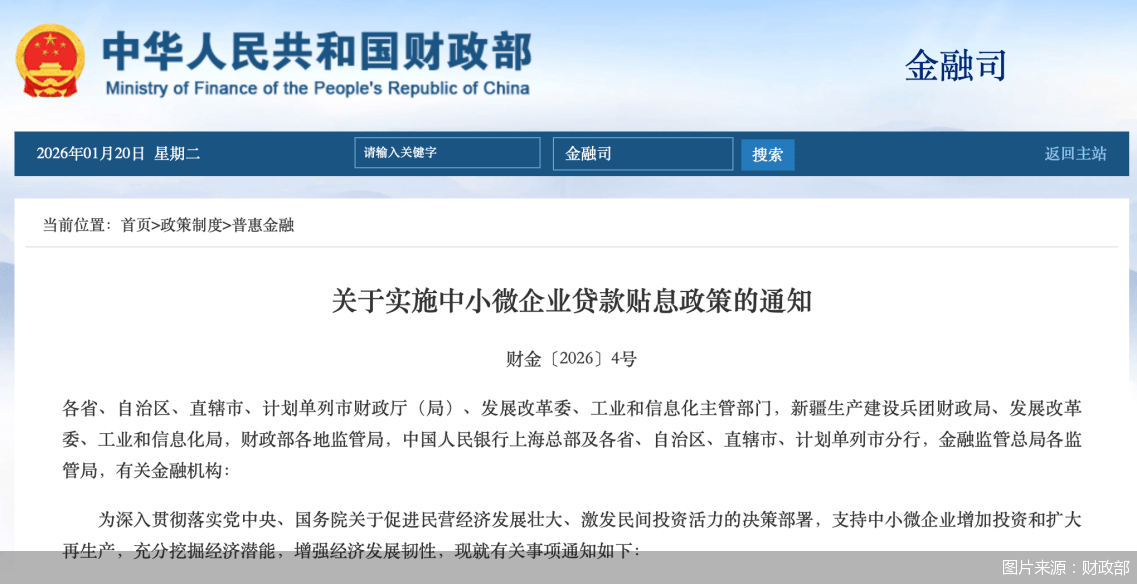
财政部、国家发改委、工信部、央行、金融监管总局,发布通知
券商中国· 2026-01-20 06:10
Core Viewpoint - The article discusses the implementation of a loan interest subsidy policy for small and micro enterprises in China, aimed at supporting their fixed asset loans and participation in new policy financial tools starting from January 1, 2026 [1]. Group 1: Policy Details - The subsidy will provide an annual interest rate reduction of 1.5 percentage points for a maximum of two years [1]. - The maximum loan amount eligible for the subsidy is 50 million yuan, with a maximum subsidy of 1.5 million yuan per enterprise [1]. - The policy is set to be implemented for one year initially, with the possibility of extension based on future evaluations [1]. Group 2: Supported Sectors - The policy targets key industrial chains and upstream and downstream industries, including sectors such as new energy vehicles, industrial mother machines, pharmaceuticals, medical equipment, basic and industrial software, civil aircraft, servers, mobile communication devices, new displays, instruments, industrial robots, rail transit equipment, marine engineering equipment, agricultural machinery, and emerging fields like artificial intelligence [1]. Group 3: Compliance and Oversight - The Ministry of Finance, in collaboration with the financial regulatory authority, will conduct joint inspections to ensure compliance, with penalties for enterprises found to be in serious violation of regulations [2]. - Banks involved in colluding with enterprises for improper subsidy operations will face strict accountability measures, including the potential cessation of related subsidy business [2].
华创医药投资观点&研究专题周周谈 · 第158期:海外脑机接口代表企业布局情况-20260110
Huachuang Securities· 2026-01-10 11:12
Investment Rating - The report maintains a "Recommended" rating for the medical device sector, particularly highlighting opportunities in innovative drugs and medical devices [49]. Core Insights - The report emphasizes a transition in the innovative drug sector from quantity to quality, suggesting a focus on differentiated products and internationalization by 2025 [11]. - In the medical device sector, there is a notable recovery in bidding volumes for imaging equipment, with a focus on companies like Mindray and United Imaging [11]. - The report identifies a significant growth potential in the orthopedic market due to aging demographics and increasing surgical penetration rates in China [43]. - The life sciences service sector is experiencing a demand recovery, driven by both domestic and international market needs, with a focus on the importance of mergers and acquisitions for growth [50]. Summary by Sections Market Review - The medical index rose by 7.70%, outperforming the CSI 300 index by 4.91 percentage points, ranking 5th among 30 sectors [7]. - The top-performing stocks included Baitai, Innovation Medical, and Sanbo Neuroscience, while the worst performers were Baihua Pharmaceutical and Jinhao Medical [7]. Overall Views and Investment Themes - Innovative drugs are expected to see a shift towards quality, with a focus on companies like BeiGene and Innovent [11]. - Medical devices are benefiting from a recovery in bidding for imaging equipment and a push for domestic substitutes in the market [11]. - The innovative chain (CXO + life sciences services) is anticipated to see a rebound in investment, with a focus on high-growth potential companies [11]. - The report highlights the potential for growth in the blood products sector, with an emphasis on companies like TianTan Biological and Boya Biological [11]. Specific Company Insights - Neuralink is positioned as a leader in the invasive brain-computer interface sector, with significant advancements in its technology and clinical trials [21]. - Synchron is noted for its endovascular brain-computer interface, which offers a safer solution for severely paralyzed patients [25]. - Paradromics focuses on high-bandwidth brain-computer interfaces, aiming to decode complex human intentions [32]. - CorTec is pioneering closed-loop brain-computer interfaces, providing real-time interaction between the brain and external devices [36]. - Precision Neuroscience is innovating minimally invasive implantation techniques for brain-computer interfaces [39]. - Blackrock Neurotech is recognized for its comprehensive solutions in the brain-computer interface field, aiding patients with sensory restoration and control [42].