
中小微企业贷款贴息

Search documents
财政部等五部门:实施中小微企业贷款贴息政策|营商环境周报
2 1 Shi Ji Jing Ji Bao Dao· 2026-01-27 09:06
Group 1: Support for SMEs - The Ministry of Finance and five other departments issued a notification to support small and micro enterprises in increasing investment and expanding production, providing a 1.5% annual interest subsidy for eligible enterprises [1] - The policy focuses on key industries such as new energy vehicles, industrial machinery, pharmaceuticals, medical equipment, and emerging fields like artificial intelligence [1] - The subsidy applies to fixed asset loans and new policy financial tools for eligible small and micro enterprises, with a maximum loan subsidy limit of 50 million yuan per enterprise [1] Group 2: National Emerging Industry Innovation Centers - The National Development and Reform Commission released a management method for national emerging industry innovation centers, aiming to promote the integration of technological and industrial innovation [3] - These centers will be led by industry leaders and will collaborate with upstream and downstream resources, focusing on key and frontier technologies [3] - The centers are expected to operate as independent corporate entities with diverse ownership structures and will utilize venture capital to support technology transfer and incubation [4] Group 3: Logistics and Supply Chain Development - The Ministry of Transport and seven other departments issued an action plan to enhance the service capacity of supply chains, aiming to create around 100 comprehensive logistics integrators by 2030 [5] - The plan encourages the establishment of a unified transportation market and supports the integration of logistics services across different modes of transport [5][6] - It promotes collaboration between logistics companies and upstream enterprises to improve efficiency and reduce costs in transportation logistics [6] Group 4: Regional Economic Development Initiatives - Yunnan Province introduced an action plan to develop its park economy, targeting a GDP contribution of over 25% from park areas by 2028 [7] - The plan emphasizes upgrading existing parks, focusing on manufacturing, and fostering high-tech enterprises [7][8] - It encourages collaboration among neighboring parks to enhance industrial development and resource sharing [8] Group 5: Business Environment Improvement - Jinshan District in Shanghai launched an action plan to enhance its business environment, focusing on high-quality development and streamlined project approval processes [9] - The plan includes personalized support for key projects and aims to reduce the administrative burden on enterprises [9] - It also emphasizes the creation of service brands tailored to specific industries, such as smart vehicles and advanced materials [9] Group 6: Innovative Approval Services - Beijing Economic-Technological Development Area introduced a new licensing model for the co-production of regular and health foods to reduce costs and improve efficiency [10][11] - The model allows for customized review processes and collaborative risk assessments to ensure compliance with safety standards [11] - This approach has led to significant cost savings and increased production capacity for participating companies, exemplifying a replicable model for other regions [11]
银泰证券鑫新闻:研究所日报
Yintai Securities· 2026-01-21 02:50
Fiscal Policy and Investment - The overall fiscal expenditure for 2026 will "only increase" and focus on key areas to "strengthen" support, with a special bond issuance of 500 billion yuan for private investment[2] - A 500 billion yuan guarantee plan for private investment aims to guide banks in providing loans to small and micro enterprises[2] - The implementation of interest subsidies for loans in 14 key industrial chains is expected to support social investment activities and consumption[2] Market Performance - On January 20, the Shanghai Composite Index fell by 0.01%, while the Shenzhen Component Index dropped by 0.97%, with total trading volume at 27,776.57 billion yuan, an increase of 693.09 billion yuan from the previous trading day[3] - Major global stock indices experienced declines, with the NASDAQ, S&P 500, and Dow Jones down by 2.39%, 2.06%, and 1.76% respectively[3] - The 10-year government bond yield in China decreased by 1.66 basis points to 1.8260%[3] Currency and Commodity Trends - The US dollar index closed at 98.5413, down by 0.51%, while the offshore RMB appreciated by 10 basis points to 6.9559[4] - Gold prices rose above $4,762 per ounce, and silver prices peaked at $95 per ounce amid increased global risk aversion[2] Sector Performance - The oil and petrochemical, construction materials, and real estate sectors led gains with increases of 1.74%, 1.71%, and 1.55% respectively[3] - The telecommunications, defense, and computer sectors saw declines of 3.23%, 2.87%, and 1.94% respectively[3]
财政金融协同促内需一揽子措施出台 加大个人消费贷款和服务业经营主体贷款贴息力度
Zhong Guo Zheng Quan Bao· 2026-01-20 23:16
Group 1 - The core viewpoint of the article is the introduction of a comprehensive set of fiscal and financial policies aimed at boosting domestic demand, particularly through enhancing consumer spending and supporting private investment [1][4]. Group 2 - The optimization of the "dual subsidy" policy includes increased subsidy amounts for personal consumers, with the subsidy per transaction rising from 500 yuan to 3000 yuan, and for service industry enterprises, the loan subsidy limit increased from 1 million yuan to 10 million yuan [2]. - The implementation period for the optimized personal consumption and service industry loan subsidy policies has been extended to the end of 2026, with potential for further extension based on effectiveness [2]. - The coverage of financial institutions has expanded from over 20 national institutions to more than 500, enhancing accessibility for consumers and businesses [3]. Group 3 - The policy to stimulate private investment includes a subsidy of 1.5% on fixed asset loans for equipment updates, applicable for a maximum of two years, and covers loans issued from 2026 onwards for technology innovation [4]. - The subsidy for small and micro enterprises includes a 1.5% annual subsidy on fixed asset loans, with a maximum loan size of 50 million yuan, and is set to be implemented for one year with the possibility of extension [5]. - A special guarantee plan for private investment has been established with a total quota of 500 billion yuan, aimed at enhancing government financing guarantees and directing financial resources to support quality goods and services [5].
中小微企业贷款贴息来了!新能源、医药等重点领域产业链迎针对性支持
Sou Hu Cai Jing· 2026-01-20 11:45
Core Viewpoint - The Chinese government has introduced a loan interest subsidy policy for small and micro enterprises to lower their financing costs and stimulate investment, with a focus on specific industries and efficient management [1][4]. Group 1: Policy Details - The policy provides a 1.5% annual interest subsidy on eligible fixed asset loans for small and micro private enterprises, with a maximum loan size of 50 million yuan per entity [3]. - The subsidy applies to loans issued by banks starting from January 1, 2026, and is initially set for one year, with the possibility of extension [3]. - Targeted industries include advanced manufacturing, productive services, and emerging sectors such as artificial intelligence, with a focus on enhancing the national industrial chain [3][4]. Group 2: Expected Impact - The policy is expected to directly reduce the fixed asset investment costs for small and micro enterprises, thereby stimulating private investment and supporting industrial upgrades [4]. - Approximately 1 million small and micro enterprises are eligible, with an estimated subsidy scale of 150 billion to 180 billion yuan based on a 20% application rate [4]. - The policy is part of a broader initiative to support private investment and reduce financing barriers for enterprises [5]. Group 3: Future Adjustments - There is potential for future adjustments to the policy, including extending the implementation period, increasing loan limits, and expanding the scope to include working capital loans [6]. - A differentiated, tiered subsidy mechanism may be introduced to enhance funding efficiency, linking subsidies to employment and innovation outcomes [6].

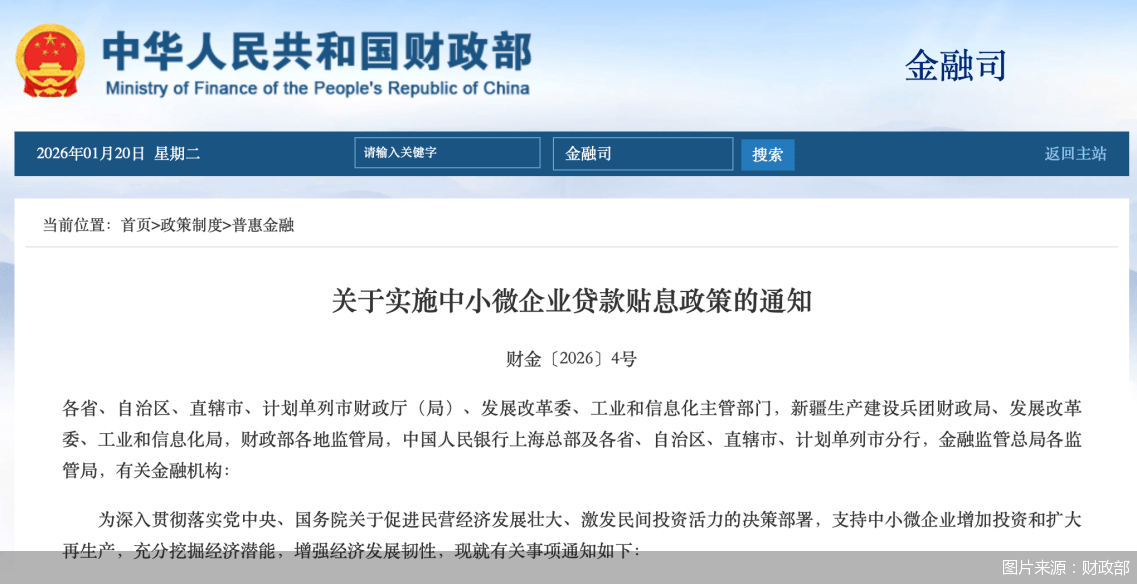
财政部:新设中小微企业贷款贴息,可为企业提供贷款总额的1.5个百分点贴息
Sou Hu Cai Jing· 2026-01-20 08:30
Core Viewpoint - The Chinese government is implementing a series of policies aimed at stimulating private investment to promote high-quality economic and social development, with a focus on reducing financing costs and easing access to financing for private enterprises [3][4]. Group 1: Policies to Stimulate Private Investment - The new policies include a variety of support measures such as credit, interest subsidies, guarantees, and compensations, which are designed to lower financing costs for private enterprises [3]. - A specific interest subsidy of 1.5 percentage points is introduced for loans to small and micro enterprises, significantly expanding the scope and purpose of supported loans [3]. - For example, a manufacturer of agricultural machinery could save 1.5 million yuan in interest over two years on a 50 million yuan loan, enhancing its ability to invest [3]. Group 2: Reducing Financing Barriers - The government aims to lower financing barriers through special guarantees and risk-sharing mechanisms, making it easier for private enterprises to secure funding [4]. - A new special guarantee plan increases the credit guarantee limit from 10 million yuan to 20 million yuan, facilitating access to loans for businesses with lower credit ratings [4]. - The risk-sharing ratio for the national financing guarantee fund will increase from 20% to a maximum of 40%, allowing for higher government-backed guarantees on loans [4].
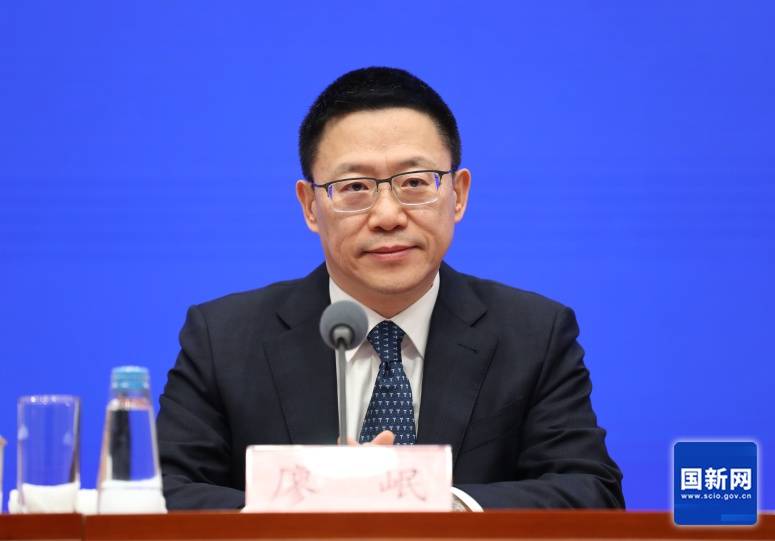
一揽子支持政策缓解中小微企业“融资难融资贵”
Sou Hu Cai Jing· 2026-01-20 06:52
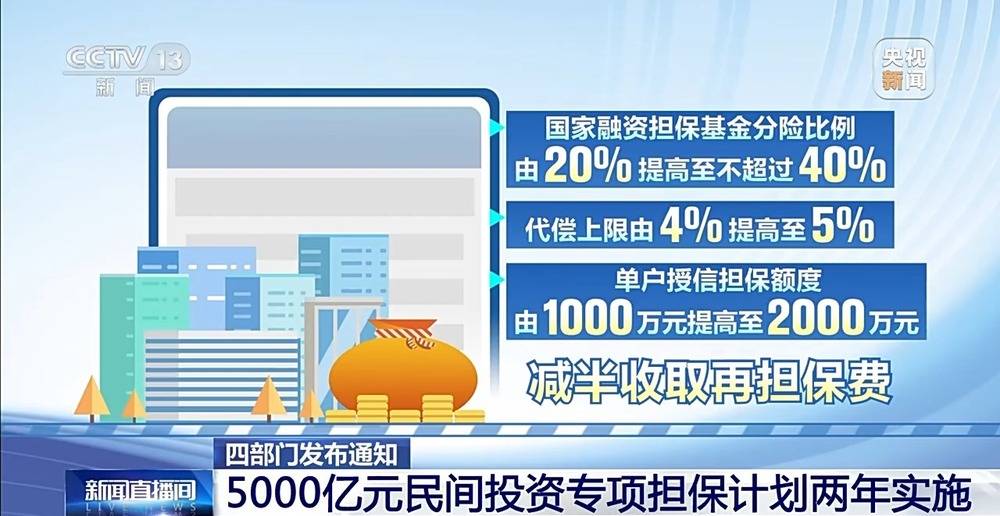
Core Viewpoint - The Ministry of Finance and other departments have announced a special guarantee plan for private investment, which will provide 500 billion yuan in funding support to the market [1][2]. Group 1: Special Guarantee Plan - The special guarantee plan will be implemented over two years, aiming to guide banks to increase lending of 500 billion yuan for fixed asset loans to small and micro enterprises [2]. - The risk-sharing ratio of the National Financing Guarantee Fund will be increased from 20% to a maximum of 40%, and the compensation cap will rise from 4% to 5% [2][8]. - The single credit guarantee limit will be raised from 10 million yuan to 20 million yuan, and the re-guarantee fee will be halved [2]. Group 2: Impact on Private Investment - The investment guarantee plan is expected to leverage a total of nearly 900 billion yuan in private investment through a three-tier government financing guarantee mechanism [4]. - The plan is crucial for stabilizing and promoting private investment in the current economic climate [4]. Group 3: Targeted Support Areas - The policy will support small and micro enterprises engaged in purchasing equipment and raw materials, technological transformation, and various production and operational activities [5]. - It will also cover sectors such as catering, health, elderly care, childcare, culture, entertainment, tourism, and green and digital industries [5]. Group 4: Loan Interest Subsidy Policy - Starting this year, a loan interest subsidy policy for small and micro enterprises will be implemented, focusing on key industries such as new energy vehicles, medical equipment, and high-end manufacturing [9][11]. - The subsidy will provide a 1.5 percentage point interest reduction for eligible fixed asset loans, with a maximum loan amount of 50 million yuan and a cap of 150,000 yuan per borrower [13]. Group 5: Coordination of Fiscal and Financial Policies - Experts believe that these policies are part of a coordinated effort between fiscal and financial sectors to alleviate the challenges of financing for market entities [14]. - The special guarantee plan is seen as an innovative mechanism that will contribute to increasing investment, creating jobs, and stabilizing economic growth [16].
合条件的中小微企业贷款贴息1.5个百分点
Di Yi Cai Jing· 2026-01-20 06:36
Core Viewpoint - The Chinese government is implementing a loan interest subsidy policy to support small and micro enterprises in increasing investment and expanding production, aiming to fully tap into economic potential [1] Group 1: Policy Details - The loan interest subsidy policy is applicable to small and micro private enterprises involved in fixed asset loans for key industry chains and their upstream and downstream industries [2] - The policy covers four major areas: new energy vehicles, industrial mother machines, pharmaceuticals, medical equipment, software, civil aircraft, servers, mobile communication devices, new displays, industrial robots, rail transit equipment, marine engineering equipment, agricultural machinery, and emerging fields like artificial intelligence [2] - The subsidy standard is set at an annualized rate of 1.5% for eligible loans issued by banks starting from January 1, 2026, with a maximum loan size of 50 million yuan per enterprise [2] Group 2: Implementation and Administration - The policy is initially set to last for one year, with the possibility of extension based on circumstances, and loans cannot benefit from multiple subsidy policies simultaneously [3] - The policy will be administered by 21 national banks, including the Development Bank of China, as well as city commercial banks and foreign banks with a financial regulatory rating of 3A or above [3] - Enterprises must apply for loans through the designated banks, providing necessary documentation, while banks will approve loans based on market principles and pay the subsidy to enterprises after loan issuance [3]
五部门:联合实施中小微企业贷款贴息政策
Zhong Guo Xin Wen Wang· 2026-01-20 05:45
Core Viewpoint - The Chinese government has announced a loan interest subsidy policy aimed at supporting small and micro enterprises, particularly in key industries, to stimulate investment and enhance economic resilience [1][2]. Policy Content - **Eligible Entities**: The policy applies to all small and micro private enterprises involved in key industry chains and their upstream and downstream sectors, including those recommended by financing coordination mechanisms or shared by the Ministry of Industry and Information Technology [2]. - **Targeted Sectors**: The policy supports sectors such as new energy vehicles, industrial mother machines, pharmaceuticals, medical equipment, software, civil aircraft, and various service industries including logistics and environmental services [3]. - **Subsidy Standards**: Starting from January 1, 2026, eligible loans will receive a subsidy of 1.5% per annum for a maximum of two years, with a cap of 50 million yuan per loan. The policy is initially set for one year, with potential extensions [3]. Implementation Mechanism - **Participating Banks**: The policy involves 21 national banks and certain city commercial banks with a financial regulatory rating of 3A or above [4]. - **Operational Process**: Enterprises can apply for loans directly to banks, which will approve based on market principles. The subsidy funds will be allocated through a "pre-allocation + settlement" method [6][7]. - **Funding Settlement**: Banks must report their loan issuance monthly, and the Ministry of Finance will oversee the settlement of subsidy funds [7][9]. Organizational Implementation - **Information Reporting**: Banks are required to report on the execution of the policy monthly, including loan issuance and subsidy usage [9]. - **Collaboration**: The Ministry of Finance will lead the implementation, ensuring budget management and supervision of subsidy usage, while other ministries will provide guidance on loan fund allocation [9][10]. - **Supervision and Management**: The Ministry of Finance and financial regulatory authorities will conduct joint inspections to ensure compliance and prevent misuse of funds [10].
财政部等:实施中小微企业贷款贴息政策
Xin Lang Cai Jing· 2026-01-20 04:33
Core Viewpoint - The Ministry of Finance and other departments have announced a loan interest subsidy policy for small and micro enterprises, effective from January 1, 2026, aimed at supporting fixed asset loans and new policy financial instruments for eligible private enterprises [1] Group 1: Policy Details - The central government will provide an annual interest subsidy of 1.5 percentage points on the principal of eligible loans, with a maximum loan size of 50 million yuan per enterprise [1] - The subsidy is applicable for loans with a term not exceeding 2 years, and the policy is initially set to last for one year, with the possibility of extension based on future evaluations [1] - Loans that have already benefited from other central government interest subsidy policies are not eligible for this new subsidy [1]
五部门:实施中小微企业贷款贴息政策
Xin Lang Cai Jing· 2026-01-20 04:32
Core Viewpoint - The Ministry of Finance has announced a loan interest subsidy policy for small and micro enterprises, providing a 1.5% annual subsidy on eligible fixed asset loans and new policy financial instruments, with a maximum subsidy loan limit of 50 million yuan per enterprise, effective from January 1, 2026, for a preliminary period of one year [1][3]. Group 1: Policy Content - The policy targets small and micro private enterprises involved in key industry chains and their upstream and downstream sectors, including but not limited to those recommended by financing coordination mechanisms or shared by the Ministry of Industry and Information Technology [2]. - The supported sectors include new energy vehicles, industrial mother machines, pharmaceuticals, medical equipment, software, civil aircraft, servers, mobile communication devices, new displays, industrial robots, and various service industries such as technology, logistics, and environmental protection [3]. Group 2: Implementation Mechanism - The policy will be executed through a "total-to-total" model, where the Ministry of Finance will coordinate with major banks, including the Development Bank and several commercial banks, to streamline the process of subsidy fund allocation and management [5]. - Eligible enterprises can apply for loans directly from the designated banks, which will make independent decisions based on market principles [6]. Group 3: Funding Process - The subsidy funds will be allocated using a "pre-allocation + settlement" method, with banks required to submit annual subsidy fund applications by February 5, 2026, and provincial finance departments to report these applications to the Ministry of Finance by February 28, 2026 [7]. - Monthly reports on loan issuance and subsidy usage will be submitted by banks to the relevant finance departments, ensuring transparency and accountability in the use of funds [9]. Group 4: Supervision and Management - The Ministry of Finance will oversee the implementation of the policy, ensuring budget management and conducting audits on the use of subsidy funds [10]. - Banks are required to monitor the flow of loan funds to prevent misuse, and any violations will result in penalties, including the recovery of subsidy funds [10].