协作机器人

Search documents
永安期货晨会纪要-20260320
Xin Yong An Guo Ji Zheng Quan· 2026-03-20 05:37
Group 1: Market Overview - The A-share market experienced a significant decline, with the Shanghai Composite Index dropping by 1.39% to 4006.55 points, and the Shenzhen Component Index falling by 2.02% [1] - The Hang Seng Index also saw a sharp drop of 2.02%, closing at 25500.58 points, while the Hang Seng Technology Index decreased by 2.19% [1][5] - In the external market, major European indices closed lower, and the US indices also saw slight declines, with the Dow Jones down by 0.44% to 46021.43 points [1][5] Group 2: Central Bank Actions - The European Central Bank (ECB) maintained interest rates, with President Christine Lagarde stating that the bank is prepared to respond to the risks posed by the ongoing war [8][14] - The ECB warned that the conflict in the Middle East is accelerating inflation and slowing economic growth, indicating a commitment to stabilize inflation around the 2% target [14] - The ECB's projections suggest that inflation could peak at 6.3% in 2027 under severe scenarios related to the conflict [14] Group 3: Geopolitical Developments - Israeli Prime Minister Benjamin Netanyahu announced that Israel would no longer target Iranian energy facilities and would assist the US in attempting to reopen the Strait of Hormuz [8][14] - Netanyahu claimed that Iran is no longer capable of uranium enrichment or missile manufacturing, suggesting that the war would end sooner than expected [8][14] Group 4: Economic Indicators - China's fiscal expenditure in January-February recorded the fastest growth since 2022, with a year-on-year increase of 6%, while total fiscal revenue fell by 1.4%, leading to a deficit exceeding 1 trillion yuan [8][14] - The increase in fiscal spending is seen as a measure to support the economy amid rising external uncertainties [14]

马年第四日:亚太市场分化,科技新势力崛起待A股接棒
Sou Hu Cai Jing· 2026-02-20 09:50
Group 1: Hong Kong Market Performance - The Hong Kong stock market opened with a decline, with the Hang Seng Index falling by 1.10% and the Hang Seng Tech Index dropping by 2.91% [2] - Internet technology stocks faced significant pressure, with Baidu and Bilibili both down over 5%, and Alibaba falling more than 3% [2] - Despite the overall decline, there was a notable shift in investment, with funds reallocating towards emerging sectors such as AI and robotics, as evidenced by the significant gains of companies like Zhiyuan (up over 42%) and Yuejiang (up over 21%) [2][3] Group 2: Japan and South Korea Market Divergence - The Nikkei 225 index in Japan decreased by 1.12%, reflecting a cautious sentiment among investors due to recent fluctuations in the yen, which have pressured export-oriented companies [4] - In contrast, the South Korean Composite Index rose by 2.31%, driven by positive sentiment in the semiconductor sector, which is benefiting from the AI wave [4] Group 3: European Market Trends - European stocks opened higher, continuing the previous day's rebound, with the FTSE 100 up by 0.35%, DAX up by 0.18%, and CAC 40 up by 0.51% [6] - This indicates that the recent pullback in US markets did not lead to a trend decline, and the market remains in a state of high-level fluctuation and sector rotation [6] Group 4: Emerging Investment Themes - The significant gains of Zhiyuan and Yuejiang highlight a growing interest in AI and robotics, which are becoming the new focal points for investment as traditional sectors show limited growth potential [7][10] - The shift in funds from internet giants to hard technology sectors suggests a search for more promising growth opportunities in the market [7][10] Group 5: Anticipation for A-Share Market - The upcoming opening of the A-share market is highly anticipated, with the performance of the Hong Kong market potentially influencing investor sentiment [8] - The focus will be on whether the trend of reallocating funds towards hard technology will continue in the A-share market [8][11]


越疆启动回A计划 2025年上半年仍在亏损 销售费用约是研发费用两倍
Xin Lang Cai Jing· 2026-01-05 09:14
Group 1 - The company, Shenzhen Yujiang Technology Co., Ltd. (referred to as "Yujiang"), announced its plan to launch an initial public offering (IPO) of RMB ordinary shares (A-shares) and list on the Shenzhen Stock Exchange, marking the start of its "H+A" dual capital platform strategy [1][3] - The purpose of returning to A-shares is to promote business development, enhance overall competitiveness, and ensure the achievement of operational goals and long-term development strategies [1][3] - Yujiang holds a 13.0% market share in the global collaborative robot industry, ranking second globally and first in China, with a cumulative shipment of over 72,000 units, serving more than 80 Fortune 500 companies [1][3] Group 2 - Despite its market position, Yujiang's performance post-Hong Kong listing has been underwhelming, remaining in a loss state as of the first half of 2025 [1][3] - In 2024, the company reported a revenue of RMB 374 million, a year-on-year increase of 30.3%, but still incurred a net loss of RMB 95.36 million, only narrowing by 7.6% year-on-year [1][3] - For the first half of 2025, revenue grew by 27.08% to RMB 153 million, while the net loss narrowed to RMB 40.87 million [1][3] Group 3 - The company's operating cash flow has been consistently negative, with cash and cash equivalents amounting to RMB 164 million as of the first half of 2025, while sales expenses reached RMB 82.21 million, significantly exceeding research and development expenses of RMB 40.89 million [4] - Historical data shows that sales expenses for 2023 and 2024 were RMB 127 million and RMB 138 million, respectively, while research and development expenses were only RMB 70.53 million and RMB 71.79 million, about half of the sales expenses [4] - The decision to return to A-shares coincides with a financing boom in the robotics industry and rapid growth in the domestic collaborative robot market [4] - According to the High-tech Robot Industry Research Institute, the sales volume of collaborative robots in China is expected to reach 50,300 units in 2025, a year-on-year increase of 25.75%, with projections of nearly 124,000 units by 2028 and a market size exceeding RMB 5 billion [4]
东杰智能重组背后:规避借壳上市?先控股后资产注入 遨博智能估值是否提前透支
Xin Lang Cai Jing· 2025-12-26 08:17
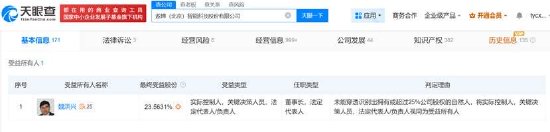
Core Viewpoint - The transaction involving Aobo Intelligent's injection into Dongjie Intelligent raises questions about whether it is a strategy to circumvent the shell listing red line, as the controlling party adopts a strategy of first gaining control and then injecting assets [1][2]. Group 1: Transaction Details - Dongjie Intelligent announced a major restructuring involving the issuance of shares and cash to acquire the controlling stake in Aobo Intelligent, with the transaction expected to be disclosed within ten trading days [1][14]. - The actual controller of Dongjie Intelligent, Han Yongguang, holds only 7.1681% of Aobo Intelligent, making this transaction an associated transaction [2][15]. - The transfer of 99% of the fund shares from the controlling shareholder to Han Yongguang is valued at 1.62 billion RMB, which will not change the number of shares held by the controlling shareholder [2][15]. Group 2: Market Context - Aobo Intelligent, founded in 2015, is a leading provider of collaborative robots, achieving over 1 billion RMB in sales for 2024 and a valuation of 7.35 billion RMB after its C round financing [3][18]. - Dongjie Intelligent's revenue for 2024 is projected to be 800 million RMB, indicating that the injection of Aobo Intelligent could trigger shell listing standards [5][18]. - The stock price of Dongjie Intelligent has shown significant movement prior to the change in control, with a reported annual increase of over 200% and a current market capitalization of 10.3 billion RMB [11][22]. Group 3: Industry Competition - Aobo Intelligent is recognized as one of the "three giants" in the domestic collaborative robot sector, alongside Yujian Technology and Jieke Robotics, with Yujian Technology holding a 13% global market share [6][20]. - Jieke Robotics recently faced a setback with its IPO application being withdrawn, raising concerns about the potential success of Aobo Intelligent's similar transaction [25][26]. - Aobo Intelligent's sales volume for 2024 is projected at only 30,000 units, significantly lower than its competitors, which may impact its market positioning [20].

每6个人就有一个“老板”,广东做对了什么?
2 1 Shi Ji Jing Ji Bao Dao· 2025-12-25 13:12
Group 1 - Guangdong has registered over 20 million business entities as of September 3, 2024, marking a 5% increase from the end of 2023, maintaining the highest total in the country [2] - The province's entrepreneurial landscape is diverse, with a significant presence of private enterprises, individual businesses, and foreign companies, contributing to a robust economic foundation [3][4] - The number of foreign-invested enterprises in Guangdong reached 230,000 by the end of August 2024, reflecting a net increase of 15,000, or 6.97% [4] Group 2 - The majority of new businesses are focusing on emerging industries, with nearly 40% of new enterprises established in 2024 belonging to the "Four New Economies" such as artificial intelligence and platform economy [4] - Guangdong's industrial ecosystem is characterized by collaboration among various business sizes and types, supported by nine trillion-yuan industrial clusters [5] - The advanced manufacturing and high-tech manufacturing sectors in Guangdong saw value-added growth rates of 5.4% and 6.4%, respectively, significantly outpacing the provincial average [5] Group 3 - Guangdong has nurtured over 2,000 "specialized, refined, distinctive, and innovative" small giant enterprises and more than 30,000 specialized small and medium-sized enterprises [7] - The province's support for innovation is evident in its policies aimed at fostering the growth of startups and established companies alike, ensuring a healthy economic ecosystem [6][9] - Companies like Tuosida Technology and Xiaoma Zhixing exemplify the successful transition from traditional manufacturing to intelligent manufacturing, benefiting from Guangdong's comprehensive industrial support [9][10]
节卡股份终止科创板IPO:两年上市路戛然而止,协作机器人赛道再起波澜
Xin Lang Cai Jing· 2025-12-22 09:26
Core Viewpoint - Jeka Robotics Co., Ltd. has voluntarily withdrawn its IPO application after more than two years of waiting, marking the end of its capital journey [1][5]. Company Summary - The IPO journey of Jeka Robotics began on May 9, 2023, when its application was accepted by the Shanghai Stock Exchange. The company faced multiple inquiries and had its review suspended several times due to expired financial data and regulatory concerns regarding its R&D independence and reliance on external sourcing for core components [1][6]. - On August 1, 2025, the company was set to face a critical review, but the Shanghai Stock Exchange announced a last-minute cancellation of the review, making it the first IPO project of the year to be halted before the meeting [1][6]. Financial Performance - Jeka Robotics experienced significant fluctuations in its financial performance. From 2022 to 2024, the company's revenue grew from 281 million to 400 million yuan, while net profit dropped from 5.74 million to -28.55 million yuan, with a slight recovery to 6.23 million yuan in 2024. In the first half of 2025, revenue was 174 million yuan, a year-on-year increase of 4.29%, but the net profit was a loss of -19.97 million yuan [2][6]. - The company attributed the first-quarter loss of over 20 million yuan to seasonal sales downturn, stating that it achieved breakeven in the second quarter [2][6]. Industry Context - The financial pressures faced by Jeka Robotics reflect structural challenges within the collaborative robotics industry. A report indicated that in 2024, domestic manufacturers would face intensified price competition, with average prices dropping by 26% year-on-year [7]. - Additionally, regulatory changes are raising industry standards. In November 2025, a spokesperson from the National Development and Reform Commission warned about the risks of high redundancy and compressed R&D space in the humanoid robotics sector, while the Ministry of Industry and Information Technology is advancing unified technical standards [7]. IPO Outlook - Historical data suggests that companies whose IPO applications are canceled have a low probability of successfully going public in the future. Despite this setback, Jeka Robotics maintains its vision of being a "global leader in general-purpose intelligent robotics," indicating that this capital market setback may be a tactical adjustment in its long journey [3][7].

深圳何以盛产“少年上市公司”?
Xin Lang Cai Jing· 2025-12-09 13:41
Core Insights - Shenzhen has successfully listed 121 companies within ten years of their establishment, outperforming the national average, highlighting the region's favorable business environment [1][9] - The article emphasizes Shenzhen's innovative policies and supportive ecosystem that facilitate startups in overcoming challenges and achieving growth [1][9] Group 1: Young Listed Companies - Shenzhen has produced a significant number of "young listed companies," with 121 firms achieving IPO status in under ten years, including notable names like BYD and Dazong Laser [1][3][10] - The majority of these companies are leaders in niche markets, with many being the first in their respective industries, such as the "first stock" in various sectors [3][11] Group 2: Innovation and Resource Transformation - The success of these young companies is attributed to Shenzhen's "20+8" industrial cluster, which focuses on strategic emerging industries and future industries [3][12] - Shenzhen has cultivated a large group of innovative enterprises, resulting in a robust pipeline of resources for public listings, with 347 new specialized "little giant" companies added this year [3][12] Group 3: Government Support and Policies - The Shenzhen government has implemented various supportive policies to encourage company listings, creating a nurturing environment for startups and growth-stage companies [5][13] - The city has established a comprehensive system to support businesses at different stages, from incubation to public listing, with a focus on private enterprises [5][13] Group 4: Financial Ecosystem - Shenzhen's financial ecosystem is characterized by a multi-layered and specialized capital structure, with over 1.5 trillion yuan in private equity and venture capital funds [7][15] - The city hosts regular events like "Shenzhen Venture Capital Day" to connect innovative companies with global capital, facilitating significant funding agreements [7][15] Group 5: Capital and Investment Strategies - The local government has established investment funds that have mobilized nearly 500 billion yuan, contributing to the listing of around 600 companies [8][16] - Shenzhen aims to create a "double ten thousand" framework by 2026, targeting a substantial increase in the number of investment funds and promoting early-stage investments in technology [8][16]




东杰智能易主,未来将进军具身智能赛道
3 6 Ke· 2025-08-29 02:48
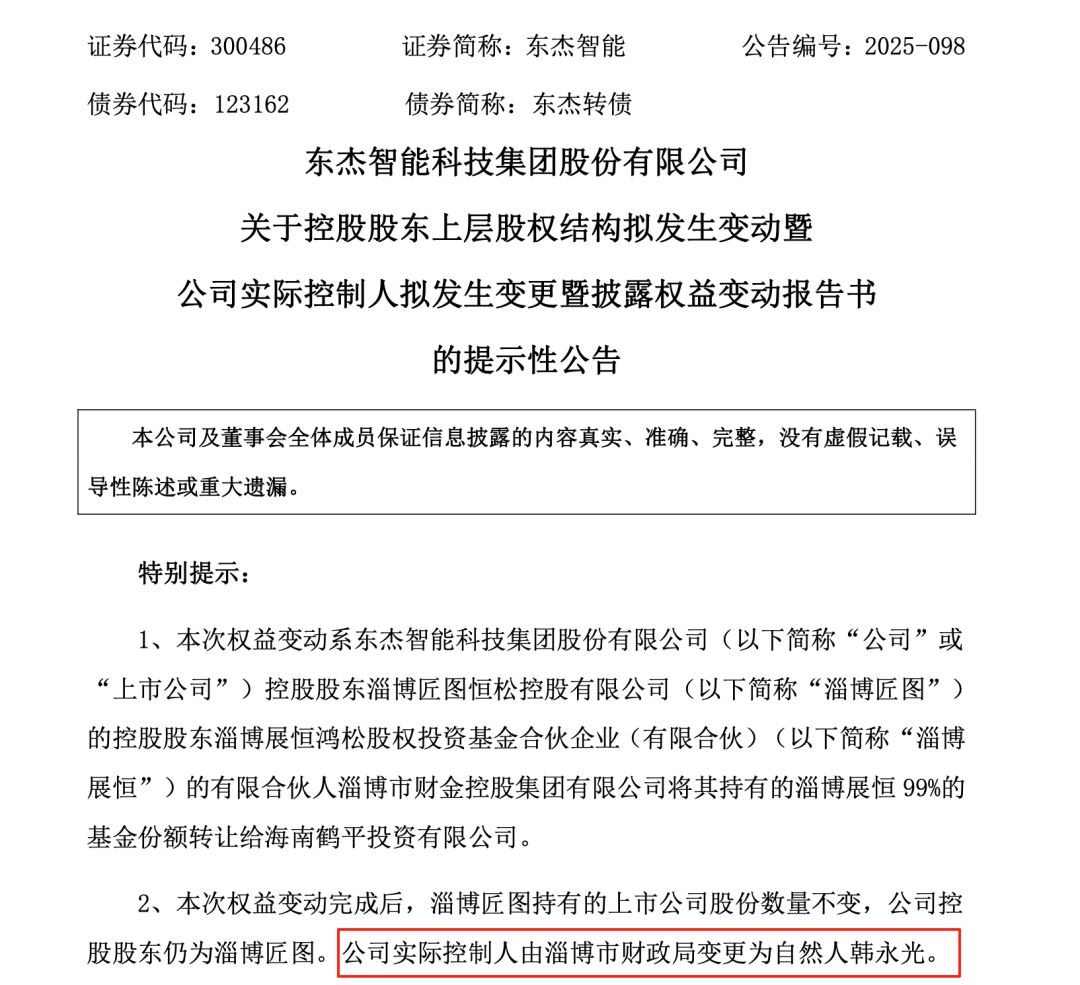
Core Viewpoint - The change of actual controller from state-owned to individual ownership marks a new chapter for Dongjie Intelligent, with expectations of revitalization and entry into the embodied intelligence sector under the leadership of Han Yongguang [1][2][3]. Company Overview - Dongjie Intelligent Technology Group Co., Ltd. is a leading smart manufacturing service provider in China, focusing on intelligent logistics equipment and integrating technologies such as 5G, big data, and AI to offer comprehensive solutions for global manufacturing enterprises [3][6]. Change of Control - The actual controller of Dongjie Intelligent has shifted from the Zibo Municipal Finance Bureau to Han Yongguang, a natural person with extensive experience in the robotics field [1][3]. - The transfer of control was facilitated by the sale of 99% of the fund shares of Zibo Zhanzheng Hongsong Equity Investment Fund Partnership to Hainan Heping Investment Co., Ltd. for 1.62 billion yuan [3][4]. Market Reaction - Following the announcement of the change in actual controller, Dongjie Intelligent's stock price surged from 12.43 yuan per share on July 31 to 23.18 yuan on August 27, reflecting an increase of approximately 86.5% and a market capitalization rise from about 5.666 billion yuan to 10.567 billion yuan [2][4]. Financial Performance - Dongjie Intelligent has faced declining performance over the past three years, with revenues of 1.143 billion yuan, 872 million yuan, and 807 million yuan from 2022 to 2024, and net profits of 39.71 million yuan, -243 million yuan, and -257 million yuan respectively [4][8]. - However, the company reported a turnaround in the first half of 2025, achieving a revenue of 539 million yuan, a year-on-year increase of 24.9%, and a net profit of 5.9454 million yuan, up 113.96% [4][5]. Strategic Direction - The new actual controller, Han Yongguang, is expected to leverage his connections in the robotics industry to enhance Dongjie Intelligent's capabilities, particularly in the field of collaborative robots, which can complement the company's existing logistics solutions [6][7]. - The company aims to develop embodied intelligence solutions for smart warehousing and logistics, thereby expanding its business footprint in high-end smart manufacturing [6][8]. Challenges and Opportunities - Dongjie Intelligent has faced significant challenges, including intense competition from peers and reliance on capital expenditures from downstream industries like new energy vehicles, steel, and chemicals, which can lead to performance volatility [8]. - The transition to private ownership is seen as a strategic move to improve operational flexibility and resource allocation, potentially leading to better performance outcomes in the future [5][8].
大牛股!东杰智能(300486),拟易主!
Zheng Quan Shi Bao· 2025-08-27 01:17
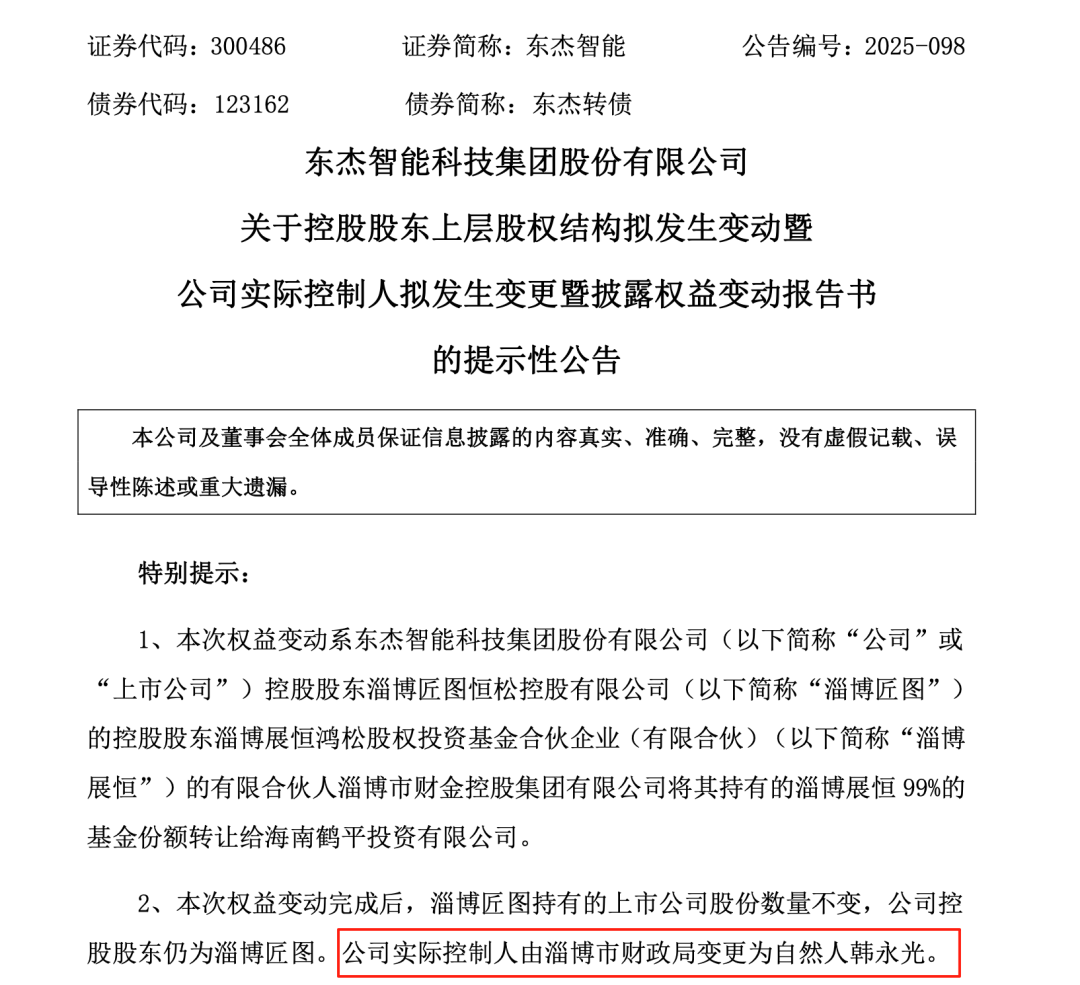
Core Viewpoint - The actual controller of Dongjie Intelligent has changed from the Zibo Municipal Finance Bureau to individual Han Yongguang, who is a director at Aobo (Beijing) Intelligent Technology Co., Ltd. The company's stock will resume trading on August 27 [1][4]. Group 1: Company Ownership Changes - Dongjie Intelligent announced that its controlling shareholder, Zibo Jiangtu Hengsong Holdings Co., Ltd., transferred 99% of the fund shares held by its limited partner, Zibo Zhanzheng Hongsong Equity Investment Fund Partnership (Limited Partnership), to Hainan Heping Investment Co., Ltd. for a transaction price of 1.62 billion yuan [1][4]. - Following the transaction, the number of shares held by Zibo Jiangtu in Dongjie Intelligent remains unchanged, but the actual controller shifts to Han Yongguang [1][4]. Group 2: New Leadership - Han Yongguang, born in 1973 and holding a master's degree, has been appointed as the chairman of the board of Dongjie Intelligent. He is also a director at Aobo Intelligent and has held various leadership roles in other companies [4][5]. - The previous chairman, Xing Chengliang, submitted a resignation report due to work adjustments but will continue to serve as a director and committee member [5]. Group 3: Market Performance - Dongjie Intelligent has been a strong performer in the A-share market since the third quarter, with its stock price rising significantly from around 8 yuan per share in early July to a closing price of 23.03 yuan per share on August 19, just before the trading suspension [6].
大牛股300486,拟易主
Zheng Quan Shi Bao· 2025-08-26 14:10
Core Viewpoint - Dongjie Intelligent has undergone a significant change in its actual controller, shifting from the Zibo Municipal Finance Bureau to individual Han Yongguang, who is also a director at Aobo (Beijing) Intelligent Technology Co., Ltd. The company's stock will resume trading on August 27 [1]. Group 1: Ownership and Control Changes - The controlling shareholder of Dongjie Intelligent, Zibo Jiangtu Hengsong Holdings Co., Ltd., transferred 99% of its fund shares in Zibo Zhanzheng Hongsong Equity Investment Fund Partnership to Hainan Heping Investment Co., Ltd. for a transaction price of 1.62 billion yuan [1]. - Following the transaction, the number of shares held by Zibo Jiangtu in Dongjie Intelligent remains unchanged, but the actual controller has shifted to Han Yongguang [1]. Group 2: New Leadership and Strategic Direction - Han Yongguang, born in 1973 and holding a graduate degree, has a notable background, serving as a director in multiple companies, including Aobo Intelligent and Yijia Oil Intelligent Robotics Co., Ltd. He has received several accolades for his contributions to innovation and economic development in Zibo [5]. - The new actual controller aims to leverage technological and industrial resource advantages to enhance the company's existing operations and develop intelligent solutions for the smart warehousing and logistics industry, thereby creating new profit growth points and expanding into high-end intelligent manufacturing [5]. Group 3: Market Performance - Dongjie Intelligent has been performing well in the A-share market, with its stock price rising significantly from around 8 yuan per share in early July to 23.03 yuan per share before the trading halt on August 19 [6]. - The company has shown strong financial performance, with total revenue of 539 million yuan, a year-on-year increase of 24.90%, and a net profit attributable to shareholders of 5.95 million yuan, reflecting a year-on-year growth of 113.96% [6].