城市建设投资

Search documents
以四川省为例:从预算执行报告及政府工作报告看地方化债情况
Lian He Zi Xin· 2026-03-04 11:09
Report Industry Investment Rating - Not provided Core Viewpoints - In 2025, Sichuan Province's implicit debt resolution progress exceeded the scheduled progress, with the resolution progress by the end of 2025 not less than 65%. In 2026, the scale of "fiscal debt resolution" by the Sichuan provincial government may decline, and the focus of debt resolution will shift to the resolution of operating debt risks [4][5][6]. Summary by Directory 1. Estimation of the Province-wide Debt Resolution Progress - By leveraging the central special debt resolution policy and local self - debt resolution, Sichuan Province's implicit debt resolution progress exceeded the scheduled progress in 2025. As of the end of 2023, the national implicit debt balance was 14.3 trillion yuan. Based on the one - time implicit debt replacement refinancing special bond quota obtained by Sichuan Province (344.4 billion yuan), the implicit debt scale in Sichuan Province at the end of 2023 was estimated to be about 820 billion yuan [4]. - Besides issuing government bonds to replace implicit debts, Sichuan Province also resolved implicit debts through various means such as fiscal budgets and asset revitalization. By estimating based on Chengdu, as of the end of 2025, Sichuan Province's implicit debt scale did not exceed 287.8 billion yuan, and the implicit debt resolution progress was not less than 65%. By the end of 2025, Chengdu's implicit debt was nearly 80% resolved, and the reduction rate of financing platforms reached 86% [5]. 2. Key Points of Debt Resolution in Sichuan Province in 2026 - As the debt resolution work achieved certain results, in 2026, the scale of "fiscal debt resolution" by the Sichuan provincial government may decline, and the focus of debt resolution will shift to the resolution of operating debt risks. The prevention and resolution of operating debt risks formed during the market - oriented operation of urban investment companies will become the key point of local debt resolution in the next stage [6]. - Sichuan Province will "take multiple measures to resolve the operating debt risks of local government financing platforms and strictly prohibit the illegal addition of implicit debts" as the key work of debt risk resolution in 2026 [7]. - From 2023, Sichuan's urban investment companies have made useful attempts in resolving operating debt risks. The operating debt scale of Sichuan's urban investment companies is relatively high in cities such as Chengdu (about 50% of the province), Mianyang (4.3%), Yibin (3.7%), Meishan (3.2%), and Luzhou (2.7%). The resolution of operating debts can be achieved through introducing strategic investors, market - oriented debt - to - equity swaps, using operating income, and revitalizing existing assets [9].
美元债双周报(26年第9周):美以联合袭击伊朗,避险情绪驱动美债利率下行-20260302
Guoxin Securities· 2026-03-02 03:17
Investment Rating - The report maintains a "Weaker than Market" rating for the U.S. stock market [5]. Core Insights - The geopolitical tensions following the U.S.-Israel military action against Iran have heightened market risk aversion, leading to a decline in U.S. Treasury yields [2]. - The implementation of a new 10% global tariff by the U.S. has raised uncertainties in international trade, impacting corporate investment decisions [1]. - The unexpected rise in the U.S. core PPI in January has complicated the Federal Reserve's policy outlook, with inflation pressures remaining persistent [3]. - The report suggests a defensive investment strategy focusing on short to medium-term bonds to mitigate risks associated with interest rate volatility and inflation [4]. Summary by Sections U.S. Treasury Market - The U.S. Treasury market is currently experiencing a tug-of-war between geopolitical risk and inflation resurgence, with yields dropping below 4% due to recent military actions [4]. - The core PPI data indicates a significant inflationary pressure that could influence future monetary policy decisions [3]. Economic Indicators - January's core PPI increased by 0.8% month-over-month and 3.6% year-over-year, surpassing market expectations and highlighting ongoing production cost pressures [3]. - The market is reassessing the likelihood of interest rate cuts, with the probability of a March rate cut now at only 7.4% [3]. Investment Strategy - The report recommends a cautious approach, advising investors to limit duration exposure and focus on 2-5 year bonds to secure stable yields while waiting for clearer economic signals [4].
河南城投年度指数发布!谁在领跑、谁在转型突围→
Sou Hu Cai Jing· 2026-02-02 12:26
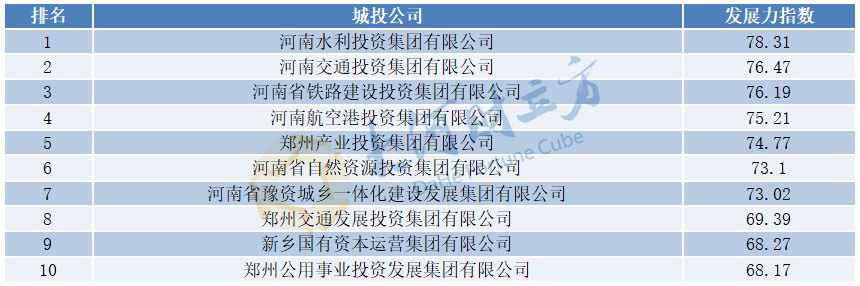
Core Insights - The 2025 annual index for Henan urban investment companies has been officially released, showing a stable development power index for these companies [1][5] - The index reflects the ongoing efforts in debt resolution and structural transformation within Henan province [5] Group 1: Development Power Index Rankings - The top three companies in the 2025 development power index are Henan Water Investment Group (78.31), Henan Transportation Investment Group (76.47), and Henan Railway Construction Investment Group (76.19) [3][2] - Zhengzhou Transportation Development Investment Group has made its first appearance in the top ten of the rankings [2][5] Group 2: Changes in Development Power - The average development power index for Henan urban investment companies in 2025 is 54.50, remaining stable compared to 2024 [5] - The provincial-level urban investment companies saw an increase of 0.92 points in their average index, while the city-level companies decreased by 2.08 points, and the county-level companies increased by 0.69 points [6] Group 3: Specific Company Developments - Henan Water Investment Group is recognized for its sustainable development capabilities, with significant projects like the Jia Ru River comprehensive management project (total investment of 7.244 billion) and the South-to-North Water Diversion project (total investment of 6.461 billion) [6][7] - Zhengzhou Industrial Investment Group has increased its registered capital from 1 billion to 30 billion RMB and plans to invest in various emerging industries [7] - Zhengzhou Aviation Port Science and Technology Group is actively involved in capital operations and has established funds for low-altitude economy and advanced computing [7] Group 4: Regional Performance - The development power index varies across different provincial cities, with cities like Anyang, Nanyang, and Jiaozuo showing improvements compared to the 2024 rankings [8] - Specific average development power indices for cities include Zhengzhou (58.09), Luoyang (48.23), and Nanyang (57.63), indicating mixed performance across the region [9]

城投公司“退平台”:市场化转型的三大挑战
Sou Hu Cai Jing· 2026-01-29 03:14
Core Viewpoint - The "exit platform" for urban investment companies is not the end but rather the first step in accelerating reform and transformation [2] Group 1: Urban Investment Companies' Challenges - Traditional urban investment models have made significant contributions but have also led to a crossroads due to extensive development [2] - The "exit platform" is an inevitable outcome, indicating a shift in operational strategy [2] - Post "exit platform," urban investment companies face immense survival pressure and numerous challenges, including heavy burdens, difficulties in resolving historical issues, and challenges in asset revitalization [2] Group 2: Financial Pressures - Urban investment companies are grappling with high operational debts, which exacerbate their financial strain [2]

上海建工2026年1月28日涨停分析:城市建设投资+房产开发+融资成功
Xin Lang Cai Jing· 2026-01-28 04:11
Core Viewpoint - Shanghai Construction Group (SH600170) experienced a trading halt on January 28, 2026, with a closing price of 3.18 yuan, reflecting a 10.03% increase and a total market capitalization of 28.257 billion yuan [1] Group 1: Business Performance - The company's urban construction investment business reported a year-on-year growth of 1883.33%, indicating significant breakthroughs in the new infrastructure sector [2] - The real estate development business also showed a counter-cyclical growth rate of 17.96%, outperforming the industry average [2] - The third quarter saw a non-recurring net profit increase of 134.91%, demonstrating improved operational efficiency [2] Group 2: Financing and Market Conditions - The company successfully completed a financing round of 2 billion yuan at a low interest rate of 2.90%, which was fully subscribed, indicating high market recognition and reduced financial costs [2] - There are 18 major engineering projects in the pipeline, each exceeding 1 billion yuan, totaling 26.38 billion yuan, ensuring future revenue streams [2] - The construction and real estate sectors have recently seen increased activity due to macroeconomic policies and market expectations, contributing to a positive market environment [2] Group 3: Technical Indicators - Technical analysis suggests potential positive signals, such as the MACD indicator possibly forming a golden cross and the BOLL channel potentially breaking through, attracting more investor interest [2]

呼伦贝尔能源投资开发集团注册资本增至208亿元
Zheng Quan Ri Bao Wang· 2026-01-12 13:49
Group 1 - The core point of the article is that Hohhot Energy Investment Development (Group) Co., Ltd. has undergone a business change, with Hohhot Urban Construction Investment (Group) Co., Ltd. exiting the shareholder list and the registered capital increasing from 100 million to approximately 20.8 billion [1] Group 2 - The registered capital increase signifies a substantial growth in the company's financial capacity, which may indicate future expansion or investment opportunities [1] - The exit of Hohhot Urban Construction Investment (Group) Co., Ltd. as a shareholder could suggest a strategic shift in the company's ownership structure [1]
城投公司化债跟踪:成效持续显现,压力犹存
Lian He Zi Xin· 2026-01-05 11:06
Report Industry Investment Rating There is no information about the report industry investment rating in the provided content. Core Viewpoint of the Report In 2025, the number of new debt - resolution policies has significantly slowed down, with the focus shifting to policy implementation to consolidate debt - resolution achievements. In the first half of 2025, the debt scale of urban investment companies continued to grow but at a slower pace, the debt term structure improved, and the financing structure was optimized. However, some urban investment companies still faced relatively large liquidity pressures, and regional differentiation was further evident. Looking forward, urban investment companies still face the pressure to deepen market - oriented transformation to achieve a new dynamic balance between serving regional economic development and consolidating debt stability [2][39]. Summary by Relevant Catalogs Policy Environment Change - Since 2023, a series of debt - resolution policies have been introduced, with 2023 and 2024 seeing relatively frequent policy releases. In 2025, the focus shifted to implementation and consolidation of achievements. The core of these policies is to resolve existing debts, control new debts, promote the exit and transformation of financing platforms, and seek development [4]. - As of August 31, 2025, 4 trillion yuan of the one - time increase of 6 trillion yuan in special bond quotas had been issued, reducing the average interest cost by over 2.5 percentage points and saving over 450 billion yuan in interest. As of September 12, 2025, 2.78 trillion yuan of new local government special bonds had been issued, with 800 billion yuan allocated to supplement government - funded financial resources for debt resolution [6]. - From 2023 to December 19, 2025, 722, 428, and 353 urban investment platforms exited respectively. Since 2024, various provinces have taken measures in debt replacement, platform exit, enterprise transformation, asset revitalization, and cooperation with financial institutions, achieving certain results. Key provinces have effectively reduced interest burdens and eased repayment pressures through special refinancing bonds, while non - key areas have focused on long - term mechanism building [5][6][8]. Changes in Financial Indicators of Urban Investment Companies Investment - Since 2022, the growth rates of urban construction - related assets and self - operated assets have continued to decline, but they remain the main capital flow due to the large base. In the first half of 2025, the investment growth rate further slowed down, and the investment structure continued to adjust [13]. - From 2022 to June 2025, the scales of urban construction - related assets, self - operated assets, and equity and fund investment assets of urban investment companies all continued to rise. In June 2025, the proportions of urban construction - related assets, self - operated assets, and equity and fund - related assets were 63.06%, 24.22%, and 12.72% respectively [13][15]. - As of June 2025, most provinces' total investment in the three categories and urban construction - related asset investment showed positive growth. The total investment growth rate of Inner Mongolia was negative. Hainan, Beijing, Hebei, and Jilin had relatively high growth rates [16]. - As of June 2025, Hainan and Heilongjiang had relatively high proportions of urban construction - related assets; Inner Mongolia, Tibet, Guangdong, and Gansu had relatively high proportions of self - operated assets; Yunnan, Hebei, Shanghai, and Guangdong had relatively high proportions of equity and fund - related investments [17]. Receivables - In the first half of 2025, the accounts receivable scale of urban investment companies continued to expand, but the overall growth rate slowed down, and a small number of provinces achieved a reduction in accounts receivable. The cash - to - income ratio remained at a high level [19][20]. - From 2022 to June 2025, the accounts receivable scale of urban investment companies continued to grow. As of June 2025, Jiangsu, Sichuan, Shandong, Zhejiang, Anhui, and Hunan had relatively large accounts receivable scales, while Heilongjiang, Inner Mongolia, Tibet, Ningxia, Hainan, and Qinghai had accounts receivable below 10 billion yuan. Jilin, Heilongjiang, and Qinghai had relatively fast growth rates, while Shanxi, Liaoning, and Tibet had negative growth rates [21][22]. Financing - In the first half of 2025, the financing activities of urban investment companies remained in a net inflow state, with further regional differentiation. Provinces with large net inflows were concentrated in economically developed regions such as Zhejiang and Jiangsu. Yunnan and Qinghai had continuous net outflows since 2022, and Tibet and Guizhou changed from net inflows in 2024 to net outflows in the first half of 2025 [23][25]. - From 2022 to 2024, the cash inflow and outflow of urban investment companies' financing activities both increased year - by - year, with a decreasing net inflow. In the first half of 2025, the financing cash was in a net inflow state. In the first half of 2025, regions with large cash inflows from financing activities included Jiangsu, Zhejiang, Shandong, Sichuan, and Henan [26][27]. Interest - Bearing Debt - In the first half of 2025, the debt scale of urban investment companies continued to grow, but the debt growth rate continued to slow down. The debt term structure improved compared to the end of the previous year, but the overall liquidity pressure was still relatively large, and the financing structure was optimized, still mainly relying on bank loans [28]. - As of June 2025, the debt scale of urban investment companies still increased, but the growth rate slowed down. Jiangsu, Zhejiang, Sichuan, and Shandong had relatively large debt scales. Hainan had a debt growth rate of over 20%, while some key provinces such as Henan, Guizhou, and Inner Mongolia saw a decline in debt scale [31]. - As of June 2025, the short - term debt ratio of urban investment companies decreased compared to the end of 2024. Jiangsu and Shandong had relatively high short - term debt ratios. The short - term debt ratios of some key provinces such as Yunnan and Liaoning decreased [32]. - As of June 2025, the financing channels of urban investment companies were mainly bank loans (62.40%), followed by bond financing (22.04%) and non - standard financing (15.56%). The proportion of bank loans increased, while the proportions of bond financing and non - standard financing decreased. The issuance scale of urban investment bonds in all provinces decreased in the first half of 2025, with a larger decline in key provinces [33][30]. Debt - Repayment Ability - In the first half of 2025, the overall debt burden of urban investment companies still increased, but the debt burden of most key provinces' urban investment companies decreased. The cash - to - short - term - debt ratio improved, but attention should still be paid to the debt - repayment and liquidity pressures [36]. - From the end of 2022 to June 2025, the overall asset - liability ratio and total debt capitalization ratio of urban investment companies continued to rise, and the cash - to - short - term - debt ratio rebounded in June 2025. Beijing, Zhejiang, and other regions had relatively heavy debt burdens, while most key provinces' urban investment companies saw a reduction in debt burden [38]. Summary - Since 2025, provinces have achieved certain results in debt resolution, including significantly reducing financing costs through debt replacement, significantly reducing the number of financing platforms, and revitalizing assets to provide important funds for debt repayment. The debt scale growth rate of urban investment companies has continued to slow down, and the term and financing structures have been adjusted [39]. - Urban investment companies still face the pressure to deepen market - oriented transformation, aiming to achieve a new dynamic balance between serving regional economic development and consolidating debt stability [39].
湖北省发债城投企业财务表现观察:债务化解稳步推进,投融资结构持续改善
Lian He Zi Xin· 2025-12-30 11:26
Report Industry Investment Rating - Not provided in the report Core Viewpoints - Hubei Province's debt resolution work is progressing steadily. The investment growth rate of urban investment companies has slowed down, the investment structure has been continuously adjusted, the growth rate of debt scale has slowed down, and new financing has mainly shifted to bank loans, with the combined proportion of bonds and other financing continuously decreasing. Most regions of urban investment companies in the province have seen an expansion in accounts receivable, and the repayment pressure needs to be alleviated. The net cash inflow from financing activities of urban investment companies has been shrinking year by year, and some regional urban investment companies still face liquidity pressure. Urban investment companies need to improve their operational efficiency through "Three Capitals and Three Transformations" and substantial transformation, and promote debt resolution and development in a coordinated manner by enhancing their self - hematopoietic ability [2][40] Summary by Directory I. Hubei Province's Debt Control Situation - **Overall Debt Control**: Hubei Province strictly implements the debt resolution plan. It actively resolves debts through measures such as the "Three Capitals" reform and strives for replacement bond quotas. It also strengthens supervision through digital platforms, achieving the goal of exiting financing platforms ahead of schedule and keeping local debt risks generally under control [4][6] - **"Three Capitals and Three Transformations"**: Since 2023, Hubei has promoted the construction of a large - fiscal system with debt resolution as the entry - point. By the end of 2024, the province basically completed the inventory of "Three Capitals". In May 2025, it deepened the reform of state - owned "Three Capitals" management. Provincial - owned enterprises aim to revitalize 150 billion yuan of inefficient and idle assets in three years [5] - **Replacement Bonds**: In November 2024, after the National People's Congress Standing Committee approved the local debt - resolution "combination punch", Hubei Province received 294.6 billion yuan, with an annual issuance quota of 98.2 billion yuan from 2024 to 2026 for special bonds to replace implicit debts [6] - **Regional Debt Control**: In 2025, various cities in Hubei Province actively carried out debt - control and debt - resolution work, including revitalizing state - owned "Three Capitals", formulating debt - resolution plans, and strengthening debt supervision. For example, Wuhan revitalized assets worth 142.6 billion yuan, and Xiangyang completed the replacement of 7.75 billion yuan of implicit debts ahead of schedule [7] II. Changes in Financial Indicators of Urban Investment Enterprises in Hubei Province 1. Investment - **Overall Situation**: From 2022 to June 2025, the scale of three types of investments (urban construction assets, self - operating assets, equity and fund investment assets) of urban investment companies in Hubei Province continued to rise, but the growth rate has been slowing down since 2023. Since 2023, the growth rates of self - operating assets, equity and fund investment assets have exceeded that of urban construction assets. The proportion of urban construction assets has continued to decline slightly, but it remains the main asset composition [13] - **Regional Differences**: In 2024, most regions in Hubei Province saw an overall increase in the three types of investments, with a median growth rate of 3.81%. The combined growth rate of the three types of investments in provincial - level, Shiyan, Jingmen, Xianning and Xiaogan was relatively high. The proportion of urban construction assets in most regions was relatively high, except for Wuhan where the proportion of self - operating assets was relatively large [14][15] 2. Collection - **Overall Situation**: Since 2022, the accounts receivable of urban investment companies in Hubei Province have been increasing year by year, with fluctuating growth rates. The cash - income ratio has declined slightly since 2023 [18][20] - **Regional Differences**: In 2024, the accounts receivable of Wuhan's urban investment companies were significantly higher than those in other regions. The growth rates of accounts receivable in Qianjiang, Tianmen and Jingzhou were relatively fast. In 2024, the cash - income ratios of Huangshi, Shiyan, Jingmen, Xiantao and Enshi were high, while those of Tianmen and Ezhou were relatively low [21] 3. Financing - **Overall Situation**: From 2022 to 2024, the net cash inflow from financing activities of urban investment companies in Hubei Province continued but shrank year by year. In 2024, the net cash flow from financing activities decreased significantly. In the first half of 2025, the net cash inflow from financing activities increased by 45.16% year - on - year [23][25][26] - **Regional Differences**: In 2024, the financing activities of Wuhan's urban investment companies accounted for nearly 40% of the province. The financing activities of various cities in Hubei Province showed significant differences. The financing activities of urban investment companies in Jingzhou, Qianjiang, Huanggang, Ezhou, Enshi and Xiantao showed net outflows, while those of other cities showed net inflows [26] 4. Interest - Bearing Debt - **Debt Scale**: From 2022 to June 2025, the debt scale of urban investment companies in Hubei Province continued to grow, but the growth rate slowed down. In 2024, the growth rate decreased by 7.15 percentage points to 3.50%. In 2024, the debt scale of Wuhan's urban investment companies accounted for nearly 50% of the province [31] - **Debt Maturity**: The overall debt maturity structure of urban investment companies in Hubei Province is still dominated by long - term debt, but the proportion of short - term debt has shown a slight upward trend. As of June 2025, short - term debt accounted for about 20%. The proportion of short - term debt in provincial - level and Huangshi exceeded 30% [31] - **Debt Structure**: As of the end of 2024, bank loans were the main financing channel for urban investment companies in Hubei Province (about 56%), followed by bond financing (about 28%) and other financing (about 16%). Since 2022, the combined proportion of bond financing and other financing has continued to decline, while the scale and proportion of bank financing have continued to increase [32] - **Bond Financing**: From 2024 to January - September 2025, the overall bond financing of urban investment companies in Hubei Province showed a net outflow. In 2024 and January - September 2025, most regions' urban investment bond financing showed net outflows [32] 5. Solvency - **Overall Situation**: From 2022 to June 2025, the overall debt scale of urban investment companies in Hubei Province continued to expand, the asset - liability ratio and the overall debt capitalization ratio showed an upward trend. From 2022 to the end of 2024, the cash - to - short - term - debt ratio decreased year by year and rebounded to the level at the end of 2023 in June 2025 [37] - **Regional Differences**: In 2024, the debt burdens of provincial - level, Ezhou, Wuhan, Jingzhou and Xiangyang were relatively heavy. The debt burdens of Shiyan and Suizhou were relatively light. Most cities in Hubei Province faced relatively large short - term solvency pressure, while Wuhan, Huanggang and Tianmen faced relatively small short - term solvency pressure [37][38] III. Conclusion - Hubei Province's debt resolution work has been progressing steadily, but urban investment companies still face challenges such as slow investment growth, accounts receivable pressure, and liquidity pressure. They need to improve operational efficiency and self - hematopoietic ability through "Three Capitals and Three Transformations" and substantial transformation to promote debt resolution and development [40]
上交所:重庆市合川城市建设投资(集团)有限公司债券12月18日挂牌,代码281018
Sou Hu Cai Jing· 2025-12-17 04:08
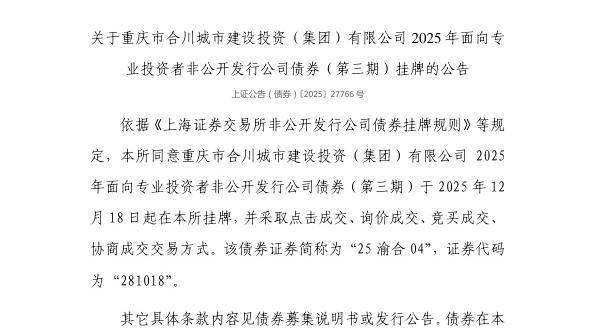
Core Viewpoint - The Shanghai Stock Exchange has announced the listing of the third phase of non-public corporate bonds issued by Chongqing Hechuan Urban Construction Investment (Group) Co., Ltd. aimed at professional investors, effective from December 18, 2025 [1][2]. Group 1 - The bonds will be traded under the name "25渝合04" with the security code "281018" [2]. - The trading methods for these bonds include click transaction, inquiry transaction, bidding transaction, and negotiated transaction [2].
陕西韩城市被点名化债不力…
Xin Lang Cai Jing· 2025-12-08 05:55
Core Insights - The article discusses the ongoing efforts of Shaanxi Province in China to address the issue of hidden local government debt, focusing on the "zero clearance" pilot program aimed at sustainable economic development [2][8]. Group 1: Hidden Debt "Zero Clearance" Pilot - Shaanxi Province has shifted its focus from a province-wide "zero clearance" approach to targeting specific cities and counties for achieving hidden debt clearance, reflecting a more precise and operational strategy [10]. - The county-level practices, such as those in Qishan County, demonstrate significant progress with clear repayment plans and successful debt resolution through bond funding, alleviating local debt burdens and fostering economic growth [10][12]. Group 2: Debt Clearance Challenges in Han City - Han City faces significant challenges in debt clearance, with ongoing issues of unpaid debts to private enterprises, raising concerns about the effectiveness of debt resolution efforts [11][12]. - The Han City Investment Group has reportedly defaulted on nearly 10 billion yuan in payments, including substantial debts related to the pepper industry park project, leading to accusations of fraudulent agreements and fund misappropriation [12]. Group 3: Comprehensive Measures for Debt Resolution - Shaanxi Province employs a multi-faceted approach to achieve debt clearance, including debt replacement and resolution through the issuance of special local government bonds to reduce interest burdens and optimize debt structures [12][13]. - A differentiated handling mechanism for various types of debts and arrears has been established, promoting amicable negotiations for disputed debts and guiding unresolved cases through judicial channels [13]. - The province is also pushing for the market-oriented transformation of financing platform companies to prevent the accumulation of new hidden debts, which is crucial for sustainable economic development [13][5].