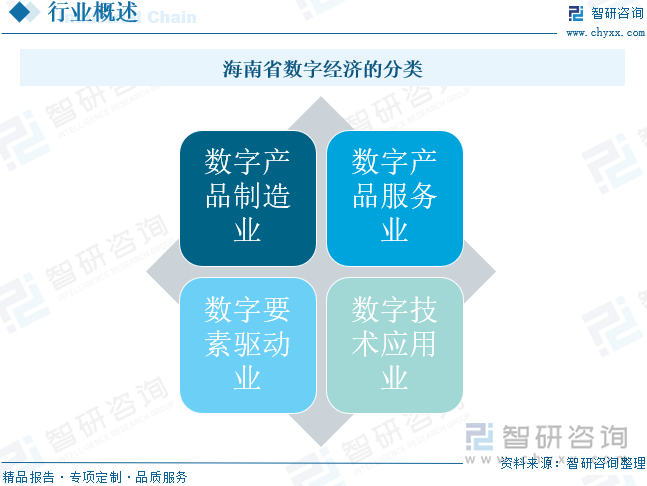
数字要素驱动业

Search documents
2025年广州经济的“稳”与“进”
Sou Hu Cai Jing· 2026-02-06 07:07
Core Insights - Guangzhou's economic performance in 2025 reflects resilience amid external challenges and internal structural adjustments, with a focus on consumption and industrial upgrades as dual engines of growth [1][6] Consumption Dynamics - The city's consumption market shows strong resilience, with daily retail sales for automobiles and communication devices reaching 375 million yuan and 132 million yuan respectively, and various goods maintaining an annual growth rate of over 6% [3] - Online retail sales of physical goods exceeded 350 billion yuan, marking a 13.1% year-on-year increase and accounting for 31.9% of total retail sales, indicating a transition from a traditional to a digital commerce hub [3] - Service consumption is becoming a new growth driver, with over 110,000 commercial performances held in a year, attracting 264 million tourists and boosting cultural and tourism consumption [3][4] Infrastructure and Investment - Baiyun Airport handled over 83 million passengers, ranking among the top ten globally, while the metro system recorded an annual ridership of 3.4 billion, showcasing robust transportation infrastructure [4] - New loans exceeded 510 billion yuan, ranking third nationally, with actual foreign investment growing by 9.1%, supporting the consumption infrastructure [4] Industrial Growth - The service sector's contribution to GDP surpassed 2.4 trillion yuan, accounting for over 80% of GDP growth, with the productive service industry making up 59% of this sector [4] - The digital economy is rapidly expanding, with core industry value-added growth at 6%, and digital product services growing by 15% [4][6] - Traditional industries are revitalizing through technological upgrades, with significant investments in industrial technology improvements during the 14th Five-Year Plan period [5][6] Emerging Industries - The "3+5" strategic emerging industries are projected to exceed 1 trillion yuan in value-added, growing by 4.2% and constituting 32.4% of GDP [6] - The automotive sector is transitioning towards new energy vehicles, with production increasing by 21.6%, and significant growth in charging stations and battery production [6] - The integration of innovation and industry is evident, with a notable increase in the number of specialized small and medium enterprises contributing significantly to industrial growth [6] Conclusion - Guangzhou's economic report illustrates a balanced approach to transitioning from old to new, with a solid foundation for current stability and a clear trajectory for future growth [6]


国家统计局:2024年全国数字经济核心产业增加值为140891亿元 占GDP比重为10.5%
智通财经网· 2025-12-30 04:08
Core Insights - The core viewpoint of the article highlights the significant contribution of the digital economy to China's GDP, with the core industries of the digital economy accounting for 10.5% of the total GDP in 2024 [1][2]. Summary by Category - **Digital Economy Core Industries**: The total value added of the digital economy core industries is 140,891 billion yuan, representing 10.5% of GDP [1][2]. - **Digital Technology Application Industry**: This sector has the highest value added at 61,928 billion yuan, making up 44.0% of the digital economy core industries [1][2]. - **Digital Product Manufacturing Industry**: The value added in this category is 48,145 billion yuan, accounting for 34.2% of the digital economy core industries [1][2]. - **Digital Factor-Driven Industry**: This industry contributes 26,519 billion yuan, which is 18.8% of the digital economy core industries [1][2]. - **Digital Product Service Industry**: The value added here is 4,298 billion yuan, representing 3.1% of the digital economy core industries [1][2].
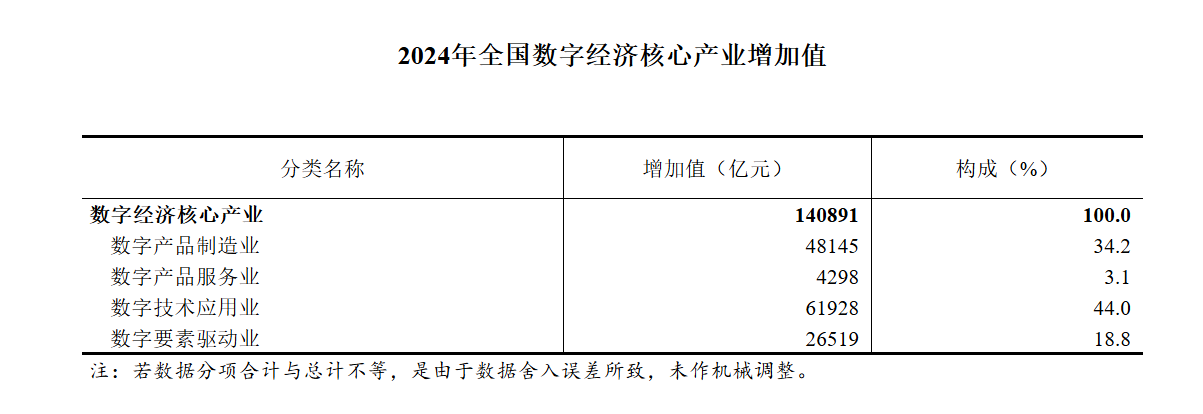
2024年全国数字经济核心产业增加值占GDP比重为10.5%
Yang Shi Wang· 2025-12-30 02:04
Core Insights - The core viewpoint of the article is that the value added by the core industries of the digital economy in China for 2024 is projected to be 140,891 billion yuan, accounting for 10.5% of the GDP [1]. Summary by Category - **Digital Economy Core Industries**: The total value added is 140,891 billion yuan, representing 100% of the digital economy core industries [3]. - **Digital Technology Application Industry**: This sector has the highest value added at 61,928 billion yuan, making up 44.0% of the digital economy core industries [1][3]. - **Digital Product Manufacturing Industry**: The value added in this category is 48,145 billion yuan, which constitutes 34.2% of the digital economy core industries [1][3]. - **Digital Factor-Driven Industry**: This industry contributes 26,519 billion yuan, accounting for 18.8% of the digital economy core industries [1][3]. - **Digital Product Service Industry**: The value added here is 4,298 billion yuan, representing 3.1% of the digital economy core industries [1][3].
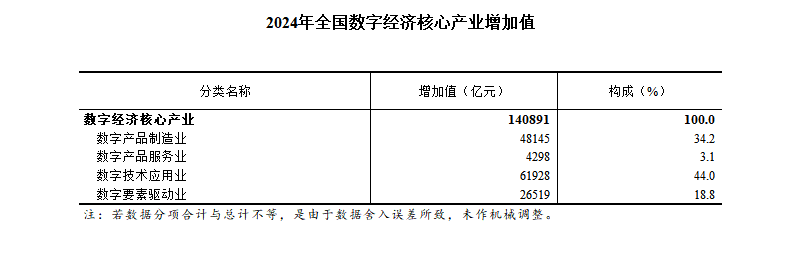
2024年全国数字经济核心产业增加值占GDP比重为10.5% - 国家统计局
Guo Jia Tong Ji Ju· 2025-12-30 01:37
Core Insights - The core value added of the national digital economy core industries in 2024 is projected to be 140,891 billion yuan, accounting for 10.5% of GDP [1][3]. Industry Composition - The digital technology application industry has the highest value added at 61,928 billion yuan, representing 44.0% of the digital economy core industries [1][3]. - The digital product manufacturing industry contributes 48,145 billion yuan, making up 34.2% of the total [1][3]. - The digital factor-driven industry adds 26,519 billion yuan, which is 18.8% of the total [1][3]. - The digital product service industry has a value added of 4,298 billion yuan, accounting for 3.1% [1][3]. Definitions and Methodology - The digital economy core industries refer to economic activities that provide digital technologies, products, services, infrastructure, and solutions for industrial digitalization, as well as those fully reliant on digital technologies and data factors [4]. - The value added of the digital economy core industries is defined as the new value created by all resident units in a certain period through production activities [4]. - The classification for the digital economy core industries is based on the "Statistical Classification of Digital Economy and Its Core Industries (2021)" and includes four main categories: digital product manufacturing, digital product services, digital technology applications, and digital factor-driven industries [5].
国家税务总局:我国数实融合发展态势良好
Zhong Guo Jing Ying Bao· 2025-12-25 15:07
Group 1 - The core focus is on the deep integration of the digital economy and the real economy, which is essential for building a modern industrial system and promoting high-quality development [1] - The "14th Five-Year Plan" emphasizes advancing the construction of a digital China and fostering the integration of the digital and real economies [1] - From January to November 2025, the sales revenue of core digital economy industries grew by 10% year-on-year, significantly outpacing the overall growth rate of enterprises [1] Group 2 - In the manufacturing sector, sales revenue for smart manufacturing industries such as intelligent equipment manufacturing and electronic components manufacturing increased by 28.2% and 10.9% year-on-year, respectively [1] - The sales revenue of digital technology applications, primarily driven by AI models, big data, and IoT, grew by 14.3%, with internet-related services and IT services increasing by 16.1% and 15.2% year-on-year [1] - Digital transformation investments in manufacturing increased, with the amount spent on digital technology by manufacturing enterprises rising by 11.2% year-on-year [1] Group 3 - The sales revenue driven by data elements grew by 6.3% year-on-year from January to November 2025 [2] - Internet platforms, including those for network freight, food delivery, and ride-hailing, saw a sales revenue increase of 16.2% [2] - Internet retail and supply chain management services, including live e-commerce and instant retail, experienced sales revenue growth of 11.9% and 24.7%, respectively [2]
趋势研判!2025年中国海南省数字经济行业相关政策、产业链、营业收入、主要企业及前景展望:海南省释放数字经济澎湃动能,助力海南自贸港快速发展[图]
Chan Ye Xin Xi Wang· 2025-05-08 01:20
Core Viewpoint - Hainan is leveraging its unique geographical advantages to develop a robust digital economy, focusing on digital infrastructure and industry transformation, with significant growth projected in the coming years [1][12]. Group 1: Hainan's Digital Economy Overview - The digital economy in Hainan integrates advanced technologies such as the internet, big data, cloud computing, and artificial intelligence, becoming a new engine for the development of the Hainan Free Trade Port [3]. - Hainan's digital economy encompasses four core industries: digital product manufacturing, digital product services, digital technology applications, and data-driven industries [3]. Group 2: Digital Economy Policies - Hainan has implemented various policies to accelerate digital economy development, including the "Hainan Free Trade Port Digital Economy Promotion Regulations" and the "Three-Year Action Plan to Boost and Expand Consumption" [5][7]. - By 2027, the revenue from Hainan's core digital economy industries is expected to exceed 2,200 billion yuan [5]. Group 3: Digital Economy Industry Chain - The upstream of Hainan's digital economy industry chain includes hardware facilities, basic software and technology, and data elements, which are essential for data transmission and processing [8]. - The midstream focuses on the deep integration of digital technology with the real economy, promoting the digital transformation and intelligent upgrading of traditional industries [8]. Group 4: Current Development Status - Hainan has accelerated the construction of digital infrastructure, including international submarine cables, data centers, and 5G applications, with a total of 37,700 5G base stations built by 2024 [10][12]. - The revenue of Hainan's digital economy core industries is projected to exceed 2,000 billion yuan in 2024, representing a 70% increase from 2022 [12]. Group 5: Key Enterprises in the Digital Economy - Key enterprises in Hainan's digital economy include Alibaba (Hainan), ByteDance (Hainan), and various local innovative companies, which together create a vibrant industrial ecosystem [18][19]. - Alibaba (Hainan) is a leading player in information transmission and software services, while ByteDance (Hainan) leverages its parent company's resources to expand rapidly in the digital content sector [18][19]. Group 6: Future Trends - Hainan is expected to become a hub for international data flow and digital trade, driven by the continuous release of policy dividends and the expansion of cross-border data security trials [24]. - The integration of digital economy with traditional industries such as tourism, agriculture, and healthcare will create new business models and enhance the value of traditional sectors [26].