新茶饮连锁

Search documents
跨境出海周度市场观察-20260118
Ai Rui Zi Xun· 2026-01-18 05:06
Industry Trends - Goldman Sachs' "2025 Global E-commerce Handbook" suggests Chinese sellers focus on ASEAN, Latin America, and the EU, as global e-commerce growth slows[1] - China's direct investment in South Africa is projected to reach $13.21 billion in 2024, shifting from traditional infrastructure to consumer goods and renewable energy[1] - Chinese automotive global market share is expected to reach 38%, with overseas sales potentially hitting 15%-20% by 2030[1] - By 2025, China's outbound model is expected to shift from single-point sales to systematic capability output, enhancing user shopping experiences[1] Top Brand News - Genki Forest has entered over 40 countries, emphasizing brand value and cultural attitudes rather than low prices[10] - Sweet Tea has opened over 200 overseas stores in two years, focusing on balancing global standards with local operations[11] - INTO YOU's overseas sales have surpassed 150 million yuan, marking a shift from product output to brand output in the beauty sector[12] - Xiangpiaopiao plans to invest $38 million in Thailand to expand in Southeast Asia amid declining domestic revenue[14]
全球亿万富豪调查:投资黄金,看好中国
Xin Lang Cai Jing· 2025-12-25 02:40
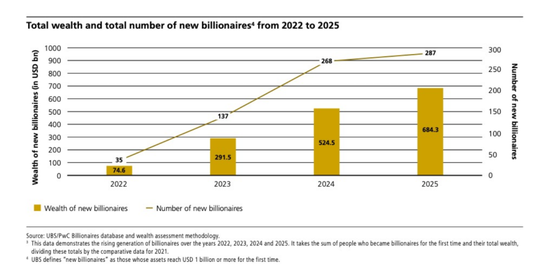
Group 1 - The core finding of the UBS report indicates that 34% of surveyed billionaires believe that Greater China will provide the greatest investment opportunities in the next year, a significant increase from 11% in 2024 [1][26] - By 2025, the number of billionaires in mainland China is expected to reach 470, with a total wealth of $1.8 trillion, reflecting a year-on-year growth of 22.2% [1][15] - The report highlights that 98% of Chinese billionaires are self-made entrepreneurs, primarily emerging from the IT and high-tech sectors, with a younger average age compared to billionaires in other regions [1][21] Group 2 - Globally, the number of billionaires is projected to increase by 287 to a total of 2,919 by 2025, marking the second-highest growth since 2015, with total wealth rising by 13% to $15.8 trillion [2][16] - The Asia-Pacific region leads in billionaire growth, with numbers rising from 981 to 1,036, while the U.S. saw an increase of 89 billionaires to 924, accounting for one-third of the global total [2][16] Group 3 - The technology sector is expected to see a significant increase in billionaire wealth, with a projected growth of 23.8% to $3 trillion by 2025, driven by advancements in artificial intelligence [4][19] - In contrast, the consumer and retail sectors are experiencing slower growth, with total wealth increasing by 5.3% to $3.1 trillion, although they remain among the top sectors for billionaire creation [5][20] Group 4 - Among newly minted billionaires, 68.3% are self-made, with a total wealth increase of $386.5 billion, primarily from sectors like marketing software and infrastructure [6][21] - The report notes that 91 billionaires inherited wealth totaling $297.8 billion, marking a 36% increase from 2024, with Western Europe having the highest number of inheritors [7][22] Group 5 - The report indicates that there are currently 374 female billionaires, whose average wealth growth rate is double that of their male counterparts, with an 8.4% increase expected by 2025 [9][25] - Female billionaires primarily derive their wealth from the consumer and retail sectors, while male billionaires predominantly gain wealth from the technology sector [10][25] Group 6 - Billionaires are increasingly diversifying their investment strategies, with 42% planning to increase exposure to emerging market stocks and 49% intending to boost private equity allocations [12][27] - Concerns among billionaires include tariffs (66%), geopolitical conflicts (63%), and policy uncertainty (59%), with regional differences in focus [12][27]

中国内地亿万富豪增至470位,98%白手起家
Xin Lang Cai Jing· 2025-12-25 02:12
Group 1 - In 2025, China will see the addition of 70 new billionaires, bringing the total number of billionaires in mainland China to 470, ranking second in the world after the United States [2][19] - The total wealth of billionaires in mainland China has reached $1.8 trillion, reflecting a year-on-year growth of 22.2% [2][19] - The majority of new billionaires in China (98%) are self-made entrepreneurs, primarily from the IT and high-tech sectors, with a younger average age compared to billionaires in other regions [20][23] Group 2 - Globally, the number of billionaires increased by 287 to 2,919 in 2025, marking the second-highest growth since 2015, with total wealth rising by 13% to $15.8 trillion [3][20] - The Asia-Pacific region saw the largest increase in billionaires, growing from 981 to 1,036 [3][20] - The United States added 89 billionaires, totaling 924, which accounts for about one-third of the global billionaire population, with total wealth increasing by 18% to $6.9 trillion [3][20] Group 3 - The technology sector is experiencing significant growth, with total wealth among tech billionaires increasing by 23.8% to $3 trillion, driven by advancements in artificial intelligence [8][22] - The industrial manufacturing sector also saw a wealth increase of 27.1% to $1.7 trillion, while the financial sector's wealth grew by 17% to $2.3 trillion [8][22] - In contrast, the consumer and retail sector's wealth growth was slower, at 5.3% to $3.1 trillion, although it remains one of the top sectors for creating billionaires [8][22] Group 4 - Among the newly minted billionaires globally, 196 are self-made, accounting for 68.3% of the new billionaire population, with a total wealth increase of $386.5 billion [9][23] - The Asia-Pacific region has the highest proportion of self-made billionaires at 79%, with China having 98% of its billionaires being self-made [10][23] - Notable new billionaires include the founders of the Chinese tea chain Mixue Ice City and the founders of BYD in the industrial manufacturing sector [10][23] Group 5 - In 2025, 91 billionaires inherited wealth totaling $297.8 billion, marking a 36% increase from 2024 and setting a record for the largest inheritance scale [11][24] - The majority of inheritors are from Western Europe, with 48 inheritors collectively receiving $149.5 billion, significantly more than those in North America and Southeast Asia [11][24] - It is projected that over the next 15 years, billionaires' children will inherit at least $5.9 trillion, with significant amounts expected in the U.S. and China [11][24] Group 6 - There are currently 374 female billionaires globally, with their wealth growth rate being double that of male billionaires, averaging an 8.4% increase [13][27] - The primary source of wealth for female billionaires is the consumer and retail sector, where they hold approximately $619.9 billion [13][27] - In contrast, male billionaires derive most of their wealth from the technology sector, holding $2.9 trillion, with 98.1% being self-made [13][27] Group 7 - A growing number of billionaires are looking to China for investment opportunities, with 34% believing it offers the best prospects in the next 12 months, a significant increase from 11% in 2024 [14][28] - While North America remains a preferred investment region, its attractiveness has decreased, with 63% of billionaires seeing it as the best return opportunity, down from 80% in 2024 [14][28] - Over the next five years, 48% of billionaires view the Greater China region as the most attractive investment destination, up from 34% in 2025 [14][28] Group 8 - Billionaires are increasing their investments in alternative assets and gold, with 49% planning to boost private equity allocations and 43% looking to increase hedge fund investments [15][29] - Concerns among billionaires include tariffs (66%), geopolitical conflicts (63%), and policy uncertainty (59%), with regional differences in focus [15][29] - A significant portion of billionaires believe that the younger generation will face multiple global challenges, with 75% citing technology and AI as urgent issues [15][30]

港股午评 恒生指数早盘跌1.91% 自驾概念股逆市走高
Jin Rong Jie· 2025-12-16 05:08
Market Overview - The Hang Seng Index fell by 1.91%, down 490 points, closing at 25,138 points, while the Hang Seng Tech Index dropped by 2.41%. The early trading volume in Hong Kong was HKD 107.2 billion [1]. Autonomous Driving Sector - The Ministry of Industry and Information Technology of China officially announced the first batch of L3 conditional autonomous driving vehicle licenses, marking a significant step in the practical application of intelligent connected vehicles. Stocks related to smart driving rose against the market trend, with Zhejiang Shibao (01057) increasing by 13.9% and Youjia Innovation (02431) rising by 9.88% [1]. Pharmaceutical Sector - The innovative drug sector declined again, with a temporary vacuum in pharmaceutical BD transactions over the past six months. Notable declines included Innovent Biologics (09969) falling over 3.62% and I-Mab (01801) down by 2.39% [1]. Gold Sector - Gold stocks experienced a widespread decline. The BOCM index is set for rebalancing, and JPMorgan indicated that gold and silver face significant technical selling pressure. Zijin Mining International (02259) dropped by 5.93%, while Zijin Mining (02899) fell by 4.5% [1]. Solar Energy Sector - The solar energy sector weakened again, with the Solar Association confirming the establishment of a storage platform, while prices for solar glass remain under pressure. New Special Energy (01799) decreased by 2%, and Xinyi Solar (00968) fell by 3.6% [1]. Optical Communication Sector - Oracle's performance for the second fiscal quarter of 2026 fell short of market expectations, leading to a continuation of declines in the optical communication sector. Cambridge Technology (06166) and Yangtze Optical Fibre and Cable (06869) both dropped by over 5% [1]. ZTE Corporation - ZTE Corporation (00763) fell by over 4%, with the company adjusting some AI capabilities in its Doubao mobile assistant and recently announcing a significant share buyback [2]. Bole Technology - Bole Technology-B (02592) saw a decline of 11% after submitting a new drug clinical trial application for its ophthalmic candidate CBT-199 in the U.S. [3]. Domestic Beverage Sector - Hushang Ayi (02589) rose by over 4%, capitalizing on the growing trend of domestic new tea beverage brands expanding into international markets, specifically entering Malaysia and the U.S. [4].
沪上阿姨上市次日股价大幅下跌 行业人士:估值偏高
Sou Hu Cai Jing· 2025-05-09 14:42
Core Viewpoint - The recent IPO of "沪上阿姨" on the Hong Kong Stock Exchange has shown a significant initial surge in stock price, but the subsequent decline raises concerns about the competitive landscape and financial performance of new tea beverage companies [1][3]. Group 1: Market Performance - "沪上阿姨" opened at HKD 190.6 per share, a 68.5% increase from the issue price, with a market capitalization exceeding HKD 18.4 billion, setting a record for first-day gains in the new tea beverage sector [1]. - On the second day, the stock price fell to HKD 160, closing at HKD 144.5, a decrease of 8.78% [1][3]. Group 2: Industry Competition - The new tea beverage market is highly saturated, with many established players like "奈雪的茶," "古茗," "茶百道," "蜜雪冰城," and "霸王茶姬" already in the space, leading to intense competition [4]. - The presence of over 40,000 stores for "蜜雪冰城" and nearly 10,000 for "沪上阿姨" indicates significant scale but also highlights the competitive pressures within the industry [4]. Group 3: Financial Performance - "沪上阿姨" is experiencing a decline in revenue and profits, with projections indicating a 15% drop in profit for 2024, which is significantly lower than competitors like "蜜雪冰城" [4]. - The valuation of "沪上阿姨" is considered high relative to its financial performance, especially when compared to "蜜雪冰城" and "霸王茶姬," which are viewed as having more reasonable valuations based on their earnings growth [4]. Group 4: Future Outlook - The industry is expected to see continued mergers and acquisitions as companies strive for efficiency and scale amidst fierce competition [5]. - The performance of new tea beverage companies post-IPO will heavily depend on their ability to grow profits, with significant disparities in valuations based on financial results [4][5].