白手起家

Search documents
全球亿万富翁人数和财富再创纪录,普通人却艰难度日,K型分化撕裂全球
3 6 Ke· 2026-01-16 13:16
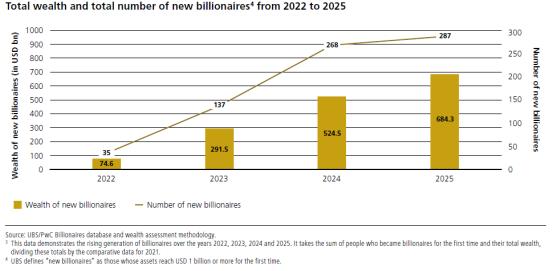
Core Insights - The UBS report indicates that by 2025, the number of billionaires globally will reach a historic peak of 2,900, with an increase of 287 billionaires in one year, marking a growth rate second only to 2021 [1][4] - The total wealth controlled by billionaires is projected to reach $15.8 trillion, a 13% increase from $14 trillion in 2024, highlighting a trend of accelerated wealth concentration [1][4] Group 1: Wealth Growth Drivers - The primary drivers for the increase in the number and wealth of billionaires are the rising valuations of global tech stocks and overall stock market strength, which provide robust support for the wealth appreciation of the ultra-rich [2] - Judy Spalthoff from UBS predicts continued growth in the billionaire population and wealth in the coming year [2] Group 2: Wealth Distribution and Inequality - The report highlights a stark contrast between the soaring wealth of billionaires and the structural inequalities in global wealth distribution, with a K-shaped divergence becoming increasingly evident [3] - The global Gini coefficient is nearing the warning threshold of 0.7, significantly exceeding the risk threshold of 0.6, indicating extreme wealth distribution imbalance [3][25] Group 3: Billionaire Demographics - Among the 2,919 billionaires, 2,059 are self-made, while 860 inherited their wealth, showcasing a dual path to billionaire status [5][6] - In 2025, 91 individuals became billionaires through inheritance, with a total inherited wealth of $298 billion, predominantly in the U.S. [6] Group 4: Regional Distribution - The Asia-Pacific region is identified as the core engine for billionaire growth, with the number of billionaires increasing from 981 to 1,036, led by mainland China with 470 billionaires [9] - The U.S. remains home to nearly one-third of the world's billionaires, with their total wealth rising by 18% to $17.5 trillion [9] Group 5: Investment Preferences - Billionaires are showing a strong preference for equities, particularly in the U.S., with 43% planning to increase their public equity holdings in the next 12 months [11] - Confidence in the U.S. as an investment destination has declined, with the percentage of billionaires seeing opportunities dropping from 80% to 63% [13] Group 6: Mobility Trends - Over one-third (36%) of billionaires have relocated, with many seeking better quality of life and favorable tax conditions, indicating a trend towards wealth concentration in policy-friendly regions [16] - The UAE, Hong Kong, and Singapore are emerging as key hubs for wealthy individuals, while cities like London are experiencing outflows due to declining living conditions [16] Group 7: Socioeconomic Implications - The report underscores the growing divide between the wealthy and the general population, with ordinary citizens facing rising inflation and stagnant wages, leading to a K-shaped economic recovery [17][18] - The wealth concentration among the top 1% is becoming increasingly unsustainable, posing risks to social stability and economic growth [25][29]


中国内地亿万富豪增至470位,98%白手起家
36氪· 2025-12-30 00:13
Core Insights - The report by UBS reveals that by 2025, China will have 70 new billionaires, bringing the total to 470, making it the second-largest number of billionaires globally, following the United States. The total wealth of these billionaires in China is projected to reach $1.8 trillion, a year-on-year increase of 22.2% [4][5]. Group 1: Billionaire Growth - The Greater China region is identified as the largest growth engine for billionaires globally, with 98% of new billionaires being self-made entrepreneurs, consistent with the characteristics of China's first-generation entrepreneurs [5][11]. - Globally, the number of billionaires is expected to increase by 287 to 2,919, marking the second-highest growth since 2015, with total wealth rising by 13% to $15.8 trillion [5][9]. Group 2: Industry Insights - The technology sector is projected to see a significant increase in billionaire wealth, with a growth of 23.8% to $3 trillion, driven by advancements in artificial intelligence [9][10]. - The consumer and retail sector's billionaire wealth growth is slower at 5.3%, totaling $3.1 trillion, while the industrial manufacturing sector sees a 27.1% increase to $1.7 trillion [10]. Group 3: Self-Made Billionaires - Among the new billionaires globally, 68.3% are self-made, with a total wealth increase of $386.5 billion, primarily from sectors like marketing software and infrastructure [12]. - In China, 98% of billionaires are self-made, a higher percentage compared to other major countries, reflecting a vibrant entrepreneurial spirit [12][11]. Group 4: Inheritance Trends - In 2025, 91 new billionaires will inherit wealth totaling $2.978 billion, a 36% increase from 2024, marking the largest inheritance record since the report's inception [14][15]. - The report indicates that over the next 15 years, billionaires' children are expected to inherit at least $5.9 trillion, with significant amounts in the U.S. and Europe [15]. Group 5: Gender Wealth Dynamics - There are currently 374 female billionaires, with their wealth growth rate being double that of male billionaires, at 8.4% compared to 3.2% [18]. - The consumer and retail sectors are the primary sources of wealth for female billionaires, with a significant portion inherited [18]. Group 6: Investment Outlook - A growing number of billionaires are looking towards China for investment opportunities, with 34% believing it offers the best prospects in the next 12 months, a significant increase from 11% in 2024 [20]. - In terms of investment strategies, 42% plan to increase exposure to emerging market stocks, while 49% intend to boost allocations to private equity [21].

全球亿万富豪调查:投资黄金,看好中国
Xin Lang Cai Jing· 2025-12-25 02:40
Group 1 - The core finding of the UBS report indicates that 34% of surveyed billionaires believe that Greater China will provide the greatest investment opportunities in the next year, a significant increase from 11% in 2024 [1][26] - By 2025, the number of billionaires in mainland China is expected to reach 470, with a total wealth of $1.8 trillion, reflecting a year-on-year growth of 22.2% [1][15] - The report highlights that 98% of Chinese billionaires are self-made entrepreneurs, primarily emerging from the IT and high-tech sectors, with a younger average age compared to billionaires in other regions [1][21] Group 2 - Globally, the number of billionaires is projected to increase by 287 to a total of 2,919 by 2025, marking the second-highest growth since 2015, with total wealth rising by 13% to $15.8 trillion [2][16] - The Asia-Pacific region leads in billionaire growth, with numbers rising from 981 to 1,036, while the U.S. saw an increase of 89 billionaires to 924, accounting for one-third of the global total [2][16] Group 3 - The technology sector is expected to see a significant increase in billionaire wealth, with a projected growth of 23.8% to $3 trillion by 2025, driven by advancements in artificial intelligence [4][19] - In contrast, the consumer and retail sectors are experiencing slower growth, with total wealth increasing by 5.3% to $3.1 trillion, although they remain among the top sectors for billionaire creation [5][20] Group 4 - Among newly minted billionaires, 68.3% are self-made, with a total wealth increase of $386.5 billion, primarily from sectors like marketing software and infrastructure [6][21] - The report notes that 91 billionaires inherited wealth totaling $297.8 billion, marking a 36% increase from 2024, with Western Europe having the highest number of inheritors [7][22] Group 5 - The report indicates that there are currently 374 female billionaires, whose average wealth growth rate is double that of their male counterparts, with an 8.4% increase expected by 2025 [9][25] - Female billionaires primarily derive their wealth from the consumer and retail sectors, while male billionaires predominantly gain wealth from the technology sector [10][25] Group 6 - Billionaires are increasingly diversifying their investment strategies, with 42% planning to increase exposure to emerging market stocks and 49% intending to boost private equity allocations [12][27] - Concerns among billionaires include tariffs (66%), geopolitical conflicts (63%), and policy uncertainty (59%), with regional differences in focus [12][27]
中国内地亿万富豪增至470位,98%白手起家
Xin Lang Cai Jing· 2025-12-25 02:12
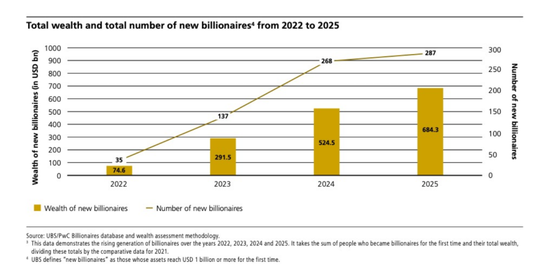
Group 1 - In 2025, China will see the addition of 70 new billionaires, bringing the total number of billionaires in mainland China to 470, ranking second in the world after the United States [2][19] - The total wealth of billionaires in mainland China has reached $1.8 trillion, reflecting a year-on-year growth of 22.2% [2][19] - The majority of new billionaires in China (98%) are self-made entrepreneurs, primarily from the IT and high-tech sectors, with a younger average age compared to billionaires in other regions [20][23] Group 2 - Globally, the number of billionaires increased by 287 to 2,919 in 2025, marking the second-highest growth since 2015, with total wealth rising by 13% to $15.8 trillion [3][20] - The Asia-Pacific region saw the largest increase in billionaires, growing from 981 to 1,036 [3][20] - The United States added 89 billionaires, totaling 924, which accounts for about one-third of the global billionaire population, with total wealth increasing by 18% to $6.9 trillion [3][20] Group 3 - The technology sector is experiencing significant growth, with total wealth among tech billionaires increasing by 23.8% to $3 trillion, driven by advancements in artificial intelligence [8][22] - The industrial manufacturing sector also saw a wealth increase of 27.1% to $1.7 trillion, while the financial sector's wealth grew by 17% to $2.3 trillion [8][22] - In contrast, the consumer and retail sector's wealth growth was slower, at 5.3% to $3.1 trillion, although it remains one of the top sectors for creating billionaires [8][22] Group 4 - Among the newly minted billionaires globally, 196 are self-made, accounting for 68.3% of the new billionaire population, with a total wealth increase of $386.5 billion [9][23] - The Asia-Pacific region has the highest proportion of self-made billionaires at 79%, with China having 98% of its billionaires being self-made [10][23] - Notable new billionaires include the founders of the Chinese tea chain Mixue Ice City and the founders of BYD in the industrial manufacturing sector [10][23] Group 5 - In 2025, 91 billionaires inherited wealth totaling $297.8 billion, marking a 36% increase from 2024 and setting a record for the largest inheritance scale [11][24] - The majority of inheritors are from Western Europe, with 48 inheritors collectively receiving $149.5 billion, significantly more than those in North America and Southeast Asia [11][24] - It is projected that over the next 15 years, billionaires' children will inherit at least $5.9 trillion, with significant amounts expected in the U.S. and China [11][24] Group 6 - There are currently 374 female billionaires globally, with their wealth growth rate being double that of male billionaires, averaging an 8.4% increase [13][27] - The primary source of wealth for female billionaires is the consumer and retail sector, where they hold approximately $619.9 billion [13][27] - In contrast, male billionaires derive most of their wealth from the technology sector, holding $2.9 trillion, with 98.1% being self-made [13][27] Group 7 - A growing number of billionaires are looking to China for investment opportunities, with 34% believing it offers the best prospects in the next 12 months, a significant increase from 11% in 2024 [14][28] - While North America remains a preferred investment region, its attractiveness has decreased, with 63% of billionaires seeing it as the best return opportunity, down from 80% in 2024 [14][28] - Over the next five years, 48% of billionaires view the Greater China region as the most attractive investment destination, up from 34% in 2025 [14][28] Group 8 - Billionaires are increasing their investments in alternative assets and gold, with 49% planning to boost private equity allocations and 43% looking to increase hedge fund investments [15][29] - Concerns among billionaires include tariffs (66%), geopolitical conflicts (63%), and policy uncertainty (59%), with regional differences in focus [15][29] - A significant portion of billionaires believe that the younger generation will face multiple global challenges, with 75% citing technology and AI as urgent issues [15][30]

钟慧娟,首次登顶中国女首富
Zheng Quan Shi Bao· 2025-10-30 04:50
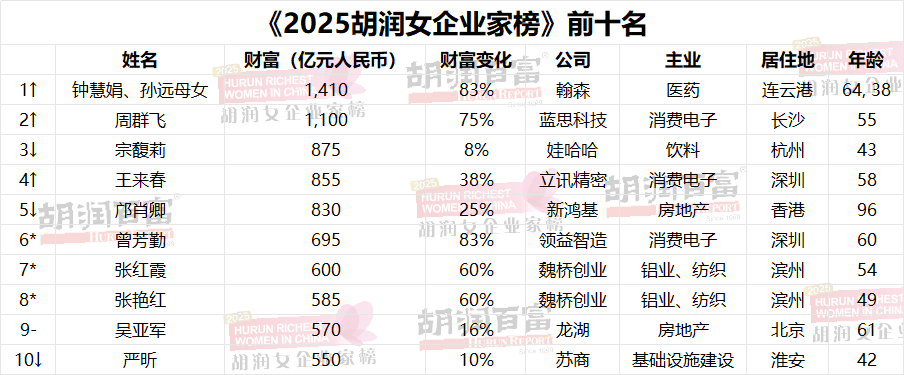
Core Insights - The 2025 Hurun Women Entrepreneurs List reveals that the total wealth of the top 50 female entrepreneurs in China reached 1.9 trillion yuan, a significant increase of 32% compared to last year [1] - The threshold for entry into the list has risen to 16 billion yuan, an increase of 40 million yuan (33%) from the previous year [1] - The average age of the top 50 female entrepreneurs is 60 years, which is 2 years older than last year, aligning with the average age of the top 50 male entrepreneurs on the Hurun Rich List [1] Company Performance - The wealthiest female entrepreneur, Zhong Huijuan of Hansoh Pharmaceutical, has a net worth of 141 billion yuan, marking an increase of 64 billion yuan (83%) from last year [3][4] - The second wealthiest, Zhou Qunfei of Lens Technology, saw her wealth grow by 47 billion yuan (75%) to 110 billion yuan, moving up three places in the rankings [4][5] - The third position is held by Zong Fuli of Wahaha, with a wealth of 87.5 billion yuan, who has shifted down two places from last year [5] Industry Distribution - The industrial products sector remains the largest source of wealth for female entrepreneurs, accounting for 15% of the top 50 [7][8] - The real estate sector follows closely with a 13% share, while the life and health sector ranks third at 12% [7][8] - Food and beverage, as well as non-ferrous metals and mining, each represent 10% of the industry distribution among the top female entrepreneurs [7][8] Wealth Source - 66% of the female entrepreneurs on the list are self-made, an increase from 58% last year, while 34% inherited their wealth, down from 42% [9]

你努力,但還是窮|因為這3道財富地獄太難破!
堆金積玉· 2025-10-19 11:01
一旦掌握這7個人生複利公式,你的人生將開始快速成長 https://youtu.be/Uz0awqTLJeA 會員頻道的內容會依照這7個公式,一步步陪你實踐 👉 加入會員頻道,從第1個公式開始實踐:https://bit.ly/goldenrich-members ☕️ 如果你想免費支持我們,這裡有個簡單的方法: 👉 https://bit.ly/GET-IBKR 🙏 點擊連結沒有任何費用,每次點擊都能幫助支持我們的頻道。IB盈透證券:全球領先、備受信賴的投資平台,交易覆蓋150個市場,低成本、資金靈活,是多元化投資的理想選擇! (Disclosures: https://bit.ly/content-disclosure) 你努力,但還是窮|因為這3道財富地獄太難破! 你知道嗎?根據瑞銀集團最新的《全球財富報告》,到2025年,全世界會有超過五千兩百萬個百萬富翁。而更驚人的是,其中有八成是白手起家! 也就是說,他們沒有富爸爸、沒有人脈、沒有背景,全靠自己從零開始,闖出一條財富自由的路。他們到底怎麼做到的?又是靠什麼突破了那道「階層的隱形牆」? 🔔 貼心提醒 訂閱後不要忘記按旁邊的鈴鐺 才不會錯過最新上傳的節 ...

白手起家的6種常見致富方式!選對一個,你也能成為富一代🔥(最後一個太狠)
堆金積玉· 2025-10-18 11:01
Main Argument - The video promotes the idea that financial success is primarily determined by personal choices rather than background [1] - It highlights that a significant majority (67%) of billionaires globally are self-made [1] Actionable Advice & Resources - The video encourages viewers to join a membership channel for practical guidance on applying "7 formulas" for personal growth [1] - It provides a link to IBKR (Interactive Brokers) as a suggested investment platform [1] Disclaimers - The content is for educational purposes only and should not be considered financial advice [1] - Investment involves risks, and individuals are responsible for their own research and investment decisions [1]