
水下智能装备

Search documents
水下智能装备企业潜行创新获近亿元C轮融资,持续夯实全球轻型水下机器人领先地位
机器人圈· 2026-03-19 10:14
Core Viewpoint - Shenzhen Qianxing Innovation Technology Co., Ltd. has completed nearly 100 million RMB in C-round financing, led by Liwan Capital, to enhance core technology R&D, product iteration, supply chain upgrades, and market expansion [2][9]. Company Overview - Established in 2016, Qianxing Innovation focuses on underwater intelligent equipment, including industry-level and consumer-level underwater robots, portable aquatic intelligent unmanned equipment, and related solutions [2]. - The company has developed a diverse product matrix covering industry-level ROVs, consumer underwater drones, pool cleaning robots, and intelligent fishing drones, and has been recognized as a national "little giant" enterprise [2][5]. - With over 300 employees and more than 400 domestic and international intellectual property rights, the company has launched 8 generations of core products and received over 100 awards globally [2]. Industry Context - The underwater robotics industry is evolving from niche professional equipment to broader industrial and scalable applications, driven by the development of the marine economy and increasing demand for aquatic intelligence [3]. - Capital market interest in underwater intelligent equipment companies with product capabilities, engineering capabilities, and global potential is on the rise [3]. Technological Development - Qianxing Innovation is leveraging Shenzhen's mature hardware supply chain to build core capabilities in flight control systems, motion control, propulsion systems, underwater image processing, and mass production [5]. - The company is innovating by reconstructing underwater robots through electronic, lightweight, and intelligent approaches, moving away from traditional heavy marine equipment logic [5]. - The focus is on enhancing underwater perception, cognition, and autonomous decision-making capabilities, with ongoing advancements in smart anti-flow, control experience optimization, and underwater imaging [6]. Market Positioning - The company has established a clear layout in multiple niche markets, applying its products in emergency rescue, hull inspection, environmental monitoring, and consumer-level underwater imaging and cleaning [8]. - Qianxing Innovation serves over 100 countries and regions globally, building a strong channel foundation and brand recognition in key overseas markets [8]. Future Plans - Post-financing, the company aims to strengthen three areas: core technology R&D and next-generation underwater intelligent robot platform development, product iteration and solution implementation, and supply chain and manufacturing system enhancements [8]. - The CEO emphasized the importance of this financing round as recognition of the potential in underwater technology and the company's core competitiveness, aiming to enhance global market solutions and contribute to China's high-quality marine economy [9][10].


深之蓝完成IPO辅导 “水下大疆”即将冲刺科创板
Xi Niu Cai Jing· 2025-12-23 05:32
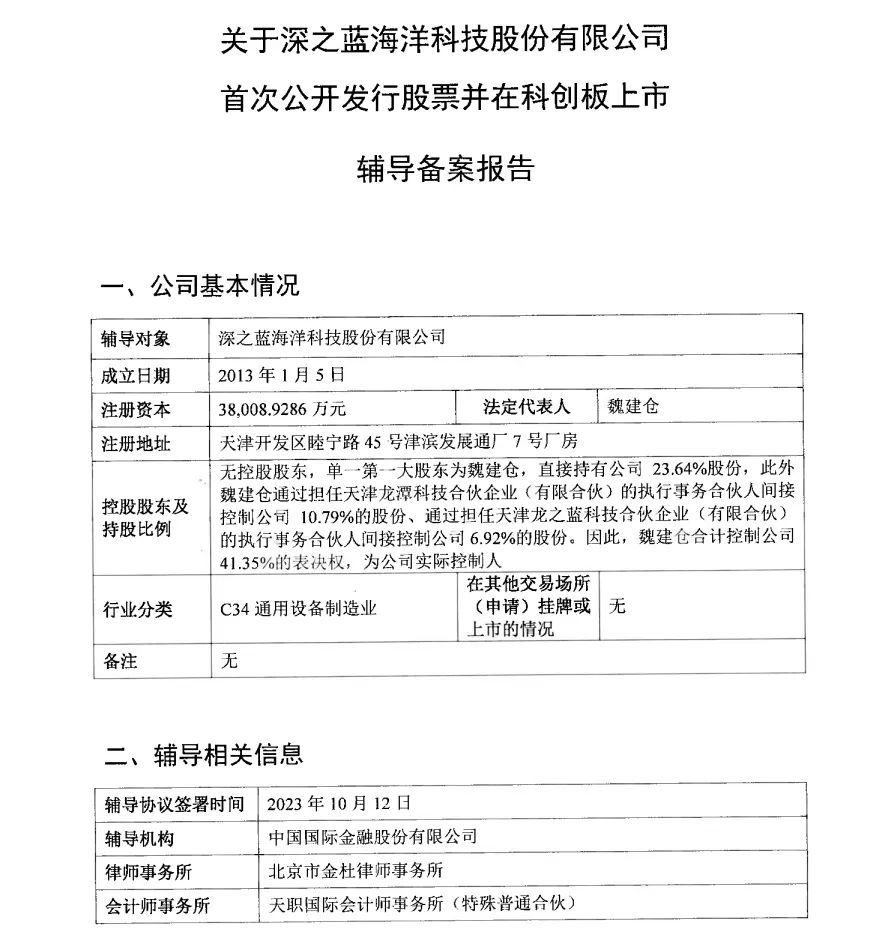
Group 1 - The core point of the news is that Deep Blue Ocean Technology Co., Ltd. has changed its IPO guidance status to "Acceptance of Guidance," aiming to list on the Sci-Tech Innovation Board after two years of guidance work [2][3] - Deep Blue was established in 2013 and focuses on the research, production, and sales of underwater intelligent equipment, covering both industrial and consumer segments [3] - The company has participated in significant national projects, including Arctic scientific research and emergency support for the Shenzhou spacecraft, showcasing its industrial-grade products like ROVs and AUVs [3] Group 2 - Deep Blue's consumer brand, Sublue, claims over 60% of the global market share in underwater propulsion devices, with 70% of its revenue coming from overseas markets [3] - The company has raised over 1.3 billion yuan in historical financing, attracting investments from over 30 institutions, but has a dispersed shareholding structure with the actual controller holding only 23.64% [3] - Analysts suggest that to sustain its high valuation, Deep Blue needs to move beyond a hardware sales model and create a "hardware-content-ecosystem" closed loop, emphasizing the importance of cost control and scalability in its IPO process [3] Group 3 - Deep Blue's IPO attempt represents a significant challenge in the underwater intelligent equipment sector, particularly in the context of the growing "blue economy" concept [3] - The company must find a balance between technological barriers, market expansion, and ecosystem construction to succeed in its IPO journey [3]

深之蓝完成IPO辅导拟冲刺科创板,工业消费双线布局成果显著
Sou Hu Cai Jing· 2025-12-17 14:44
Core Insights - Deep Blue Ocean Technology Co., Ltd. has made significant progress in its IPO journey by submitting the completion report of its counseling work to the Tianjin Securities Regulatory Bureau, marking a new phase in its listing process after over two years since its IPO counseling filing in October 2023 [1] Company Overview - Established in 2013, Deep Blue focuses on underwater intelligent equipment, forming a complete industrial chain that includes independent research and development, production, and sales [2] - The product matrix includes cable-controlled underwater robots (ROV), autonomous underwater vehicles (AUV), underwater gliders (AUG), and buoy systems, which are widely used in six major fields: marine safety monitoring, marine engineering operations, emergency rescue actions, water conservancy facility maintenance, marine scientific research, and marine tourism projects [2] Market Strategy - Deep Blue employs a "dual-wheel drive" strategy, targeting both industrial (B2B) and consumer (B2C) markets [3] - In the industrial sector, its underwater robots are essential tools for research institutions, engineering companies, and rescue departments, while the consumer brand Sublue, established in 2016, offers underwater propulsion devices and smart products [3] - Sublue has achieved global sales of over 150,000 underwater propulsion devices, capturing 60% of the market share and exporting to over 70 countries [3] Competitive Landscape - The global diving equipment market is dominated by international brands such as Scubapro, Mares, Cressi, and Aqualung, which leverage technological barriers and brand premiums to maintain high-end market positions [3] - Chinese brands like Sublue are disrupting this landscape through three strategies: technological innovation, cost advantages via efficient supply chains, and leveraging cross-border e-commerce platforms [3] Financial Overview - Deep Blue has completed over 13 billion yuan in financing since its inception, attracting investments from over 30 notable institutions, including Shunwei Capital and Source Capital [4] - The company has a research and development team of approximately 200 people focused on key technologies such as underwater navigation, power systems, and intelligent control [4]

“水下大疆”深之蓝IPO前瞻:影石创新市值破千亿元后,蓝色海洋能否游出下一个相机细分领域巨头?
Mei Ri Jing Ji Xin Wen· 2025-08-19 09:27
Core Insights - The article highlights the emergence of underwater intelligent equipment as a promising investment opportunity, particularly with the upcoming IPO of Deep Blue Ocean Technology Co., Ltd. [1] - The underwater robotics market in China is projected to reach 167 billion yuan in 2024, with a 25% annual growth rate, potentially exceeding 630 billion yuan by 2030 [5][6] - Deep Blue has established itself as a leader in the industry, holding nearly 65% of the global market share for underwater propulsion devices [6] Company Overview - Deep Blue was founded in 2013 and specializes in the research, development, manufacturing, and sales of underwater intelligent equipment [2] - The company has a strong shareholder base and has completed multiple rounds of financing, raising over 1.3 billion yuan since its inception [6] - The founder, Wei Jiancang, transitioned from a stable government job to pursue opportunities in the underwater robotics sector, which was largely untapped in China at the time [7][9] Market Potential - The underwater robotics market is characterized as a "blue ocean," contrasting with the saturated drone market, indicating significant growth potential [5] - The market spans both industrial applications (e.g., oil and gas exploration, emergency rescue) and consumer segments (e.g., underwater sports and entertainment) [5][6] - The increasing popularity of underwater activities and social media sharing is expected to create a new entertainment market worth billions [5] Competitive Landscape - Deep Blue has set industry standards, such as the national standard for underwater propulsion robots, positioning itself as both a player and a regulator in the market [6] - The company’s strategy involves initially focusing on high-tech industrial products before expanding into consumer markets [10] - Competitors include established brands like GoPro, but Deep Blue differentiates itself through its comprehensive product offerings and solutions rather than just hardware [12] Challenges and Considerations - The company faces challenges related to technology, market dynamics, and ecosystem integration, which will be critical for its long-term success [10] - The underwater imaging market has unique constraints, such as seasonal usage and maintenance requirements, which may limit consumer demand compared to terrestrial sports [11] - Future observations will focus on the company's IPO documentation and order structure to assess its market viability [12]
加强经验分享和复制推广,市场监管总局公布质量技术帮扶典型案例
Xin Jing Bao· 2025-08-06 06:06
Core Insights - The article discusses the efforts of various local market regulatory authorities in China to enhance product quality and support industries through targeted assistance programs [1] Group 1: Quality Improvement Initiatives - The State Administration for Market Regulation has launched a series of quality technical assistance activities to address enterprise pain points and improve production processes [1] - The Taizhou market regulatory bureau has implemented a comprehensive quality improvement plan for the snow boot industry, which includes a tiered regulatory system and targeted training sessions for over 100 enterprise personnel [2][3] - The Chongqing market regulatory bureau has established a comprehensive support system for the electric motorcycle industry, integrating quality, standards, and certification to enhance competitiveness and export capabilities [4][5] Group 2: Industry-Specific Support - The Binzhou market regulatory bureau has organized over 30 training sessions to improve management capabilities in the commercial kitchenware industry, which has over 2,800 enterprises and accounts for 42.5% of the national market share [7][8] - The Xiamen market regulatory bureau has focused on the energy storage battery industry, identifying 151 quality issues and implementing a quality improvement mechanism to enhance production standards [9][10] - The Beijing market regulatory bureau has initiated a reliability innovation program to improve product quality reliability across key industries, including machinery and electronics [12][13] Group 3: Measurable Outcomes - The snow boot industry in Taizhou has seen a 30% increase in order volume and a rise in the first-time pass rate of product inspections from 60% to 95% due to the implemented support measures [3] - The commercial kitchenware industry in Binzhou has improved the product quality inspection pass rate by 15% and reduced quality-related legal cases by 12% [8] - The energy storage battery industry in Xiamen has achieved a 99.1% self-inspection pass rate and a 32% reduction in customer complaints [11]
晶采观察丨从“绿色”出发 驶向海洋经济新蓝海
Yang Guang Wang· 2025-06-08 07:56
Group 1 - The core theme of the article emphasizes the transition of the marine economy towards a "green" model, highlighting the ecological improvements and the potential for sustainable development [1][2] - China's marine economy is projected to exceed 10 trillion yuan in total output by 2024, accounting for 7.8% of GDP, indicating strong growth resilience and potential [1] - The number of registered deep-sea technology-related enterprises in China has surpassed 10,000, with a total of 172,700 such companies, nearly 60% of which were established within the last three years [1] Group 2 - Various regions are showcasing innovative practices, such as Fujian's initiatives in fishery carbon sinks, transforming "blue pastures" into extensive "carbon pools" [2] - The integration of marine tourism and ecological protection is evident, with tourism revenues being reinvested into ecological restoration and industrial upgrades, promoting a harmonious relationship between economy and environment [2] - The article calls for strategic long-term planning to ensure the sustainable development of deep-sea industries, contributing to China's high-quality economic growth [2]