生物材料

Search documents
破维权痛点 筑创新高地
Xin Lang Cai Jing· 2026-02-25 23:03
Core Viewpoint - Zhejiang Province's judicial system has made significant strides in enhancing intellectual property (IP) protection, thereby fostering a better business environment and supporting innovation [7][8][12]. Group 1: Intellectual Property Protection Initiatives - In June 2025, the Yiwu City Prosecutor's Office provided legal education on IP protection to foreign businesses [3]. - The Hangzhou Binjiang District Prosecutor's Office developed pre-litigation compensation schemes to address challenges in recovering losses from IP infringements [5]. - The Wu Xing District Prosecutor's Office in Huzhou held discussions with affected enterprises, highlighting the effective role of prosecutors in helping businesses recover from losses due to IP violations [7]. Group 2: Achievements in IP Enforcement - Zhejiang's prosecutors have implemented a comprehensive approach to IP protection, resulting in notable successes in safeguarding innovation and compensating losses [7][8]. - The province's experience in enhancing the criminal compensation mechanism for IP cases was recognized as a national model, being the only one from the national prosecutor system to receive this honor [7]. - From February 2024 to May 2025, over ten individuals were prosecuted for crimes related to trademark infringement, with sentences ranging from one year and three months to four years and six months [10]. Group 3: Case Studies and Legal Actions - A case involving a high-tech company revealed that the use of counterfeit components led to significant operational issues, prompting prosecutors to guide law enforcement in a comprehensive investigation [9]. - In a separate case, a competitor was found guilty of stealing trade secrets, leading to a thorough investigation and subsequent prosecution [11]. - The prosecutors have successfully facilitated compensation for 754 companies, amounting to over 360 million yuan since 2024, through pre-litigation compensation mechanisms [15]. Group 4: Focus on Foreign IP Cases - Zhejiang has seen a rise in foreign IP protection needs, prompting the judicial system to enhance its capabilities in handling such cases effectively [16]. - A case involving counterfeit medical devices highlighted the importance of swift legal action to protect consumer health and corporate interests [16]. - The prosecution of individuals involved in the sale of counterfeit products demonstrated the effectiveness of a coordinated approach in dismantling criminal networks [18]. Group 5: Future Directions - The Zhejiang Provincial Prosecutor's Office aims to continue improving the quality and efficiency of IP protection, contributing to the establishment of a robust IP environment in the province [19]. - The focus will remain on enhancing legal supervision and fostering an ecosystem conducive to innovation and business growth [19].

绿电、智算、低空商机满满!阳东喊你来做“投资合伙人”
Xin Lang Cai Jing· 2026-02-25 08:43
Core Viewpoint - Yangdong District is actively promoting high-quality economic development through a modern industrial system and inviting investment to enhance its economic landscape [1][2]. Investment and Economic Growth - Yangdong achieved an average annual growth of 9% in fixed asset investment during the 14th Five-Year Plan, with a remarkable 77% year-on-year increase in 2025, ranking among the top in the province and city [1][2]. - The district is focusing on the "Operation Improvement" initiative to attract more private capital and social forces for economic growth [1][2]. Green Energy Development - Yangdong is rapidly advancing its green energy sector, establishing a comprehensive supply system that includes nuclear, wind, solar, storage, hydrogen, and installation [2][4]. - By 2025, the green energy generation capacity is expected to exceed 560 billion kilowatt-hours, making Yangdong a significant clean energy supplier in the Guangdong-Hong Kong-Macao Greater Bay Area [4][6]. Industrial Structure and Modernization - The district is constructing a "1+3+3+X" modern industrial system, focusing on clean energy, traditional industries, and emerging sectors [9]. - The green energy demonstration industrial park is set to attract companies impacted by international green trade rules, targeting industries such as new energy vehicles, energy storage, and green appliances [8][12]. Infrastructure and Support Services - Yangdong is enhancing its infrastructure with significant investments in roads and sewage systems to improve business conditions for local enterprises [29][30]. - The government is committed to optimizing the business environment, with initiatives to streamline administrative processes and provide comprehensive support services for entrepreneurs [25][27]. Emerging Industries - The district is fostering new industries such as low-altitude economy, green computing, and biobased materials, with several major projects underway [16][24]. - Investments in green computing and biobased materials are expected to yield substantial economic benefits, with projects like the green computing center projected to generate significant annual revenue [22][24].

海正生材(688203)披露股东减持股份计划公告,2月24日股价上涨0.75%
Sou Hu Cai Jing· 2026-02-24 11:16
Group 1 - The core point of the article is the announcement of a share reduction plan by Zhejiang Haizheng Biological Materials Co., Ltd., where Sinopec Capital intends to reduce its holdings due to funding needs for business development [1] - As of February 24, 2026, Haizheng's stock closed at 13.46 yuan, with a market capitalization of 2.728 billion yuan, and a trading volume of 47.9582 million yuan [1] - Sinopec Capital holds 10,788,194 shares, representing 5.32% of the total share capital, and plans to reduce up to 2,026,700 shares, which is no more than 1% of the total share capital [1] Group 2 - The reduction period is set from March 17, 2026, to June 16, 2026, and the selling price will be determined by market conditions [1] - The share reduction will not lead to a change in the company's control or significantly impact its governance structure and ongoing operations [1]

材料合成生物学新突破!柏垠生物创始人钟超团队打造“可编程”生物纤维素平台
synbio新材料· 2026-02-06 06:27
Core Viewpoint - The article discusses a novel "bio-orthogonal functionalization" platform developed by a research team from the Shenzhen Institute of Advanced Technology, which allows for the modular integration of various bioactive functions into bacterial cellulose (BC), transforming it from a static material into a programmable platform for diverse applications in regenerative medicine, biosensing, and environmental remediation [2][5][14]. Group 1: Platform Development - The research team has successfully constructed a universal platform that combines metabolic glycoengineering and click chemistry, enabling the transformation of BC into a programmable "active base" for multi-functional integration [2][5]. - This platform allows researchers to covalently "install" functional molecules of different scales, from small drug molecules to large protein enzymes, into the cellulose network, thus customizing the material's bioactivity [5][11]. Group 2: Functionalization Strategy - The team proposed a two-step biomimetic strategy: first, "material encoding" during the synthesis phase by incorporating non-natural sugar molecules with chemical handles into the cellulose framework, and second, "click assembly" during the application phase to modularly attach various functional molecules [6][10]. - The core advantage of this strategy is its "bio-orthogonality," which ensures that the introduced azide groups remain stable during fermentation and do not interfere with biological systems, while the subsequent click reactions are mild enough to preserve the activity of functional molecules [10][11]. Group 3: Functional Validation - The platform has been validated by integrating various functional materials, including: - Small molecule antibacterial agents that provide light-responsive antibacterial capabilities [11]. - Cell adhesion peptides that significantly enhance fibroblast adhesion, spreading, and proliferation, transforming the material into a "cell-friendly base" for tissue repair [11]. - Large protein integration, achieving stable functional output and biocatalytic ability through innovative light-catalyzed alkyne modification strategies [11][12]. Group 4: Application Scenarios - The platform's capability to address complex biomedical issues is exemplified by its application in diabetic chronic wounds, where therapeutic enzymes were co-assembled on a single BC dressing to create a "micro metabolic regulator" [12][13]. - The dual-enzyme functionalized dressing demonstrated superior wound closure rates and tissue regeneration compared to traditional materials in diabetic mouse models, showcasing the platform's potential for modular integration and synergistic output [13]. Group 5: Future Prospects - The research establishes a highly versatile and modular BC-based biomaterial functionalization platform, merging programmable design with precise synthesis, allowing for both the empowerment of key functions and the expansion of multi-functional modules [14]. - Future applications may extend beyond biomedical materials to include diverse functional modules such as sensing molecules, catalytic enzymes, and conductive polymers, potentially leading to new technological pathways in biosensing, green catalysis, flexible electronics, and environmental remediation [14].

柏垠生物重组贻贝粘蛋白绿色生物制造:突破产业瓶颈,引领生物材料绿色革新
Jing Ji Guan Cha Wang· 2026-01-27 07:18
Core Insights - The company, Baiyin Biotechnology, focuses on the development of innovative biomaterials, leveraging high-throughput synthetic biology and artificial intelligence to create sustainable and low-cost solutions in the biomaterials sector [1] Group 1: Company Overview - Baiyin Biotechnology has successfully launched several core products, including recombinant mussel adhesive protein, Colamin sodium alginate, and fibronectin, gaining recognition from multiple Fortune 500 companies [1] - The company has completed nearly 300 million yuan in financing, with investments from notable institutions such as Wu Bo Lian Guang Pharmaceutical Fund and Wuyuan Capital, providing solid support for technological research and industrialization [1] Group 2: Product Innovation - The recombinant mussel adhesive protein, known as "marine soft gold," has significant value in wound care and medical aesthetics, but traditional production methods face challenges such as low yield and high resource consumption [2] - Baiyin Biotechnology has developed a green biomanufacturing system for recombinant mussel adhesive protein using synthetic biology, achieving the highest yield strains globally, which can replace billions of mussels in extraction [2] - The company has addressed application challenges such as compatibility and discoloration, creating multi-scenario solutions and establishing a robust intellectual property system to ensure product safety and stability [2] Group 3: Industry Impact - The project has established Baiyin Biotechnology as the first company in China to complete the medical device raw material filing for recombinant mussel adhesive protein and to lead the formulation of the first related group standard, filling a gap in the industry [2] - By March 2025, the company is expected to receive multiple medical device product registrations centered on recombinant mussel adhesive protein, launching a comprehensive series of products for wound care and mucosal repair [2] - The project transforms the traditional model reliant on natural resource extraction, setting a benchmark for "green alternatives to traditional methods," significantly reducing production costs and promoting the accessibility of high-performance biomaterials [2][3]
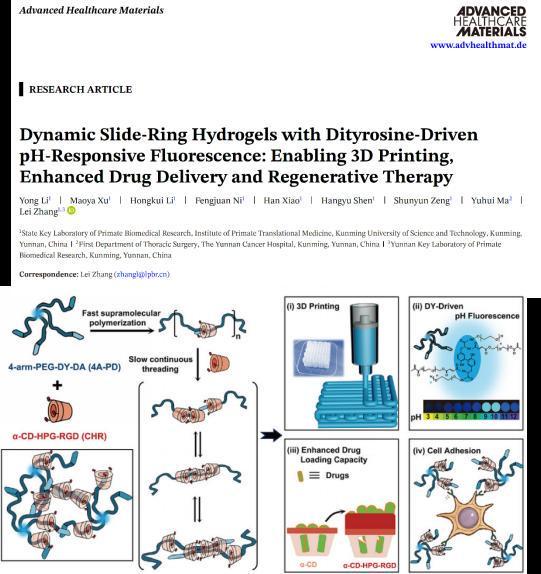
新型多功能智能水凝胶成功研发
Huan Qiu Wang Zi Xun· 2026-01-26 01:23
Core Viewpoint - The research team at Kunming University of Science and Technology has developed a novel dynamic sliding ring hydrogel that integrates multiple functions such as wound monitoring, precise fitting, and drug release, providing a new solution for regenerative medicine and precision healthcare [1][4]. Group 1: Hydrogel Composition and Mechanism - The hydrogel is constructed using a supramolecular host-guest interaction mechanism, consisting of two self-developed material components: a four-armed polyethylene glycol di-tyrosine as the guest component and a hyperbranched poly-glycerol modified α-cyclodextrin functionalized with arginine-glycine-aspartic acid peptide as the host component [1][4]. - These components form a dynamic network structure through special interactions, endowing the hydrogel with unique properties such as shear-thinning and rapid self-healing [1][4]. Group 2: Clinical Applications and Benefits - The hydrogel can be extruded for 3D printing at room temperature, allowing precise adaptation to complex wound shapes, addressing the challenge of traditional medical materials that struggle to conform to irregular wounds [4]. - The di-tyrosine core provides pH-responsive fluorescence sensing capabilities, enabling real-time feedback on pH fluctuations in the wound microenvironment, which aids healthcare professionals in assessing infection and inflammation levels visually [4]. - The application of hyperbranched poly-glycerol modification significantly enhances the hydrogel's drug loading capacity and sustained release effects for antibiotics like tobramycin, maintaining localized antibacterial activity [4][5]. Group 3: Performance and Innovation - In tests using a full-thickness infected wound model in rats, the hydrogel demonstrated excellent antibacterial properties and tissue regeneration promotion, effectively regulating inflammatory factor expression and enhancing collagen deposition and angiogenesis, thereby accelerating wound healing [4]. - This multifunctional smart hydrogel, which integrates pH-responsive fluorescence sensing, 3D printing adaptability, efficient drug loading, and biological activity, overcomes the limitations of traditional single-function medical materials, providing an integrated solution for wound healing monitoring, infection prevention, and tissue regeneration [5]. - The design concept offers significant reference for the innovative application of smart biomaterials in regenerative medicine and precision healthcare, indicating a broad clinical translation prospect [5].
实现生物基PHA材料全产业链闭环!麦得发生物完成B轮融资!
synbio新材料· 2026-01-14 06:32
Core Viewpoint - Zhuhai Maidefa Biotechnology Co., Ltd. has completed a Series B financing round, primarily aimed at the research and production of PHA (polyhydroxyalkanoates) and global market expansion [1][2]. Group 1: Company Overview - Maidefa was established in 2019, focusing on the research, development, production, and commercialization of the next generation of fully biodegradable materials, specifically PHA and high-value health small molecules [2]. - The company has developed a complete industrial chain from upstream strain engineering to downstream product application, achieving open, continuous fermentation production and large-scale manufacturing of PHA [2][4]. Group 2: Product Features and Applications - The newly developed PHA bio-materials possess excellent thermoplastic processability, mechanical properties, biodegradability, biocompatibility, and high barrier characteristics, applicable in diverse fields such as food packaging, electronic packaging, 3D printing, drug release carriers, absorbable medical devices, and new food materials [4]. - Medical-grade PHA has successfully broken foreign monopolies and received multiple international certifications, addressing the industry pain point of non-degradable petroleum-based materials [4]. Group 3: Market Potential - With ongoing breakthroughs in synthetic biology technology and decreasing production costs, PHA production capacity is expected to increase rapidly, potentially reaching nearly 1 million tons globally by 2029, accounting for about 25% of the total capacity of biodegradable plastics [4]. - The upcoming "5th China Synthetic Biology and Bio-Manufacturing Conference" will be held in Hangzhou, featuring a session on bio-based chemicals and materials, inviting experts and industry practitioners for discussions [4].

“陕”耀新程——陕西上市公司产业升级的四种实践
Shang Hai Zheng Quan Bao· 2026-01-12 19:11
Core Insights - Shaanxi province is witnessing a transformation in its capital market, shifting from resource-driven growth to innovation and technology-driven development, with a focus on high-tech industries and global competitiveness [1][2][3] Group 1: Company Developments - As of January 12, 2026, Shaanxi has 84 A-share listed companies, with over half being high-tech enterprises, which are crucial for high-quality development [2] - Notable companies such as Kangtuo Medical, Nova Star Cloud, Tongli Co., and Lite Optoelectronics are emerging as leaders in their respective niches, focusing on advanced R&D and global market strategies [1][2] - Kangtuo Medical's PEEK materials are registered in nearly 40 countries, while Nova Star Cloud serves over 4,000 clients with its video solutions, showcasing the global reach of Shaanxi enterprises [2] Group 2: R&D and Investment - In 2024, the total R&D investment of A-share listed companies in Shaanxi exceeded 12 billion yuan, with an average R&D intensity of 8.75% among Sci-Tech Innovation Board companies, ranking among the top in the country [2] - The focus on high R&D intensity reflects a long-term commitment to innovation, positioning these companies for future market leadership [2][3] Group 3: Strategic Direction - Shaanxi companies are increasingly adopting a global perspective, not only expanding their markets but also exporting technology standards and brand value [2] - The development path for these companies involves overcoming technical barriers through sustained R&D, leading to market breakthroughs and ultimately enabling them to compete globally [3][4] Group 4: Innovation Ecosystem - The growth of Shaanxi's capital market is supported by initiatives like the "Qin Chuang Yuan" innovation platform and reforms in technology transfer, facilitating the conversion of academic research into industrial applications [4] - There are over 520 key listed companies in Shaanxi, with 96.54% being technology-oriented, indicating a robust pipeline of future growth in sectors like aerospace, semiconductors, and advanced materials [4]


生物基PHA材料企业完成新一轮融资
DT新材料· 2026-01-11 23:28
Core Viewpoint - The article discusses the recent B-round financing of Zhuhai Maidefa Biotechnology Co., Ltd. (referred to as "Maidefa"), highlighting its unique positioning in the pharmaceutical and PHA (polyhydroxyalkanoates) materials market, and the strategic partnerships that support its growth [4][7][8]. Financing and Growth - Maidefa successfully completed its B-round financing, with investments from China Taiping Innovation and Guangzhou Pharmaceutical Capital, although the specific amount remains undisclosed [4][7]. - The company has a history of financing rounds, including an angel round in March 2021, a series A round in May 2022, and an A+ round in December 2023, indicating a steady growth trajectory [5][6]. Product Lines and Market Position - Maidefa operates three main product lines: industrial-grade PHA, medical-grade PHA, and beta-hydroxybutyrate (β-HB), which together form a complete PHA value chain [14]. - The industrial-grade PHA is used in biodegradable packaging and has gained recognition from major companies like Walmart and Costco [16]. - The medical-grade PHA is a core differentiator for Maidefa, making it the world's first supplier of medical-grade PHA materials, with necessary regulatory approvals from both China and the USA [18]. - The beta-hydroxybutyrate product, branded as "Sainao Si," targets brain health and has been launched in markets including Macau and the USA [19]. Strategic Partnerships - Maidefa's third-largest shareholder is Lijun Pharmaceutical Group, which has been involved since the company's inception, indicating a deep-rooted strategic alignment in the pharmaceutical sector [10][12]. - Guangzhou Pharmaceutical Capital's investment is expected to provide not only financial support but also additional resources in the pharmaceutical domain, enhancing Maidefa's market capabilities [13]. Milestones and Future Plans - The company has achieved significant milestones, including the establishment of a cleanroom for medical-grade PHA production and the expansion of its production capacity for industrial-grade PHA [23][25]. - The successful completion of the B-round financing is seen as a new impetus for Maidefa's industrialization in the PHA sector, reinforcing its dual strategy of "pharmaceutical + PHA" [27].

焦点访谈 | 李博洋:细胞“打工”造万物 解码生物制造的产业潜能
Xin Lang Cai Jing· 2026-01-08 11:43
Core Insights - The article discusses the emerging field of biomanufacturing, which is recognized as one of the six future industries in China's 14th Five-Year Plan, highlighting its potential to transform various sectors through innovative production methods [11][32][34]. Group 1: Definition and Process of Biomanufacturing - Biomanufacturing involves utilizing biological entities, such as microorganisms and plant or animal cells, to metabolize raw materials into desired products, effectively turning cells into small factories [5][26]. - The process includes maintaining optimal conditions for cell growth, such as temperature and pH, and providing sufficient nutrients like carbon dioxide and hydrolyzed agricultural waste [5][26]. - The production capabilities of biomanufacturing can replace traditional agricultural methods, as seen with artemisinin production, which can be synthesized in a single container rather than requiring extensive farming [32][34]. Group 2: Market Potential and Industry Growth - The biomanufacturing industry in China reached a total scale of 1.1 trillion yuan during the 14th Five-Year Plan period, indicating significant growth potential [11][32]. - China's unified large market and comprehensive manufacturing system provide a strong foundation for developing new fields such as bio-based materials and biopharmaceuticals [34]. - The integration of biomanufacturing with over two-thirds of existing industries, including traditional chemical sectors, presents opportunities for efficiency improvements and greener production methods [34]. Group 3: Technological Advancements and Innovations - Recent breakthroughs in life sciences and synthetic biology, including gene sequencing and editing technologies, are being widely applied in biomanufacturing, leading to transformative changes in production methods [9][30]. - The establishment of national key laboratories and innovation platforms has positioned China as a leader in biomanufacturing research, with over 20% of global publications and patent applications in this field [36][37]. - The development of artificial intelligence-assisted tools for synthetic biology is enhancing the efficiency of strain design and selection processes, facilitating the production of specific therapeutic compounds [34][36]. Group 4: Infrastructure and Support for Startups - The construction of pilot testing platforms is crucial for supporting biomanufacturing startups, allowing them to transition from laboratory research to large-scale production [39][41]. - Regions like Hunan are investing in infrastructure to support biomanufacturing, including a 330-acre acceleration factory set to accommodate multiple startups for large-scale production by 2026 [39][41]. - Local governments are also creating supportive regulations and funding mechanisms to foster the growth of biomanufacturing clusters, enhancing the industry's long-term viability [41]. Group 5: Future Outlook - The rapid development and market expansion of biomanufacturing in China indicate a promising future, with ongoing efforts to innovate and apply biomanufactured products across various sectors [22][43].