
电力与天然气

Search documents
中金:“被忽略”的牛市
中金点睛· 2025-11-18 00:13
Core Viewpoint - The article discusses the current market dynamics driven by liquidity and the potential limitations of this bull market, drawing parallels with Japan's past market behavior during the 1990s [2][14][58]. Market Performance - Since the policy shift on "September 24," the domestic market has rebounded significantly, with the Shanghai Composite Index and Hang Seng Index rising by 47% and 50% from their lows, respectively [2]. - The current valuation of the Hang Seng Index stands at a dynamic PE of 11.6, which is above the historical average, indicating that certain high-growth sectors may no longer be considered cheap [2][6]. Valuation Comparisons - While the Hang Seng Index appears cheaper than the S&P 500's dynamic valuation of 22.3, this comparison lacks context regarding profitability and liquidity conditions [6][8]. - The article highlights that the median PE of leading Chinese tech companies is 17.8, which is higher than their median net profit margin of 9.6%, suggesting potential overvaluation in some sectors [6][8]. Economic Indicators - Post-August, domestic demand indicators have weakened, and recent financial credit data supports the view that the credit cycle may be turning downward in the fourth quarter [9][11]. - The article notes that risk premiums in traditional sectors like finance and real estate have dropped below historical averages, while new consumption and innovative pharmaceuticals are stabilizing around historical means [9][11]. Historical Context: Japan's Bull Markets - The article analyzes Japan's three bull markets in the 1990s, which were characterized by significant government stimulus and external economic trends, yet ultimately faced limitations due to structural issues and market sentiment [14][58]. - Each of Japan's bull markets was initiated by substantial fiscal stimulus, with the first round starting in 1992, leading to a 54% rebound over 12.8 months [19][33]. Investor Behavior - During Japan's first bull market, individual investors' participation surged, while foreign investors' share declined, indicating a shift in market sentiment [28][30]. - The second bull market saw a similar pattern, with individual investor enthusiasm waning as foreign investor participation increased [40][42]. Conclusion and Implications - The article concludes that while liquidity can drive market rallies, without substantial improvements in the underlying economy, these rallies may face ceilings [58]. - It suggests that to break through current market limitations, structural policy changes focusing on technology and income expectations are necessary, rather than relying solely on traditional fiscal measures [67].


海外需求行业盈利强劲,日股三季报开局强劲
Hua Er Jie Jian Wen· 2025-11-04 07:31
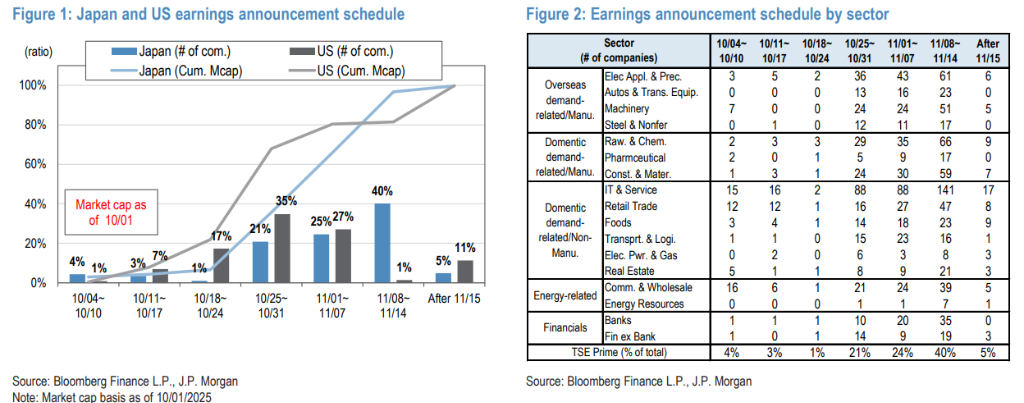
Core Insights - The core driver of profit momentum in Japan's Q3 performance is overseas demand, while domestic sectors remain relatively weak [1][5][6] - Approximately 30% of companies in the Tokyo Stock Exchange Prime market have reported Q3 results, showing significant improvement over Q2, with revenue up 2.8%, operating profit up 11.0%, and net profit up 28.7% year-on-year [1][5] Sector Performance - The electronics and precision instruments sector, including companies like Hitachi, Fujitsu, NEC, and Advantest, has been a major contributor to net profit growth, alongside the power and gas sector [5] - In contrast, the automotive sector saw a net profit decline of 0.6%, and the food sector experienced a slight drop of 0.1% due to weak consumer demand [5] - Over 50% of companies exceeded Bloomberg consensus expectations, with export-oriented manufacturing firms outperforming domestic firms significantly (15.4% vs. 7.2%) [5][6] Market Expectations and Guidance - Export-oriented companies performed better partly due to conservative market expectations influenced by tariff impacts and uncertainties in the U.S. economy [6] - 52 companies have raised their full-year earnings guidance, although automotive manufacturers have yet to report, leaving tariff impacts unclear [6] - Japanese companies maintain a USD/JPY exchange rate assumption of 144 yen for FY2025, lower than the current market level of 154 yen, providing a buffer for overseas business profitability [6] Stock Buybacks - There are signs of recovery in stock buybacks, with TSE index constituents announcing a total of 0.7 trillion yen in buyback plans since October, matching levels from the same period in 2024 [6] - Advantest announced a buyback of 150 billion yen (2% of outstanding shares), while Recruit Holdings plans to buy back 250 billion yen (3% of outstanding shares) [6]
特变电工拟发行可转债募资不超80亿元 用于煤制天然气项目
Zhi Tong Cai Jing· 2025-08-18 12:18
Group 1 - The company TBEA (600089.SH) plans to issue convertible bonds to unspecified investors, with a total fundraising amount not exceeding 8 billion yuan [1] - The initial conversion price will not be lower than the average trading price of the company's stock over the twenty trading days prior to the announcement of the fundraising prospectus and the trading price of the previous trading day [1] - After deducting issuance costs, the net proceeds from the fundraising will be fully utilized for the 20 billion Nm3/year coal-to-natural gas project in Quanzhong [1]
