零售贸易

Search documents
【环球财经】土耳其2月经济信心指数重返乐观区间
Xin Hua Cai Jing· 2026-02-27 16:36
Group 1 - The Turkish economic confidence index increased by 1.4% in February, reaching 100.7, marking the first time since March 2025 that it has returned to the optimistic zone above 100 [1] - The index reflects the economic outlook of consumers, manufacturing, and major service industries, indicating an improvement in market expectations [1] - The rise in confidence is driven by improvements in manufacturing confidence and stable performance in the service and retail sectors, despite some sectoral disparities [1] Group 2 - The consumer confidence index rose by 2.3% to 85.7, although it remains below the neutral level of 100, indicating improved household expectations [1] - The manufacturing sector's confidence index increased by 1.1% to 104.1, the highest level since October 2023, reflecting enhanced expectations for future output, orders, and production activities [1] - The service sector confidence index remained unchanged at 113.8, while the retail trade confidence index rose by 2.9% to 115.9, indicating resilient domestic business demand [1] - In contrast, the construction sector confidence index decreased by 2.1% to 83.9, remaining below the neutral line [1] Group 3 - Turkish Finance Minister Mehmet Simsek stated that economic expectations across various sectors are improving, with the recovery in manufacturing confidence indicating enhanced industrial recovery momentum [2] - The government is implementing relevant policy measures to continuously improve economic predictability and strengthen the macroeconomic foundation [2]
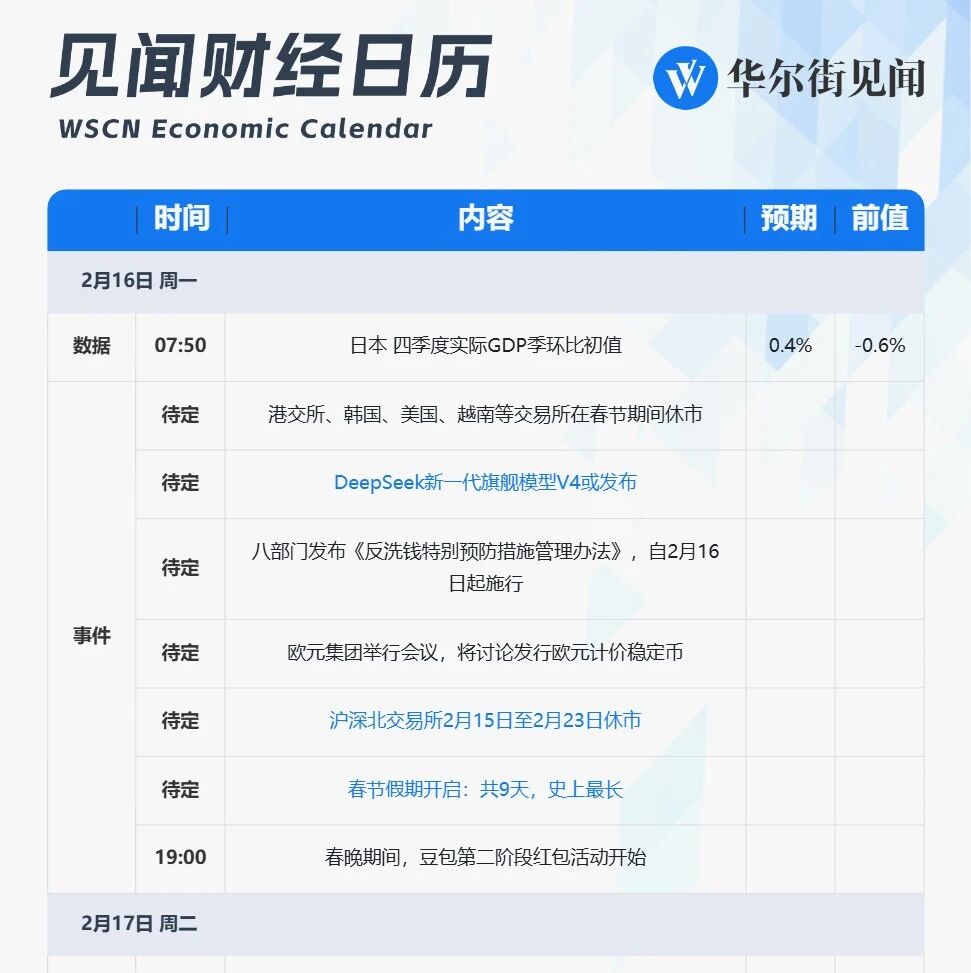
春节周重磅前瞻:美联储最爱通胀指标,DeepSeek V4或发布
华尔街见闻· 2026-02-15 10:56
Core Viewpoint - The article highlights significant upcoming economic events and data releases, particularly focusing on the AI industry during the Chinese New Year, macroeconomic indicators, and geopolitical developments that may impact global markets [6][7][11]. Group 1: AI Industry Developments - The "AI Spring Festival" is set to be a major theme, with the first Indian AI Summit featuring prominent tech leaders like NVIDIA's CEO Jensen Huang and Google's CEO Sundar Pichai from February 15 to 20 [9][10]. - DeepSeek's new flagship model V4 is expected to be released around mid-February, showcasing improvements in programming capabilities that may surpass existing top models in the market [8]. - Google is set to launch the Pixel 10a smartphone and Android 17 Beta 1 on February 18, coinciding with the AI developments [12]. Group 2: Key Macroeconomic Data and Policy - The U.S. Federal Reserve will release the December PCE inflation data and the fourth-quarter GDP initial estimate on February 20, with expectations of a 0.3% month-on-month increase in core PCE, raising the year-on-year rate to 2.9% [7]. - The fourth-quarter GDP growth is projected to reach 3.0%, exceeding market expectations of 2.8% [7]. - The FOMC meeting minutes from January are anticipated to show increasing support for a prolonged pause in interest rate cuts, although inflation trends may allow for a potential 100 basis points cut later in the year [7]. Group 3: Geopolitical and Market Events - The longest Chinese New Year holiday, lasting nine days from February 15 to 23, will see major stock exchanges, including those in China and Hong Kong, closed [13][14]. - The U.S. Supreme Court is scheduled to rule on the constitutionality of tariffs imposed by former President Trump on February 20, which could significantly impact trade policies and result in over $16 billion in monthly losses for importers if deemed unconstitutional [11]. - Japan will hold a prime ministerial election on February 18, with the current cabinet expected to resign, which may lead to fluctuations in the yen's exchange rate [19].

联合国最新报告指出—— 最不发达国家服务业转型乏力
Jing Ji Ri Bao· 2026-02-14 02:11
Core Insights - The report by the United Nations Conference on Trade and Development explores whether the service sector can become a new pathway for structural transformation in least developed countries (LDCs) [1] - Despite the growth of the service sector, it has not effectively translated into widespread development and structural transformation [1] Group 1: Service Sector Growth - The service sector has become the largest economic sector in LDCs, accounting for an average of 48.9% of GDP in 2023 and providing 38.4% of employment [1] - Growth in the service sector is primarily concentrated in low-productivity, informal traditional service areas such as retail trade [1] - Overall labor productivity in LDCs is growing slowly, with only a few knowledge-intensive sectors like financial and business services experiencing productivity increases [1] Group 2: Trade Vulnerabilities - The service export structure of LDCs is highly concentrated, with tourism and transport accounting for nearly 70% of total service exports, making them vulnerable to external shocks [2] - LDCs are missing out on digital opportunities, with their participation in the dynamic global trade of digital delivery services being only about 0.16%, the lowest recorded share [2] - In 2024, the trade deficit in digital delivery services accounted for 41.1% of the total trade deficit of LDCs, highlighting significant trade capacity limitations [2] Group 3: Strategic Recommendations - The relationship between the service sector and industrialization is complementary rather than substitutive, suggesting a dual approach of promoting both sectors [3] - The report recommends that LDCs and their development partners adopt a comprehensive transformation strategy that integrates service sector development into broader structural transformation agendas [3] - Key recommendations include investing in infrastructure and human capital, upgrading traditional service sectors, and enhancing regional and international cooperation to expand service trade [3]
联合国最新报告指出——最不发达国家服务业转型乏力
Sou Hu Cai Jing· 2026-02-13 23:10
Core Insights - The report by UNCTAD explores whether the service sector can become a new pathway for structural transformation in least developed countries (LDCs), highlighting that despite the growth of the service sector, it has not yet become a strong engine for broad development and structural transformation [1] Group 1: Service Sector Growth - The service sector has become the largest economic sector in LDCs, accounting for an average of 48.9% of GDP in 2023 and providing 38.4% of employment [1] - Growth in the service sector is primarily concentrated in low-productivity, informal traditional service areas such as retail trade, with slow overall labor productivity growth in LDCs [1] - Only a few knowledge-intensive sectors, like financial and business services, have seen productivity growth, while productivity in trade services, which employs a large portion of the workforce, has stagnated [1] Group 2: Vulnerabilities in Service Trade - The service export structure of LDCs is highly concentrated in traditional sectors, with tourism and transport accounting for nearly 70% of total service exports, making them vulnerable to external shocks [2] - LDCs are missing out on digital opportunities, with their participation in the dynamic global trade of digital delivery services being extremely low, at approximately 0.16%, the lowest recorded share [2] - Due to insufficient trade capacity, LDCs face significant deficits in service trade, with trade deficits in digital delivery services accounting for 41.1% of their total trade deficit in 2024 [2] Group 3: Strategic Recommendations - The relationship between the service sector and industrialization is complementary rather than substitutive, suggesting that national strategies should not choose between "services or industry" but rather promote both [3] - The report recommends that LDCs and their development partners adopt a comprehensive transformation approach, integrating service sector development into broader structural transformation agendas [3] - Key strategies include investing in infrastructure and human capital, upgrading traditional service sectors, and enhancing regional and international cooperation to expand service trade [3] - The report emphasizes that the service sector alone is not a "magic bullet" for development challenges; it must be deeply integrated with the national economy and supported by comprehensive national strategies and favorable global conditions to effectively drive structural transformation [3]
最不发达国家服务业转型乏力
Xin Lang Cai Jing· 2026-02-13 22:46
Group 1 - The core viewpoint of the report is that while the service sector is growing in least developed countries (LDCs), it has not yet become a strong engine for broad development and structural transformation [1] - In 2023, the service sector accounted for an average of 48.9% of GDP in LDCs and provided 38.4% of employment, but this growth is primarily in low-productivity, informal traditional service areas like retail [1] - Labor productivity growth in LDCs is slow, with only a few knowledge-intensive sectors like financial and business services showing productivity increases, while trade services, which employ most workers, have stagnated [1] Group 2 - The report highlights the vulnerability of service trade patterns in LDCs, with tourism and transport accounting for nearly 70% of service exports, making them susceptible to external shocks [2] - LDCs are missing out on digital opportunities, with their participation in the dynamic global digital delivery services sector at only about 0.16%, the lowest recorded share [2] - In 2024, LDCs' trade deficit in digital delivery services accounted for 41.1% of their total trade deficit, indicating significant trade capacity limitations [2] Group 3 - The report suggests a comprehensive transformation path, emphasizing that the relationship between services and industrialization is complementary rather than substitutive [3] - It recommends that LDCs and their development partners adopt integrated development strategies that include service sector development within broader structural transformation agendas [3] - Key recommendations include investing in infrastructure and human capital, upgrading traditional service sectors, and deepening regional and international cooperation to enhance service trade [3]
北京日报社区小板报|春节文旅活动“京彩”菜单出炉啦
Bei Jing Ri Bao Ke Hu Duan· 2026-02-06 23:28
Group 1 - Beijing's cultural tourism bureau launched a series of activities for the Spring Festival, including ten must-visit lists, innovative intangible cultural heritage routes, over 40 themed fairs, and more than 3,000 cultural performances to create a vibrant "Beijing Colorful New Year" experience [3] - The traffic management department in Beijing announced that the evening peak will be advanced to the afternoon on February 14, coinciding with the Spring Festival holiday, due to increased travel demand [5] - The Beijing Municipal Bureau of Commerce released new guidelines for the 2026 appliance and digital product recycling subsidy program, which will provide a 15% subsidy on the final sales price after discounts [7] Group 2 - The 2026 Beijing automobile trade-in subsidy policy was officially announced, offering up to 20,000 yuan for eligible consumers starting February 9 [9] - The Chaoyang District Library will launch a new mini-program called "Chaotu Cloud Reading" on February 9, providing personalized reading reports and a range of digital resources [11] - A joint consumer advisory from Beijing, Tianjin, and Hebei emphasized the importance of understanding the difference between deposits and advance payments when booking New Year's Eve dinners [11] Group 3 - The "Global Gathering at Yabao" event in Beijing will showcase products from over 30 Eurasian countries, running from February 6 to February 11 [13] - The "Beijing Flavor" gift box featuring local delicacies was launched by Ziguangyuan, which includes traditional foods recognized by the Beijing Cultural and Tourism Bureau [15] - The Central Document No. 1 for this year emphasizes the importance of the "vegetable basket" project, focusing on improving food safety and quality in agricultural products [17] Group 4 - The "Fortune Horse Welcomes Spring" lantern festival in Miyun will run from February 6 to March 3, featuring over 10,000 square meters of display space and various themed areas [19] - The resurgence of springs in the Arrow River area of Shunyi, after over 30 years, was reported, indicating positive environmental changes [21] - A recent cultural relics survey in Beijing's Yanqing District uncovered nearly 100 new remains of independent enemy towers or beacon towers, contributing to the cultural heritage of the Great Wall [23] Group 5 - The first conference for new employment group party members in Haidian District was held, launching the "City Civilization Manager" recruitment initiative [25] - The "Eight Proactive Measures" for new employment group party members were introduced to enhance their responsibilities and engagement in community activities [26]

2025年欧盟零售贸易额同比增长2.3%
Shang Wu Bu Wang Zhan· 2026-02-06 16:18
Group 1 - The core viewpoint is that the EU retail trade experienced a year-on-year growth of 2.3% in 2025, indicating a positive trend in consumer spending [2] - In December 2025, the retail trade volume in the EU increased by 1.7% compared to the same month in the previous year, reflecting ongoing consumer demand [1] - The growth in retail sales was driven by various sectors, with food, beverages, and tobacco sales rising by 0.8%, non-food sales increasing by 2.0%, and automotive fuel sales growing by 2.4% [1]
美股纳斯达克指数包含哪些行业企业?
Jin Rong Jie· 2026-02-03 04:52
Group 1 - The technology sector is a significant component of the NASDAQ index, encompassing software and application services, computer hardware, semiconductor chips, internet technology, and social media, with a focus on technological innovation driving the digital economy [1] - The healthcare industry holds a notable share in the NASDAQ index, including biotechnology research, medical device manufacturing, healthcare services, and pharmaceuticals, closely linked to global medical demand and research advancements [1] - The consumer sector is also represented in the NASDAQ index, involving retail trade, e-commerce platforms, and daily consumer goods manufacturing, directly addressing consumer needs through diverse products and services [1] Group 2 - The financial and industrial sectors are part of the NASDAQ index, with financial companies focusing on fintech, payment solutions, and asset management, while industrial firms cover aerospace, renewable energy equipment manufacturing, and industrial automation [2] - The NASDAQ index showcases a diversified industry composition, reflecting both emerging sectors like technology and traditional industries such as consumer and industrial, providing a comprehensive view of growth and innovation in the U.S. capital market [2] - This diversity in industry structure offers market participants valuable insights into the development status of related companies and highlights the capital market's acceptance of innovation and growth potential across different sectors [2]
2025年12月爱沙尼亚零售贸易额同比持平
Shang Wu Bu Wang Zhan· 2026-01-31 04:00
Group 1 - The core viewpoint of the articles indicates that Estonia's retail trade sector showed mixed performance in December 2025, with overall sales remaining stable at 1 billion euros year-on-year [1] - In 2025, the total retail trade turnover in Estonia reached 10.8 billion euros, reflecting a year-on-year growth of 2% [2] Group 2 - The turnover of automotive fuel retail businesses increased by 10.2% year-on-year [1] - Specialized stores selling computers and accessories, telecommunications equipment, sports equipment, games, and toys saw a year-on-year turnover growth of 9.1% [1] - Pharmacies and cosmetic stores experienced a year-on-year turnover increase of 1.9% [1] Group 3 - The turnover of second-hand goods and non-store retail (stalls, markets, and direct sales) decreased by 6.1% year-on-year [1] - Stores selling home goods, appliances, hardware, and building materials saw a year-on-year turnover decline of 4.9% [1] - Retail turnover through mail order or internet sales dropped by 4.0% year-on-year [1] - Department stores primarily selling manufactured goods experienced a year-on-year turnover decline of 3.8% [1] - Stores selling textiles, clothing, and footwear saw a year-on-year turnover decrease of 2.4% [1]
解释城市|纽约市城市服务型制造对上海发展制造业有哪些参考
Xin Lang Cai Jing· 2026-01-30 10:23
Core Insights - The article discusses the economic structure and industrial layout of New York City, highlighting the distribution of major industry sectors and their impact on the regional economy [2][7]. - It emphasizes the concentration of economic activity in a few key sectors while many others contribute relatively less, illustrating a dual characteristic of concentration and dispersion in New York's economy [7][8]. Economic Structure - In 2023, New York City's total economic output was $1,285.74 billion, with a clear distinction between "core pillar industries" (over 10% contribution), "mid-tier supporting industries" (3%-10%), and "specialty supplementary industries" (below 3%) [7][8]. - The "core pillar industries" include finance and insurance, real estate, information, and professional and technical services, collectively contributing $785.84 billion, or 61.1% of the city's GDP [8]. Key Industries - The finance and insurance sector alone accounts for approximately 25% of New York City's GDP, underscoring its status as a global financial center [8]. - Real estate and rental services are significant contributors, primarily driven by transactions, property management, and related services concentrated in Manhattan [8]. - The information sector has seen rapid growth, increasing from 10% to 12.4% of GDP over the past 20 years, while professional and technical services contribute around 10% [8]. Supporting Industries - "Mid-tier supporting industries" encompass public administration, wholesale and retail trade, healthcare, and accommodation and food services, collectively making up 23.3% of the economy [9][10]. - These industries are essential for maintaining the city's operational stability and resilience against economic fluctuations, as they are less affected by short-term economic changes [10]. Specialty Industries - "Specialty supplementary industries" include agriculture, mining, utilities, construction, manufacturing, transportation, management services, education, and arts and entertainment [11]. - Although these industries have a lower economic contribution, they play a vital role in supporting core industries and enhancing the city's cultural vibrancy [11]. Manufacturing Sector - Manufacturing's share of New York City's GDP has drastically declined to only 0.8% in 2023, reflecting a broader trend of urban centers moving away from manufacturing towards service-oriented economies [14][19]. - The historical context shows that manufacturing was once a significant part of New York's economy, particularly post-World War II, but has since diminished due to the rise of the service sector [15][18]. Current Manufacturing Landscape - The remaining manufacturing in New York is characterized by "urban service-oriented manufacturing," focusing on light industries such as food and apparel, which cater directly to local consumer needs [22][23]. - The manufacturing sector is primarily composed of food manufacturing (26.9%), apparel manufacturing (15.0%), and printing (13.4%), indicating a strong alignment with urban consumption patterns [25][22].