
海外需求

Search documents
【宏观】出口逆势破局,继续看好2026年表现——2025年12月进出口数据点评(赵格格/周可)
光大证券研究· 2026-01-15 23:04
Core Viewpoint - The article highlights the optimistic outlook for China's export growth in 2026, driven by strong overseas demand and the competitive advantages of Chinese exports, despite facing high year-on-year comparison bases [3][4]. Group 1: Export Performance - In December 2025, China's exports increased by 6.6% year-on-year, with a cumulative annual growth of 5.5%, primarily due to robust overseas demand and significant competitive advantages in exports [3]. - High-tech products, integrated circuits, and automobiles were the main drivers of export growth, while labor-intensive products contributed less [3]. Group 2: Future Outlook - The outlook for exports remains optimistic, as the fiscal expansion in major economies like the US and EU is expected to boost demand in 2026 [4]. - The alignment of China's advantageous industries with global demand is anticipated to support continued export growth [4]. - The transition of China's export dynamics towards new growth drivers, such as industrial robots and integrated circuits, aligns with global trends in green transformation and intelligent upgrades, potentially increasing their share in global trade [4]. - The easing of US-China trade tensions is expected to reduce uncertainties in exports to the US in 2026 [4].


出口缘何再“超预期”?
Xinda Securities· 2026-01-15 06:04
Group 1: Overseas Demand - In December 2025, China's exports increased by 6.6% year-on-year in USD terms, exceeding market expectations[5] - South Korea's export growth rose from 8.0% to 13.3% in December, while Vietnam's export growth improved from 15.2% to 23.8%[6] - China's manufacturing new export orders PMI rose by 1.4 percentage points to 49.0%, indicating increased export orders[6] Group 2: Port Container Throughput - December 2025 saw a decline in port container throughput to approximately 25.55 million TEUs, down from 33.53 million TEUs in November[17] - The average weight per container has been increasing from September to December 2025, suggesting a shift in export product structure towards more machinery and less labor-intensive products[19] - The decline in container throughput may mislead market perceptions regarding export performance[17] Group 3: Non-US Market Expansion - China's exports to ASEAN, EU, Russia, India, and the UK have shown both month-on-month and year-on-year increases, countering the high base effect from 2024[23] - The export ratio to the US and Japan has decreased, while the share to ASEAN and Hong Kong has increased, indicating a shift towards non-US markets[24] - The resilience of exports is expected to continue into 2026, potentially becoming a pillar of economic growth[25] Group 4: Risk Factors - Risks include insufficient growth policy measures, lower-than-expected global economic conditions, and unexpected trade frictions[27]
光伏50ETF(159864)盘中涨超1.3%,技术迭代与海外需求成关注焦点
Mei Ri Jing Ji Xin Wen· 2026-01-09 08:18
Core Viewpoint - The photovoltaic (PV) industry is experiencing a positive shift due to increased overseas demand, particularly optimistic export strategies to the U.S. and a reduction in trade disputes, which may lead to growth in exports of electric and new energy equipment [1] Group 1: Industry Trends - The photovoltaic equipment sector is entering a bottoming phase, indicating that the worst is over for the industry [1] - The themes of "cost reduction and efficiency enhancement" and "technological innovation" remain central to the industry's development [1] - Short-term focus is on technological iterations such as N-type long crystal, Xbc/0BB/HJT/TOPCon, which are expected to drive equipment demand [1] - In the medium to long term, perovskite batteries are anticipated to open up new growth opportunities [1] Group 2: Market Dynamics - The photovoltaic equipment sector is part of the broader semiconductor industry, with potential for expansion into semiconductor equipment [1] - Future transformations in the industry may unlock long-term development opportunities [1] - Attention is needed on the "anti-involution" policy advancements and the potential changes in competitive landscape due to localization of overseas new energy industries [1] Group 3: Index Information - The PV 50 ETF (159864) tracks the photovoltaic industry index (931151), which includes listed companies across the entire PV value chain, from upstream silicon materials to downstream power station construction and operation [1] - The photovoltaic industry index is characterized by significant growth potential and policy orientation, making it an important indicator for observing the development of the PV industry [1]
光伏50ETF(159864)收涨超2.1%,行业关注太空光伏与海外需求双主线
Mei Ri Jing Ji Xin Wen· 2025-12-24 09:52
Group 1 - The core viewpoint emphasizes the importance of the "space photovoltaic" theme in the photovoltaic equipment industry, highlighting its connection to US-China strategic competition and low-orbit resource contention, with fundamental catalysts expected to accelerate faster than emerging industries like nuclear fusion [1] - The European offshore wind demand is showing continuous improvement, with Poland's 3.4GW offshore wind tender being realized, and it is anticipated that the annual grid-connected scale of offshore wind in Europe will exceed 14GW by 2031-2032, leading to an acceleration in the release of future orders for piles, submarine cables, and wind turbines [1] - The price of lithium carbonate is surging, with spot prices breaking through 100,000 yuan/ton, and market inventory falling below 110,000 tons, indicating that prices are expected to remain strong in the short term [1] Group 2 - The photovoltaic 50 ETF (159864) tracks the photovoltaic industry index (931151), which selects listed companies involved in the entire solar photovoltaic power generation industry chain from the Shanghai and Shenzhen markets, including upstream raw material supply, midstream battery component manufacturing, and downstream power station construction and operation [1] - The index focuses on companies that are technologically advanced and competitive in the market, aiming to comprehensively reflect the overall development status and future trends of China's photovoltaic industry [1]
2025年11月进出口数据点评:11月的出口高增速可持续吗?
EBSCN· 2025-12-08 11:41
Export Data - In November 2025, China's exports reached $330.35 billion, with a year-on-year growth of 5.9%, significantly higher than the expected 3.0% and the previous month's decline of 1.1%[2][3][4] - The increase in exports is attributed to the fading high base effect and strong overseas demand, particularly in integrated circuits and automobiles, while the drag from labor-intensive products has lessened[3][4][14][16] Import Data - Imports in November 2025 totaled $218.67 billion, showing a year-on-year increase of 1.9%, up from 1.0% in October[2][18] - The rise in imports is driven by robust export-related intermediate goods demand and a low base effect from the previous year, with significant increases in copper and iron ore imports of 35.3% and 15.9%, respectively[18] Trade Balance - The trade surplus for November 2025 was $111.68 billion, an increase from the previous month's surplus of $90.07 billion[2] Regional Export Performance - Exports to the EU, Africa, and Latin America saw notable increases, with the EU experiencing a year-on-year growth of 14.8%[5][4] - In contrast, exports to the US declined by 28.6%, indicating ongoing challenges in US-China trade relations[5] Future Outlook - December's export growth may face challenges due to high base effects, but optimism remains for 2026 driven by global fiscal expansion and improved US-China trade relations[3][21] - The expected reduction in tariffs on certain products and potential interest rate cuts by the Federal Reserve could further support China's exports to the US[21]
——2025年11月进出口数据点评:11月的出口高增速可持续吗?
EBSCN· 2025-12-08 09:33
Group 1: Export Performance - In November 2025, China's exports reached $330.35 billion, with a year-on-year growth of 5.9%, significantly higher than the expected 3.0%[2] - The increase in export growth is attributed to the fading high base effect and strong overseas demand, particularly in integrated circuits and automobiles[3] - Exports to the EU, Africa, and Latin America showed notable increases, while exports to the US slightly declined by 28.6%[5] Group 2: Import Trends - November 2025 imports totaled $218.67 billion, reflecting a year-on-year increase of 1.9%, up from 1.0% in October[2] - The rise in imports is driven by robust export-related demand for intermediate goods and a low base effect from the previous year[18] - Key imports such as copper and iron ore saw significant growth, with copper imports increasing by 35.3% and iron ore by 15.9%[18] Group 3: Future Outlook - December's export growth may face challenges from high base effects, but optimism remains for overseas demand in 2026 due to global fiscal expansion and improved US-China trade relations[21] - The expected decrease in the fentanyl tariff rate from 20% to 10% is anticipated to narrow the year-on-year decline in exports to the US[21] - Continued strong demand for key mineral resources from Africa is expected to support capital goods exports from China[21]
海外需求行业盈利强劲,日股三季报开局强劲
Hua Er Jie Jian Wen· 2025-11-04 07:31
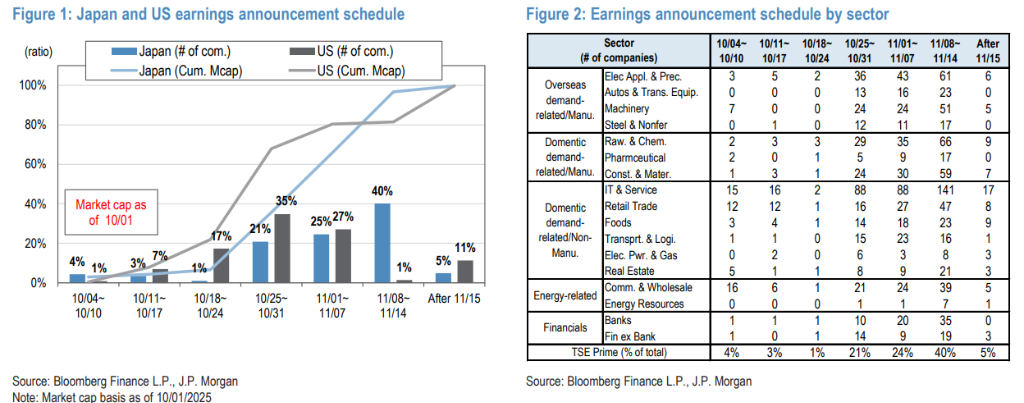
Core Insights - The core driver of profit momentum in Japan's Q3 performance is overseas demand, while domestic sectors remain relatively weak [1][5][6] - Approximately 30% of companies in the Tokyo Stock Exchange Prime market have reported Q3 results, showing significant improvement over Q2, with revenue up 2.8%, operating profit up 11.0%, and net profit up 28.7% year-on-year [1][5] Sector Performance - The electronics and precision instruments sector, including companies like Hitachi, Fujitsu, NEC, and Advantest, has been a major contributor to net profit growth, alongside the power and gas sector [5] - In contrast, the automotive sector saw a net profit decline of 0.6%, and the food sector experienced a slight drop of 0.1% due to weak consumer demand [5] - Over 50% of companies exceeded Bloomberg consensus expectations, with export-oriented manufacturing firms outperforming domestic firms significantly (15.4% vs. 7.2%) [5][6] Market Expectations and Guidance - Export-oriented companies performed better partly due to conservative market expectations influenced by tariff impacts and uncertainties in the U.S. economy [6] - 52 companies have raised their full-year earnings guidance, although automotive manufacturers have yet to report, leaving tariff impacts unclear [6] - Japanese companies maintain a USD/JPY exchange rate assumption of 144 yen for FY2025, lower than the current market level of 154 yen, providing a buffer for overseas business profitability [6] Stock Buybacks - There are signs of recovery in stock buybacks, with TSE index constituents announcing a total of 0.7 trillion yen in buyback plans since October, matching levels from the same period in 2024 [6] - Advantest announced a buyback of 150 billion yen (2% of outstanding shares), while Recruit Holdings plans to buy back 250 billion yen (3% of outstanding shares) [6]
头部电池厂抢货 磷酸铁锂厂商悄然启动新一轮扩产
Zheng Quan Shi Bao Wang· 2025-10-29 23:20
Core Viewpoint - Leading battery manufacturers are intensifying their investments in lithium iron phosphate (LFP) production, with CATL making a significant investment in a subsidiary of Fulin Precision, aiming to secure high-density LFP capacity in response to strong market demand [1] Industry Summary - Major LFP manufacturers are initiating a new round of capacity expansion driven by robust downstream market demand [1] - The current expansion trend is characterized by a shift from competing on price and scale to focusing on value and technology, reflecting a more rational approach in the industry [1] - Capacity planning is becoming increasingly globalized, indicating a strategic shift in the industry's operational focus [1]


投资者聚焦美债、日债拍卖 重点关注债务风险与海外需求
智通财经网· 2025-05-27 22:27
Group 1 - The U.S. Treasury plans to issue a total of $183 billion in new interest-bearing government bonds, coinciding with a recently passed fiscal bill that significantly increases the national debt, raising market sensitivity towards debt outlook [1] - The auction of $69 billion in two-year Treasury bonds saw a yield of 3.955%, slightly lower than pre-auction market levels, indicating decent investor demand [1] - The auction is the first key benchmark debt issuance since Moody's downgraded the U.S. sovereign credit rating on May 16, raising concerns about the debt trajectory [1] Group 2 - Indirect bidders, primarily foreign central banks, accounted for 63.3% of the two-year bond auction, with total bids reaching $177.3 billion, 2.57 times the supply, although below the average of 2.65 from the last six auctions [1] - Last month, foreign participation in the two-year bond auction dropped nearly 20 percentage points to 56.2%, significantly below the six-auction average of 73%, indicating a need for improved confidence among overseas investors [2] Group 3 - The U.S. two-year Treasury yield stands at 3.977%, while the ten-year and thirty-year yields are at 4.444% and 4.948%, respectively, as market participants await the upcoming release of the Federal Reserve's May policy meeting minutes and April's core PCE inflation data [3] - A tax and spending bill pushed by President Trump is set to enter the Senate, with the Congressional Budget Office estimating it could increase the fiscal deficit by approximately $3.8 trillion over the next decade, further exacerbating the debt burden [3]