
硬盘驱动器

Search documents
2026年科技股迎来“证明之年”:是泡沫还是稳健标的?
智通财经网· 2025-12-19 12:48
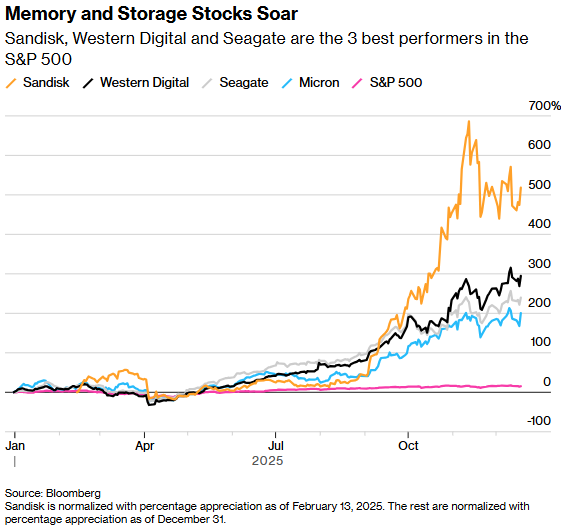
Core Insights - The AI hype is growing, but concerns about market bubbles and the disruptive power of the technology are increasing as well [1] - Despite strong earnings from tech giants like Alphabet and Nvidia, overlooked sectors such as memory chips and hard drives are seen as better investment opportunities [1] - The sustainability of massive AI-related capital expenditures and the return on investment from large cloud computing companies are under scrutiny as the bull market in US stocks continues into its fourth year [1] Company-Specific Concerns - OpenAI's profitability is being questioned, particularly regarding its ability to fulfill a $300 billion cloud computing agreement with Oracle, leading to a 45% drop in Oracle's stock since its peak in September [2] - Oracle faces additional challenges, including high data center leasing costs, project delays, and rising debt levels, which have raised credit risk indicators to their highest since the financial crisis [2] - Other cloud providers like CoreWeave and Nebius Group have also seen significant declines in market value, with CoreWeave losing about two-thirds of its value since June and Nebius down over 42% from its October peak [2] Sector Performance - In 2025, investors identified new AI trading opportunities by tracking promised capital expenditures, with companies like SanDisk, Western Digital, and Seagate performing well in the S&P 500 [3] - Software stocks, particularly SaaS companies, have struggled due to fears of being disrupted by AI technologies like ChatGPT and Alphabet's Gemini, which could erode demand and pricing power [6] - The SaaS sector saw a 10% decline in the Morgan Stanley SaaS index, while broader software indices, including AI winners like Microsoft, rose by 5% [6] Valuation Trends - Despite concerns over high valuations, stocks like Palantir Technologies and Tesla have performed well, with Palantir's stock rising 146% and Tesla reaching a historical high, both maintaining high price-to-earnings ratios [9][12] - Analysts expect Palantir's revenue to grow by 43% in 2026 and 39% in 2027, while Tesla's sales are projected to increase by 13% in 2026 and 19% in 2027 [9][12] - The technology sector enters 2026 with high expectations and expensive valuations, necessitating companies to prove their growth potential to sustain stock price increases [12]


“硬盘荒”将延续!希捷科技(STX.US)HDD毛利率或将突破50%,大摩上调牛市目标价至341美元
Zhi Tong Cai Jing· 2025-12-16 03:18
Core Viewpoint - Morgan Stanley reiterates "Overweight" rating for Seagate Technology (STX.US) with a target price of $270 and a bull case target price of $341, citing strong cycles and expected HDD sales to enjoy over 50% gross margins in the next 12 months [1] Group 1: Financial Projections - Analysts led by Erik Woodring predict revenue growth, profit margins, and earnings per share are trending towards or exceeding current bull case forecasts, estimating FY2027 earnings per share at approximately $17, compared to Morgan Stanley's base estimate of $15.40 and market consensus of $14.67, supporting the bullish target price of $341 [1] - The CFO of Seagate, Gianluca Romano, indicated that HDD demand is tracking significantly faster than the 25% annual growth in HDD storage capacity (exabytes) driven by Seagate, with estimates potentially reaching around 40% [1] Group 2: Market Dynamics - The HDD market is expected to remain in a supply-demand imbalance throughout the 2027 calendar year, even as the industry begins to certify new, higher-capacity drives in the first half of 2026 [1] - The quality of HDD demand is noted to be close to "real" demand, minimizing risks of inventory buildup or excessive ordering that could jeopardize the cycle [1] - Apart from Western Digital (WDC.US), Seagate faces minimal competition in the hard disk drive technology sector [1]

大摩:硬盘驱动器目标价格和预测大幅上调 - 前景更加乐观
2025-10-09 02:00
Summary of Conference Call Notes Industry Overview - The conference call focuses on the hard disk drive (HDD) industry, particularly the companies Seagate and Western Digital (WD) [1][2]. Key Insights and Arguments - **Nearline Storage Demand**: There is a significant increase in nearline storage demand, with a projected growth rate of 25% over the next three years. HDD supply shortages are expected to persist until 2026, granting pricing power to Seagate and WD, which will drive the adoption of high-capacity HDDs and the application of Hammer technology [1][3]. - **Cloud Computing Capital Expenditure**: There is a strong correlation (R-squared of 0.9) between cloud computing capital expenditure and HDD revenue growth. Continuous upward adjustments in cloud capital spending indicate robust growth potential for HDD revenues, benefiting related companies [1][4]. - **Impact of Artificial Intelligence (AI)**: The shift in AI towards multimodal reasoning is leading to an exponential increase in data storage needs, as the volume of generated data (images, videos) far exceeds that of text files. This trend is expected to significantly drive HDD demand [1][5]. - **Supply Shortages and Pricing Power**: The ongoing HDD supply shortage is providing Seagate and WD with pricing power, encouraging customers to adopt higher-capacity HDDs. This situation is also promoting the use of profit-generating technologies like Hammer, with Seagate's gross margin expected to reach 40% by the end of fiscal year 2026 [1][6]. - **Valuation of WD and Seagate**: The valuation methods for WD and Seagate involve comparing them with semiconductor hardware and networking companies related to data centers. Despite leading in revenue growth and cloud service revenue share, their price-to-earnings ratios are relatively low. Regression analysis suggests that their current enterprise value/sales ratio of 4-4.5 should rise to around 8, indicating significant upside potential. Target prices are set at $171 for WD and $265 for Seagate [1][7][8]. Other Important Insights - **Beneficiaries of the HDD Cycle**: The long-term strong HDD cycle not only benefits WD and Seagate but also positively impacts TDK (a key supplier of HDD heads and arms), Hoya (the sole supplier of glass substrates for HDD heads), and storage companies like SanDisk and Micron, which are also rated as buy due to the current strong NAND flash cycle driven by HDD shortages [2][9].

大摩唱多硬件:HDD行业正进入“长期走强”周期 上行峰值延至2028年 瞄准西部数据(WDC.US)希捷科技(STX.US)
智通财经网· 2025-09-30 11:15
Core Viewpoint - Morgan Stanley's report indicates that the HDD industry is entering a "Stronger For Longer" cycle, with the peak expected to extend until 2028, currently in the mid-cycle phase [1] Demand Side - HDD demand is driven by cloud capital expenditure and AI, showing explosive growth; global top 11 cloud providers' capital expenditure is projected to reach $459 billion in 2025, a 61% year-on-year increase, with a 16% growth rate in 2026 [1] - From 2024 to 2028, global data center spending is expected to reach $2.9 trillion, with 85% allocated to AI-specific data centers; the revenue correlation between Western Digital and Seagate with cloud capital expenditure is as high as 0.8-0.9, with cloud business accounting for over 75% of their revenues [1] Supply Side - Supply constraints are expected to exacerbate the supply-demand imbalance, pushing HDD prices upward; a projected supply gap of approximately 150EB, or 10% of market demand, is anticipated over the next 12 months, continuing until 2028 [2] - The difficulty in expanding HDD production capacity is a core reason for supply constraints, with new factory setups taking 12 months for equipment procurement and hiring, followed by another 12 months for production ramp-up, with costs exceeding $500 million per factory [2] Pricing and Contracts - Western Digital announced a gradual price increase for all HDD products, with Seagate following suit, expecting price hikes of 7-10%; major cloud providers have signed long-term agreements with HDD manufacturers, providing 18 months of visibility into industry demand [3] Financial Performance and Valuation - Morgan Stanley significantly raised revenue forecasts for Western Digital and Seagate, with Western Digital projected to generate revenues of $11.286 billion to $15.166 billion from FY26 to FY28, an increase of 3%-32% from previous estimates; EPS is expected to rise to $7.03-$12.84, a 6%-58% increase [3] - Seagate's revenue is projected to be $10.462 billion to $13.673 billion for FY26 to FY28, with EPS expected to rise to $10.71-$20.54, an increase of 4%-26% [4] Industry Valuation - The HDD industry is undergoing a structural revaluation, transitioning from a cyclical to a structurally growing asset class; current valuations are significantly below reasonable levels, with projected EPS compound growth rates exceeding 35% for both companies over the next three years [4][5] - Current PE ratios for Western Digital and Seagate are 14x and 18.3x, respectively, placing them in the bottom 25% of the industry, while the implied reasonable target multiple is 8x, indicating an 80% upside potential [4]
当公司陷入灭火循环,就该敲响警钟了
3 6 Ke· 2025-08-01 02:16
Core Insights - The article discusses the concept of "firefighting syndrome," which occurs when organizations face an overwhelming number of problems that exceed their capacity to resolve them effectively [2][3]. Group 1: Symptoms of Firefighting Syndrome - Insufficient time to address all issues leads to a backlog of problems [2]. - Incomplete solutions result in superficial fixes rather than addressing root causes [2]. - Problems recur and new issues emerge due to inadequate solutions [2]. - Urgency takes precedence over importance, causing delays in addressing long-term issues [2]. - Accumulated problems can escalate into crises, requiring significant effort to resolve [2]. - Overall performance declines as unresolved issues and missed opportunities accumulate [2]. Group 2: Origins of Firefighting Syndrome - Problems are queued for resolution, leading to increased business volume intensity when the number of issues exceeds available resources [3][5]. - When business volume intensity exceeds 100%, firefighting behaviors begin, causing inefficiencies and prioritization of urgent tasks over important ones [5][6]. Group 3: Tactical Approaches to Mitigate Firefighting - Introduce temporary problem solvers to manage surges in issues, particularly in high-tech industries [9]. - Consider halting operations until existing problems are resolved to prevent new issues from arising [9]. - Acknowledge that some problems may not warrant resolution, allowing organizations to prioritize effectively [10]. Group 4: Strategic Approaches for Long-term Solutions - Modify product strategies to enhance compatibility and reduce design-related issues [12]. - Address problems by categorizing them to identify root causes, which simplifies individual problem resolution [12]. - Cultivate more problem solvers within the organization to free up resources for complex issues [13]. Group 5: Cultural Changes to Prevent Firefighting - Discourage patchwork solutions by fostering a culture that values genuine problem resolution [14]. - Avoid rigid deadlines that promote firefighting; instead, assess project timelines based on unresolved issues [14]. - Reward proactive management that prevents crises rather than those who merely extinguish fires [14].

市场消息:索尼(SONY.N)与西部数据将合作开发HAMR硬盘驱动器。
news flash· 2025-06-13 06:20
Group 1 - Sony (SONY.N) and Western Digital are collaborating to develop HAMR (Heat-Assisted Magnetic Recording) hard disk drives [1]