
贵金属产业

Search documents
中信建投期货:2月2日工业品早报
Xin Lang Cai Jing· 2026-02-02 01:39
Group 1: Copper Market - The main copper futures in Shanghai fell by 4.75% to 103,190 yuan, while London copper dropped to around 13,050 USD [4][17] - Macro sentiment is neutral to bearish due to Trump's nomination of Waller as Fed Chair, which has reduced interest rate cut expectations and led to a broader decline in the non-ferrous sector [5][17] - Global copper inventory increased to 1.031 million tons, with domestic copper slightly decreasing by 0.16 thousand tons to 332 thousand tons, while LME copper inventory rose by about 0.45 thousand tons to 175 thousand tons [5][17] - Despite short-term pressure on copper prices from market risk sentiment adjustments, strong supply constraints may limit further price declines, with a reference range for today's main copper futures set at 100,000 to 104,500 yuan per ton [5][17] Group 2: Nickel and Stainless Steel - The nomination of Waller as the next Fed Chair has led to tightening liquidity expectations, causing the non-ferrous sector to give back gains [6][18] - Nickel ore shipments from the Philippines are hindered by weather conditions, while supply from Indonesian nickel laterite is also tight due to rainfall [6][18] - The market for nickel iron is showing average transaction performance, and stainless steel faces oversupply pressure with limited terminal demand [6][18] - The operational strategy suggests light short positions in nickel and stainless steel, with reference ranges for nickel at 130,000 to 150,000 yuan per ton and stainless steel at 13,000 to 15,000 yuan per ton [6][18] Group 3: Aluminum Market - The alumina market showed a strong performance last week, with the May contract experiencing a reduction in positions [20][21] - A strike at a Chinese-funded mine in Guinea, which produces 15 million tons annually, has raised concerns about ore supply, although negotiations are ongoing [20][21] - The price of long-term contracts for ore has been reduced to 62 USD per ton, and domestic alumina production costs are expected to decrease significantly starting in March [20][21] - The operational strategy remains focused on short positions due to ongoing oversupply pressures in the alumina market, with reference ranges for the May contract set at 2,550 to 2,900 yuan per ton [20][21] Group 4: Zinc Market - Zinc prices showed weakness last Friday, influenced by macroeconomic factors and the nomination of Waller as Fed Chair, which is perceived as hawkish [23][24] - The processing fee for zinc is expected to see a slight increase in February, while supply is projected to decrease by over 50,000 tons due to production days and maintenance [23][24] - Zinc ingot inventories have been declining for two consecutive weeks, primarily due to reduced supply and slow arrivals [23][24] - The operational strategy suggests a wait-and-see approach for zinc, with the main contract expected to trade within a range of 24,800 to 26,000 yuan per ton [23][24] Group 5: Lead Market - The Shanghai Futures Exchange is seeking public opinion on including recycled lead as a deliverable commodity, which may reduce delivery disruptions in the future [24] - The supply of primary lead remains tight, although some previously shut-down smelters are resuming operations, leading to a relatively loose spot supply [24] - The lead market is expected to experience a range-bound trading pattern due to weak supply and demand dynamics, with the main contract projected to operate within a range of 16,800 to 17,800 yuan per ton [24] Group 6: Precious Metals - Precious metals experienced a significant pullback, with silver dropping over 20%, attributed to crowded long positions and panic selling triggered by Waller's nomination [27] - The market had seen four consecutive weeks of gains prior to the pullback, leading to a high concentration of long positions that were vulnerable to correction [27] - The operational strategy suggests reducing long positions in gold while remaining cautious with silver, platinum, and palladium [27] - Reference ranges for gold are set at 1,000 to 1,100 yuan per gram, silver at 19,000 to 25,000 yuan per kilogram, platinum at 520 to 570 yuan per gram, and palladium at 395 to 440 yuan per gram [27]



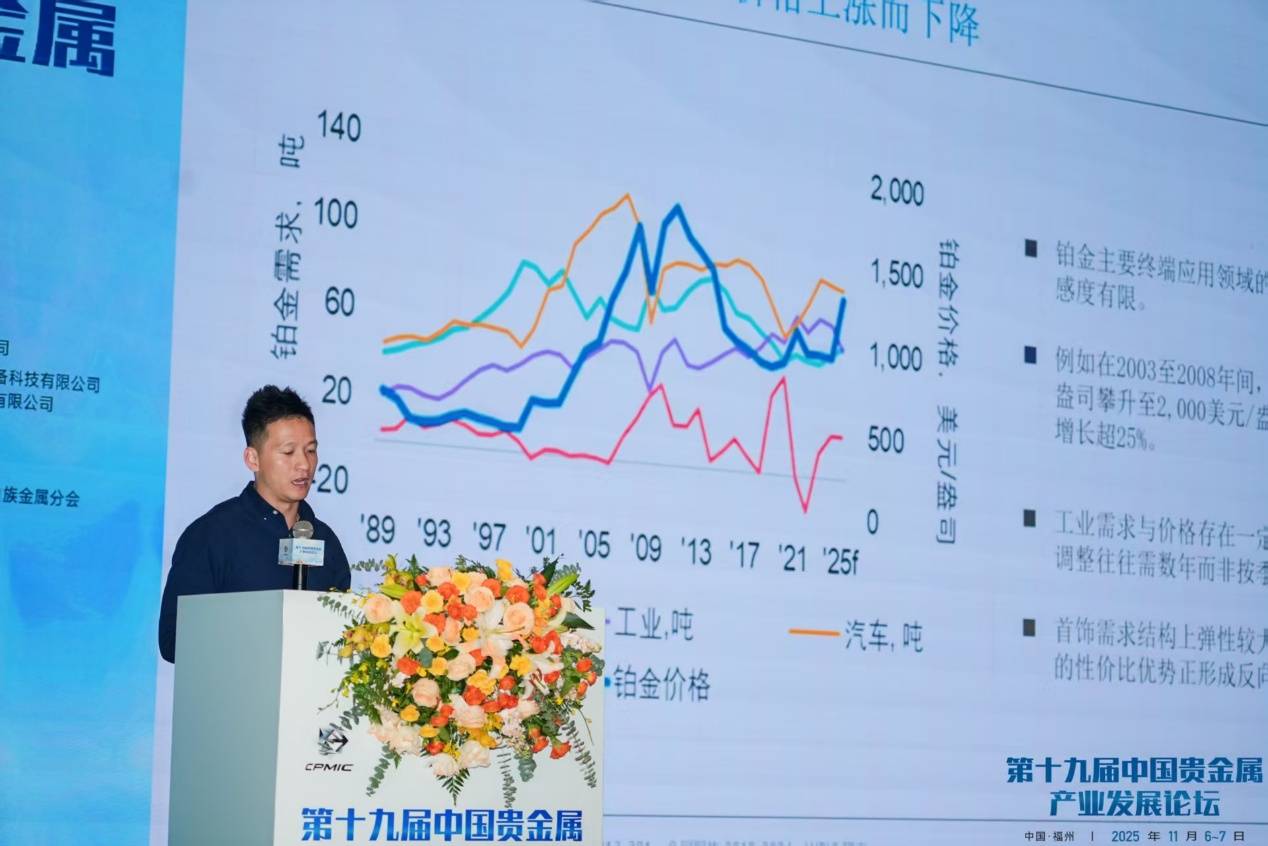
世界铂金投资协会中国市场研究负责人张文斌:中国铂金市场成全球需求增长关键引擎
Sou Hu Cai Jing· 2025-11-08 03:12
Core Insights - The platinum market has entered a continuous shortage cycle for three consecutive years, driven by supply-demand dynamics and policy adjustments, leading to significant price increases this year [1][3] - The global platinum supply is heavily reliant on South Africa, with a long mine expansion cycle of three years, making it difficult for supply to respond quickly to strong market demand, indicating a structural deficit in the industry for the coming years [3] - China has emerged as a key engine for global platinum demand growth, with a notable structural differentiation in demand, particularly in jewelry, industrial, and investment sectors, despite a decline in automotive demand [3][4] Supply Dynamics - The global platinum supply is characterized by a structural deficit due to the long lead time for mine expansions and the concentrated supply from South Africa [3] - The supply side is unable to quickly meet the increasing demand, exacerbating the supply tightness in the market [3] Demand Dynamics - Jewelry demand in China has shown remarkable growth, with platinum jewelry processing volume in Q2 of this year more than doubling year-on-year, and the demand scale for the first half of 2025 approaching the total demand for 2023 and 2024 [4] - Investment demand for platinum in China is also high, with a cumulative growth of 19% in physical investment demand from 2022 to 2024, and a significant shift towards smaller investment products, indicating a broader participation of ordinary investors in the platinum market [4] - The purchasing behavior in China has shifted from speculative to genuine demand support, as evidenced by increased purchasing even when platinum prices are relatively high [4]
铜冠金源期货商品日报-20250702
Tong Guan Jin Yuan Qi Huo· 2025-07-02 03:59
Report Industry Investment Rating No relevant content provided. Core Viewpoints - The market is influenced by a combination of domestic and international factors, with geopolitical risks, trade policies, and economic data all playing significant roles. Different commodities show various trends due to their unique supply - demand fundamentals and macro - economic environments [2][3]. - For most commodities, short - term price movements are characterized by oscillations, affected by both positive and negative factors. Some commodities may experience short - term price increases or decreases based on specific events and data [4][6]. Summary by Category Macro - Overseas: The US Senate passed the "Big Beautiful Act" with a narrow margin, and it awaits final approval in the House. Trump may reach a trade agreement with India but is skeptical about Japan, hinting at a potential increase in tariffs on Japanese imports to 30% - 35% from 24%. The US job openings in May reached a new high since November last year, and Powell suggested a "wait - and - see" approach [2]. - Domestic: President Xi Jinping chaired a meeting of the Central Financial and Economic Affairs Commission, emphasizing the promotion of a unified market and the development of the marine economy. The Caixin Manufacturing PMI in June rebounded to 50.4, returning to the expansion range. Stocks and bonds both rose, but the A - share market lacked a clear main line [3]. Precious Metals - International precious metal futures prices rose. COMEX gold futures rose 1.28% to $3349.90 per ounce, and COMEX silver futures rose 0.20% to $36.25 per ounce. Trade concerns, potential Fed rate cuts, and Middle - East geopolitical risks drove safe - haven funds into the precious metals market. However, the short - term sustainability of the price rebound is uncertain [4][5]. Copper - The price of copper showed an upward trend. The Shanghai copper main contract broke through, and the London copper price approached the $10,000 mark. The US manufacturing was in a downturn with inflation expectations rising. Globally, the shortage of concentrates and low inventory levels, along with expanding application areas, are expected to drive copper prices into a short - term oscillatory upward trend [6][7]. Aluminum - The price of aluminum showed a positive trend. The weakening US dollar index and low warehouse receipts supported the price. However, the market should also pay attention to the impact of the Senate's passage of the "Big and Beautiful" tax and expenditure bill and the upcoming July 9 trade tariff suspension deadline [8][9]. Alumina - Alumina futures showed a preference for oscillatory movement. The warehouse receipt inventory continued to decline, and the spot market had limited supply increments. The short - term price is expected to maintain a preference for oscillatory movement [11]. Zinc - The price of zinc declined slightly. Overseas refineries resumed production, and the supply disturbance weakened. Although downstream buying improved, the short - term fundamentals remained weak, and the price returned to a weakening trend [12][13]. Lead - The price of lead declined slightly. The supply of primary and recycled lead refineries is expected to recover in July, while consumption has not improved significantly. The short - term price is expected to oscillate weakly [14][15]. Tin - The price of tin showed a compensatory movement. The fundamentals were not significantly changed, with low trading volume. The supply and demand were both weak, and the high - price tin faced pressure [16]. Industrial Silicon - The price of industrial silicon faced resistance in its rebound. It was in the off - season with weakening demand. The supply side was generally weak, and the demand side in the photovoltaic industry was also lackluster. The short - term price is expected to enter a weak adjustment phase [17][18]. Lithium Carbonate - The price of lithium carbonate declined. The market sentiment cooled down, and the downstream replenishment ended. Although the cathode production in July may exceed expectations, the supply also increased, and high inventory may drag down the price [19][20]. Nickel - The price of nickel oscillated. The US economic data was mixed, and the cost side showed signs of loosening. The short - term fundamentals had no improvement, and the price oscillated [21][22]. Crude Oil - The price of crude oil oscillated. Geopolitical risks and industry logic were intertwined. Although the geopolitical heat decreased, the conflict was not completely over, and the supply side maintained a high - growth expectation [23]. Steel (Screw and Coil) - The steel futures price rebounded slightly. The market was affected by the news of production restrictions in Tangshan. The supply side's production was stable at a low level, and the demand side was weak due to high - temperature weather. The short - term price is expected to oscillate [24][25]. Iron Ore - The iron ore futures price oscillated and adjusted. The port inventory decreased slightly, but the supply pressure remained due to high overseas shipments. The demand for iron ore had some resilience, but the production of molten iron was expected to decline. The short - term price is expected to oscillate under pressure [26]. Soybean and Rapeseed Meal - The soybean meal and rapeseed meal prices may oscillate. The US soybean crushing volume in May was 6.11 million tons, and the precipitation in the US soybean - producing areas in the next two weeks was normal. The short - term price is expected to oscillate, and attention should be paid to weather changes, Sino - Canadian relations, and Sino - US trade progress [27][28]. Palm Oil - The palm oil price may oscillate. The production of Malaysian palm oil in June slowed down, and the export demand in Indonesia increased in May. The short - term price is expected to oscillate, and attention should be paid to the MPOB report [29][30].