
金属和采矿

Search documents
港股2025年终盘点:恒指涨近28%领跑全球、华虹大涨240%,阿里领衔互联网反攻、南向资金狂买1.4万亿
Hua Er Jie Jian Wen· 2025-12-31 08:22
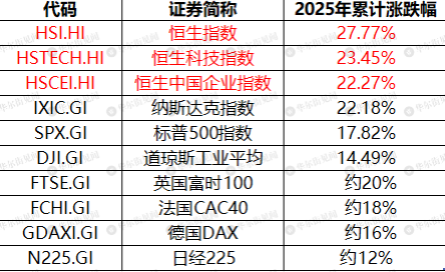
Core Viewpoint - The Hong Kong stock market concluded 2025 with its best annual performance in five years, driven by a "valuation recovery" trend throughout the year, with significant contributions from southbound capital inflows and a strong IPO market [1][2]. Market Performance - The Hang Seng Index rose from approximately 19,600 points at the beginning of the year to 25,630 points, achieving a 27.77% annual increase, marking its best performance in five years [2][3]. - The Hang Seng Tech Index and the Hang Seng China Enterprises Index also saw substantial gains, with increases of 23.45% and 22.27% respectively, outperforming major global indices such as the Nasdaq and S&P 500 [2][3]. Capital Inflows - Southbound capital inflows reached a record high of 1.41 trillion HKD in 2025, significantly up from approximately 807.9 billion HKD in 2024, serving as a key support for market liquidity [3][4]. IPO Market - The IPO market in Hong Kong was robust, with total IPO proceeds reaching 286.3 billion HKD, reclaiming the top position globally. Notably, 19 A-share companies listed in Hong Kong, raising around 140 billion HKD, which accounted for about half of the total IPO fundraising [4][5]. Sector Performance - The materials sector, particularly precious metals, showed exceptional performance, with the sector's index rising nearly 200%. Notable stocks included Zhu Feng Gold, which surged by 1,286.36% [5][6]. - The semiconductor and healthcare sectors also performed well, with the semiconductor sector increasing by 139% and the healthcare sector by over 89% [7]. Notable Stocks - A total of 379 Hong Kong stocks doubled in price during 2025, with 13 stocks increasing over tenfold. The standout was Base Champion Group, which skyrocketed over 4,164% [8][9]. - In the technology sector, Huahong Semiconductor led with a rise of over 240%, while Alibaba and XPeng Motors also saw significant increases of over 76% and 70% respectively [9][10]. Outlook for 2026 - Multiple institutions have optimistic forecasts for the Hong Kong stock market in 2026, anticipating continued upward momentum driven by improved liquidity and corporate earnings recovery. Citic Securities expects the market to benefit from the "15th Five-Year Plan" and external economic easing policies [10].

2025年5月美国行业库存数据点评:从库存和关税因素看美铜价格波动
CMS· 2025-08-01 06:43
Overall Inventory Cycle - In May, the total inventory in the U.S. increased by 2.62% year-on-year, down from 3.15% in the previous period[12] - Sales in May rose by 3.30% year-on-year, compared to 3.68% previously[12] - The U.S. is confirmed to be entering an active destocking phase, with a significant import surge occurring from November 2024 to March 2025[12] - A brief replenishment demand is expected in June and July, after which active destocking will continue[12] Industry Inventory Cycle - Six out of fourteen major industries are in active destocking as of May, including oil, gas, chemicals, transportation, automotive parts, textiles, and food[19] - The historical percentile for overall inventory in May is 32.4%, with construction materials at 83.6% and chemicals at 69.3%[19] - The first round of excess imports is estimated at $180 billion and the second at $100 billion, totaling $280 billion, which may be exhausted by November[12] - Recent rapid declines in copper prices are attributed to a 50% tariff on copper products while exempting raw materials, disrupting supply and demand dynamics[13] Risk Factors - The potential for U.S. economic fundamentals and policies to exceed expectations poses a risk to inventory and pricing stability[8]
2025年4月美国行业库存数据点评:美国Q2或进入主动去库
CMS· 2025-07-01 13:33
Overall Inventory Cycle - In April, the total inventory in the U.S. increased by 3.37% year-on-year, compared to a previous value of 3.43%[1] - The total sales in April rose by 3.74% year-on-year, down from 4.04% previously[1] - The data indicates a preliminary shift towards active destocking in the U.S. inventory cycle[1] Industry Inventory Cycle - Among 14 major industries in April, 10 were in passive restocking, including construction materials, metals, and consumer goods[12] - The historical percentile for overall inventory in April was 39.2%, with chemical products at 85.7% and construction materials at 83.2%[12] - Oil and chemical sectors are likely transitioning to active destocking, while construction and metal inventories remain high[12] Future Outlook - Despite uncertainties regarding tariffs, the U.S. inventory cycle is expected to lean towards active destocking in Q2 due to previous overstocking[1] - The "panic import" demand has extended the passive restocking cycle for downstream industries[14] - Active destocking is anticipated for automotive and automotive parts as of December 2024, with a continued trend into April 2025[14]
2025年3月美国行业库存数据点评:美国Q1工业品抢进口大幅透支未来需求
CMS· 2025-06-02 08:04
Overall Inventory Cycle - In March 2025, the total inventory in the U.S. increased by 3.47% year-on-year, compared to a previous value of 2.54%[1] - Sales in March 2025 rose by 4.05% year-on-year, up from 3.21% previously[1] - The U.S. was expected to enter an active destocking phase by late 2024, but tariff expectations led to a surge in imports, particularly in industrial and consumer goods, exceeding seasonal norms and potentially overextending future demand[1] Industry Inventory Cycle - As of March 2025, 10 out of 14 major industries were in a passive restocking phase, including chemicals, building materials, and metals[19] - The historical percentile for overall inventory growth in March was 40.8%, with chemicals at 87.1%, building materials at 68.9%, and automotive parts at 55.1%, indicating high inventory levels relative to historical data[19] - The oil and gas sector has been in an active destocking phase since March 2025, while other sectors remain in passive restocking[20] - The transportation sector is currently in an active destocking phase, while machinery manufacturing is in a passive destocking phase[21] - Consumer goods, including durable goods and textiles, are also in a passive restocking phase as of March 2025[22]
招商宏观:美国下游或仍有“抢进口”需求 库存周期切换进程或将加速
智通财经网· 2025-05-04 02:42
Core Viewpoint - The overall inventory cycle in the U.S. is likely transitioning towards an active destocking phase by 2025, with significant implications for various industries [1][2][3]. Overall Inventory Cycle - In February, U.S. total inventory increased by 2.45% year-on-year, compared to a previous value of 2.25%. Sales increased by 3.45% year-on-year, down from 3.69% [2][3]. - The inventory cycle remains in a passive restocking phase due to "import grabbing," with Q1 net imports increasing by $359.26 billion year-on-year, of which over one-third ($129.71 billion) converted into inventory [2][3]. Industry Inventory Cycle - Among 14 major industry categories, 8 are in a passive restocking phase, including upstream chemical products, building materials, midstream electrical equipment, and downstream durable consumer goods [4]. - Historical inventory percentiles show that total inventory is at a historical percentile of 30.5%, with building materials at 71.5%, automotive parts at 67.8%, and paper and forestry products at 53.8% [4]. Upstream Inventory Status - Half of the upstream industries are in passive restocking, while the other half are in active destocking [5][6][7][8]. - Specific sectors like oil, natural gas, and consumer fuels are in active destocking as of February 2025 [5]. Midstream Inventory Status - Inventory status is mixed, with paper and forestry products in active restocking, while electrical equipment and transportation are in passive restocking [9][10]. - Mechanical manufacturing is currently in passive destocking [9]. Downstream Inventory Status - The current passive restocking phase is prolonged, indicating potential "import grabbing" demand [11]. - Automotive parts are transitioning to active destocking as of February 2025, while other sectors like household durable goods and textiles remain in passive restocking [11].