
金饰品

Search documents
东海期货11月宏观数据观察:CPI同比超预期回升,PPI降幅有望收窄
Xin Lang Cai Jing· 2025-12-10 09:38
Group 1 - In November, China's CPI increased by 0.7% year-on-year, matching expectations, and up from 0.2% in the previous month [1][19] - The PPI decreased by 2.2% year-on-year, slightly worse than the expected decline of 2.0% and a previous decline of 2.1% [1][19] - The rise in CPI was driven by a significant rebound in food prices, while PPI's decline was influenced by high base comparisons from the previous year and ongoing supply-demand structural optimization in certain industries [20][21] Group 2 - The overall improvement in domestic supply-demand relationships is expected to lead to a gradual narrowing of PPI declines, supported by ongoing capacity governance in key industries [20][21] - International commodity prices have generally risen, while domestic demand remains weak, but some industries are experiencing price increases due to improved supply-demand fundamentals [20][21] - The core CPI maintained a high year-on-year growth rate of 1.2%, with non-food prices rising by 0.8%, indicating effective consumer demand policies [20][21] Group 3 - Food prices shifted from a decline of 2.9% last month to an increase of 0.2%, significantly impacting the CPI [20][21] - Energy prices fell by 3.4% year-on-year, contributing to the overall inflationary pressure [20][21] - The service sector saw price increases, with notable rises in household appliances and clothing prices, reflecting the effectiveness of domestic demand expansion policies [20][21]


11月金饰品价格同比增长58.4%!
Jin Rong Shi Bao· 2025-12-10 04:25
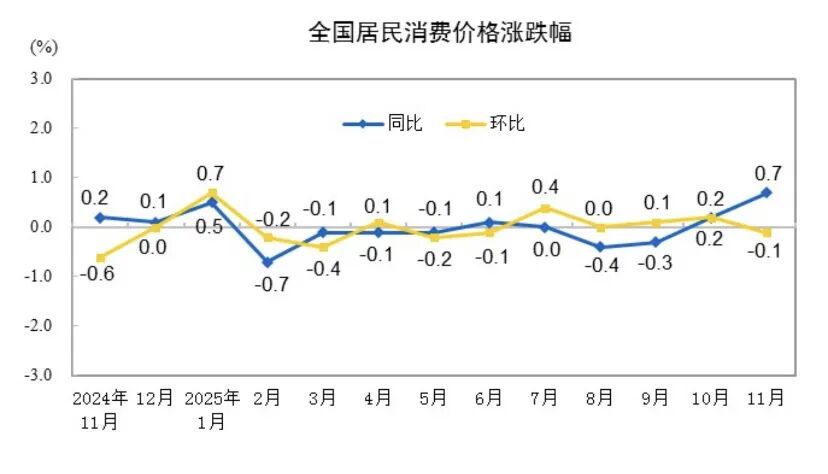
Group 1 - The core CPI excluding food and energy prices rose by 1.2% year-on-year in November, marking the third consecutive month above 1% [5] - The overall CPI in November showed a slight month-on-month decrease of 0.1% but a year-on-year increase of 0.7%, the highest since March 2024 [3][4] - The increase in CPI was primarily driven by a turnaround in food prices, particularly fresh vegetables, which rose by 14.5% after a previous decline [3][5] Group 2 - The PPI in November decreased by 2.2% year-on-year, while the industrial producer purchase prices also fell by 2.5% [6] - Month-on-month, the PPI increased by 0.1%, marking the second consecutive month of growth, influenced by seasonal demand increases in certain industries [8] - The average PPI from January to November showed a decline of 2.7% compared to the same period last year, indicating ongoing macroeconomic policy effects [6][8]
消费市场运行总体平稳
Sou Hu Cai Jing· 2025-10-20 01:16
Group 1 - The consumer price index (CPI) increased by 0.1% month-on-month in September, while year-on-year it decreased by 0.3%, with the core CPI (excluding food and energy) rising by 1.0%, marking the fifth consecutive month of growth [1][2] - Food prices rose by 0.7% month-on-month, contributing approximately 0.13 percentage points to the CPI increase, while clothing prices increased by 0.8% due to seasonal changes [1] - The producer price index (PPI) remained flat month-on-month and decreased by 2.3% year-on-year, with the decline narrowing by 0.6 percentage points compared to the previous month [2][3] Group 2 - The year-on-year decline in CPI of 0.3% was primarily influenced by a negative carryover effect of approximately 0.8 percentage points, while new price changes contributed about 0.5 percentage points [2] - The PPI's month-on-month stability is attributed to improved supply-demand dynamics in certain industries, with coal processing prices rising by 3.8% and coal mining prices increasing by 2.5% [2][3] - The narrowing year-on-year decline in PPI is a result of ongoing macroeconomic policy effects, with some industries experiencing positive price changes due to market competition and structural upgrades [3]