中老年营养燕麦片

Search documents
西麦食品子公司产品抽检不合格,公司回应称已召回销毁
Jing Ji Guan Cha Wang· 2026-02-13 14:57
Company Developments - Recently, a quality issue was identified with the "Middle-aged and Elderly Nutritional Oatmeal" produced by a wholly-owned subsidiary of the company, where the total bacterial count did not meet national standards. The company attributed the problem to inadequate control in the distribution channel and has recalled and destroyed the affected batch of products, while enhancing channel supervision. This incident may impact brand trust, and the effectiveness of subsequent rectifications should be monitored [2] - The company is actively advancing its health strategy, with positive feedback from trial sales of the "Food and Medicine Homologous" product series launched in the fourth quarter of 2025. It is expected to become a new growth point when rolled out nationwide in 2026. Online channels, such as Douyin, are experiencing high growth, and the expansion into new channels like bulk snacks and Sam's Club is progressing smoothly, making 2026's channel performance noteworthy [3] - Benefiting from a decline in raw material costs for Australian oats, the company's gross margin has improved in 2025. The raw material supply and demand situation is expected to continue improving in 2026, potentially further releasing cost benefits, coupled with expense optimization, which may enhance profit elasticity [4] Industry Overview - The overall growth rate of the oatmeal industry is slowing down; however, the company, as a leader, continues to focus on the silver economy and health consumption. By optimizing its product structure, such as increasing the proportion of high-margin composite oatmeal, it maintains its competitiveness. In 2026, the company plans to deepen its omnichannel layout and explore overseas markets [5]
旗下产品抽检不合格,西麦食品渠道管控露短板?
Bei Jing Shang Bao· 2026-01-22 13:55
Core Viewpoint - Ximai Food, known as the "first oat stock" in China, is facing renewed market scrutiny due to product quality issues, specifically the detection of excessive microbial counts in its "nutritional oat flakes for the elderly" [2][4][5] Group 1: Product Quality Issues - The National Market Supervision Administration reported that Ximai's oat flakes exceeded the national food safety standard for microbial counts, with all five samples tested showing levels above the acceptable limit of 10,000 CFU/g [4] - This is not the first instance of Ximai's products failing quality checks, with previous incidents of mold contamination reported in 2020 and 2024 [5] - The company attributes the recent quality issues to poor management by distributors rather than production flaws, and has initiated recalls and strengthened oversight of distribution channels [4][5] Group 2: Market Position and Challenges - Ximai Food holds a 26% market share in China's oat market, which is projected to exceed 10.134 billion yuan in 2024, but the industry's growth rate is slowing, with a forecasted compound annual growth rate (CAGR) of only 1.1% from 2024 to 2029 [6] - The company is facing increasing competition from both domestic and international brands, prompting it to explore new growth avenues in the health sector [6][8] - Despite being a market leader, Ximai's reliance on traditional oat products, which account for approximately 90% of its revenue, poses risks as the sector matures [8] Group 3: Strategic Initiatives - In 2023, Ximai launched a probiotic protein powder, generating over 10 million yuan in sales within four months, indicating potential in the health market [6][7] - The company plans to expand its health product line in 2024, introducing various new items such as collagen peptide drinks and probiotic powders [7] - However, the contribution of these new products to overall revenue remains limited, with traditional oat products still dominating sales [8] Group 4: Future Outlook - Experts suggest that while the shift to high-value health products aligns with strategic goals, Ximai must overcome challenges in consumer education and channel development to succeed [8][9] - The ongoing quality control issues may divert resources and focus from new business initiatives, potentially jeopardizing the "recreate a new Ximai" plan [9]

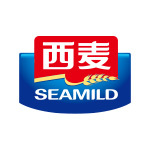
菌落总数超标!“燕麦第一股”西麦再登市场监管总局抽检“黑榜”
Guo Ji Jin Rong Bao· 2026-01-21 12:03
Core Viewpoint - Ximai Food, known as "China's Oatmeal First Stock," has been flagged for non-compliance with microbial standards, following a previous incident of excessive mold levels in 2024, raising concerns about its product safety and quality control measures [1][7]. Group 1: Product Quality Issues - Ximai Food's "Middle-aged Nutritional Oatmeal" was found to have unacceptable total bacterial counts, exceeding the national food safety standards during a recent inspection of 2,136 samples, with 40 samples identified as non-compliant [2][4]. - The specific bacterial counts for the oatmeal samples were recorded as 34,000 CFU/g, 49,000 CFU/g, 18,000 CFU/g, 15,000 CFU/g, and 25,000 CFU/g, all surpassing the allowable limits [2][4]. - The company attributed the quality issues to improper management by a distributor, which has since terminated its partnership with Ximai [1][7]. Group 2: Historical Context and Recurrent Issues - This incident follows a previous case in late 2024 where another product, "High-Calcium Milk Oatmeal," was also flagged for excessive mold, with counts significantly exceeding the safety limit [7][8]. - Ximai has faced multiple quality control issues in the past, including a 2019 incident involving "Oatmeal Walnut Powder" due to mold contamination [8]. - The frequency of these quality problems coincides with Ximai's strategic push into the health market, which may undermine consumer trust and impact sales and partnerships [8]. Group 3: Regulatory and Market Implications - The National Market Supervision Administration indicated that such issues may stem from inadequate control over production and processing hygiene, as well as potential problems with packaging and storage conditions [4]. - As Ximai aims to establish a new growth trajectory focused on health products, the ongoing quality concerns could jeopardize its brand value, which is closely tied to food safety [8].
1批次西麦食品中老年营养燕麦片检出菌落总数超标
Bei Jing Shang Bao· 2026-01-20 12:25
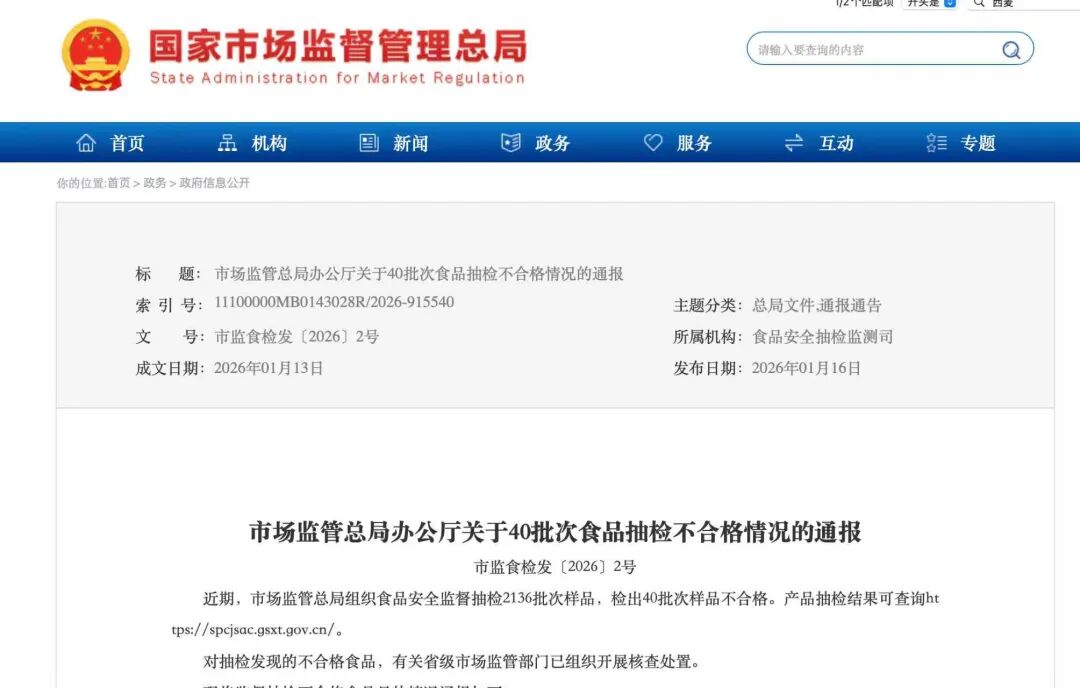
Group 1 - The market regulatory authority conducted a food safety supervision sampling, testing a total of 2,136 batches, with 40 batches found to be non-compliant [1] - One batch of oatmeal produced by Ximai Food was detected with excessive total bacterial count, failing to meet national food safety standards [1] - The specific product involved is a senior nutrition oatmeal (700g) produced by Hebei Ximai Food Co., Ltd., with a shelf life until June 25, 2024 [1] Group 2 - The local market regulatory departments have initiated investigations and actions regarding the non-compliant food products identified in the sampling [1] - Attempts to contact Ximai Food for further information were unsuccessful, as there was no response to phone inquiries [1]
1批次西麦食品中老年营养燕麦片检出菌落总数不合格
Xin Jing Bao· 2026-01-20 10:29
Group 1 - The core issue is that the State Administration for Market Regulation conducted a food safety inspection, revealing that out of 2,136 samples tested, 40 were found to be non-compliant, including a batch of oatmeal produced by Ximai Food [1] - The specific product in question is a senior nutrition oatmeal produced by Ximai Food, which was found to have excessive total bacterial counts, indicating potential hygiene issues during production [1] - Total bacterial count is an indicator of microbial quality rather than a direct pathogen indicator, reflecting the sanitary conditions during food production [1] Group 2 - The excessive total bacterial count can compromise the nutritional value of the food and accelerate spoilage, which may be attributed to inadequate control of hygiene conditions during production or improper packaging and storage [1] - Provincial market regulatory authorities have initiated investigations and actions regarding the non-compliant food products identified in the inspection [1] - Attempts to contact Ximai Food for further information regarding the non-compliance and subsequent actions were unsuccessful, as no one answered the provided contact number [1]
1批次燕麦片菌落总数超标!西麦食品:问题出现在经销商环节
Nan Fang Du Shi Bao· 2026-01-20 09:56
Core Viewpoint - A batch of Ximai Foods' senior nutrition oatmeal was found to exceed the total bacterial count limit, resulting in it being classified as an unqualified product by the State Administration for Market Regulation [2] Group 1: Product Quality Issue - The affected batch of oatmeal was produced by Ximai Foods Group in Guilin, Guangxi, and manufactured by Hebei Ximai Foods Co., Ltd., with a production date of June 25, 2024, and a shelf life of 18 months [2] - Ximai Foods has stated that the issue arose in the distribution channel rather than at the production level, and the company has cooperated with local regulatory authorities to address the situation [2] Group 2: Company Performance - Ximai Foods, established in 1994 and listed on the Shenzhen Stock Exchange in 2019, is recognized as the "first stock of oatmeal" [2] - The latest financial report indicates that for the first three quarters of 2025, the company's revenue increased by 18.34% year-on-year to 1.696 billion yuan, while the net profit attributable to shareholders rose by 21.90% to 132 million yuan [2]
市场监管总局办公厅关于40批次食品抽检不合格情况的通报
Zhong Guo Zhi Liang Xin Wen Wang· 2026-01-16 13:05
Core Viewpoint - The State Administration for Market Regulation (SAMR) reported that out of 2,136 food samples tested, 40 batches were found to be non-compliant with national food safety standards, prompting provincial market regulation departments to initiate investigations and corrective actions [3]. Group 1: Non-compliant Products - A batch of pure grain liquor from Hubei Province was found to contain non-compliant levels of acesulfame and sweeteners [3]. - Two batches of pancakes and sesame pancakes from Shandong Province were found to have non-compliant levels of sorbic acid and its potassium salt [3]. - A batch of Boss dry bread imported from Myanmar, sold on Douyin, was found to have non-compliant levels of sodium saccharin [3]. Group 2: Specific Violations - A batch of vermicelli from Shanxi Province showed non-compliance with standards for benzoic acid and aluminum residue [4]. - A batch of soft toast from Jiangxi Province was compliant with food safety standards but did not meet labeling requirements [4]. - A batch of rose plum from Qinghai Province was found to have non-compliant levels of food coloring agents [4]. Group 3: Additional Non-compliance Cases - A batch of dried goji berries from Liaoning Province was found to have non-compliant levels of sulfur dioxide [5]. - A batch of canned sweet potatoes from Henan Province showed non-compliance with sulfur dioxide residue standards [5]. - A batch of dried apricots from Xinjiang was found to have non-compliant levels of sulfur dioxide [5]. Group 4: Further Violations - A batch of dried mountain yam from Guangxi Province was found to have non-compliant levels of sulfur dioxide [6]. - A batch of instant jellyfish from Liaoning Province showed non-compliance with aluminum residue standards [8]. - A batch of peanut-shaped candy from Beijing was found to have non-compliant levels of sunset yellow [8].