
人工智能业务

Search documents
高盛:英伟达强劲财报难阻股价下跌 利好兑现压力显现
Xin Lang Cai Jing· 2026-02-26 18:08
Group 1 - Goldman Sachs noted that despite Nvidia's (NVDA.O) revenue increasing by 73% year-over-year and providing an optimistic outlook for its AI business, the stock still fell by 4.5%, impacting the semiconductor sector and the S&P 500 index [1] - Analysts indicated that this decline reflects a "sell the news" sentiment, profit-taking, and concerns regarding the sustainability of capital expenditures on AI by large-scale cloud service providers [1] - AI spending is expected to grow by 62% in 2026, which is a decrease from the 73% growth anticipated in 2025, although supply-demand imbalances and strong balance sheets may still drive expectations higher [1] Group 2 - Current demand for data centers and memory bottlenecks are providing support for Nvidia, with market focus shifting towards 2027 when capital expenditures may peak [1]

数据中心成“众矢之的”,Meta等科技巨头集体为AI基建“公关”
Huan Qiu Wang· 2026-01-28 02:47
Group 1 - The core focus of the article is on Meta's investment of $6.4 million in advertising campaigns across several U.S. cities to gain public support for new data centers, scheduled for the second half of 2025 [1][4] - The advertising campaign features short, relatable videos highlighting the job creation and community revitalization benefits of data centers, using examples from Meta's facilities in Altoona, Iowa, and Los Lunas, New Mexico [4] - The data center industry, including companies like Digital Realty, QTS, and NTT Data, is engaging in large-scale lobbying efforts to counter public backlash and defend the construction of new data centers [4] Group 2 - Recent winter storms have revealed the strain on the existing power grid, particularly in areas with concentrated data centers, raising concerns about energy supply [4] - Major companies such as Meta, Microsoft, and Google rely on large data centers as essential infrastructure for their AI operations, yet public sentiment towards these facilities is declining [4] - Community opposition to new data centers is primarily driven by concerns over rising energy costs and excessive water consumption, leading to delays or cancellations of billions of dollars in data center investments across the U.S. [4]



“易主”变“借壳”?监管问询,再次跌停!
Jin Rong Shi Bao· 2026-01-15 11:04
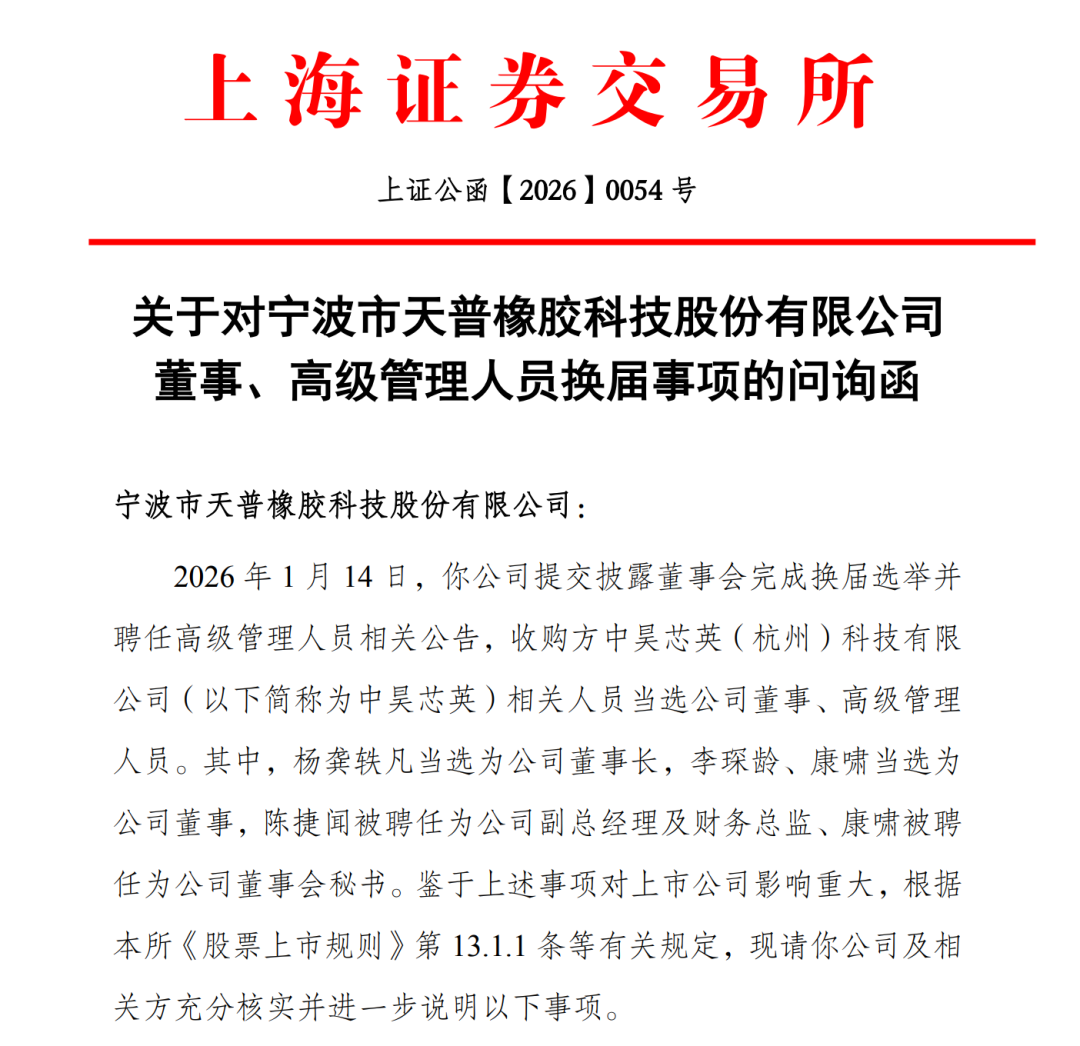
Core Viewpoint - The Shanghai Stock Exchange has raised concerns regarding Tianpu Co., Ltd.'s recent board reshuffle and management changes, questioning the company's previous commitments about its main business operations and the implications of these changes on its governance and independence [2][5][6] Group 1: Board Reshuffle and Management Changes - Tianpu Co., Ltd. held a temporary shareholders' meeting on January 14, 2026, to elect a new board of directors, appointing Yang Gongyifan as chairman and several other executives from Zhonghao Xinying, indicating a significant shift in management [2][3] - The new board's composition, heavily influenced by Zhonghao Xinying, contradicts earlier statements made by Tianpu regarding its business plans and management structure, raising regulatory concerns [3][4] Group 2: Regulatory Concerns and Investigations - The Shanghai Stock Exchange issued an inquiry letter to Tianpu, demanding explanations regarding the qualifications of the new management team and the alignment of their roles with the company's business strategy [5][6] - Tianpu has faced scrutiny for previous inaccuracies in its disclosures related to stock trading fluctuations, leading to regulatory warnings and an ongoing investigation by the China Securities Regulatory Commission [2][7] Group 3: Market Reaction and Stock Performance - Following the announcement of the management changes, Tianpu's stock price experienced significant volatility, including a drop to the daily limit shortly after the market opened on January 15, 2026 [2][7] - The stock had previously surged nearly 720% from August 22 to December 30, 2025, amid speculation about its association with AI business, but has since faced a dramatic decline post-restructuring [3][7]

瑞银:债务激增不足为虑 甲骨文(ORCL.US)投资级评级“不太可能”遭下调
Zhi Tong Cai Jing· 2026-01-07 03:39
Group 1 - UBS Group indicates that Oracle Corporation (ORCL.US) is likely to maintain its investment-grade rating in the short term despite taking on hundreds of billions in debt to expand its artificial intelligence business [1] - UBS strategist Matthew Mish noted that while Oracle's rating may be downgraded to the lowest tier of investment grade, concerns about it falling to "junk status" are likely overstated [1] - Oracle's outstanding debt is approximately $95 billion, making it the largest corporate bond issuer outside the financial sector in the Bloomberg high-rated corporate index [1] Group 2 - Oracle's decision to issue $18 billion in bonds last September for data center expansion aimed at capitalizing on the AI investment boom has led to ongoing market concerns regarding its rating sustainability [1] - The ability of Oracle to maintain its investment-grade status will ultimately depend on the prospects of its AI business and future borrowing plans [1] - All three major rating agencies currently rate Oracle two notches above junk status [1]

12月13日收盘:美股收跌纳指下跌400点 AI个股普跌
Xin Lang Cai Jing· 2025-12-12 21:11
Market Overview - US stock market experienced a decline, with technology stocks leading the drop, particularly the Nasdaq which fell by nearly 40 points [1][8] - The Dow Jones Industrial Average (DJIA) dropped by 245.96 points, a decrease of 0.51%, closing at 48,458.05 points; the Nasdaq fell by 398.69 points, down 1.69%, closing at 23,195.17 points; the S&P 500 index decreased by 73.59 points, down 1.07%, closing at 6,827.41 points [3][10] - The recent downturn has led to a weekly decline for the S&P 500 and Nasdaq, with the former down 0.63% and the latter down 1.62%, while the DJIA saw a weekly increase of 1.05% [3][10] Company-Specific Developments - Broadcom's stock fell by 11.4%, attributed to concerns over profit margin compression despite announcing projected revenues of $64 billion for fiscal year 2025 and $73 billion in AI backlog orders [4][10] - Stocks related to AI, including Nvidia, AMD, Palantir Technologies, and Micron, also declined alongside Broadcom [4][10] - In contrast, stocks in the financial, healthcare, and industrial sectors saw gains, with Visa, Mastercard, UnitedHealth Group, and GE Aerospace performing well [4][10] Investor Sentiment - The market showed a rotation towards value stocks over growth stocks, with investors appearing cautious about AI investments [11][12] - Jed Ellerbroek from Argent Capital Management noted that while companies investing in AI have seen good returns, the market cannot sustain the same stocks outperforming indefinitely [12][13] Federal Reserve Insights - Anna Paulson, President of the Philadelphia Federal Reserve, indicated that there is room for further interest rate cuts, citing unemployment as a greater threat to the economy than inflation [6][13] - Paulson believes that current monetary policy is slightly tight and that if the labor market weakens, there will be more room for easing [6][13] - Conversely, Jeff Schmid, President of the Kansas City Federal Reserve, opposed the recent rate cut, arguing that inflation remains too high and the economy shows ongoing momentum [7][14]

午盘:标普500从纪录高位回落,资金持续撤离科技股
Xin Lang Cai Jing· 2025-12-12 17:12
Market Overview - US stock market experienced a decline, with technology stocks leading the drop as investors shifted from tech to value sectors [1][7] - The Dow Jones Industrial Average fell by 219.58 points (0.45%) to 48,484.43, the Nasdaq dropped by 386.73 points (1.64%) to 23,207.13, and the S&P 500 decreased by 71.98 points (1.04%) to 6,829.02 [3][9] Company Performance - Broadcom's stock fell by 11% due to concerns over profit margin compression, despite reporting projected revenue of $64 billion for FY2025 and $73 billion in AI backlog orders [10] - Other companies in the AI sector, including AMD, Palantir Technologies, and Micron, also saw declines alongside Broadcom [10] - Financial, healthcare, and industrial sectors saw gains, with Visa, Mastercard, UnitedHealth Group, and GE Aerospace performing well [10][11] - Lululemon's stock surged by 10% after announcing its CEO would step down at the end of January, following a year of poor performance [10] Investment Sentiment - There is a cautious sentiment among investors regarding AI investments, with a shift towards cyclical stocks that are more sensitive to economic conditions [4][11] - The recent market movements indicate a rotation in trading strategies, with investors taking profits from growth stocks related to AI [4][11] Economic Indicators - Federal Reserve's Anna Paulson indicated there is room for further rate cuts, citing unemployment as a greater threat to the economy than inflation [5][12] - Paulson believes inflation may decrease as the year progresses, suggesting that current monetary policy is slightly tight [12][13] - Kansas City Fed's Jeff Schmid opposed the recent rate cut, arguing that inflation remains too high and the economy shows ongoing momentum [6][14]
研报掘金丨中信建投:予广电运通“买入”评级,人工智能与跨境支付业务进展积极
Ge Long Hui A P P· 2025-11-26 09:13
Core Viewpoint - The report from CITIC Construction Investment Securities indicates that Guangdian Yuntong's revenue remains stable in the first three quarters of 2025, while profits are under short-term pressure, with a positive trend observed in Q3, laying a solid foundation for upcoming mid-term dividends [1] Group 1: Financial Performance - The company maintains steady revenue, with profits facing short-term challenges [1] - Q3 shows a positive trend, indicating potential recovery and support for future dividends [1] Group 2: Strategic Developments - The company continues to advance its "AI in All" strategy, securing a significant contract worth 308 million yuan in its artificial intelligence business [1] - The focus on software projects signifies the company's AI capabilities are increasingly penetrating the "AI + Life Health" sector [1] Group 3: Regulatory and Market Position - Guangdian Yuntong's subsidiary, Guangdian Huitong, has officially obtained the Hong Kong MSO license, enabling compliant cross-border fund settlement and foreign exchange services [1] - The combination of Zhongjin Payment and the MSO license creates a closed loop for cross-border payment, enhancing the company's global service capabilities and fintech strength [1]


金山云:2025年Q3收入和利润实现大幅增长
Sou Hu Cai Jing· 2025-11-19 12:05
Core Insights - The company has significantly improved its profitability in Q3 2025, with a notable turnaround in financial performance [1][2] Financial Performance - Total revenue reached RMB 24.78 billion, representing a year-on-year increase of 31.4% and a quarter-on-quarter growth of 5.5% [2] - Public cloud revenue amounted to RMB 17.52 billion, showing a substantial year-on-year growth of 49.1% and a quarter-on-quarter increase of 7.8% [2] - Industry cloud revenue was RMB 7.26 billion, remaining relatively stable [2] - Gross profit stood at RMB 3.81 billion, reflecting a year-on-year increase of 25.6%, with a gross margin of 15.4% [2] - Adjusted operating profit turned from a loss to a profit, recording RMB 15.4 million compared to a loss of RMB 1.40 billion in the same period last year [2] - Adjusted net profit was RMB 28.7 million, marking the first profitable quarter compared to a net loss of RMB 237 million in the previous year [2] - Adjusted EBITDA reached RMB 82.7 million, soaring by 345.9% year-on-year, with a profit margin of 33.4% [2] Business Highlights - Revenue from artificial intelligence business reached RMB 7.82 billion, showing an approximate year-on-year growth of 120% [2] - The collaboration with Xiaomi contributed significantly, with revenue increasing by 83.8% year-on-year to RMB 6.91 billion [2] Cost Management - Operating costs were RMB 2.097 billion, up 32.5% year-on-year, primarily due to increased investments in artificial intelligence computing resources [1][2] Cash Position - Cash and cash equivalents totaled RMB 39.55 billion, a decrease from the previous quarter mainly due to investments in computing equipment [2]
金山云:第三季度总收入24.78亿元 同比增长31.4%
Sou Hu Cai Jing· 2025-11-19 11:17
Core Insights - Kingsoft Cloud reported a year-on-year revenue growth of 31.4%, reaching RMB 2,478.0 million in Q3 [1] - Public cloud service revenue increased by 49.1% year-on-year to RMB 1,752.3 million [1] - The AI business generated billing revenue of RMB 782.4 million, with a year-on-year growth rate of approximately 120% [1] Financial Performance - Adjusted gross profit for Q3 was RMB 392.6 million, reflecting a year-on-year increase of 27.6% and a quarter-on-quarter increase of 12.0% [1] - Adjusted EBITDA for Q3 reached RMB 826.6 million, showing a significant year-on-year growth of 345.9% [1] - The adjusted EBITDA margin for Q3 was 33.4%, which is an increase of 23.6 percentage points year-on-year [1]
金山云(03896)第三季度经调整净利润首度实现盈利 达到2870万元
智通财经网· 2025-11-19 11:16
Core Insights - The company reported a total revenue of RMB 2.478 billion for Q3 2025, representing a year-on-year increase of 31.4% and a quarter-on-quarter increase of 5.5% [1] - Gross profit reached approximately RMB 381 million, up 25.6% year-on-year [1] - The net loss narrowed significantly to RMB 7.847 million, a 99.26% improvement year-on-year, while non-GAAP net profit turned positive at RMB 28.7 million [1] Revenue Growth - Revenue growth was primarily driven by the increasing demand from AI-related clients as the company upgraded its AI infrastructure and products [1] - Public cloud service revenue surged by 49.1% year-on-year to RMB 1.7523 billion [1] - AI business billing revenue reached RMB 782.4 million, reflecting a growth rate of approximately 120% [1] Profitability Improvement - Adjusted gross profit was RMB 392.6 million, showing a year-on-year increase of 27.6% and a quarter-on-quarter increase of 12.0% [1] - Adjusted EBITDA profit soared to RMB 826.6 million, a year-on-year increase of 345.9%, with an adjusted EBITDA margin of 33.4%, up 23.6 percentage points year-on-year [1] - The company achieved adjusted operating profit of RMB 15.4 million, compared to a loss of RMB 140 million in the same quarter last year and a loss of RMB 166.4 million in the previous quarter [1] Strategic Partnerships - The strategic partnership with Xiaomi-Kingsoft ecosystem contributed significantly, with revenue from this ecosystem increasing by 83.8% year-on-year to RMB 691 million [1] - The integration of AI and cloud services is seen as a major market opportunity for the company, with optimism about rapid AI adoption across various verticals [1]